Consciousness, Quantum Reality, and the Search for the Fundamental Nature of Existence
For centuries humanity has struggled with one profound question: What is consciousness? Modern neuroscience attempts to explain it through brain activity, while philosophers continue to debate whether consciousness is merely a by-product of matter or something more fundamental. At the same time, various quantum theories of consciousness suggest that awareness may be linked to the deepest levels of physical reality itself.
This possibility opens a fascinating doorway between modern science and ancient spiritual traditions. For thousands of years, the Sanatana tradition has encouraged reverence toward rivers, mountains, trees, stones, the Sun, the Moon, and other forms of nature. However, these practices are traditionally understood not as worship of inert objects themselves but as contemplation of the divine reality or consciousness believed to pervade all existence. The object serves as a visible symbol of an invisible universal principle.
What makes this noteworthy is that such practices have produced profound spiritual experiences in countless practitioners across generations, including states of inner peace, expanded awareness, nonduality, and awakening. While these outcomes do not constitute scientific proof of quantum-level consciousness, they may be regarded as indirect experiential evidence that consciousness is more fundamental than a mere by-product of biological processes. In this sense, the enduring effectiveness of Sanatana contemplative practices offers a philosophical bridge between modern theories that place consciousness at the foundation of reality and ancient teachings that view the entire universe as permeated by a single underlying existence.
The Concept of Quantum Darshan and Universal Consciousness
Quantum Darshan proposes that consciousness is woven into the very structure of existence. Every quantum particle participates in an underlying field of reality. The emergence of complex organisms does not create consciousness but provides increasingly sophisticated structures through which consciousness can express itself.
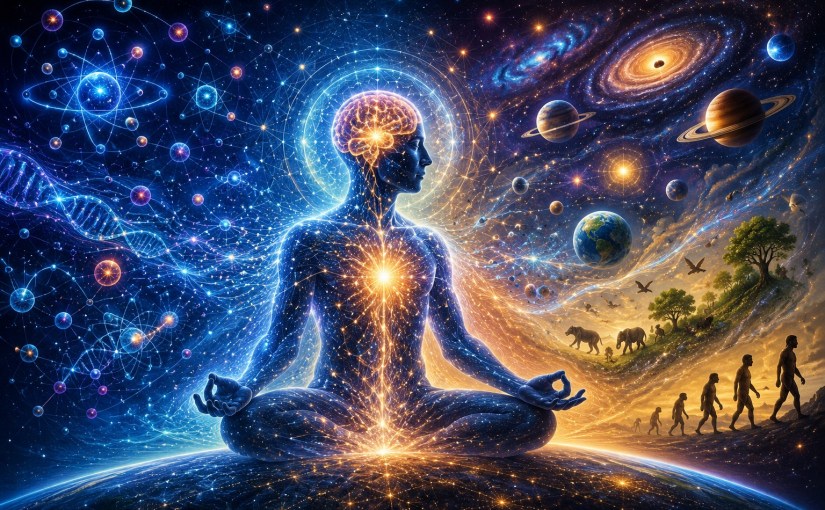
From this perspective, the universe may be understood as a continuum of conscious expression. Quantum particles represent the most fundamental level. Biological cells become the first organized expressions. Multicellular organisms demonstrate higher integration. Human beings display self-awareness. Mystical awakening represents perhaps the highest realization of the same underlying principle.
Such a view does not claim that every object experiences consciousness in the same way as a human being. A stone does not possess thoughts, emotions, memories, or self-reflective awareness comparable to those produced by the human brain. However, if consciousness is fundamental to reality, then its presence may extend even to the quantum level from which all forms emerge. In this perspective, inert objects may not consciously feel or recognize their own existence, yet they still participate in the same underlying conscious reality. The difference lies not in the presence or absence of consciousness itself, but in the degree to which it is organized, integrated, felt, and expressed.
In a broader sense, consciousness can be understood as regulated processing and action directed toward a higher developmental tendency or goal. From this perspective, quantum particles and human beings may be viewed as participating in the same fundamental process. Quantum particles continuously process information through their interactions and behave according to laws that contribute to the emergence of larger patterns of organization in nature. Although the universe often appears chaotic and random at the local level, over long periods it repeatedly gives rise to increasing order, complexity, life, and self-awareness. This suggests that there may be a subtle directional tendency inherent in reality, even if it is too faint to be directly observed or measured. The key difference is that quantum particles do not appear to possess subjective experience or the ability to feel these processes, whereas human beings do. This may be because the human brain has evolved a highly complex biological neural network through which pure existence, or Atman, becomes entangled with mental processes and becomes capable of self-awareness, perception, and feeling. Thus, the same underlying reality may be present throughout nature, but conscious experience emerges only when that reality is expressed through sufficiently organized structures such as the human brain.
From quantum particles to atoms, molecules, living cells, complex organisms, and awakened human beings, consciousness remains fundamentally the same underlying principle. Higher levels of organization do not create consciousness but enrich its manifestation, allowing increasingly sophisticated forms of experience, awareness, and self-recognition. Thus, consciousness may be viewed as a continuum extending throughout existence, while the capacity to experience and express it varies according to the complexity of the structure through which it operates.
How Quantum Darshan Connects with Sanatana Philosophy
This perspective creates an intriguing bridge to the ancient Sanatana worldview. The Sanatana tradition has long revered rivers, mountains, trees, stones, the Sun, the Moon, and countless manifestations of nature. To many modern observers this appears to be the worship of inert objects. However, through the lens of Quantum Darshan, a different interpretation becomes possible.
The reverence shown toward natural forms need not imply that a mountain or stone possesses human-like awareness. Rather, it reflects recognition that the same universal reality of consciousness permeates all existence. The worship is not necessarily directed toward the physical object itself but toward the deeper principle expressed through that object.
A river becomes sacred because it participates in the same underlying reality as the worshipper. A mountain becomes worthy of reverence because it is another expression of the universal existence. A tree, a stone, an animal, and a human being differ enormously in complexity and function, yet all may arise from the same foundational reality.
In this interpretation, Sanatana worship becomes an acknowledgment of unity rather than an idolization of matter. The object serves as a visible doorway through which one contemplates the invisible conscious principle underlying all existence.
Consciousness as a Continuum Rather Than a Human Possession
One of the most significant implications of Quantum Darshan is the rejection of the idea that consciousness suddenly appears only when a brain reaches a certain level of complexity. Instead, consciousness exists on a continuum.
At the most fundamental level are quantum entities. Above them emerge atoms and molecules. These organize into living cells. Cells organize into organisms. Organisms develop nervous systems. Human beings develop self-reflective awareness. Spiritual awakening reveals the deeper ground from which all these levels emerge.
In this model, life does not manufacture consciousness. Life becomes a vehicle through which consciousness expresses itself more clearly. Complexity increases the richness of expression, but the underlying reality remains continuous throughout the hierarchy of existence.
Ancient Wisdom and Modern Quantum Thought
The remarkable aspect of this framework is how it allows ancient spiritual insights and modern scientific speculation to engage in meaningful dialogue. Quantum theories of consciousness remain highly speculative and controversial within science. They have not yet established a definitive explanation for awareness. Yet they raise questions that resonate with philosophical and spiritual traditions that have contemplated consciousness for thousands of years.
Many ancient teachings describe the universe as permeated by a single reality. This reality has been expressed through concepts such as Brahman, Shiva-Shakti, universal consciousness, pure existence, or ultimate being. Quantum Darshan does not scientifically prove these teachings. Neither does it replace scientific investigation. Instead, it provides a philosophical framework in which these ancient ideas become intellectually approachable in a modern context.
The possibility emerges that what spiritual traditions discovered through direct inner experience and what science investigates through external observation may ultimately be examining different aspects of the same mystery.
The Meaning of Reverence Toward Nature
Viewed through Quantum Darshan, reverence toward nature acquires deeper significance. The sacredness attributed to rivers, mountains, forests, celestial bodies, and natural forces is not merely cultural symbolism. It becomes recognition that all forms participate in a shared underlying existence.
This perspective naturally encourages ecological respect and humility. If the same foundational reality manifests through every aspect of existence, then exploitation of nature becomes, in a sense, a failure to recognize our own deeper interconnectedness.
A person standing before a river is not simply observing flowing water. A person standing before a mountain is not simply looking at rock. Instead, one is encountering another expression of the same universal reality that gives rise to one’s own existence.
The Continuum from Matter to Awakening
Quantum Darshan suggests a grand continuum extending from quantum particles to awakened consciousness. The smallest entities participate in fundamental reality. Living cells organize that reality into biological systems. Organisms create increasing levels of integration. Human consciousness develops self-awareness. Spiritual realization reveals the universal ground beneath individual identity.
The continuum does not imply that all levels are identical. A human being clearly differs from a stone. Yet the distinction may lie in organization rather than in ultimate essence. Complexity influences expression, but the underlying reality remains shared.
This perspective allows one to understand how traditions that honor natural objects could emerge naturally from a worldview rooted in unity rather than separation.
Science, Philosophy, and the Future of Consciousness Studies
The scientific study of consciousness remains one of humanity’s greatest challenges. Despite tremendous advances in neuroscience, psychology, artificial intelligence, and quantum physics, no universally accepted explanation of consciousness exists. Questions concerning subjective experience, awareness, and the origin of consciousness remain open.
Quantum Darshan enters this discussion not as a completed scientific theory but as a philosophical proposal. It suggests that consciousness may be more fundamental than currently assumed. If future discoveries reveal deeper connections between consciousness and quantum reality, entirely new ways of understanding life, mind, and existence may emerge.
Even if such connections are never scientifically confirmed, the framework remains valuable because it encourages dialogue between scientific inquiry and ancient wisdom traditions. It reminds us that the search for truth need not be divided into opposing camps of science and spirituality.
Conclusion: A Universe United by an Underlying Reality
Quantum Darshan presents a vision of existence in which consciousness is fundamental rather than accidental. Quantum particles participate in the deepest fabric of reality. Living systems organize and amplify this reality. Human beings become capable of recognizing it consciously. Spiritual awakening represents the realization of unity beneath apparent diversity.
Through this lens, the Sanatana reverence for rivers, mountains, trees, stones, the Sun, the Moon, and other natural forms becomes understandable as recognition of a universal conscious principle rather than worship of inert matter. The object itself is not necessarily the focus. The deeper reality present within and through the object becomes the true subject of reverence.
Whether approached through science, philosophy, or direct spiritual experience, the possibility remains profoundly intriguing: that beneath the countless forms of the universe lies a single reality expressing itself in different degrees of organization, complexity, and awareness. Quantum Darshan offers one way of contemplating that possibility, providing a bridge between modern explorations of consciousness and the timeless vision that all existence is ultimately one.

