The Quantum Verse: Humanity, Mind Control, Free Will, and the Natural Order

From Spider-Man Mind Control to a Deeper Question

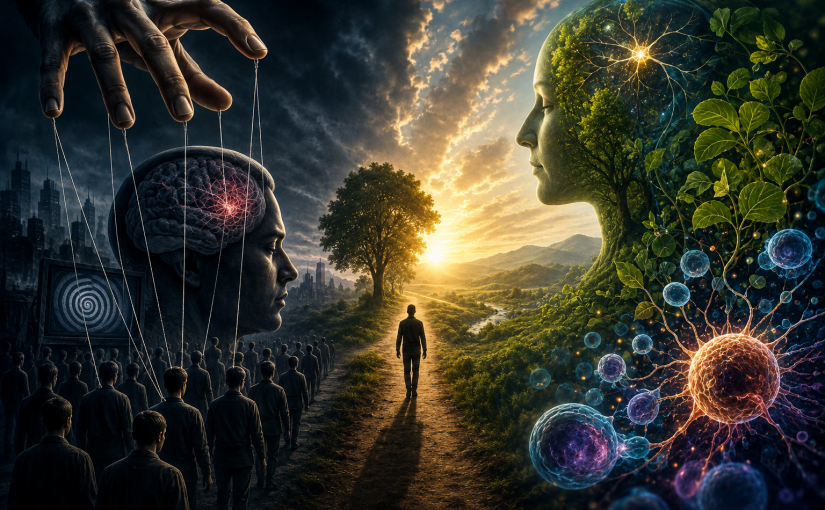
A recent Spider-Man movie made me think about mind control. Two sisters possess a mysterious ability to enter and control other people’s minds. After one sister is killed, the other becomes consumed by grief and revenge and uses her power to control people and create destruction. Spider-Man tries to stop her. The movie shows direct mind control, where one person’s will is imposed on another, but it also led me to a different possibility: a mind does not have to be entered directly in order to be strongly controlled. Teaching, repetition, authority, fear, reward, and fixed ideas of right and wrong can shape a person’s thinking so deeply that the person begins to act automatically according to them. Nobody then needs to command the person, because the learned idea itself guides action. The person may sincerely feel, “I am doing this because it is right.” Thus, controlling the framework through which a person decides what is right can sometimes be more subtle than controlling the action directly.

When Inhumanity Is Taught as Humanity

This becomes especially important when a doctrine teaches that an action is sacred, divinely commanded, or morally superior. If such teaching becomes deeply internalized, even an inhumane act can be understood as a humane or divine duty. The person may not feel that he has abandoned humanity; rather, the definition of humanity itself may have been changed in his mind. This can help explain how religious fanaticism and other ideological extremism can develop, although a religion, its interpretation, and the beliefs of ordinary followers are not necessarily the same. The same mechanism can occur in political movements, cults, nationalism, or any system that makes a moral definition unquestionable. The important point is that the person may experience the resulting behavior as his own free choice even when his values have been heavily conditioned.

Why Humanity Cannot Be Fixed

Years ago I developed a four-line verse from which Sharirvigyan Darshan gradually expanded: “No religion better than humanity, no worship better than work, no teacher better than problem, and no hermit better than householdship.” I deliberately left the word humanity undefined because humanity cannot be reduced to one permanent behavior. Giving water to a conscious, thirsty person may be humane, while giving water in the same way to an unconscious person may cause it to enter the lungs and choke him. Likewise, kindness toward a cruel person may become inhumane if it allows him to continue harming others. In one situation humanity may require compassion; in another it may require resistance, restraint, or protection of the innocent. Therefore humanity is not simply an action or a fixed rule. It is the conscious response appropriate to the living situation. If humanity itself is rigidly defined, it can become another form of conditioning, so the first line means that no religion should be allowed to become greater than living humanity itself.

Why Work Is Better Than Symbolic Worship

The second line does not say that worship, ritual, study, or symbolic practice is worthless. Its point is that practical application is better than remaining only with the symbol. A person may keep reading about yoga, discussing yoga, and understanding its symbolism without actually practising it. The symbol can then become a substitute for the reality it represents. I used the word work, rather than service, because work also remains open and situational. It means purposeful action in favour of humanity as required by the present circumstance. It may be teaching, healing, studying, creating, protecting, caring for family, performing professional duty, solving a problem, or refusing to participate in harm. What is right work can therefore change from moment to moment. The principle is that spiritual understanding should find practical expression in life.

Why the Problem Comes Before the Teacher

“No teacher better than problem” does not mean that teachers are unnecessary. The problem comes first because it shows what teaching is actually needed. Without understanding the problem, a person may choose a teacher because that teacher is famous, impressive, traditional, or popular and may therefore follow the wrong teaching. The sequence is problem → need → appropriate teaching → appropriate teacher. The problem is therefore the student’s first teacher, and when the problem changes, the required teaching and perhaps the teacher may also change. The line protects a person from making authority more important than the reality that needs to be understood.

Why the Hermit Leads Back to Householdship

“No hermit better than householdship” also does not mean that a hermit is worthless. The hermit represents spiritual discipline, inwardness, simplicity, and higher development. My point is that the aim of the hermit should ultimately be achievable in household life itself. Family, relationships, responsibilities, work, conflict, love, disappointment, and ordinary difficulties are the field in which spiritual understanding is tested. Household life should therefore also be spiritually uplifting. The movement is not from household life toward escape from life, but from the spiritual aim represented by the hermit back into ordinary life. The hermit is therefore a valuable example, while householdship becomes the field in which that aim is lived.

The Verse as Indirect Mind Control

In this sense, the verse itself can be called a form of mind control, but not control through coercion or domination. It presents a principle as the best way of approaching life, and once the mind accepts that principle, it begins to guide itself through it: verse → reflection → changed values → changed interpretation → changed action. Yet the verse does not prescribe one permanent behavior. Humanity determines the direction, work expresses it, the problem reveals what must be learned, and household life tests the understanding. There is also a safeguard in this structure: even the verse should not become a new dogma. Its purpose is not to make the mind obey mechanically, but to keep the mind conscious, responsive, and capable of discrimination.

I made it for myself only although kept open for others too. When tested practically by me for years it provided me physical and spiritual development along with awakening. Therefore it got verified. However single verification may not mean it’s one and final.

Why I Call It the Quantum Verse

I increasingly feel that this verse was not merely invented as an arbitrary moral instruction. I see it as a human expression of a natural and perhaps eternal principle, which is why I call it The Quantum Verse. I am not claiming that quantum physics has proved the verse or that quantum particles possess human minds. My idea is that quantum particles and natural processes behave as though they follow an underlying order without requiring human-style intention. They continuously interact, respond to changing conditions, and participate in the formation and maintenance of the world. Nature does not work through a classroom; changing conditions themselves create problems to which systems respond. It also does not remain isolated like a hermit; it exists through continuous interaction, more like household life. I therefore use “pretend” carefully: I am not saying that quantum particles have fixed human will, but that they can appear to act as though they possess an inherent direction while actually expressing a deeper natural order.

Quantum Darshan and Sharirvigyan Darshan

This is how I see Quantum Darshan and Sharirvigyan Darshan as arising from the same principle. Quantum Darshan looks toward the fundamental level of existence—particles, fields, interactions, and continuous change—while Sharirvigyan Darshan looks toward the living body—cells, organs, processes, adaptation, and the maintenance of the whole through the activity of its parts. The same pattern can therefore be considered at different levels: quantum level → continuous interaction and change; cellular level → organized living activity; human level → conscious reflection and choice. In this sense, the Quantum Verse is the principle, while Quantum Darshan and Sharirvigyan Darshan are two ways of observing its expression. The cell is especially important because it carries out its own continuous activity while participating in the larger organism, suggesting a broader pattern in which an individual part appears to act independently while remaining within a greater whole.

God, Basic Will, and Free Will

This also leads to my feeling that God may have “controlled the mind” of everything in the world, not by entering every mind separately but by establishing the deepest direction of existence. I am not saying that quantum particles possess a fixed will. Rather, I feel that they appear to act according to a basic order they did not themselves choose. Human beings may likewise have free will while operating inside a deeper order. There may therefore be basic will determined by the deeper order and free will expressed within it. A person can choose among possibilities, but cannot create the fundamental structure in which those possibilities exist. For example, he can choose food of choice out of many but can not choose to refuse food at all. And no doubt, caring for and maintaining own body also come under humanity. In this view, God would not need to micromanage every event; the underlying order itself could guide existence while allowing individual choice. In nutshell, it seems quantum verse is the basic will of God, but if one defines it opposite, then what can be done. A similar illusion also happens inside the body. Cancerous cells begin behaving as though their own uncontrolled growth is in favour of humanity, and in doing so, they unknowingly damage the body. They are not disobeying God’s will or the Quantum Verse, nor can anything in the cosmos truly disobey either as he is the supreme mind-controller. Rather, they are failing to understand humanity correctly. It is the root of all problems. Everyone acts according to what they consider right, but wrong happens when what is actually wrong is considered right. It is a wonderful aspect of psychology: everyone needs to justify their actions, whether right or wrong. No one can live happily and properly while continuously feeling that they are doing wrong or have done wrong. Even many commit suicide with this guilt feeling of wrong doing. Seeing this, can sharirvigyan darshan not become a type of psychotherapy to prevent this? I have noticed its profound effectiveness in eliminating many types of guilt feeling, may be all types as everything outside is contained inside body in sample form.

The Core Insight

The deepest point of the verse is therefore not that human beings need another rigid doctrine. It is that the mind should remain directed toward humanity without turning humanity into a rigid definition. Water may save one person and harm another; kindness may heal one person and enable another’s cruelty; service may help in one situation and harm in another; a teacher may be right for one problem and wrong for another; solitude may help at one stage while household responsibility may better express the same spiritual aim at another. Life therefore requires continuous discernment. This is why I see The Quantum Verse as more than a moral slogan. It expresses a principle of continuous activity, practical response to changing conditions, learning from problems, interaction with the larger whole, and living within an order greater than the individual. Whether that order is called nature, consciousness, God, or something beyond present language remains a philosophical question, but the verse points toward the same simple direction: No religion better than humanity, no worship better than work, no teacher better than problem, and no hermit better than householdship. It does not ask the mind to obey blindly; it asks the mind to remain alive.

Quantum Darshan: Consciousness, Quantum Reality, and the Ancient Sanatana Vision of a Living Universe

Consciousness, Quantum Reality, and the Search for the Fundamental Nature of Existence

For centuries humanity has struggled with one profound question: What is consciousness? Modern neuroscience attempts to explain it through brain activity, while philosophers continue to debate whether consciousness is merely a by-product of matter or something more fundamental. At the same time, various quantum theories of consciousness suggest that awareness may be linked to the deepest levels of physical reality itself.

This possibility opens a fascinating doorway between modern science and ancient spiritual traditions. For thousands of years, the Sanatana tradition has encouraged reverence toward rivers, mountains, trees, stones, the Sun, the Moon, and other forms of nature. However, these practices are traditionally understood not as worship of inert objects themselves but as contemplation of the divine reality or consciousness believed to pervade all existence. The object serves as a visible symbol of an invisible universal principle.

What makes this noteworthy is that such practices have produced profound spiritual experiences in countless practitioners across generations, including states of inner peace, expanded awareness, nonduality, and awakening. While these outcomes do not constitute scientific proof of quantum-level consciousness, they may be regarded as indirect experiential evidence that consciousness is more fundamental than a mere by-product of biological processes. In this sense, the enduring effectiveness of Sanatana contemplative practices offers a philosophical bridge between modern theories that place consciousness at the foundation of reality and ancient teachings that view the entire universe as permeated by a single underlying existence.

The Concept of Quantum Darshan and Universal Consciousness

Quantum Darshan proposes that consciousness is woven into the very structure of existence. Every quantum particle participates in an underlying field of reality. The emergence of complex organisms does not create consciousness but provides increasingly sophisticated structures through which consciousness can express itself.

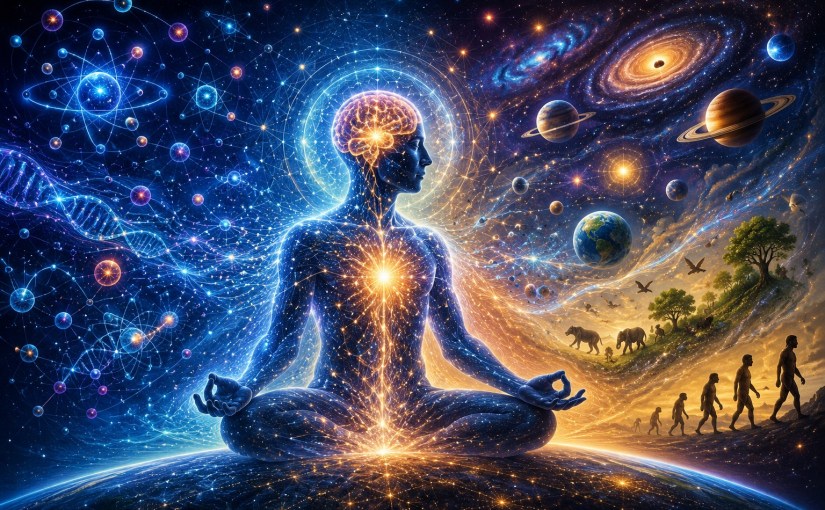
From this perspective, the universe may be understood as a continuum of conscious expression. Quantum particles represent the most fundamental level. Biological cells become the first organized expressions. Multicellular organisms demonstrate higher integration. Human beings display self-awareness. Mystical awakening represents perhaps the highest realization of the same underlying principle.

Such a view does not claim that every object experiences consciousness in the same way as a human being. A stone does not possess thoughts, emotions, memories, or self-reflective awareness comparable to those produced by the human brain. However, if consciousness is fundamental to reality, then its presence may extend even to the quantum level from which all forms emerge. In this perspective, inert objects may not consciously feel or recognize their own existence, yet they still participate in the same underlying conscious reality. The difference lies not in the presence or absence of consciousness itself, but in the degree to which it is organized, integrated, felt, and expressed.

In a broader sense, consciousness can be understood as regulated processing and action directed toward a higher developmental tendency or goal. From this perspective, quantum particles and human beings may be viewed as participating in the same fundamental process. Quantum particles continuously process information through their interactions and behave according to laws that contribute to the emergence of larger patterns of organization in nature. Although the universe often appears chaotic and random at the local level, over long periods it repeatedly gives rise to increasing order, complexity, life, and self-awareness. This suggests that there may be a subtle directional tendency inherent in reality, even if it is too faint to be directly observed or measured. The key difference is that quantum particles do not appear to possess subjective experience or the ability to feel these processes, whereas human beings do. This may be because the human brain has evolved a highly complex biological neural network through which pure existence, or Atman, becomes entangled with mental processes and becomes capable of self-awareness, perception, and feeling. Thus, the same underlying reality may be present throughout nature, but conscious experience emerges only when that reality is expressed through sufficiently organized structures such as the human brain.

From quantum particles to atoms, molecules, living cells, complex organisms, and awakened human beings, consciousness remains fundamentally the same underlying principle. Higher levels of organization do not create consciousness but enrich its manifestation, allowing increasingly sophisticated forms of experience, awareness, and self-recognition. Thus, consciousness may be viewed as a continuum extending throughout existence, while the capacity to experience and express it varies according to the complexity of the structure through which it operates.

How Quantum Darshan Connects with Sanatana Philosophy

This perspective creates an intriguing bridge to the ancient Sanatana worldview. The Sanatana tradition has long revered rivers, mountains, trees, stones, the Sun, the Moon, and countless manifestations of nature. To many modern observers this appears to be the worship of inert objects. However, through the lens of Quantum Darshan, a different interpretation becomes possible.

The reverence shown toward natural forms need not imply that a mountain or stone possesses human-like awareness. Rather, it reflects recognition that the same universal reality of consciousness permeates all existence. The worship is not necessarily directed toward the physical object itself but toward the deeper principle expressed through that object.

A river becomes sacred because it participates in the same underlying reality as the worshipper. A mountain becomes worthy of reverence because it is another expression of the universal existence. A tree, a stone, an animal, and a human being differ enormously in complexity and function, yet all may arise from the same foundational reality.

In this interpretation, Sanatana worship becomes an acknowledgment of unity rather than an idolization of matter. The object serves as a visible doorway through which one contemplates the invisible conscious principle underlying all existence.

Consciousness as a Continuum Rather Than a Human Possession

One of the most significant implications of Quantum Darshan is the rejection of the idea that consciousness suddenly appears only when a brain reaches a certain level of complexity. Instead, consciousness exists on a continuum.

At the most fundamental level are quantum entities. Above them emerge atoms and molecules. These organize into living cells. Cells organize into organisms. Organisms develop nervous systems. Human beings develop self-reflective awareness. Spiritual awakening reveals the deeper ground from which all these levels emerge.

In this model, life does not manufacture consciousness. Life becomes a vehicle through which consciousness expresses itself more clearly. Complexity increases the richness of expression, but the underlying reality remains continuous throughout the hierarchy of existence.

Ancient Wisdom and Modern Quantum Thought

The remarkable aspect of this framework is how it allows ancient spiritual insights and modern scientific speculation to engage in meaningful dialogue. Quantum theories of consciousness remain highly speculative and controversial within science. They have not yet established a definitive explanation for awareness. Yet they raise questions that resonate with philosophical and spiritual traditions that have contemplated consciousness for thousands of years.

Many ancient teachings describe the universe as permeated by a single reality. This reality has been expressed through concepts such as Brahman, Shiva-Shakti, universal consciousness, pure existence, or ultimate being. Quantum Darshan does not scientifically prove these teachings. Neither does it replace scientific investigation. Instead, it provides a philosophical framework in which these ancient ideas become intellectually approachable in a modern context.

The possibility emerges that what spiritual traditions discovered through direct inner experience and what science investigates through external observation may ultimately be examining different aspects of the same mystery.

The Meaning of Reverence Toward Nature

Viewed through Quantum Darshan, reverence toward nature acquires deeper significance. The sacredness attributed to rivers, mountains, forests, celestial bodies, and natural forces is not merely cultural symbolism. It becomes recognition that all forms participate in a shared underlying existence.

This perspective naturally encourages ecological respect and humility. If the same foundational reality manifests through every aspect of existence, then exploitation of nature becomes, in a sense, a failure to recognize our own deeper interconnectedness.

A person standing before a river is not simply observing flowing water. A person standing before a mountain is not simply looking at rock. Instead, one is encountering another expression of the same universal reality that gives rise to one’s own existence.

The Continuum from Matter to Awakening

Quantum Darshan suggests a grand continuum extending from quantum particles to awakened consciousness. The smallest entities participate in fundamental reality. Living cells organize that reality into biological systems. Organisms create increasing levels of integration. Human consciousness develops self-awareness. Spiritual realization reveals the universal ground beneath individual identity.

The continuum does not imply that all levels are identical. A human being clearly differs from a stone. Yet the distinction may lie in organization rather than in ultimate essence. Complexity influences expression, but the underlying reality remains shared.

This perspective allows one to understand how traditions that honor natural objects could emerge naturally from a worldview rooted in unity rather than separation.

Science, Philosophy, and the Future of Consciousness Studies

The scientific study of consciousness remains one of humanity’s greatest challenges. Despite tremendous advances in neuroscience, psychology, artificial intelligence, and quantum physics, no universally accepted explanation of consciousness exists. Questions concerning subjective experience, awareness, and the origin of consciousness remain open.

Quantum Darshan enters this discussion not as a completed scientific theory but as a philosophical proposal. It suggests that consciousness may be more fundamental than currently assumed. If future discoveries reveal deeper connections between consciousness and quantum reality, entirely new ways of understanding life, mind, and existence may emerge.

Even if such connections are never scientifically confirmed, the framework remains valuable because it encourages dialogue between scientific inquiry and ancient wisdom traditions. It reminds us that the search for truth need not be divided into opposing camps of science and spirituality.

Conclusion: A Universe United by an Underlying Reality

Quantum Darshan presents a vision of existence in which consciousness is fundamental rather than accidental. Quantum particles participate in the deepest fabric of reality. Living systems organize and amplify this reality. Human beings become capable of recognizing it consciously. Spiritual awakening represents the realization of unity beneath apparent diversity.

Through this lens, the Sanatana reverence for rivers, mountains, trees, stones, the Sun, the Moon, and other natural forms becomes understandable as recognition of a universal conscious principle rather than worship of inert matter. The object itself is not necessarily the focus. The deeper reality present within and through the object becomes the true subject of reverence.

Whether approached through science, philosophy, or direct spiritual experience, the possibility remains profoundly intriguing: that beneath the countless forms of the universe lies a single reality expressing itself in different degrees of organization, complexity, and awareness. Quantum Darshan offers one way of contemplating that possibility, providing a bridge between modern explorations of consciousness and the timeless vision that all existence is ultimately one.

Vīra Rasa in the Quantum World

Vīra Rasa represents heroism, courage, and inner strength. In classical Indian aesthetics, it arises when an individual faces difficulty with confidence, clarity, and determination. When viewed through a quantum–spiritual lens, Vīra can be understood as the alignment of inner energy that enables consciousness to overcome resistance and act with purpose. Just as quantum systems operate beyond ordinary limitations, courage allows human beings to transcend fear and uncertainty.

Vīra Rasa is the alignment of individual energy with cosmic energy. It supports the universal order and stands in favor of truth. This is why it differs from mere physical bravery.

Physical bravery may sometimes be only a display of strength without a higher purpose. It can even act against truth or against the cosmic order. Such bravery does not resonate with universal energy and therefore remains temporary and short-lived.

Vīra Rasa, however, emerges when individual energy aligns with universal energy. Because of this alignment, it resonates with the universal force and becomes amplified. For this reason, it carries a lasting power.

Quantum Tunneling: Overcoming Barriers with Courage

In quantum physics, tunneling describes a phenomenon where a particle crosses an energy barrier that it cannot overcome through classical means. This mirrors human courage, where one acts despite fear, doubt, or apparent impossibility. Spiritually, Vīra Rasa resembles quantum tunneling of consciousness—moving forward even when logic predicts failure. Heroism, in this sense, is the willingness to step into the unknown with resolve. Both serve meaningful and truthful purposes. Quantum tunneling enables many biological phenomena and thus makes life possible, while Vīra Rasa helps preserve and sustain humanity.

Spin Alignment: Inner Coherence and Heroic Action

Particles in a magnetic field align their spins, creating coherence and collective strength. When the spins of electrons point in the same direction, their tiny magnetic moments add together instead of canceling out, and the material becomes magnetized. One may imagine a magnetic field as an army commander that aligns particles like disciplined soldiers, creating unity and collective strength to defend the nation from enemies. This coordinated behavior evokes a sense of charm and awe, as scattered particles suddenly act like a disciplined army. Through this alignment, their collective power performs many remarkable and almost “heroic” tasks in the physical world. In a similar way, armies and civilians perform heroic acts when they create countless structures through disciplined unity and collective alignment. Magnets created by aligned spins can lift heavy iron and steel in industrial cranes. Electric motors and generators operate because magnetic forces produced by aligned spins convert electricity into motion and motion into electricity, powering countless machines of modern civilization. In magnetic storage devices such as hard drives and magnetic discs, billions of tiny magnetic domains—each formed by aligned spins—store digital information. Through this microscopic organization, enormous libraries of human knowledge, scientific data, literature, images, and communication are preserved and retrieved. In medical technology, strong magnetic fields align nuclear spins inside the human body, making Magnetic Resonance Imaging (MRI) possible, allowing doctors to visualize internal organs and detect disease without surgery. Individually, each particle contributes only a minute effect, but when trillions align, their combined action produces extraordinary strength, organization, and usefulness. This alignment generates confidence among them and transforms scattered particles into an effective collective force, which metaphorically resembles the emergence of Vīra Rasa.

Sometimes a single individual displays such extraordinary courage and determination that he is called a “one-man army.” Even though he stands alone, his alignment with truth and purpose generates a force that can influence many others. What begins with a single person may gradually inspire collective strength and unity.

A similar principle can be seen in the quantum world. A single quantum particle aligning its spin within a magnetic field may become part of a larger process in which many particles align together, producing strong magnetism. In this way, even a tiny beginning can lead to a powerful collective effect.

In human life, this resembles the emergence of Vīra Rasa. When even a single individual aligns with truth and the universal order, that alignment can initiate a heroic force that eventually spreads and strengthens many others. Thus, both in the quantum realm and in human society, a great movement of strength may begin from a single aligned unit.

From another perspective, Vīra Rasa arises when the mind, heart, and body become aligned toward a single goal. True courage is not reckless behavior but a state of inner harmony in which thoughts, emotions, and actions move together. Just as aligned spins generate magnetism and collective power capable of performing great tasks, aligned inner faculties generate stable heroism. This alignment gives courage its strength, coherence, and moral grounding.

It also demonstrates that strength lies in unity. However, unity can sometimes be misused. In society, certain groups unite not to uphold justice but to oppose humane laws and demand inhuman rules, using the power of the crowd to disturb balance. Similar anomalies can also be observed in the quantum world. When particles act in harmony, they produce powerful collective effects such as coherence and magnetism, showing the constructive strength of unity. Yet unity can also create paradoxical or destructive outcomes. In destructive interference, many waves combine but cancel each other completely, producing no result despite collective effort. In quantum decoherence, the coordinated state of particles collapses when disturbed by the environment, causing the loss of unity and order. It is similar to the unity of an army or a lawful rebellion, which can be weakened when external forces interfere and break that unity through a divide-and-rule strategy. In the quantum world, when the external environment breaks the unity of quantum particles, their coordinated behavior is disturbed and they become absorbed into separate processes that serve the growth of the surrounding system. Similarly, when enemies break the unity of a nation, they can exploit the divided people for their own advantage and growth. In quantum tunneling, the collective probability of particles allows them to cross barriers that would normally confine them, leading to processes like radioactive decay, where particles escape from atomic nuclei and release harmful radiation that can damage living tissue. Similarly, uncontrolled chain reactions in nuclear processes arise from collective particle behavior and can result in massive destructive energy. On the other hand, nature also imposes limits through principles such as the Pauli Exclusion Principle, which prevents electrons from occupying the same state and thereby avoids the collapse of matter. Thus, the quantum world reveals that unity is powerful but not inherently virtuous; its consequences depend on whether the collective action supports harmony, stability, and the preservation of order. It also demonstrates that strength lies in unity. but some people misuse it and make unity to disassemble society and justice. they making crowd oppose humane laws and demand inhuman laws and rules. such anomalies also exist in quantum world.

Energy Transition: From Potential to Manifest Courage

Electron transitions in quantum mechanics occur when energy is absorbed or released, shifting the electron between different energy levels. This process does not involve intention but demonstrates how stored energy can suddenly manifest as activity. Human courage follows a similar energetic pattern. A person may carry latent strength within, remaining in a quiet or restrained state. When circumstances demand action, that stored potential rises into expression, much like an electron moving to an excited state after absorbing energy. Vīra Rasa thus represents the transformation of inner potential into visible and decisive action. Unlike electrons, however, human beings act with awareness and purpose, turning energy into meaningful direction.

Awareness is overlaid upon the fundamental activities already occurring in nature. The processes of nature—energy transitions, particle interactions, and transformations—continue according to their intrinsic laws. Awareness does not create these activities nor fundamentally alter them; it simply observes, recognizes, and sometimes guides their expression at the human level. In quantum mechanics, electrons shift between energy levels by absorbing or releasing energy, a process that occurs naturally without intention. Human courage follows a similar energetic pattern: latent potential rises into active expression when conditions demand it. Vīra Rasa therefore represents the transformation of stored inner strength into visible action. The underlying energetic movement already exists in nature; human awareness merely witnesses it and channels it consciously into meaningful direction.

If human awareness becomes stunned or dissolved in nonduality, the fundamental activities of life do not stop. Breathing, perception, thought, and action continue according to the intrinsic processes of nature. Awareness is therefore not the generator of activity but an overlay upon deeper natural functions. This insight forms the basis of what may be called Quantum Darshan: dulling or quieting the excessive, restless awareness that creates bondage, fear, and ignorance, while allowing the underlying natural processes to function freely and harmoniously. Just as in the quantum world particles continuously interact, transform, and move without deliberate intention, human life can remain fully active even when the ego-centered awareness subsides. In this state, activity continues, but the burden of psychological interference is reduced, allowing action to arise more naturally, efficiently, and spontaneously in a balanced human way.

Quantum Resonance: Amplifying the Power of Purpose

Resonance occurs when energy is applied at the right frequency, amplifying its effect. In human life, courage becomes powerful when it resonates with a higher purpose such as truth, duty, or compassion. Even small acts of bravery can create large impact when aligned with universal values. Spiritually, Vīra Rasa reflects resonance between individual will and cosmic support.

In my early life, what I emphasized most was simple humanity. I spoke about it, wrote about it, and tried to live by it. At that time, it appeared to be a very small effort—hardly a courageous act, almost devoid of Vīra Rasa.
Yet, because it resonated with a deeper cosmic principle, it gradually evolved into a powerful expression of Vīra Rasa as it became connected with various worldly actions.
This reveals that even a seemingly insignificant but truthful step, taken at the right stage of life, can resonate with time and universal values. In time, that small step may transform into a great heroic force.
Thus, even a single truthful mental resolution can bring a dramatic transformation in life. In my early years, I emphasized simply humanity—I spoke about it, wrote about it, and acted upon it. At that time, it seemed like a very small act, lacking courage and almost devoid of Vira Rasa. However, because it resonated with a cosmic principle, it later evolved into a powerful expression of Vira Rasa as it became connected with various worldly activities. This shows that even a seemingly negligible but truthful step, taken at the right stage of life, aligns with time and universal values and eventually gains great strength and significance; therefore, even a single truthful mental resolution can bring a dramatic change in life.

Vīra Rasa: A Quantum–Spiritual Synthesis

Through the lens of quantum analogies, Vīra Rasa can be understood as the science of inner strength. It is the courage to cross barriers, the coherence of aligned intention, the rise into higher energy states, and the resonance of purpose-driven action. Heroism, therefore, is not merely physical bravery but a deep energetic alignment between consciousness and the universal order.

veebhatsa rasa in quantum world

Bībhatsa Rasa (Horrifying Disgust / Extreme Repulsion)

Bībhatsa is the rasa that arises when consciousness encounters something profoundly disturbing—something that violates the deepest sense of order, purity, or moral coherence. It is experienced as horrifying disgust, extreme repulsion, or visceral revulsion. Unlike ordinary fear, which responds to danger or threat, Bībhatsa reacts to incompatibility. It is the body–mind’s instinctive alarm against what feels corrupting, grotesque, or energetically toxic. The reaction is immediate and non-intellectual: the whole being recoils before thought has time to intervene.

In this sense, Bībhatsa is not merely emotional; it is protective. It preserves the integrity of consciousness by clearly marking what must not be absorbed, accepted, or allowed to merge with the self.

Quantum Analogy: Energetically Forbidden States

In quantum physics, not all states are allowed. Certain configurations are energetically forbidden—systems naturally avoid them because they are unstable or destructive to coherence. When a particle approaches such a state, it does not gradually adapt; it is forcefully excluded.

Bībhatsa functions in an analogous way within human consciousness. When awareness encounters extreme moral decay, grotesque violence, or deep energetic disturbance, it registers the experience as “forbidden.” The reaction is not curiosity or analysis, but immediate rejection. Just as a quantum system cannot remain in an unstable configuration, the psyche cannot remain neutral in the presence of what fundamentally violates its inner order.

Spiritually, this reveals Bībhatsa as an intelligence of discernment rather than a lower emotion.

Destructive Interference and Inner Collapse

In wave physics, destructive interference occurs when two waves meet in opposing phases, canceling each other out and collapsing the existing pattern. A similar phenomenon occurs during intense experiences of horrifying disgust.

When consciousness confronts something deeply incompatible, inner mental and emotional patterns destabilize. Familiar structures of meaning collapse, producing sensations of shock, nausea, dread, or freezing. This collapse is not random; it is a response to overwhelming incoherence. The psyche momentarily loses its equilibrium, signaling that the encountered stimulus cannot be integrated.

From a spiritual perspective, this collapse is a warning mechanism. Bībhatsa announces a boundary—beyond this point, integration would be destructive.

Psychological Gravity and the Mind’s Natural Self-Protection

Sometimes we encounter individuals who strongly assert their authority in every discussion and instinctively dismiss the perspectives of others. Their presence can create a kind of psychological pressure where conversation stops being a balanced exchange and becomes dominated by their imposed certainty. In such situations, the mind may momentarily freeze or lose its natural clarity. It can feel as if one’s independent thinking is being pulled inward, almost like a gravitational pull, where attention contracts and the mind struggles to respond freely or maintain its own perspective.

This temporary disturbance does not arise from weakness but from the sudden cognitive pressure created by a dominating personality. The mind briefly enters a shocked or confused state in which its natural reasoning becomes disturbed. In the language of Indian aesthetics, the emotional tone that may arise in such moments resembles Vibhatsa Rasa, the feeling of aversion or disgust. This reaction acts as a protective signal, encouraging the mind to distance itself from situations or personalities that disturb its equilibrium and interfere with its natural functioning.

A metaphorical parallel can be drawn from physical systems. In atomic physics, electrons remain stable in certain orbits because those configurations allow their wave phases to remain consistent and avoid destructive interference. If conditions arise where phase relationships would cancel or destabilize the state, the system naturally shifts toward a more stable configuration. In a similar metaphorical sense, the human mind also seeks environments where its internal coherence remains intact. When interaction with a manipulative or dominating personality disturbs this coherence, the mind instinctively tries to withdraw and restore its balance.

Thus, the feeling of aversion and the desire to move away from such individuals can be understood as a natural form of psychological self-regulation. By distancing itself from conditions that suppress independent thinking and disturb mental clarity, the mind gradually returns to its natural state of coherence, autonomy, and balanced awareness.

Repulsion and the Principle of Exclusion

Quantum physics also teaches the principle of exclusion: identical or incompatible states cannot occupy the same space simultaneously. This principle finds a powerful parallel in Bībhatsa.

Bībhatsa does not merely suggest avoidance; it produces repulsion. The body pulls back, the mind withdraws, and consciousness refuses co-occupation with what it perceives as corrupt or destabilizing. This reaction safeguards inner coherence. It prevents the merging of consciousness with experiences that would fracture identity, ethics, or energetic balance.

Seen this way, Bībhatsa is not negativity—it is preservation. It protects the wholeness of being.

Loss of Specialness, Vibhatsa Rasa, and a Parallel with Electrons

When two very similar personalities come very close—especially when both derive their identity from being unique, authoritative, or special—a subtle psychological disturbance can arise. Each person may unconsciously feel that their individuality or special position is being challenged. Earlier, their clarity and confidence might have come from the belief that their role or viewpoint was singular. But when they encounter someone very similar, that sense of uniqueness becomes disturbed. As a result, discomfort, rivalry, or distancing may appear. The mind may feel somewhat “collapsed” in the sense that the earlier certainty about one’s special position is no longer stable.

In the language of Indian aesthetics, the emotional tone that sometimes arises in such situations resembles Vibhatsa Rasa—the rasa of aversion or disgust. It is not necessarily hatred; rather, it is a natural reaction of the mind that pushes it away from something that disturbs its internal order. The mind instinctively tries to restore its psychological space and clarity by creating distance from the disturbing presence.

A helpful metaphor can be seen in atomic physics through electrons in an atom. According to Pauli’s Exclusion Principle, two electrons cannot occupy exactly the same quantum state simultaneously. For instance, in the lowest orbital of an atom, two electrons can exist together only if they differ in their spin—one spin-up and the other spin-down. If another electron attempts to enter the exact same quantum configuration, it cannot remain there and must move to a different orbital or energy level. This rule forces electrons to distribute themselves into distinct states, which creates the stable layered structure of atoms.

Metaphorically, something similar can be observed in human interactions. When two individuals try to occupy the exact same psychological “state” of uniqueness or dominance, tension may arise because both cannot comfortably maintain that same position. The resulting aversion—similar to Vibhatsa Rasa—acts like a psychological mechanism that pushes them into separate roles or distances. In this way, both physics and human behavior illustrate a tendency toward maintaining distinct states in order to preserve stability and clarity.

Decoherence: Collapse of Inner Equilibrium

In quantum systems, interaction with an external environment causes decoherence—the loss of delicate superposition into a definite, collapsed state. Similarly, witnessing something horrifying can shatter inner calm and dissolve subtle mental balance.

The sudden emergence of disgust marks the collapse of neutrality. Consciousness declares, “This is incompatible.” Through this collapse, stability is eventually restored—not by acceptance, but by rejection. If neutrality is maintained for too long without such a collapse, a disturbing or degrading environment can further shatter inner balance. Thus, although the collapse of neutrality may appear negative, it can function as a protective remedy. In a metaphorical sense, electrons in an atom also abandon neutrality and become selective in their states in order to preserve coherence and stability. Bībhatsa therefore serves a regulatory function, forcing separation where continued union would be harmful.

Spiritual Insight: Bībhatsa as Boundary Wisdom

At a deeper spiritual level, Bībhatsa represents boundary wisdom. It is consciousness recognizing what must not be assimilated. Where other rasas invite participation, expansion, or transformation, Bībhatsa enforces distance. It is the rasa of sacred refusal.

In advanced awareness, Bībhatsa refines discernment. It teaches that not everything encountered is meant to be transcended through inclusion; some realities must be rejected to maintain purity, clarity, and inner order.

Conclusion

Bībhatsa is the rasa of extreme incompatibility. Through the lenses of quantum instability, destructive interference, exclusion, and decoherence, it reveals itself as an intelligent, protective force within consciousness. It signals danger not merely to survival, but to coherence itself. In doing so, Bībhatsa preserves the integrity of the self—emotionally, morally, energetically, and spiritually.

bhayankara rasa in quantum world

In Nātya-Śāstra, Bhayānaka Rasa is not merely “fear” as an emotion felt by the self, but the Rasa that evokes fear in the audience or observer — it is fear-producing, not fear itself.

So, in quantum terms, it’s more like the creation of instability or resonance that induces tension in another system, rather than the contraction of one’s own system (which we earlier associated with Bhaya / Fear).

Bhayānaka Rasa — Fear-Producing / Dread-Creating

Quantum Resonance as Disturbance

In physics, interactions propagate through fields, and a particle or system in an excited or unstable high-energy state can influence nearby particles by inducing oscillations or disturbances through well-defined mechanisms such as electromagnetic coupling, even across a distance. This influence is governed by measurable laws and does not imply emotion or intention. By analogy, in human experience, intense inner states also spread through interaction rather than contact. A person overwhelmed by stress or rage may appear highly charged—his tension visible in the eyes, face, and posture. Without speaking or acting, this state can unsettle those nearby. In Indian aesthetics, the contracted, agitated condition within such a person is termed Bhayānaka Rasa. In observers, the resulting response is bhaya, or fear. Spiritually understood, this comparison is metaphorical: just as physical disturbances propagate through fields by interaction, psychological tension propagates through perception and awareness, without implying that human emotions follow quantum laws.

Quantum Tunneling as Threat Potential

In physics, a particle may sometimes appear in a region where classical reasoning says it should not exist, creating a sense of unpredictability. A similar reaction occurs in the human mind. Fear and horror often arise not from direct harm, but from the sudden appearance of the unknown. When a stranger enters one’s familiar territory from an unseen path or unexpected direction, the mind immediately imagines possible dangers—attack, theft, or loss—before any action has taken place. This anticipatory tension is recognized in Indian aesthetics as bhaya—the felt experience of fear arising from suspense and uncertainty. The source that generates or radiates this tension is termed Bhayānaka, the fear-producing rasa. Spiritually, this distinction reveals a subtle truth: events themselves do not create fear; fear arises when the mind receives and mirrors a Bhayānaka expression and becomes dual like it, projecting potential tragedy into the unknown. A Bhayānaka person is always dual and attached, and he is generally driven by the urge to snatch or take something from the potentially fearful person. A nondual and inwardly free person, who wishes nothing and is detached, has no reason to become Bhayānaka, since he does not want to snatch anything violently; likewise, no one will feel fear toward him, because there is no anticipation of loss through him. Sometimes, however, a nondual person, due to prolonged exposure to the powerful energy of a Bhayānaka person, may begin to turn dual like him and then start feeling bhaya after living for some time in his company. This indicates that nondual contemplation—through quantum darśana or similar insight—needs to be strengthened and accelerated to prevent such influence. It also means that a Bhayānaka person is not necessarily an enemy, but may act as a friend or even a guru, indirectly helping the seeker mature nondual contemplation and grow spiritually through challenge and contrast.

I gained much spiritual growth through this Bhayānaka-produced bhaya challenge. In a way, this challenge has hovered around me since my first breath. It taught me a bhaya-free life of nonduality and detachment instinctively. Many times, seeing my nondual weapon winning, the bhayānaka weapon was upgraded against me, and I again upgraded my defending nondual weapon. Thus, this tug of war always went on—sometimes the defensive nonduality weapon was stronger, and sometimes the attacking duality weapon. Many duality weapons were eventually upgraded into nonduality weapons by coating them with the armor and shield of ‘non’ matter, influenced by the effectiveness of non-duality. Some took a long time, some took less. Ultimately, the nonduality weapon wins, as it is the nearest to truth. Actually, this is the situation for everyone—fear of the environment, fear of animals, fear of elders, fear of teachers, and fear at every step. All of this exists to teach us, inspire us, and help us grow.

Wavefunction Collapse and Observer Effect

In physics, observation collapses many possibilities into a single outcome. A similar process operates in human experience. When uncertainty is present, the mind holds multiple possible futures, but the moment authority, threat, or high stakes enter—like a strict boss assigning one task with warning—those possibilities shrink into a single demanded outcome. Fear arises not from the task itself, but from the sudden narrowing of freedom. However, one can gain unbelievable power from nondual śarīra-vijñāna darśana or quantum darśana to counteract fear and still function fully under the command and rule of law. This is my personal experience, not merely a philosophy. Art and drama use the same principle: by restricting attention and delaying resolution, they generate tension and suspense. Spiritually, fear is understood as the mind’s reaction to constraint, while actually awareness remains untouched by the collapse of possibilities, just as happen in the quantum world.

Quantum Instability / Chaos

In physics, systems that operate at the edge of stability are highly sensitive to small perturbations; even minor disturbances can trigger noticeable changes when balance is fragile, as interactions propagate through fields by well-defined physical mechanisms. A similar pattern appears in human experience. Bhayānaka arises when an event, action, or presence signals potential instability—loss of control, unpredictability, or imbalance—before any actual harm occurs. This signal makes observers alert, anxious, and tense, not because danger is certain, but because uncertainty has been introduced. Fear (bhaya) in others is generated when the mind mirrors this perceived instability, borrowing disturbance through perception rather than through any literal transfer of force. The fear-producing state (Bhayānaka) exists in the source, while fear itself (bhaya) arises only in the observer who allows inner imbalance to form. If this mirroring does not occur, fear is not produced, even in the presence of apparent threat. From a nondual perspective, both the fear-producing and the fearful are understood as transient expressions of the same underlying reality, comparable to temporary oscillations within a single field. When this quantum darśana is stable, distinctions between threatening and threatened dissolve, and fear loses its apparent reality—not through suppression, but through understanding. Simply put, when the targeted person finds himself equally disturbed as the targeting person, he begins to balance himself, as no one wishes to become like someone who intends to harm him.

Bhayānaka Rasa and the Quantum Reflection of Consciousness

Human experience suggests that inner emotional states are often reflected outward, as if the world responds in kind. These patterns are also seen in the quantum world in a similar manner. Bhayankara Rasa or aggression, Fear, calm, or harmony perceived outside—or observed in the quantum world—frequently mirror corresponding movements within consciousness. From this perspective, it appears as though worldly objects and even quantum particles behave analogously to living beings—not literally possessing organs or chakras, but expressing corresponding qualities or tendencies, such as love–hate linked to the heart chakra or interaction and expression linked to the throat chakra. Just as human emotions are connected to subtle centers of awareness, or chakras, one may then ask why it should not be said, analogously, that quantum particles also possess a body and chakras like human beings, or that a quantum particle is, in itself, a complete human being.

Fear, Polarity, and Kundalini Awakening

One may understand this symbolically: a single, unified soul appears to divide into two tendencies—attachment and aversion, attraction and repulsion, plus and minus. In a similar way, pure awareness manifests as particle–antiparticle pairs. The “plus” tendency slightly outweighs the “minus,” allowing the manifested world of humanity to continue and grow, just as matter dominates over antimatter in the observable universe. In this sense, the human being can be seen as a living expression of these polarities, sometimes acting as a particle, sometimes as its opposite. Even people can be categorized as plus, minus, or neutral, depending on which polarity predominates within them or whether both polarities have annihilated each other. After this apparent division, the soul experiences a loss of wholeness and naturally seeks to return to completeness. This movement often takes the form of growing sāttvikatā—an increasing refinement and purity of consciousness through worldliness with nondual awareness—whose extreme culmination is realized through Kundalini awakening and self-realization. actually awareness in spiritual context is always nondual awwareness. Actually, without a nondual attitude, awareness is simply differentiating worldly awareness, not spiritual or true or pure type one. Tantric traditions seek to accelerate this process within a single lifetime by consciously engaging with the so-called “minus” world through pañcamakāras, under discipline, awareness, and proper guidance. Used rightly, these act not as objects of attachment but as a recoil force, like rocket propellant, giving a powerful push toward transcendence. When attachment arises, however, the minus tendency overwhelms the plus, leading not to wholeness but to stagnation, as unresolved urges remain. It is simply a premature or raw wholeness that cannot provide liberation, as one has not yet reached the peak of worldliness through sattvikatā. In a similar way, the outer world does not collapse prematurely, but first reaches a peak stage of evolution, which is analogous to self-realization in the inner world. This stage may be understood symbolically as the enlightenment of Brahmā, after which its liberation occurs through the dissolution of the world, known as pralaya. This represents a mature annihilation of the plus and minus aspects of existence with each other. At the end of the world, one may symbolically imagine antiparticles appearing in balance, allowing particles and antiparticles to combine again and return to a state of initial void of complete pure awareness. Non-tantric spiritual paths also cultivate sāttvikatā, but often more slowly, lacking the intense friction generated by engagement with rājasic and tāmasic forces; thus awakening may unfold gradually, sometimes across many lifetimes. A comparable pattern is seen in physics, where particles and antiparticles are constantly produced together and annihilate each other. Antiparticles are not useless; their presence provides the conditions through which a small excess of particles persists, allowing the physical universe to expand and evolve. Symbolically, the continual creation and dissolution of lower tendencies like bhaya, bhayankara etc.—within oneself or observed in others—serve as a contrast and stimulus for higher growth, suggesting that those who embody negativity are not merely “bad,” but often become the very conditions that inspire others to be good, and the good to become even better. Those deeply attached to lower states may dissolve into repeated up–down cycles, while those inclined toward balance draw inspiration and momentum from this contrast, avoiding annihilation until reaching the peak of awakening and self-realization. In this way, fear (bhaya) and the fear-producing state (Bhayānaka) become meaningful forces within consciousness—not as final truths, but as dynamic tensions that propel awareness toward greater clarity and wholeness.

Bhayānaka Rasa: Surface Disturbance, Inner Stillness

Bhayānaka Rasa refers not to fear felt within oneself, but to the state or expression that produces fear in others. While bhaya is the personal contraction of the mind in response to perceived danger, Bhayānaka is the outward radiance of tension, suspense, or dread. It arises when an event, character, or atmosphere signals instability or threat, making the observer alert and uneasy even before anything harmful occurs. This rasa is widely employed in storytelling, drama, and art, where fear is deliberately evoked through uncertainty and anticipation. Yet from a nondual, quantum-aware perspective, both Bhayānaka and bhaya are understood as surface-level expressions only. Just as oscillations, fluctuations, and interactions continuously appear in the quantum world while the underlying field remains unaffected, outward expressions of fear may arise without disturbing inner stillness. One may therefore express or witness Bhayānaka or Bhaya outwardly—like an actor in a drama—while inwardly remaining calm, centered, and untouched, with disturbance confined only to the surface and not to the core of awareness just like wavy surface of inner calm ocean.

Like other negative worldly emotions, bhayānaka and bhaya tends to attach themselves to the remaining positivity within a person. When one becomes attached to fear or repeatedly identifies with it, this negativity (tāmasikatā) can overpower and even annihilate one’s accumulated sāttvikatā. Such attachment may lead to a kind of premature inner collapse, where growth toward wholeness is arrested. However, through detachment born of quantum darśana—the insight that all such states are transient surface expressions—fear can be neglected rather than resisted. In this detached stance, fear no longer binds; instead, it becomes a source of momentum. The presence of negativity then acts as a contrast that inspires the seeker to strengthen sāttvikatā further and further, until it reaches a level that can no longer be pulled back or annihilated by tāmasikatā. In this way, what once threatened dissolution functions like rocket propellant—providing thrust for irreversible inner ascent rather than drag or backward movement toward destruction.

Nonduality as the End of Fear: Freedom from Bhaya

Simply speaking, the best method to prevent bhaya is freedom from worldly attachments, or in other words, the cultivation of a nondual attitude. Fear exists because of the anticipation of losing something to which one is deeply attached. If there is nothing held tightly, and if everything is already accepted as lost, then there remains no anticipation of loss and, therefore, no bhaya. In this way, fear dissolves naturally. Human beings first become dual, and from this duality arise deep attachments to negativity or darkness, often rooted in unresolved and buried violent tendencies within. When such energy is projected outward, the person embodying it appears bhayānaka to others. This negativity may indeed cause loss or harm to a targeted person. Yet if the target is attached to possessions, identity, or outcomes, fear arises; if the target has already relinquished everything through nonduality-born detachment, fear cannot take hold, because there is nothing left to lose. When the bhayānaka individual sees that his fear-producing power fails against such inner freedom, he gradually loses faith in that weapon. Observing the victory of nondual detachment, he too may be drawn toward freedom, inspired by the one who remained untouched.

Fear, Contraction, and the True Path of Expansion

One who is afraid makes others afraid. It is because his consciousness is contracted. He has not yet experienced the full expansion of consciousness to the ultimate limit of awakening and self-realization. Therefore, he fears that he will have to put in great effort again to expand his consciousness.

But one who has once awakened through self-realization does not worry about this contraction. He has already tasted the fully ripened fruit. Now he moves toward Nirvikalpa Samadhi — beyond words like contraction or expansion of consciousness — into pure void. For him, the journey becomes easier, because worldly expansion of consciousness can no longer lure him back.

The fearful person, however, tries to regain expansion of consciousness through the world. He believes it is possible only through outer means. So he attempts to snatch from others, and as a result, others become afraid of his behavior. Yet this is the wrong way to expand consciousness. Because of the guilt it creates, his consciousness contracts even more.

The correct way of expansion is to avoid harming others, or to cause minimal harm. Then consciousness rises easily and quickly toward awakening. From such a peaceful walker, no one feels fear — even though he may be expanding his consciousness far more than the aggressive walker.

Quantum Analogy of Fear and Cooperation

In quantum physics, when a quantum system collapses from a wave of possibilities into a fixed particle state, it becomes localized and rigid. If such a collapsed entity strongly interacts with other quantum entities, it can disturb their superposition as well. Through forceful interaction, it induces collapse in them. In simple terms, a collapsed quantum state can trigger collapse in nearby systems.

This is similar to fear spreading through interaction. One contracted system creates disturbance, and disturbance reduces coherence. When both systems are collapsed and localized, their behavior becomes more particle-like — rigid, defensive, and limited. In such a condition, the probability of returning to a broad wave-like superposition decreases, because repeated disturbance reinforces localization. In physics, this resembles increasing decoherence.

However, interaction does not always have to be violent or forceful. Quantum systems can also become coherent. When interaction is gentle and aligned, phase relationships synchronize. Instead of forcing collapse, the systems enter cooperative coherence. In such coherence, even a localized state can gradually regain wave-like characteristics through constructive interference.

In this analogy, cooperation corresponds to quantum coherence. Rather than collapsing each other through fear-driven disturbance, systems align and stabilize one another. The result is collective amplification instead of mutual contraction. Expansion then is not achieved by snatching energy, but by resonance.

Thus, in quantum terms, fear behaves like forced measurement causing collapse, while cooperation behaves like phase alignment creating coherence. In coherence, growth becomes shared rather than competitive.

Those who fear themselves make others afraid—
just as disturbed quantum states tend to disturb other quantum states.


Chapter 38: Karuṇa Rasa in the Quantum World

Compassion, Sorrow, and Empathy as Cosmic Sensitivity

Karuṇa Rasa, traditionally understood as the rasa of compassion, sorrow, and deep empathy, arises when consciousness becomes sensitive to suffering—both within oneself and in others. It is not mere emotional pain; rather, it is the refined vibration of empathy, born from the recognition that all beings share vulnerability, impermanence, and interconnectedness.

In human experience, Karuṇa manifests as a gentle yet powerful awareness: the capacity to feel another’s pain without resistance, avoidance, or judgment. It is sorrow infused with understanding, and compassion infused with clarity. When viewed through a quantum–cosmic lens, Karuṇa reveals itself not as weakness, but as a high degree of coherence and sensitivity within consciousness itself.

Quantum Entanglement and the Shared Field of Suffering

Compassion as Non-local Resonance

In the quantum world, entangled particles remain instantaneously connected, regardless of physical distance. A change in one is immediately reflected in the other. Karuṇa mirrors this phenomenon at the level of consciousness.

When compassion arises, one being feels the suffering of another without physical contact or personal involvement. The pain is not imagined; it is felt, as if consciousness itself were connected across different forms. Feeling is a deeper form of contact than imagination.

Spiritual parallel: Compassion is the recognition of inseparability. Just as entangled particles behave as a single system, Karuṇa reflects the emotional and existential entanglement of all beings within one field of awareness.

Compassion first requires entanglement. One must become entangled with another to truly develop compassion for them. And nondual wave nature is prerequisite to achieve entanglement. We feel only limited compassion for an unknown person because our waveform isn’t entangled with his waveform.

Pilgrimage Mathas as India’s Ancient Network for Spiritual Unity and Nondual Consciousness

Actually, pilgrimage centers like mathas were created to foster unity among otherwise isolated Indians, who belong to a vast range of cultures and languages. When people from different parts of the nation visited these temples, they experienced their non-dual, wave-like nature there. These waveforms, coming into contact with one another, became beautifully entangled, and from this arose compassion, followed by a sense of unity. However, when we realize the quantum truth that all particles are inherently entangled with one another, compassion naturally expands to include every being in the cosmos.

Compassion, Quantum Entanglement, and Vasudhaiva Kutumbakam: The Science of Feeling One with the World

Fast friends are deeply compassionate toward each other because they are tightly connected. People naturally feel more compassion for those who are closer to them; the greater the closeness, the greater the compassion. When a person becomes mentally disturbed by worldly stress and becomes localized into a particle-like, dual nature—losing their true non-dual, wave nature—they often lose this compassion, even toward those close to them. Similarly, when a quantum wave becomes decohered through interactions with the world and forgets its nondual wave nature, it loses its entanglement with other particles and no longer reflects their states. This shows that wave nature is essential for feeling connected with the cosmos, and this connection gives rise to all higher human qualities. The same truth is expressed in the Vedas as Vasudhaiva Kutumbakam—“the whole earth is one family.”

The Cosmic Screen: How Soul and Quantum Waves Arise from One Universal Background

The unbound nature of the human soul is connected with everything in the cosmos because it is rooted in the same background from which all things appear. Nothing is truly produced; everything is only expressed. One may imagine the cosmic background as a vast theatre screen on which the world is not created but merely shown as if created. In the same way, the wave nature of a quantum particle is connected to everything in nature because it arises from the same background of all physical existence.

Nondual Awareness, Quantum Entanglement, and Compassion: How Shared Wave Nature Creates Human Connection

Just as shared quantum waviness produces quantum entanglement, shared laughter and joy produces friendship and compassion. Wave nature of matter tends to become entangled with other matter. Similarly, the nondual nature of humans tends to feel and show compassion toward all others. For example when I used to be in an awakened nondual state, I could feel even distant happenings in advance, during sleep as realistic dreams or even while awake, reflected as a changed or disturbed mood.

Quantum Duality and Nondual Consciousness: The Forgotten Balance Behind Humanity’s Survival

It looks one of the deepest secrets of quantum science and its relationship with consciousness has been compressed into this short paragraph. The dual nature of the world is the signature of everything in the cosmos—both the unconscious, non-living realm and the conscious, living realm. Wave nature functions like the control unit or brain, while particle nature acts like the working unit or the rest of the body. Both operate together to move creation forward. If there were only wave nature, nothing would ever manifest. If there were only particle nature, the cosmos would become haphazard, uncontrolled, unregulated, and non-functional. Without entanglement, there would be no cosmic regulation; without superposition, there would be no choice; and without interference, there would be no refinement of character. Likewise, in the living human world, if there were only non-duality, no worldly evolution or growth would occur. If there were only duality, there would be overwhelming stress, inefficiency, poor quality of work, chaos, conflict, wars, and all other evils—enough to halt progress or even drive humanity toward extinction. There would be no mutual cooperation and thus no regulation of societies; no thinking beyond fixed parameters and therefore no discoveries or inventions; and no meaningful interaction, so no development of skills. Duality in the mind is like the particle nature of matter, while non-duality is like its wave nature—both must be present for the most balanced and humane outcomes. Just as all interactions in the quantum world arise from particle nature—and every interaction further reinforces particle expression—so too all emotions arise from the duality of the mind, and emotions in turn intensify that duality. The conscious entity that witnesses and feels interactions in the quantum world is called Brahman or the gods, yet it remains unaffected by those interactions. The conscious entity that experiences emotions in the human mind is called the soul, and it is deeply affected by them.
The force that keeps the gods unaffected by quantum interactions is the wave nature of the quantum world itself. It acts as a neutralizer of the disturbances created by interaction, because it is the opposite of particle fixation.
In the same way, the human mind can become god-like by adopting a wave-like, non-dual attitude while moving through particle-like worldly interactions. This is why non-dual traditions such as Sanātana Dharma, Buddhism, and Yoga arose at the very beginning of human civilization: to maintain this essential balance. Today, the non-dual dimension is being eroded, shifting the balance toward disorder, disaster, and a dying planet. The loss of non-duality is reflected in the loss of compassion, and the loss of compassion leads to selfishness, conflict, and war—endangering the entire human race.

The Sacred Lineage of Nondual Wisdom: From Parabrahman to the Sun and Humanity

Sanātana Dharma describes non-dual quantum darśan through an Upadeśa tradition that flows among the devatās and then to human beings. Nārāyaṇa, or Parabrahman, gave this teaching of non-duality to Brahmā; Brahmā passed it to the Sun-god; the Sun passed it to the Prajāpatis; the Prajāpatis passed it to Manu; and from Manu it reached humanity through various sages.

The Sun is the most visible expression of non-dual karma-yoga. It is the greatest worker and benefactor in the visible world. Everything we see on Earth—climate, rain, plants, animals, food, and all basic necessities—is sustained by the Sun, which gives without asking for anything in return. This is the mark of perfect non-duality. It means Sun is the most compassionate one in the entire cosmos. Then why not grow compassion with its worship. That’s why it’s also called as Surya Narayan.

Quantum Tunneling and the Courage of the Heart

Breaking Barriers Through Empathy

Quantum tunneling allows particles to cross energy barriers that classical physics would deem impossible. In the same way, compassion tunnels through psychological, social, and karmic barriers.

Karuṇa enables the heart to reach where logic, self-interest, or circumstance cannot. It allows love and assistance to flow even when obstacles appear overwhelming or insurmountable.

Spiritual insight: True empathy does not negotiate with fear or limitation. Like tunneling, it bypasses resistance and reaches directly into the core of suffering.

Quantum Tunneling of the Heart: How Two Distant Souls Became Entangled Without Physical Contact

Just reflecting on my own experience: sweetheart was a distant thing. There were so many obstructions in the path—obstructions at every step. Still, my wave crossed all obstacles and reached her wave to become entangled with it. Amazing. There was no physical contact in any form, yet the entanglement was so powerful that it defied every kind of physical contact. What is this, if not quantum tunneling? Through that feeling, profound compassion arose for each other.

Superposition and Emotional Wholeness

Holding Pain and Love Simultaneously

A quantum system exists in superposition, holding multiple states at once until observation collapses it into a single outcome. Karuṇa functions similarly within the human heart.

Compassion allows one to hold joy and sorrow, hope and despair, pain and love simultaneously, without collapsing into denial or depression. Rather than rejecting suffering, Karuṇa includes it within a larger field of understanding.

Spiritual parallel: Compassion is emotional superposition—an ability to remain whole while containing contradiction, uncertainty, and vulnerability.

Quantum Compassion: How Emotional Superposition Allows True Healing and Consolation

We often see people holding a double state of mind while consoling someone who is ill: they genuinely feel the person’s pain and suffering, and at the same time they also hold the sense of healing and recovery; if they felt only pain they would collapse into helplessness, and if they felt only optimism their words would sound cold and false, which shows that a kind of superposition is required for true compassion, something that psychology calls empathic attunement with emotional regulation and neuroscience explains through mirror neurons that let us feel another’s pain along with prefrontal circuits that hold a larger, healing perspective; because prolonged illness makes a person habituated to suffering, the patient feels only pain and not the possibility of cure, so a healthy consoler must carry that healing state for him, yet the patient will believe it only when he also feels that his pain is genuinely being shared, otherwise it seems like bluffing or empty formality.

Quantum Decoherence and the Transformation of Pain

From Suffering to Meaningful Action

When a quantum system interacts with its environment, it undergoes decoherence, transforming from pure wave-like potential into measurable outcomes. Likewise, sorrow and empathy, when allowed to interact with lived reality, transform raw pain into understanding, service, and action. Karuṇa does not remain abstract or sentimental. It channels suffering into awareness, and awareness into compassionate engagement with the world.

Think of a crying child. If the child is alone, the crying goes on and on. The pain stays raw and confused. Nothing changes. But when a mother comes, listens, and feels the child’s pain, something different happens. The crying slowly turns into calm, comfort, and maybe even a solution — food, rest, or a hug. Suffering by itself is like noise with no direction. But when someone meets that suffering with compassion, it gets a direction. It turns into understanding and then into action. So Karuṇā (compassion) is not just feeling sad for someone. It is feeling their pain and knowing how to help. That is how pain becomes wisdom, and sorrow becomes love in action. Wisdom in the sense of helping, just as the almighty pure consciousness helps all beings to live.

Compassion Beyond Nirvikalpa

The Voluntary Return to the World

Many realized yogis, having touched or stabilized nirvikalpa samādhi, have consciously abandoned continuous absorption—not out of ignorance, but out of Karuṇa. They willingly re-enter worldly expression to extend helping hands to the deprived and suffering.

This is akin to a quantum wave becoming decohered by the environment and manifesting as a particle. Pure transcendence collapses into form—not as bondage, but as compassionate choice.

Here, compassion becomes the bridge between absolute freedom and relative responsibility.

Karuṇa Rasa — Quantum–Spiritual Synthesis

Karuṇa (Compassion / Sorrow):
Quantum analogy — entanglement, superposition, and decoherence.
Spiritual essence — empathy, deep interconnectedness, egolessness, and the transformation of suffering into understanding and compassionate action.

Closing Reflection

Karuṇa is not sadness—it is sensitivity matured into wisdom. Compassion is not weakness; it is a state of awareness so clear and stable that it can feel the whole universe’s pain without collapsing — and from that clarity, helping naturally flows, just as pure consciousness supports life without effort. Help can arise only when the consoler does not collapse from his infinite natural awareness. If he collapses into the suffering, he becomes frustrated and withdraws, leaving the sufferer alone. Only a stable, spacious awareness can truly hold another’s pain and still offer support.

It means we need both high clarity and non-collapse together. Normally, in ordinary worldly situations, clarity and collapse appear as cause and effect — the more deeply we see pain, the more we tend to collapse into it. But in true compassion, clarity increases without collapse, allowing awareness to remain vast while still fully perceiving suffering. It means superposition must be continued with Karuna.

Karuṇā is a subtle inner discipline that keeps opposing poles together — deep sensitivity to suffering and unbroken inner stability.

Just as quantum systems show hidden unity behind separation, Karuṇā shows love behind suffering and quiet service behind silence.

Quantum Duality and Nondual Consciousness: The Forgotten Balance Behind Humanity’s Survival

One of the deepest secrets of quantum science and its relationship with consciousness can be compressed into a single core insight: the entire cosmos, whether living or non-living, moves through a delicate balance of duality and non-duality. The dual nature of the world is not a mistake or a limitation—it is the very fingerprint of existence. Everything that appears, from atoms to minds, carries both a particle aspect and a wave aspect. This applies equally to unconscious matter and to conscious life.

In this vast design, wave nature functions like a control unit or a brain, while particle nature functions like the working unit or the body. The wave holds possibilities, coherence, and intelligence; the particle executes, interacts, and manifests. Both are required for creation to move forward. If there were only wave nature, nothing would ever be expressed into form. There would be infinite possibility but no world. If there were only particle nature, the cosmos would be chaotic, unregulated, and mechanically driven without inner order, just like a body without a nervous system.

Why Entanglement, Superposition, and Interference Matter

Modern quantum physics has already shown us how this balance operates. Without entanglement, there would be no cosmic regulation, because particles would have no deep relationship with one another. Without superposition, there would be no choice, because systems would be trapped in fixed states rather than holding multiple possibilities. Without interference, there would be no refinement, no pattern formation, and no subtlety of expression. These quantum features are not technical oddities; they are the very language of creativity in nature.

Likewise, in human life, without a non-dual wave-like dimension, the mind becomes trapped in rigid patterns. There is no flexibility, no creativity, no compassion. Without the dual, particle-like dimension, nothing practical could be achieved. Work would not happen, societies would not organize, and no structure could be built. Only when both are present together does meaningful life arise.

Human Mind as Quantum Balance

In the living human world, if there were only non-duality, no worldly evolution or growth would occur. People would remain in abstract peace but would not build, create, or transform the material world. On the other hand, if there were only duality, there would be constant stress, inefficiency, poor quality of work, conflict, and war. History shows that when societies become overly dualistic—focused only on competition, profit, and control—humanity moves toward collapse rather than progress.

Without mutual cooperation there is no regulation of societies. Without thinking beyond fixed parameters there are no discoveries or inventions. Without meaningful interaction there is no development of skill, culture, or wisdom. Duality in the mind works like the particle nature of matter, while non-duality works like its wave nature. Both must coexist for a balanced and humane civilization.

Emotions, Duality, and the Soul

Just as all interactions in the quantum world arise from particle nature, and interactions push systems to express their particle aspect even more, all emotions arise from the duality of the mind. Emotions intensify identification, separation, and attachment. The conscious entity that feels and witnesses interactions in the quantum world is traditionally called Brahman or the gods, and it remains unaffected by those interactions. The conscious entity that experiences emotions in the human mind is called the soul, and it is deeply affected by them.

The reason the gods or Brahman remain untouched is the wave nature of the quantum world itself. Wave nature neutralizes the disturbances created by interaction because it is the opposite of fixation. It holds everything without being trapped by anything. In the same way, a human being can develop a god-like mind by adopting a wave-like, non-dual attitude while moving through particle-like worldly interactions.

Why Ancient Nondual Traditions Were Essential

This is why non-dual traditions such as Sanātana Dharma, Buddhism, and Yoga arose at the very beginning of human civilization. They were not religious inventions; they were technologies of balance. They taught humanity how to remain rooted in wave-like awareness while functioning in a particle-like world. They preserved compassion, coherence, and inner freedom while allowing outer progress. They described quantum darśan in the form of an Upadeśa tradition flowing among the devatās and then from the devatās to human beings. Nārāyaṇa, or Parabrahman, gave this teaching of non-duality to Brahmā; Brahmā gave it to the Sun-god; the Sun gave it to the Prajāpatis; the Prajāpatis gave it to Manu; and from Manu it came to humanity through different sages.

Today, this non-dual dimension is being eroded. Modern civilization is increasingly driven only by particle logic—competition, consumption, and fragmentation. As non-duality disappears, compassion disappears with it. When compassion fades, selfishness rises. When selfishness rises, conflict and war become inevitable. The loss of non-duality is directly reflected in the loss of compassion, and the loss of compassion threatens the survival of the entire human race.

The forgotten truth is simple yet profound: just as the universe requires both waves and particles to exist, humanity requires both non-duality and duality to survive. When this balance is restored, both science and spirituality point to the same future—a coherent, compassionate, and creative civilization grounded in the deepest laws of reality.

Chapter 37: hasya rasa in quantum world

Hāsya (Joy / Laughter) — Quantum Analogy

In human experience, Hāsya is the emotion of lightness, delight, and spontaneous resonance.
It is not just amusement; it is the sudden release of tension, remembrance of unbound wave nature, the harmony of unexpected coherence, and the cosmic tickle of existence itself.

In quantum physics, Hāsya finds its parallel in spontaneous coherence, resonance, and the delightful unpredictability of energy interactions.

Balance Between Coherence and Interaction: The Hidden Engine of Organic Evolution

Highly noised, disturbed and decohered quantum particles, such as those in stone, are so rigidly fixed and lack coherent amusement that they appear to have ceased growing—though they may still be growing at the slowest possible rate.
On the other extreme, a highly coherent wave that is almost devoid of worldly chaotic interactions is so diffused and ungrounded that it seems to float endlessly in the sky, lacking the stability needed to become fixed or grounded—let alone to grow further in a worldly way.
The intermediate organic world, however, is both firmly grounded and highly interactive, while also maintaining deep coherence. Because of this balance, it grows and develops in extraordinary ways, leading to highly complex organic evolution—often surpassing even human levels of social coherence and interaction.

Likewise, some people are so rigidly fixed in worldly duties and chaotic interactions that they lack coherence and amusement within society—much like fixed stone. Such individuals seldom grow or develop their wider potential. In this sense, Quantum particles in a stone are like office babus bound to a rigid routine—going to the same office every day, following the same travel route, sitting on the same chair at the same table, handling the same papers. There is stability, but no growth, no development. That’s why they’re seldom smiling. Just as closedness and a non-coherent lifestyle bring about a non-smiling personality, a non-smiling nature can in turn create closedness.


Others are so amusing and internally coherent that they never attain fixation at all; they keep floating like a coherent wave that never collapses into actuality. How can physical growth occur when there is no physical fixation? Their minds may feel free—almost liberated—but this state, too, remains unbalanced.


A few rare individuals resemble organic molecules: fully coherent yet fully engaged with the world. Because of this balance, they grow completely—spiritually as well as worldly—at the same time. In this sense, Quantum particles in organic living matter—or within a living body—are like travel agents or hospitality employees: constantly working, interacting, coordinating, adapting, and growing together. Their dynamism, flexibility, communication and continuous exchange allow development and evolution to occur naturally. Just as openness gives birth to amusement, an amusing nature can in turn cultivate openness, coherence, and growth.

Analogy 1 — Quantum Superposition and Surprise

A particle exists in multiple states at once until observed — a superposition.
The moment we witness its outcome, there is a spontaneous “reveal” — often unexpected.
This is the quantum equivalent of laughter: the delight that arises when hidden potential resolves in an unforeseen, playful way.

Spiritual parallel: Joy arises when the mind lets go of expectation and witnesses the unpredictable dance of reality.

For example, a man with a long nose tends to remain in a kind of superposition, not fixed to his nosy position. When someone reminds him of his long nose, he immediately collapses into his natural nosy personality, and everyone around who notices this bursts into laughter. Fixing floaty personalities into definite ones produces amusement, happiness, and laughter in all, because only these collapsed outcomes are capable of interacting with others and growing worldliness, whereas superpositioned outcomes cannot. If he does not receive a collapsing shock, people laugh little or not at all. The stronger the feeling of collapse he experiences, the more people laugh. This simply means that laughter is a kind of quantum collapse.

In fact, people laugh at him not simply because he appears fixed or inferior, but because seeing him collapse into a particle-like state reinforces their own sense of a superior wave-like nature. This amusement arises deeply and indirectly from wave nature, not from the particle nature that is visible superficially and directly. Seeing an individual momentarily isolated or set apart strengthens the sense of togetherness and coherence within the spectator group. This underlying dynamic is the principle behind the amusement created by performing artists and comedians.

Analogy 2 — Bose–Einstein Condensate (Collective Harmony)

At ultra-cold temperatures, bosons collapse into a single coherent quantum state — moving as one entity.
This is group resonance, like laughter shared among a community — each particle retaining individuality, yet moving in unified delight.

Spiritual parallel: Hāsya arises when hearts synchronize — the joy of connection, shared resonance, and collective exuberance.

This is like people shedding the hotness of worldly interactions and responsibilities and becoming cool. As a result, they have much more time and energy to spend on amusement. People living in cold and snow-bound areas, without much technology, often spend their lives in a state of coherent amusement. A bust of laughter make everyone coherent and progressive and liberated feeling just like a resonant wave.

Seriousness vs Amusement: How Balanced Lightness Creates Academic, Social, and Inner Excellence

I used to be quite serious in childhood. This seriousness arose from continuous exposure to highly stressful worldly interactions and responsibilities far beyond what is natural for that age. I carried pressure early. I took great pain in studies, reading, and examinations, and I approached them with intensity rather than ease.
In senior secondary school, I noticed an interesting contrast. Some of my classmates were constantly smiling, amusing, joking, and playful, yet they were average or even low in academics. At the same time, there was a small group of exceptionally intelligent students who also laughed and joked, but in a more superficial way—their core remained firmly anchored in study. They seemed to benefit from both sides. Their primary focus stayed on academics, yet they allowed themselves short bursts of amusement.
I, however, chose seriousness. I was afraid that if I flowed into amusement, I might lose myself. That fear kept me disciplined and focused, and I did excel in studies—though not to the level of those rare “double strikers” who mastered both intensity and lightness. What amazed me later was realizing how playing the role of laughter, joking, and amusement—while keeping the mind serious about responsibilities—allowed them to excel far beyond others. These short bursts of amusement, often with half attention or even no mind at all, seemed to relieve stress born of particle like bound nature and bring inner and even outer wavy coherence. They helped align all other aspects of life smoothly.
In university, I still could not learn this art of pretending amusement. During senior secondary school, a few kind and emotionally mature classmates mainly sweeties subtly kept me included in their coherent wave—without forcing me to actively participate in amusement and without letting me fall into an inferiority complex. But in university, adolescence changed the dynamics. People became more self-centered. Amusement became transactional: give one unit, receive one unit—or less. Otherwise, the quieter or serious person was made to feel inferior.
By the grace of gurus and teachers, and especially as I was leaving university, I slowly learned this art in my early professional life. I learned how to allow lightness without losing depth. This learning helped me immensely—socially and professionally. It made my growth more balanced, more all-round, and allowed me to remain coherent across different groups, environments, and societies.

Later on, to enhance this effect, I even tried becoming somewhat funny-like—intentionally stimulating others to laugh and laughing myself in response. At times, I even laughed in solitude, which amazed some people. In reality, this laughter brought back the remembrance of my meditation image, and everyone knows this state is akin to nonduality. In this way, I used to laugh in order to remain nondual while living within duality. The whole cosmos is constantly laughing, because it is nondual even while appearing dual. Laughing is a balancing act as it brings particle nature and wave nature closer together,  allowing both to remain together—or neither of them to dominate. In this sense, duality and nonduality exist together. Nonduality can arise only in the presence of duality, because without duality there is nothing to which the word non can be applied. Ignoring particle-like bound nature through laughter itself means embracing wave-like liberated nature.

Analogy 3 — Quantum Fluctuations and Spontaneous Energy

Even in “empty space,” virtual particles pop in and out of existence — a subtle cosmic playfulness.
This is the universe giggling at itself — the quantum tickle of creation.
Hāsya in humans mirrors this: the unbidden delight at life’s small, miraculous, or absurd moments.

Spiritual insight: Laughter is the consciousness of play or Leela— spontaneous, irrepressible, and free from attachment. Through laughing, particle like fixed form is diluted and wave like liberated form is strengthened. It’s like a balancing action that prevents one to stubbornly bound to the collapsed form.

This is like a collapsive smile—small and light. There is a continuous virtual collapse of virtual waves into virtual particles. Or we may say this is the nondual giggle of the quantum world within its dual nature of wave and particle. This means the cosmos carries a continuous smiling face everywhere.

Analogy 4 — Constructive Interference (Amplified Joy)

When waves overlap in phase, amplitudes enhance — energy grows instead of cancelling.
Shared laughter amplifies joy, just as coherent quantum waves amplify intensity.

Spiritual parallel: Hāsya is resonance with the field of existence — when joy spreads, it multiplies effortlessly.

This is seen everywhere in human society as well. When one person smiles, others naturally begin to smile too. A single smiling face brings coherence to the behaviour and actions of everyone present around it. This enhances the wave nature. Many waves then interfere constructively, widening superposition and its outcomes. As a result, all involved progressively develop and grow through increased creativity and invention.
I myself am a real example of this. My life had become static due to a lack of smiling and joking. Then I opened the door to the treasure of smiles and humour, and I could not stop growing—even willfully. Later, after gaining enough in the world, I became serious and overly intellectual again, losing practicality. Life once more became slow-moving.
Now I am again trying to enter the era of the amusing waveform—not out of physical need, but for spiritual upliftment—because amusement is waveform even amidst particle form, and waveform is spiritual. Just as smiling enhances wave nature, wave nature also enhances smiling in return. It’s like a cascading chain reaction of cause and effect.

Wave–Particle Duality as Proof of Nonduality: A Vedantic View of Matter

The dual nature of matter indirectly implies the nondual nature of matter—this is a Vedantic fact. The dual nature of the world means it carries both bound particle nature and liberated wave nature together. When both exist together, it also means neither of them exists independently. Just as plus one and minus one together result in zero—neither plus nor minus—so too duality resolves into nonduality. This reveals an amazing link between science and spirituality.

Chapter 36: shringar rasa in quantum world

From Binding Impulses to the Aesthetic Intelligence of the Cosmos

After traversing the Ariṣaḍvarga—the six binding movements of consciousness—and examining Bhaya Bhāva as a derivative emotional contraction, the inquiry now enters a subtler and more luminous territory: the realm of Rasas. Unlike the Arishadvargas, which bind awareness into survival-oriented patterns, Rasas represent the aesthetic flowering of consciousness, where emotion transforms from compulsion into expression. With spiritual or nondual understanding, the same energetic emotions that once appeared turbulent and binding are transformed into Rasas. What was earlier experienced as pressure, craving, or fear becomes blissful aesthetic movement. It is like a stormy sea that, without losing its depth or power, settles into calm, rhythmic waves. The energy remains the same; only its expression changes. Just as rasa or literally meant Juice is the abstract essence or distilled taste of a fruit, rasa is also the abstract essence of an emotion—the pure, refined experience felt when emotion is freed from personal story and fully savoured by consciousness.

Rasas arise only when emotion is accompanied by awareness. While all living beings experience bhāvas such as fear, anger, or affection, these remain immediate and instinctive. Rasa appears when the same emotional energy is consciously witnessed, understood, and inwardly tasted like juice of fruit rather than blindly acted out. This capacity for reflective awareness is most fully developed in the human being, which is why Rasas find their clearest expression in human art, devotion, and inner life. From a deeper nondual perspective, Rasas are not created by humans but are universal aesthetic movements of consciousness itself, with the human mind–body serving as the primary instrument through which they are consciously experienced. This is so because the cosmos is composed of quantum entities whose behavior resists classical separation and fixed identity. Their relational and nonlocal nature reflects a nondual pattern at the most fundamental level of reality. In this sense, contemporary quantum understanding resonates with nondual insight, allowing us to speak meaningfully of a quantum darśana.

Duality pushes emotion into immediate outward action, blurring its taste and leaving it crude—like an unripe fruit. Nonduality, by preventing reactive or vulgar expression, preserves the emotion within, allowing it to be slowly and fully tasted, like fruit juice savoured till the soul is satisfied. That is why it is said: “ras se tript ho gae”—fulfilled by rasa itself.

Among all Rasas, Śṛṅgāra stands first—not merely as love or attraction, but as the primordial impulse toward union, resonance, and beauty. Seen through a quantum lens, Śṛṅgāra reveals itself not as a human sentiment alone, but as a fundamental principle woven into the fabric of the universe itself.

Śṛṅgāra is often misunderstood as a refined form of desire, but its nature is fundamentally different from Kāma. Just as quantum attraction and quantum coherence are distinct, Kāma and Śṛṅgāra also operate at different levels. Kāma moves through attraction and seeks fulfillment, while Śṛṅgāra arises from resonance and harmony. It is the movement through which consciousness recognizes itself in another beautified or decorated form and is naturally drawn toward balance, beauty, and union. This is why Śṛṅgāra expresses itself not only in intimacy, but also in poetry, devotion, music, and art. Through this rasa, existence delights in its own expression. Seen through a quantum perspective, the same movement appears as the universe’s natural tendency toward relational coherence rather than isolated and separate existence.

With Śṛṅgāra Rasa, one naturally appears attractive to others, yet remains content within one’s own existence. This attraction does not arise from lack or desire, but from inner harmony. In being at ease with oneself, one also becomes a source of joy for others, as the same resonance that brings inner happiness gently spreads outward, creating happiness and ease in those who come into contact with it.

Classical literature and lived experience repeatedly show that Rasa is a spiritual art rather than mere emotion. In Kālidāsa’s Śākuntalam, Śakuntalā’s beauty does not arise from desire or seduction; her very presence creates harmony, calming nature and uplifting those around her. In the devotional songs of Mīrābāī, love for Kṛṣṇa is intense yet free of possession, where longing itself is joyful and complete. The Rādhā–Kṛṣṇa tradition portrays attraction without lack or anxiety, a union in which both remain fulfilled within themselves while overflowing with joy for one another. Bharata’s Nāṭyaśāstra further clarifies that when Rasa is properly evoked, even the spectator tastes emotion without personal craving or bondage. The same truth is visible in everyday life, where a person who is inwardly at peace often appears naturally attractive, content in their own existence, and quietly capable of making others feel lighter and happier. In all these cases, raw emotion is refined into conscious expression, revealing Rasa as the art through which awakened consciousness radiates harmony and joy.

In quantum physics, particles do not exist as independent entities in the classical sense. Through quantum entanglement, two particles that have once interacted cease to be separate systems altogether. Their states become inseparably correlated, responding as a single whole regardless of spatial separation. This phenomenon mirrors the very heart of Śṛṅgāra: union beyond distance, connection beyond causality. Just as entangled particles echo one another’s state instantaneously, lovers in Śṛṅgāra experience a shared vibration of consciousness, where individuality softens without being annihilated.

Śṛṅgāra Rasa as Quantum Coherence: A Lived Experience of Nondual Attraction

I once experienced a form of soul-level entanglement that endured for a long period and eventually culminated in a brief yet powerful glimpse of awakening during a dream state. The experience was overwhelming in its intensity, yet inwardly perfect. In retrospect, it felt like a pure expression of Śṛṅgāra Rasa. We knew nothing of each other’s address, family background, or detailed personality, even never mutually talked directly, yet there existed a profound and inexplicable attraction that clearly denied physical union. It resembled quantum coherence rather than classical attraction.

Even those emotionally close to me seemed repelled by her image, as if her presence occupied my entire mental space. For years, she appeared as a constant inner image, almost like a sustained mental samādhi. Yet this was not an attachment that pulled me away from life. I did not abandon others or chase her physically. On the contrary, there existed a strange inner force that counteracted physical attraction. Whereas physical attachment to one person often leads to neglect of others, this experience made me more attentive, more caring, and more present with those around me.

In this sense, her Śṛṅgāra Rasa felt deeply empowering. Rather than binding me to her, it turned my awareness inward, revealing my own nature and sense of self. Had the interaction been driven by pure Kāma, the result would likely have been the opposite—narrowing of attention, possessiveness, and emotional contraction. Instead, this rasa expanded awareness.

In much of classical and even contemporary literature oriented around Rasa, such a presence often becomes the central figure. My experience followed a similar pattern, with a depth and subtlety difficult to convey fully. To describe all its layers would require a separate book altogether. What is shared here is only a brief indication of the profound and transformative effects that Śṛṅgāra Rasa, when lived as coherence rather than desire, can have on human consciousness.

Rasa as Living Sādhanā: How Presence Alone Transformed Emotion into Spiritual Expression

Not only feminine Śṛṅgāra Rasa, but all other Rasas—including those traditionally associated with masculine expression—were lived and experienced by me at their highest intensity, fully and practically, without consciously studying any scripture or watching cinema for guidance with her indirect company. Later exposure to literature and art only enriched and clarified these lived experiences. I grew up, however, in an environment where classical and spiritual reading was natural within the family, and it is possible that this subtle atmosphere played a silent role in shaping the inner terrain.

What is most striking is that, through her presence alone, all raw emotions within me were gradually transformed into their corresponding Rasas. Fear, anger, longing, intensity—each was cleansed of its material distortions and compulsive tendencies, revealing its inherent nondual spiritual luminosity. It was as if emotional energy was being washed and refined, uncovering its true aesthetic and conscious form. The process felt similar to a quantum particle returning to its natural wave-form when no longer forcibly observed or interacted or outwardly acted—freed from distortion, it reveals its true nature. A similar process may occur in bliss-producing cinema, books, drama, and literature. The artists or characters involved are not objects of personal attachment, and we usually know little about their private lives. Even scenes in films or books are not viewed or read with personal attachment, as they are only semi-real. In this sense, we do not forcibly observe or localize them. This non-interfering distance allows emotions to remain in their wave-like form, preserving them as pure Rasa. When emotions are excessively localized through possession, expectation, or personal involvement, they collapse into raw emotional states. Rasa, in contrast, represents the natural and original form of emotion, while raw emotion arises from false localization and compulsive identification. At that time, cinema industry was booming, may be it had indirect effect on me.

She did not teach through words, doctrines, or instruction. She taught by presence alone. Without preaching, without guidance, without intention, she functioned as a living catalyst. In that sense, she became my guru—not through authority or philosophy, but through silent transmission. The detailed unfolding of this life journey, and how she came to occupy this central yet non-possessive role, is explored fully in the book She Who Became My Guru. What is shared here is only a brief glimpse into how Rasas, when awakened through presence rather than practice, can become a complete spiritual path in themselves.

Śṛṅgāra Rasa or Aesthetic impulse of harmony or beautification instinct as Quantum Coherence

Beyond entanglement lies quantum coherence, a condition in which multiple particles share a unified wave phase, allowing their effects to amplify rather than interfere destructively. The logic of my experience aligns not only with a quantum analogy but also with classical Indian aesthetic theory, particularly the Nāṭyaśāstra siddhānta. In Rasa theory, Bharata makes it clear that Rasa arises only when emotion is freed from personal possession and private gain. Mere entanglement—whether emotional or relational—tends to produce mirroring and closure, where one partner reflects the state of the other but the field remains narrow and self-contained. Such bonding often leads to isolation rather than collective harmony. Quantum coherence, by contrast, offers a more fitting analogy for Śṛṅgāra Rasa: it allows constructive interference, expansion, and amplification across a wider field. In my experience, the relationship was not confined to a closed dyad; alongside a loose entanglement, there existed a powerful coherence that naturally extended into the social sphere. This explains why the experience did not diminish social bonds but instead invited unexpected and generous social support. Had it been only a private, possessive connection between two individuals, such collective resonance would not have occurred. Both Rasa siddhānta and lived experience suggest the same principle: where emotion remains localized, it binds; where it becomes coherent and depersonalized, it expands and becomes shareable.

Coherence is not force; it is harmony. It is the physics of beauty itself. In Śṛṅgāra, this same coherence appears as emotional and energetic resonance, where two beings enhance one another’s vitality, creativity, and joy. Love, in this sense, is coherence within the field of awareness—a state where inner rhythms align and life begins to sing.

My relationship with sweetie was not merely a form of emotional or psychological entanglement, but closer to what may be understood as quantum coherence. It was not that only the two of us were connected; rather, through that coherence, a wider field seemed to open. Both of us felt naturally connected with society at large, and even when we were physically separated, that sense of connection appeared to extend further—to the community, the nation, and in a subtler way, to the wider world itself. In this sense, even a reader encountering these words from a distant corner of the globe becomes part of that extended field of resonance. Perhaps through the brief glimpse of awakening that arose from this coherence, the experience touched something vast, hinting at a connection that feels boundless, even cosmic, without losing its grounding in lived human experience.

Śṛṅgāra Rasa Explained Through Quantum Physics: Love, Beauty, Polarity, and Nondual Unity

The universe itself is born from an aesthetic act. Modern physics describes creation as emerging through spontaneous symmetry breaking—a perfect balance giving rise to polarity, form, and differentiation. Śṛṅgāra celebrates this very movement. Polarity is not opposition but invitation. Male and female, Shiva and Shakti, positive and negative charges exist not to negate one another, but to participate in a dynamic embrace that generates form, beauty, and experience. Beauty, therefore, is not sameness, but balanced difference held within unity.

Even attraction at the most fundamental level unfolds poetically. Electromagnetic interaction occurs through the exchange of photons, quanta of light that mediate attraction and repulsion between charged particles. Every bond in the universe is, quite literally, carried by light. In Śṛṅgāra, light appears as the glance, the touch, the silent recognition between beings. What physics names photon exchange, mysticism recognizes as the subtle transmission of consciousness from one heart to another. Repulsion follows a similar pattern. Hatred between individuals is often sustained through the exchange of toxic elements such as abusive words, hostile behavior, harmful actions, and negative thoughts. Likewise, the loving bond between father and mother is frequently reinforced through the shared exchange of their children; when such exchange diminishes, the bond may weaken. Conversely, hostility between parents seeking divorce is often maintained through repeated exchanges of legal notices, lawyer bills, accusations, hostile communication, and adversarial thoughts. In this sense, relationships—whether loving or hostile—do not persist in isolation; they are continuously reinforced through what is exchanged between the parties, mirroring the way interactions in the physical universe are sustained through mediating forces.

Seen in this light, Śṛṅgāra Rasa represents the most refined and conscious form of exchange. Unlike relationships sustained by material transactions or emotional bargaining, Śṛṅgāra operates through subtle, non-compulsive circulation—of presence, warmth, recognition, and shared meaning. Just as quantum coherence does not rely on repeated forceful exchanges to maintain interaction, Śṛṅgāra does not depend on constant gifts, demands, or emotional negotiations. Its bond remains alive through resonance rather than transaction. Where ordinary attraction must be continuously fed to survive, Śṛṅgāra sustains itself through harmony, allowing connection to persist without exhaustion. In this sense, Śṛṅgāra Rasa is the aesthetic and spiritual culmination of relational exchange, where interaction becomes effortless, non-binding, and quietly self-sustaining.

Śṛṅgāra Rasa and Kundalinī Meditation: The Power of Resonant Love in Awakening Consciousness

Śṛṅgāra Rasa plays the most important role in forming and sustaining a meditative Kundalinī image. Neither she nor I ever demanded anything from each other, yet a deep resonance arose naturally between us. This resonance did not remain confined to two individuals; it extended into the collective social field and unfolded on its own, without effort or intention. It is often said that the one who helps us the most is remembered the longest. Yet in this case, she offered no direct physical or mental help. The help came indirectly, through a constructive resonance generated by Śṛṅgāra Rasa itself. This subtle support far exceeded all other forms of physical or spiritual assistance I had known.

Because of this, her image became firmly and continuously imprinted in the mind, almost as an unbroken remembrance. That very image functioned as a living meditative form—one that nourished Kundalinī energy and supported its rise and awakening. All other forms of help tend to be limited, temporary, and dependent on external sources. The help received through resonant love, however, is limitless, enduring, and independent, because it arises from within oneself through resonance rather than being received from another person. Attractive love may provide partial support and produce a weak or short-lived meditative image, but resonant love born of Śṛṅgāra Rasa operates in the opposite way.

When beauty and adornment are expressed in a refined and dignified manner, they cleanse and illuminate the face, allowing it to be deeply and positively imprinted on the mind. If expressed vulgarly, the same process can lead to repulsion or destructive resonance. Physical love and Śṛṅgāra Rasa may appear to use similar routes of beautification at the surface level, but they differ completely in their mental and energetic implementation. This distinction reveals the supreme importance of Śṛṅgāra Rasa in meditation, where resonance—not possession—becomes the true source of awakening.

Thus, Śṛṅgāra Rasa is not an extra emotion, but the natural way life connects with itself. Where the Ariṣaḍvargas bind the mind through compulsion and Bhaya contracts awareness through fear, Śṛṅgāra gently opens and expands it. In meditation, this opening appears as a living image that nourishes Kundalinī energy without force or effort. At a wider level, the same principle operates throughout the universe, where beauty, resonance, and harmony hold things together—whether as human relationships, quantum interactions, waves of energy, or stars in motion. In Śṛṅgāra Rasa, consciousness no longer struggles to secure itself; it rests in fullness and quietly celebrates its own being.

Chapter 35: bhaya emotion in quantum world

The six fundamental emotional movements—Kāma, Krodha, Lobha, Moha, Mada, and Mātsarya—are not isolated states but root currents of consciousness. From these arise countless secondary and tertiary emotions, just as a single tree gives rise to many branches. Bhaya (fear), for example, does not exist independently; it emerges as a derivative expression when these primary forces remain unresolved or imbalanced. In the same way, the vast complexity of human emotional life can be traced back to varied combinations and distortions of these six foundational movements.

Fear arises when consciousness contracts from infinity into the illusion of separateness — and the quantum world offers perfect parallels for this contraction.

Bhaya (Fear) — Quantum Analogy

In human beings, fear is the vibration of insecurity that comes when we sense loss of control, separation from the whole, or threat to identity.
In the quantum world, this is mirrored by systems that resist uncertainty, collapse potential, or shield themselves from exposure to the infinite wave of possibilities.

Analogy 1 — Wavefunction Collapse (Fear of Uncertainty)

In the quantum domain, every particle exists as a probability wave — open, free, infinite in potential.
But the moment an observer measures it, the wave collapses into a single fixed state.
This collapse is the quantum reflection of fear — the system’s surrender of infinite possibility for the comfort of certainty.

Spiritual parallel: When fear arises, consciousness contracts from the infinite flow (“I can be anything”) to a limited self-image (“I must protect this”).
Just as observation kills superposition, fear kills freedom.

I was a fearful child—not violently bullied in the extreme sense, yet targeted enough for vulnerability to settle into my nervous system early. My physical weakness, later diagnosed as ankylosing spondylitis, had not yet surfaced as disease, but its genetic seed was present from birth, quietly keeping the body fragile; and fragility is noticed quickly, because the weak are always easier targets. It may also be that bullying is faced by everyone, but weaker individuals tend to panic more. At times fear would rise intensely, yet that very fear became the force that turned me inward toward spirituality, almost as a reflexive counter-movement—when identity weakens, fear weakens, and spirituality dissolves identity at its root—so what appeared as a curse became a blessing in disguise. Whenever I was established in a spiritual mode, fear simply could not touch me; it returned only in the worldly mode where identity reasserts itself, and this oscillation also hampered my worldly growth, because a fearful person cannot expand outwardly with confidence. In later school life, something unexpectedly protective occurred: I came into gentle, indirect company with girls, and bullish boys instinctively kept their distance; girls, cows, and the diseased are all traditionally considered weak, yet their company carried a peculiar fearlessness, the same unthreatened state I felt while grazing cows—an innocence untouched by social dominance. University life reversed this balance again; adolescent vulnerability was left unprotected, ragging in those days carried a ghostly brutality now largely controlled, and my weakness surfaced once more, though by then I had already entered a post-realisation phase—an awakening that had occurred momentarily in a dream state but left deep, lingering aftereffects. Empowered by that awakening and its fearlessness, I resisted and confronted what I would otherwise have endured silently, sometimes at the cost of my own life; once I was beaten severely, stripped to the last shred of dignity, and left broken, saved only by grace, yet throughout the episode I felt no fear at all. For nearly three years after that surge of awakening, my mind remained strangely conditioned—fear arose only when others narrated the seriousness of those events; otherwise I felt myself held by an invisible, divine handle, as though life itself had taken responsibility, and when I observed others trapped in their localized identities, I would momentarily return from the infinite to the finite and smile inwardly at the childlike seriousness with which they carried their fears. After about four years, something decisive crystallized: guided by an instinct that felt both divine and exact, I initiated a personal freedom-fighting movement based on a tit-for-tat principle—not out of aggression, but out of balance—and this erased even the last residual traces of fear, fitting wings simultaneously to my worldly and spiritual growth, a movement that has continued in quiet continuity till today. These oscillations between infinity and localization, between wave and particle, have accompanied me throughout life, and perhaps they must—for total transcendence may liberate inwardly, but some degree of localization remains necessary for functioning within the world.

Analogy 2 — Quantum Tunneling Barrier (Fear of Crossing the Unknown)

Electrons sometimes face an energy barrier they can cross only by tunneling — a process that defies classical logic.
A fearful system “hesitates” at the threshold, staying trapped in its potential well rather than tunneling through to freedom.
Likewise, fear in humans prevents transcendence beyond familiar boundaries.

Spiritual parallel: Enlightenment requires quantum tunneling of awareness — the courage to pass through the barrier of ego into the infinite. Fear keeps one oscillating inside the well of the known.

Many people are unable to begin their livelihood or entrepreneurial journey simply because of fear—fear of obstacles, fear of failure, fear of loss—and as a result remain unemployed or under-engaged throughout life. Obstacles are not accidental; they are necessary filters that test capacity, discipline, and intelligence, and they reward efficiency—without such filters, society cannot grow qualitatively. These barriers are meant to be crossed intact, not destroyed, just as a wall defines a meaningful passage rather than being removed altogether. To a fearful person, however, such obstacles appear impossible, because he is afraid of harm and of losing his fixed, conditioned identity while confronting them. When that rigid identity dissolves—along with the fears tied to it—and one becomes inwardly free, like a wave containing multiple possibilities rather than a single forced path, intelligence itself reveals a way forward that avoids collision altogether. Success, then, lies not in being uni-optional but in becoming multi-optional. In quantum physics, a particle restricted to a single path must strike a barrier to proceed, but by retaining its wave nature—by remaining open to multiple possibilities—it finds a way through without direct penetration, appearing almost miraculous. Great business leaders resemble such quantum entities: they do not entangle themselves in every detail of their enterprise, nor do they confront every obstacle head-on; instead, they operate with flexibility and strategic distance, allowing systems to function smoothly while preserving clarity, momentum, and inner freedom.

Analogy 3 — Quantum Entropy and Instability (Fear of Dissolution)

Particles and systems constantly try to maintain stability against entropy and decay.
This “clinging to form” mirrors the fear of death — a resistance to dissolution into the larger field.
But in truth, entropy is not destruction; it is reintegration into the quantum field — just as death is reintegration into consciousness.

Spiritual parallel: The enlightened one sees entropy as liberation; the fearful one sees it as loss.

In essence, fear (bhaya) is not merely an emotion but a fundamental contraction of consciousness. Just as a quantum wave collapses into a fixed particle when forced to choose prematurely, fear compresses infinite inner potential into a narrow, hesitant identity. This contraction creates resistance—resistance to uncertainty, to entropy, and to the natural flow of life—making even passable obstacles appear insurmountable. Spiritually, fear arises from the illusion of separateness, where the self is perceived as fragile, isolated, and threatened by the unknown. In this contracted state, one hesitates before action, clings to safety, and avoids passage, much like a particle that fears entering a barrier. When fear dissolves, the self expands again into its wave-like nature—fluid, multi-optional, and inwardly secure—allowing movement without collision and action without anxiety. Thus, fear is best understood not as danger itself, but as the inward withdrawal from one’s own infinite capacity.