There are some experiences in meditation that are difficult to explain unless they happen repeatedly. They are not conclusions drawn from books but observations made quietly over time. Recently I had one such experience that made me think deeply about the relationship between meditation, sleep, awareness and inner energy.
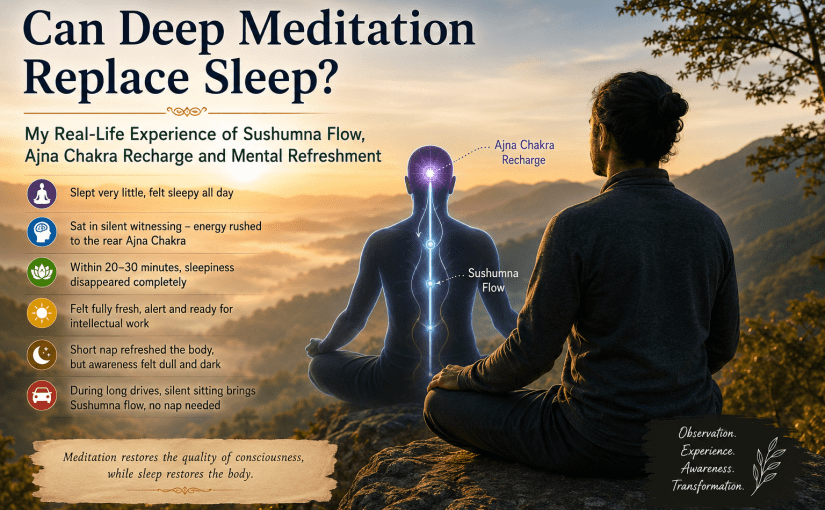
One night I slept very little. The next day I remained sleepy almost throughout the day. Normally such sleep deprivation reduces concentration, mental sharpness and enthusiasm for work. However, whenever I sat quietly for meditation without making any effort, something remarkable happened. As soon as the mind became peaceful and settled into simple witnessing, I repeatedly felt a strong movement of energy towards the rear region of the Ajna Chakra. It did not feel imaginary. It was as if the back portion of the brain was being recharged from within.
Within about thirty minutes the sleepiness disappeared completely. Instead of feeling dull after a sleepless night, I became mentally fresh, alert and ready for intellectual work. It felt almost as though a new day had just begun. This happened more than once during the day and naturally raised a question in my mind. If meditation can refresh the brain so completely, is ordinary sleep always necessary? Can Sushumna flow and Ajna Chakra recharge become an alternative to sleep?
This question deserves careful thinking because the experience itself was genuine. Deep meditation seemed to restore mental clarity in a way that ordinary relaxation never could. During meditation my awareness became clean, bright and steady. There was no heaviness, no mental fog and no struggle to remain awake. The state felt more than ordinary wakefulness. It carried a quality of heightened self-awareness that is difficult to describe in words.
From the yogic point of view, such an experience can be understood as prana gradually withdrawing from scattered mental activity and becoming concentrated in the central channel. Many traditions describe that when prana begins to move through Sushumna, the mind naturally becomes quiet, inner awareness brightens and much less energy is wasted through constant thinking and sensory activity. The practitioner often feels inwardly nourished, refreshed and mentally light. My experience appeared to fit this description remarkably well.
At the same time, modern neuroscience also offers useful insight. Deep meditation activates relaxation mechanisms within the nervous system, reduces unnecessary mental activity and can restore attention after fatigue. This may explain why meditation can remove the feeling of sleepiness and greatly improve mental performance. However, science also reminds us that sleep performs important biological functions such as memory consolidation, tissue repair, hormonal regulation, immune support and the clearance of metabolic waste from the brain. Therefore, meditation and sleep may overlap in some benefits while still serving different purposes.
As I continued observing this phenomenon, another experience taught me an equally valuable lesson. After several cycles of becoming refreshed through meditation, I decided to lie down in Tribhangmurari Asana for further meditation. My intention was not to sleep but simply to continue witnessing in a relaxed posture. However, despite my efforts, I drifted into a short nap. After some time rising stomach acid woke me because of my tendency towards acid reflux.
The result surprised me even more than the earlier meditation. Physically I felt refreshed after the short sleep, but mentally I did not experience the same crystal-clear awareness that meditation had produced. Instead, I felt somewhat dull, dark and heavy. The body seemed rested, but the luminous self-awareness that had accompanied meditation was missing.
This comparison became very meaningful. Meditation had produced extraordinary clarity of consciousness, whereas the interrupted nap restored the body but not the same quality of awareness. It appeared that the two experiences were serving different functions.
One possible explanation is that deep meditation maintained a continuous stream of awareness while energy remained concentrated inwardly. The short sleep interrupted that continuity. On waking suddenly because of acid reflux, I may also have experienced ordinary sleep inertia, the temporary grogginess that often follows abrupt awakening from deeper stages of sleep. This could explain why I felt physically refreshed yet mentally less clear.
From the yogic perspective, another possibility is that meditation had organized the flow of prana in a stable manner, while unconscious sleep temporarily dissolved that organized state. Whatever the exact explanation may be, the contrast between the two states was unmistakable. Meditation refreshed consciousness itself, whereas the nap refreshed the body but not the same level of awareness.
Naturally I felt a little disappointed. I had hoped that meditation would continue providing complete refreshment without any need for sleep. I wanted sleepless meditative renewal to continue indefinitely. Yet the involuntary nap suggested that although the mind had repeatedly become fresh through meditation, the body still carried a physiological need for sleep after the previous night’s deprivation.
This realization itself became another lesson. Perhaps advanced meditation should not be judged by whether it eliminates sleep altogether. Many classical yogic traditions describe great practitioners gradually requiring less sleep, but they also suggest that this happens naturally rather than through deliberate effort. Reduced sleep is presented as a consequence of transformation, not as a goal to be forced. Chasing sleeplessness may therefore become a distraction from the deeper purpose of meditation, which is the refinement of awareness itself.
Another observation from daily life strengthened my understanding further. During long-distance driving, if I begin feeling sleepy, I never continue driving carelessly. Instead, I safely park the car at the roadside and sit quietly. I do not force concentration or repeat anything mentally. I simply remain silent, witnessing the inner play of consciousness.
Almost every time, after about twenty minutes, the same inward movement appears. The feeling of Sushumna becoming active and the rear Ajna region receiving energy gradually develops. The drowsiness disappears without taking a nap. I become mentally fresh once again, almost as if I have just started the day. The difference in alertness is remarkable and consistent enough that I have observed it repeatedly.
Even so, this experience should be understood carefully. Feeling mentally refreshed does not necessarily mean that all the biological consequences of insufficient sleep have disappeared. Meditation may restore subjective alertness very effectively while the body may still require proper sleep later. Therefore, the safest practice is exactly what I follow during driving: stop immediately when drowsiness appears, rest or meditate only after parking safely, and continue driving only when genuine alertness has returned. Meditation should never become an excuse to ignore serious sleep deprivation.
Looking back over these experiences, one distinction has become increasingly clear to me. Meditation and sleep are not identical. Meditation appears to restore the quality of consciousness, bringing exceptional clarity, stable awareness and renewed mental energy. Sleep, on the other hand, appears to restore many deeper physiological functions that meditation may not completely replace. The fact that my body eventually entered sleep despite repeated meditative refreshment suggests that both forms of restoration have their own place.
Perhaps the more important discovery is not whether meditation can eliminate sleep, but why meditation can produce a quality of awareness that even sleep does not always provide. The clean, luminous and deeply present state experienced after silent witnessing feels fundamentally different from ordinary wakefulness and also different from the refreshed feeling after a short nap. It is this difference that deserves continued observation.
For now, I do not see these experiences as final conclusions. They are simply careful observations from personal practice. They encourage humility rather than certainty. They also remind me that genuine meditation is not merely relaxation. When the mind becomes still and awareness settles naturally within itself, something profound seems to happen. Whether one describes it as Sushumna flow, Ajna Chakra activation, refined nervous system function or a combination of all these possibilities, the result is a state of extraordinary mental freshness that is difficult to compare with ordinary rest.
My journey continues with the same attitude that produced these observations in the first place: to witness carefully, avoid exaggerated conclusions, respect both ancient yogic wisdom and modern scientific understanding, and allow direct experience to remain the primary teacher. If meditation eventually reduces the need for sleep naturally, that will simply be another observation. But the greatest gift already received is not reduced sleep. It is the discovery that a silent mind can awaken a level of clarity, freshness and self-awareness that transforms the quality of consciousness itself.


