Why Does Dhyana Become Effortless After Years of Yoga?
For nearly ten years, I have practised yogasanas, pranayama and meditation almost daily. Like many beginners, I initially struggled to enter dhyana. Simply sitting quietly did not naturally produce meditation. Sometimes there were thoughts, sometimes restlessness and sometimes only sleep. Over the years, however, I began noticing a remarkably consistent pattern that gradually changed my understanding of meditation.
I repeatedly observed that effortless dhyana was usually preceded by a gentle, pleasant feeling of fullness in the head. It was not an ordinary headache or painful pressure. Rather, it felt stable, comfortable and blissful. Whenever this fullness reached a certain level, merely sitting with light awareness of the breath became sufficient for meditation to arise almost automatically. It felt less like I was practising meditation and more like meditation itself was beginning.
I do not present this as scientific proof but as a long-term yogic observation based on repeated personal experience.
Yoga Appears to Prepare the Ground for Meditation
Recently, after several days of travel, I could not perform my usual yoga because of lack of time. My body became slightly less flexible, the internal flow experienced during practice seemed somewhat obstructed and meditation no longer settled naturally. When I resumed yogasanas and pranayama, even though I performed them quickly before leaving for office, the pleasant fullness returned and dhyana began almost unwillingly near the end of practice. I had to deliberately stop after about twenty to thirty minutes only because I was getting late for office. Otherwise it appeared capable of continuing much longer.
This experience strengthened an observation I had already made many times. Yoga itself does not seem to create meditation directly. Rather, it appears to prepare the internal conditions in which meditation naturally arises.
The Role of Head Fullness
Initially I called this experience head pressure, but later I realised that “fullness” described it more accurately because the feeling was pleasant rather than painful. Gradually another possibility occurred to me. Perhaps what I experience as head fullness is actually concentrated prana. From the traditional yogic perspective this interpretation seems reasonable. Science cannot presently measure prana directly, but yoga has always emphasised disciplined experience as an important means of understanding consciousness.
One important observation is that meditation does not require maximum fullness. There appears to be a threshold. Below that threshold, meditation struggles to settle. Once it is reached, dhyana begins effortlessly. Beyond that, increasing the sensation further does not appear necessary.
Mental Work Produces It More Than Physical Work
Another surprising observation concerns daily work. Physical work rarely produces this state, whereas prolonged intellectual work often does. Thinking, planning and sustained mental effort increase the feeling of fullness in the head far more than physical labour. Although physical work also produces it however it should be with baseline nonduality so that head fullness can develop.
However, this happens only if morning yoga has already prepared the body. In that case, intellectual work often pushes the system beyond the threshold where meditation naturally begins. Merely sitting quietly with gentle attention to the breath produces brief thoughtlessness, witnessing and calm.
Without morning yoga, the same intellectual work usually produces only tiredness or sleep rather than meditation. This suggests that mental work alone is insufficient. Yoga appears to create the necessary preparation.
Worldly Stress and the Natural Tendency Towards Meditation
I also observed that demanding worldly work sometimes creates a similar tendency. After yoga, sustained mental activity often reaches a point where I no longer feel capable of continuing intense intellectual work. Instead, there is a natural inward movement. The mind wants to become silent. Meditation seems to relieve this accumulated burden. Unfortunately, many times office work and social responsibilities rarely provide enough quiet time, so the resulting meditation remains shallow and short-lived. Only brief witnessing and reduction of thoughts occur before duties interrupt the process.
A New Working Hypothesis
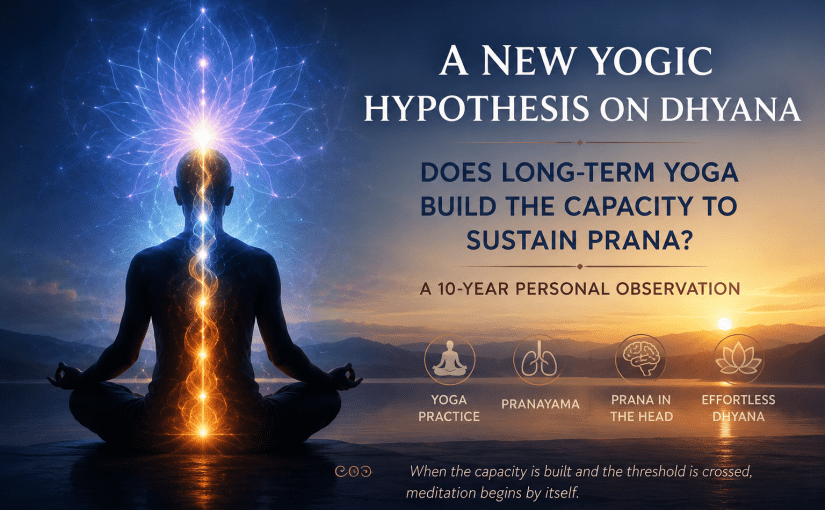
These observations gradually led me to a new hypothesis. Perhaps one of the deeper purposes of long-term yoga is to gradually develop the body’s ability to comfortably sustain increasingly refined pranic activity in the head. Early in practice, even a comparatively small amount of this activity may feel intense. Years of yogasanas and pranayama appear to increase the comfortable capacity to sustain it. Once this capacity and the level of pranic concentration reach a certain threshold, dhyana begins almost spontaneously.
This may also explain why beginners struggle with meditation. The difficulty may not lie only in controlling thoughts. The necessary internal preparation may simply require years of regular practice.
Patanjali, the Bhagavad Gita and Long-Term Practice
This understanding also gives new meaning to the repeated emphasis on abhyasa in the classical yoga tradition. Patanjali teaches that the fluctuations of the mind are restrained through persistent practice and dispassion. Likewise, in the Bhagavad Gita, Krishna acknowledges that the mind is difficult to control but teaches that it becomes manageable through practice and detachment. Various yogic traditions also associate steadiness of mind with regulation of prana.
My proposal is not that these scriptures explicitly describe “prana accumulation in the head.” Rather, my own experiences seem to resonate with their emphasis on long-term disciplined practice as the foundation of meditation.
An Invitation for Further Observation
Everything described here arises from approximately ten years of regular yoga practice. It is neither a scientific claim nor an attempt to establish a universal law. It is a working yogic hypothesis based upon repeated experience.
The central question is simple: Could long-term yoga gradually increase the comfortable capacity to sustain what practitioners experience as concentrated prana in the head, allowing effortless dhyana to arise naturally once a certain threshold is reached?
I cannot answer this question for everyone. I can only say that this pattern has repeated itself consistently throughout my own journey. If other sincere practitioners begin carefully observing what actually happens before effortless meditation arises, they may confirm, modify or reject this hypothesis through their own direct experience. Yoga has always advanced through sincere practice, careful observation and inner verification. Perhaps this question deserves deeper attention from practitioners, philosophers, neuroscientists and consciousness researchers alike.

