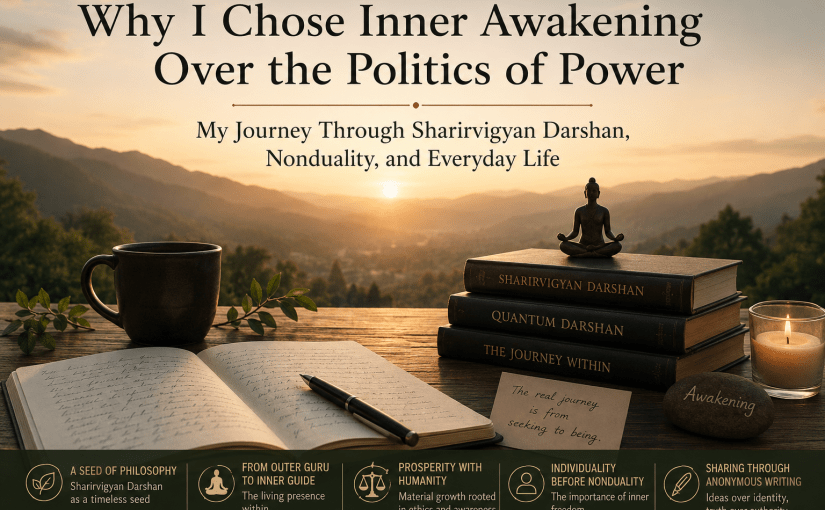
Why I Always Remained Away from the Politics of the Crown
Throughout my life, many people have wondered why I always remained away from the politics of the crown. The answer was never that I disliked leadership, authority, prosperity, or responsibility. Neither did I consider worldly success to be inferior to spirituality. My journey simply moved in a different direction.
From the beginning, my interest was less in acquiring power and more in understanding life itself. As years passed, my attention gradually shifted toward the study of consciousness, meditation, and the direct experience of existence. Politics generally demands continuous attention toward public expectations, influence, organization, strategy, competition, and visible achievements. My own mind was increasingly drawn toward contemplation. Both directions require enormous energy, and gradually I realized that my energy was naturally flowing elsewhere.
The Birth of Sharirvigyan Darshan
Nearly three decades ago, an intuitive understanding emerged within me which I later called Sharirvigyan Darshan. It was not a carefully designed philosophical system. I did not sit down with the intention of creating a new philosophy. Rather, it appeared almost like a seed. Looking back today, I feel that the philosophy arose intuitively before I fully understood its future implications.
I intentionally kept it flexible. It was never meant to become another rigid doctrine or sect. It was meant to remain a seed that different individuals could mould according to their own temperament, profession, culture, and circumstances. The philosophy was even published in a university magazine and remained openly available.
Today, after almost thirty years, I find that perhaps I myself have benefited from it the most. Initially this puzzled me. Why had I rarely heard others describe how deeply it had transformed them?
Gradually I understood something important. A philosophy can provide direction, principles, and even practical methods. It cannot live a person’s life on their behalf.
Philosophy Gives Direction, Practice Gives Transformation
Every scripture can offer theory. Some scriptures even provide remarkably practical methods. Yet every individual must eventually walk the path personally.
No philosophy can meditate for us.
No scripture can observe our thoughts for us.
No Guru can permanently replace our own direct experience.
A map shows the destination but never walks the journey.
Perhaps Sharirvigyan Darshan fulfilled exactly this role. It remained a seed. A seed never forces itself to become a tree. The receiver must nourish it through practice, reflection, observation, failures, corrections, and continuous living.
This may explain why millions read great scriptures while relatively few undergo profound transformation. Reading is only the beginning. Living is the real experiment.
Did My Inner Consciousness Become My Guru?
Sometimes I wonder whether I was really the author of Sharirvigyan Darshan. It appeared naturally rather than intellectually.
As years passed, I found myself repeatedly returning to its principles. I walked upon the very path that had emerged through me. This raises an interesting possibility in my own mind.
Perhaps my deeper consciousness first expressed itself through this philosophy and later continued guiding me through it.
During meditation, the living Guru gradually transformed into an inner meditation image. That image was never merely a memory. It functioned like a silent reference point. Whenever confusion appeared, contemplation of that inner presence often brought clarity without deliberate reasoning.
Whether one interprets this as the inner Guru, awakened intuition, deeper consciousness, divine grace, or simply psychological integration is a matter of philosophical language. My experience remains the same. The outer Guru gradually became an inner guide.
Could Everyone Have Benefited?
Sometimes I have wondered what might have happened if many people had sincerely lived according to this philosophy.
The philosophy itself was universal. It was never limited to any religion, caste, nationality, profession, or social group. Its greatest strength was flexibility. The external expression could vary completely from person to person. Only the basic orientation of the mind needed to change.
I cannot claim that everyone would certainly have attained awakening. Every individual grows differently. Yet I genuinely feel that sincere practice could have brought profound spiritual upliftment to many people.
The philosophy never asked anyone to imitate another person. It simply invited a different way of seeing life.
The Difficulty of Modern Spiritual Life
Modern people often expect immediate results.
Even in spirituality, many unconsciously expect the Guru to walk on their behalf. They admire the teacher, attend discourses, collect books, worship photographs, or repeat beautiful words. Yet the real transformation begins only when the seeker personally begins walking.
No Guru can meditate for another person.
No Guru can dissolve another person’s attachments.
The Guru can inspire, guide, encourage, and sometimes accelerate the journey, but the walking always remains personal.
Perhaps that is why I never wanted followers. I wanted fellow travellers.
Prosperity Was Never My Enemy
One misunderstanding that often arises regarding spirituality is that awakening demands rejection of material prosperity.
This was never my understanding.
I never opposed physical prosperity.
I never considered wealth sinful.
I never believed comfort was an obstacle in itself.
Rather, I felt that prosperity should remain rooted in humanity, ethical responsibility, Sharirvigyan Darshan, and the broader insights that later matured into what I call Quantum Darshan.
Material development without humanity eventually creates imbalance. Spirituality without practical responsibility becomes equally incomplete.
The ideal is integration.
Why I Did Not Become Very Prosperous
At the same time, I also recognize another reality in my own life.
As my understanding gradually became more nondual and detached, much of my available energy naturally flowed toward contemplation, meditation, writing, understanding consciousness, fulfilling my professional duties sincerely, and living with greater awareness.
Because of this, I simply did not pursue material opportunities with the same intensity as many enthusiastic material achievers, including many of my own colleagues.
This does not mean I sacrificed prosperity in order to become awakened.
The sequence was almost the opposite.
As nondual understanding matured, attachment to continuously acquiring more naturally weakened. I received enough for a comfortable and dignified life. Beyond that, my deepest satisfaction increasingly came from inner clarity rather than external accumulation.
Looking back, I do not regret the opportunities I missed.
I feel grateful that life provided enough while simultaneously allowing me to pursue what gradually became the highest aim of my life—awakening, self-realization, and living an increasingly nondual lifestyle.
Leadership and Public Expectations
I never contested elections.
Not because I hated the crown.
Not because leadership itself was wrong.
Rather, I sensed that public leadership often carries expectations that did not match my inner direction.
Many people naturally expect leaders to continuously increase visible prosperity, development, and material opportunities. These expectations are understandable because societies need practical progress.
My own vision, however, gradually became broader. I wanted prosperity along with humanity, ethical responsibility, and spiritual insight.
I felt that this vision might not easily fit the expectations commonly placed upon political leadership.
Perhaps there would have been misunderstanding.
Perhaps disappointment.
Perhaps criticism.
My inner calling was quietly moving elsewhere.
The Crowd and Individuality
Another realization gradually emerged.
Coming to the top of a crowd often creates pressure to become what the crowd expects.
Whether in politics, public life, or spirituality, the leader can slowly become shaped by public expectations.
For me, individuality was extremely important.
Not egoistic individuality, but the freedom to observe independently.
I feel that authentic individuality is often the beginning of genuine spiritual inquiry. Before one transcends individuality through nondual realization, one first discovers an authentic individuality capable of independent observation and discrimination.
If that individuality constantly dissolves into public expectations, the inner journey itself may become difficult.
This is why I gradually preferred remaining inwardly free rather than becoming publicly influential.
Sharing Without Preaching
Another insight slowly became clear.
Today’s world is not very receptive to being instructed.
People usually resist being told how to live.
Perhaps the better way is simply to share one’s own experiences, reflections, observations, failures, and discoveries without demanding agreement.
Experience invites exploration.
Preaching often invites resistance.
If someone finds value, they may explore further.
If not, nothing has been imposed.
This approach also protects spiritual freedom.
Why Writing Is Better Than Speaking
Over time I also began feeling that writing is often superior to speaking for sharing spiritual reflections.
A spoken discourse carries the personality, appearance, voice, reputation, and emotional influence of the speaker.
Writing allows ideas to stand independently.
Readers may agree.
Disagree.
Pause.
Return years later.
Or quietly move on.
The text remains patient.
Even better, anonymous writing removes another layer.
People stop asking, “Who wrote this?”
Instead they begin asking, “Is there truth in this?”
That shift is valuable.
Truth should not depend upon the social status, profession, fame, or appearance of the author.
Profession and Spiritual Identity
Anonymous writing is especially meaningful for people whose professions do not outwardly appear spiritual.
A veterinarian, engineer, scientist, administrator, businessman, or government officer may possess genuine contemplative experience.
Yet public identity often creates prejudice.
People may ridicule them by saying they are acting spiritual or merely performing a drama.
The ideas become judged through the profession instead of through their own merit.
Anonymous writing quietly removes this obstacle.
It allows the reflections to breathe freely.
My Way of Sharing Spiritual Knowledge
Looking back today, I feel that my purpose was never to create followers.
Nor was it to establish another sect.
Nor to become famous.
Nor to gather crowds.
If Sharirvigyan Darshan carries any value, it lies in quietly offering a seed.
Every individual remains completely free.
Each person may test it.
Modify it.
Reject it.
Expand it.
Or discover something entirely different.
The real authority is never the writer.
The real authority is direct experience.
Perhaps this is the simplest way to share spirituality in today’s world.
Not through preaching.
Not through argument.
Not through authority.
Not through personality.
But through honest experiences, sincere reflections, and a life quietly lived.
If those reflections help even a few sincere seekers begin their own journey toward awakening, humanity, self-realization, and a nondual way of living, then the seed has already fulfilled its purpose.
Discover more from Demystifying Kundalini
Subscribe to get the latest posts sent to your email.


