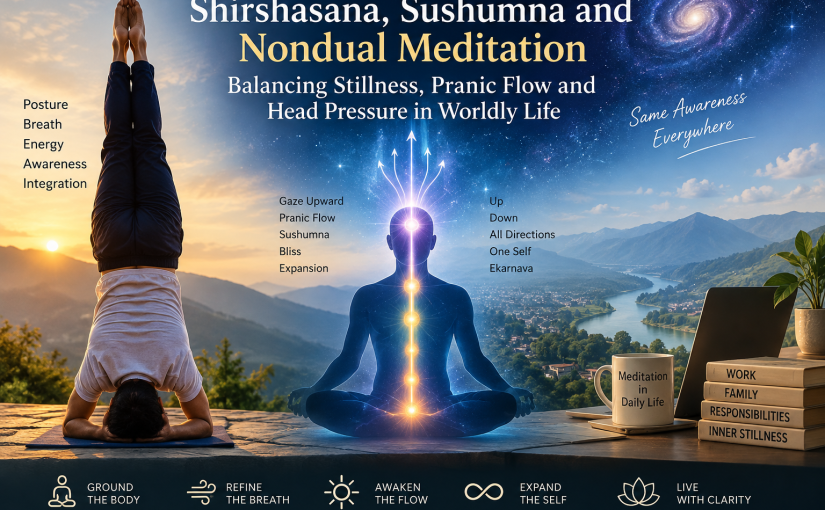
Shirshasana has traditionally been regarded as a major or “top” asana because it reverses the body’s normal orientation and strongly changes bodily awareness. My experience has made me wonder whether familiarity with head-centered sensations may help during meditation, where awareness can sometimes become concentrated around the head. This should not be understood as a claim that increased intracranial pressure is desirable or necessary; the “pressure” I mean is an experiential sensation of fullness, heaviness or activity.
In shoulder stand and Halasana, I have noticed that small changes in position can markedly alter head discomfort. Slightly lifting the head or allowing the feet to touch a wall can change weight distribution and reduce the sensation. This shows me that posture, alignment, support and muscular effort strongly influence subjective experience. Discomfort, however, should not automatically be interpreted as spiritual progress; persistent, severe or unusual head pain deserves attention rather than spiritualization.
This becomes particularly relevant to my practice of nondual meditation, including what I call shavid or quantum darshan, especially during busy worldly days. Intense awareness can sometimes be accompanied by strong head sensations. Daily kundalini yoga postures and breathing exercises seem to complement this by conditioning the body and attention to controlled changes in posture, breathing, muscular effort and internal sensation. I find that this can make intense experiences less disturbing and increase my ability to remain present rather than react to every sensation.
I therefore see kundalini practice less as a search for dramatic energetic experiences and more as preparation, grounding and conditioning. Repeated exposure to controlled intensity may make unusual bodily and mental experiences feel less foreign, although this does not prove that every sensation is caused by kundalini energy.
Yoga and nondual meditation can consequently complement each other without requiring withdrawal from ordinary life. Yoga works through body and breath; meditation works directly with awareness. Work, responsibilities, conversation and stimulation become part of the practice when awareness is maintained amid them.
Most importantly, head pressure should never become the goal. Stronger pressure does not necessarily mean deeper meditation, stronger kundalini or spiritual advancement. The meaningful measure is greater clarity, steadiness and non-reactivity. If a posture causes discomfort, changing or stopping it is more sensible than forcing it. Persistent physical symptoms should not automatically be interpreted as awakening.
For me, Shirshasana and related practices are valuable not because they create a desired amount of pressure, but because they may help the body and attention become familiar with changing sensations. Daily yoga provides a grounding counterpart to nondual meditation: the busy world supplies stimulation, meditation reveals how awareness responds, and yoga disciplines the body, breath and attention. The deeper aim is therefore not greater intensity, but the ability to meet whatever arises—with steadiness, clarity and less reactivity. However, when there is enough stillness, nondual meditation in the midst of worldly activity becomes difficult. It feels almost like water cannot be both completely still and flowing at the same time: in one place there is stasis, while in another there is movement. How, then, can the two truly coexist?
Regarding head pressure, I also experience that a certain initial upward movement or “pumping” toward the head is needed to begin breathless meditation and initiate the flow through Sushumna. With the gaze turned upward and attention resting on the infinite, all-pervading sky as the Self, or Ekarnava, a rise in head pressure may arise together with bliss. This is not experienced as discomfort but as a positive sign of the meditation deepening.
However, if the pressure becomes uncomfortable, awareness can be lowered and expanded beyond the head. The sense of Self need not be extended only upward toward the infinite; it can also be expanded downward and sideways, in all directions. This reduces the head pressure while allowing the Sushumna flow to continue. Once established, the flow can sustain itself for roughly an hour, until, in my experience, the available prana becomes exhausted.


