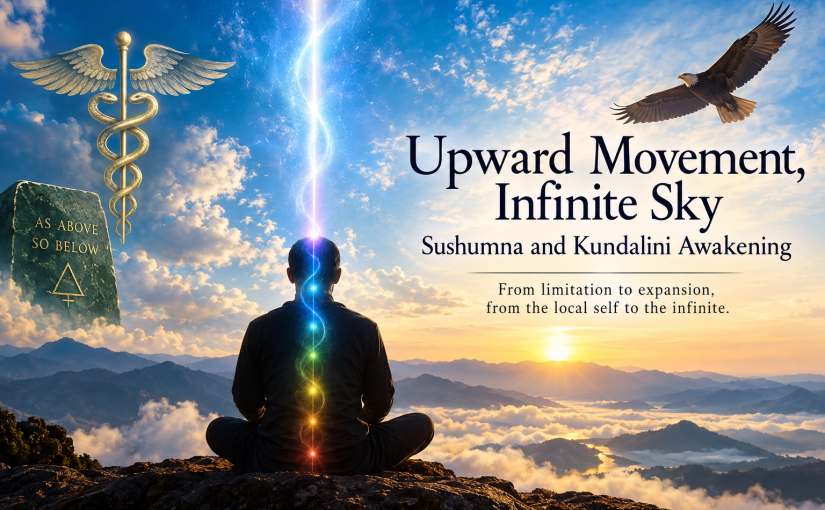
This is an experiential inquiry into a striking observation from my own practice: the same signs that arise through yoga, pranayama and shirshasana—head pressure, an upward movement, freer sushumna flow, subtler breathing and deeper dhyana—can also arise through contemplation alone, by experiencing the Self as Ekarnava, the infinite sky-ocean. What makes this observation particularly interesting is that one route works through the body and breath, while the other works through consciousness and identification. The possibility that both may lead to the same underlying movement of energy is the central discovery explored in this post.
Upward Movement and Spiritual Awakening
Flying, rising, ascending, or moving upward is commonly associated with awakening, Samadhi, Self-realisation, enlightenment, and transcendence. Across spiritual traditions, upward movement often represents a movement beyond ordinary, earth-bound consciousness toward something higher, freer, wider, or divine. This does not mean that every experience of flying or rising proves enlightenment or Samadhi, but the symbolism is remarkably consistent. The direction itself seems to carry a deep spiritual meaning: from limitation toward expansion, from contraction toward freedom, and from ordinary identification toward transcendence.
The same pattern can be noticed in very different traditions. In the caduceus, the ascending serpents culminate in wings, which naturally invites an esoteric interpretation of rising consciousness, although historically the caduceus is associated with Hermes and cannot simply be declared to be a Kundalini symbol. The Emerald Tablet also speaks of ascending from earth to heaven and descending again, with the transforming movement associated with the wind. From a yogic perspective, this can be compared symbolically with prana, although that identification is a comparative interpretation rather than the original historical meaning of the text. Yogic traditions themselves contain much more direct imagery of Kundalini rising, prana moving upward, passage through the chakras and sushumna, and yogis flying or becoming capable of moving through the sky. These different images need not have a single historical origin to reveal a common symbolic pattern of vertical ascent and transcendence.
Why the Divine Is Called the One Above
This also makes expressions such as “Upar Wala,” the One Above, understandable as spiritual symbolism. If upwardness is repeatedly associated with heaven, higher consciousness, transcendence, awakening, and liberation, then “the One Above” can be seen as a simple expression of that ancient metaphor. “Above” need not mean a literal physical location. It can mean beyond ordinary consciousness, beyond ego, beyond limitation, or transcendent to the usual sense of self. At the same time, many mystical traditions ultimately say that the Divine is not merely above but also within. Thus the movement toward what seems higher may finally become a recognition of something that was never truly separate from the deepest Self.
My Experience of the Infinite Sky
My own experience has made this symbolism much more meaningful. I have noticed that when I contemplate the Self as infinite sky often with gaze at Agya chakra, instead of imagining myself as a small individual confined to a particular body and local identity, something changes in meditation. The mind seems less bound to this local identification. There is a feeling of becoming open, vast, and unbounded, as though the sense of self is no longer limited to one point in space. After this contemplation, the sushumna seems to flow more freely upward, accompanied by greater bliss, deeper dhyana, and a more effortless and subtle breath, sometimes approaching a naturally breathless condition. I also experience genuine pressure in the head, but it is not uncomfortable.
What interests me is that the upward movement does not feel like something I am forcing. It seems to become easier when the contraction of local identification is reduced. This suggests to me that the real obstruction may not simply be an energetic obstruction but the mind’s identification with a limited body-mind structure. When the mind is tightly identified with the local self, the flow through the sushumna seems less free. When identification becomes more spacious and unobstructed, the chakras also seem to become less obstructed and the energy flow becomes more natural.
Mind, Chakras, Prana and Sushumna
Within the yogic and tantric model, mind, attention, prana, chakras, and sushumna are closely connected rather than completely separate. My experience leads me to consider whether the state of the mind directly influences how the subtle system is experienced. Local identification seems to contract attention; that contraction may be experienced as restriction in subtle flow; when identification relaxes into an unbounded sense of being, the flow through the central channel seems to become clearer. In this sense, the mind may be directly connected with the chakras, not necessarily because the physical brain is mechanically opening or closing them, but because consciousness, attention, pranic movement, and subtle experience appear to interact within the yogic framework.
This is an interpretation of experience rather than a claim that a physically measurable tube inside the body is literally blocked. “Obstruction” may refer to psychological identification, habitual tendencies, energetic contraction, or a combination of these. What matters to me is the repeatable experiential relationship: greater inner openness seems to coincide with freer upward flow, greater bliss, subtler breathing, and deeper meditation.
Flying, Samadhi and Self-realisation
This also gives a more careful meaning to experiences of flying or upward movement in relation to Savikalpa Samadhi, Nirvikalpa Samadhi, Self-realisation, and enlightenment. Experiences of ascent, expansion, lightness, bliss, inner movement, or flying may accompany deep states of meditation and may be interpreted within a yogic framework as signs of transcendence. But the experience itself does not prove enlightenment, Self-realisation, or even Samadhi. In Savikalpa Samadhi, some subtle distinction between experiencer and experience may remain. In Nirvikalpa Samadhi, ordinary subject-object distinctions are described as falling away, making the language of “I am flying upward” less applicable.
Therefore, there is an important distinction between the experience and its interpretation. “I am flying upward” is an experience within consciousness. The deeper possibility is that even the separate experiencer becomes less distinct. That is much closer to the language traditionally associated with nondual realisation. The upward movement can therefore be understood as a recurring symbol or phenomenological motif of transcendence without making the simplistic equation that flying itself means enlightenment.
From Ascent to Boundlessness
The most interesting part of my experience is that the process does not finally feel like a small self travelling upward into a distant heaven. When I imagine the Self as infinite sky, the local sense of being confined to the body becomes weaker, and the upward movement seems to happen within that very boundlessness. In this way, the old images of wings, rising serpents, flying yogis, Kundalini ascending through the sushumna, heaven above, and the One Above can be understood as different expressions of a broad spiritual language of moving beyond limitation.
My experience does not establish that all these symbols historically mean the same thing, nor that every upward sensation represents enlightenment. But it does suggest a meaningful relationship between expansion of consciousness and the experience of upward flow. When local identification relaxes, the sushumna seems less obstructed, the chakras feel more open, bliss increases, breathing becomes naturally subtler, and dhyana deepens. For me, the important discovery is therefore not simply that “upward” is spiritual, but that when the mind becomes less locally identified and more like infinite sky, the whole inner movement seems to become freer.
A final practical distinction is important: naturally subtle or temporarily imperceptible breathing should not be deliberately forced or held. Likewise, painless head pressure should not automatically be taken as spiritual progress; if it becomes intense, persistent, or accompanied by significant physical or neurological symptoms, it should be treated as a bodily symptom rather than automatically given a spiritual explanation.
The Same Effect from Two Directions: Yoga and the Infinite Sky
A Puzzle About Sushumna, Head Pressure and Deep Dhyana
I think I have finally solved a puzzle that I had been observing in my practice for a long time. Practices such as yoga, pranayama, and even shirshasana can produce a certain pressure in the head, together with a sense of upward movement, freer sushumna flow, subtler breathing, and deeper, sometimes almost breathless, dhyana. What has become especially interesting to me is that a similar effect can arise without these physical practices. When I contemplate Ekarnava, the infinite sky-ocean, and experience the Self as vast and unbounded rather than locally confined to the body, a similar type of head pressure can arise, along with a feeling of upward movement, greater freedom in the sushumna, and deeper dhyana.
This makes me think that whether one holds the ear from one side or the other, the effect may ultimately be the same. In other words, the physical route and the contemplative route may be different means of producing a similar internal result. Yogic body manipulations, pranayama, and inverted postures may influence the system from the bodily side, while deep contemplation may influence it directly through consciousness and attention.
Rajyoga and the Direct Route
This also gives me a possible explanation for why Rajyogis can say that elaborate yogasanas and pranayama are not absolutely necessary for entering deep dhyana. If the essential process is not the physical manipulation itself but the gathering and upward movement of subtle energy, then it may be possible to reach the same state through contemplation alone. The Rajyogi may not need to manipulate the body extensively if the mind can itself become sufficiently concentrated, expanded, and detached from local identification to allow the upward movement through the sushumna.
This direct route may, however, be more difficult. The body can provide a kind of support or preparation, whereas contemplation requires the mind itself to become capable of producing the necessary inward concentration and expansion. Therefore, it seems to me that the two approaches need not be opposed. The physical practices can prepare and organize the system, while contemplation can take the process further without depending entirely on physical manipulation.
Energy Rather Than Pressure Is the Main Thing
This also changes how I understand the head pressure itself. The pressure may not be the actual goal or the essential phenomenon. It may simply be a symptom or indication accompanying the gathering or upward movement of energy. Yogic practices may bring this experience about through physical and respiratory means, while contemplation of the infinite sky-ocean may produce it through a direct change in consciousness and identification.
Therefore, I would not say that head pressure itself is the evidence of progress. The important thing is the underlying process that the pressure may accompany. If there is pressure without the corresponding sense of vitality, clarity, inwardness, or energetic movement, it may simply be a physical ailment and should not automatically be interpreted as spiritual activity. The pressure is secondary; what I call energy is primary in the yogic interpretation.
Energy Everywhere
From this perspective, the idea that energy is present everywhere also becomes important. If the same underlying life-energy can support the functioning of the digestive organs in the gut, it is reasonable within the yogic model to consider that it can also support the functioning of the brain and the processes involved in contemplation. Each organ has its own natural work, and the same underlying energy is involved in sustaining those functions. The difference is in the particular work being performed, not necessarily in the existence of completely separate energies.
This gives a broader meaning to the experience. The energy that supports digestion does not have to be considered fundamentally different from the energy involved in breathing, movement, concentration, or contemplation. It may be understood as one life-energy expressing itself through different organs and functions according to their natural or destined work.
Two Routes, One Inner Movement
My present understanding, therefore, is that yoga, pranayama, shirshasana, and other bodily practices can help gather or redirect the system toward the head and central axis, sometimes producing head pressure and supporting deeper dhyana. But contemplation of Ekarnava, the infinite sky-ocean, can apparently produce a similar movement without the same physical manipulation. By expanding the sense of Self beyond local identification, contemplation itself seems capable of drawing the attention and subtle energy upward, with the same accompanying pressure and deepening of meditation.
This may explain why different yogic paths can arrive at similar states through very different methods. One begins more from the body and breath and moves toward consciousness; another begins directly with consciousness and allows the body and energy to follow. The first may make the process easier for some practitioners, while the second may be more direct but more difficult. For me, the most natural conclusion is not to choose one and reject the other, but to combine them: use yogic practices to prepare and balance the system, and use contemplation to directly expand consciousness and deepen dhyana.
The real discovery for me is that the same inner phenomenon can apparently be approached from two directions. The body can influence the movement of energy toward the head, and consciousness can influence the same movement through contemplation. The head pressure may appear in both cases, but the pressure itself is only a symptom. What matters is the deeper movement of energy, the freeing of the sushumna, the loosening of local identification, and the resulting deepening of dhyana.
Within the yogic framework, this makes the distinction between Hathyoga physical practice and Rajyoga less absolute than it first appears. They may simply be different ways of working with the same underlying relationship between body, breath, mind, prana, energy, and consciousness.


