The Hidden Link Between Mindfulness, Sexual Energy, Nonduality, and Spiritual Awakening: My Personal Self-Realization Experience

Mindfulness as an Alternative to Meditation Images

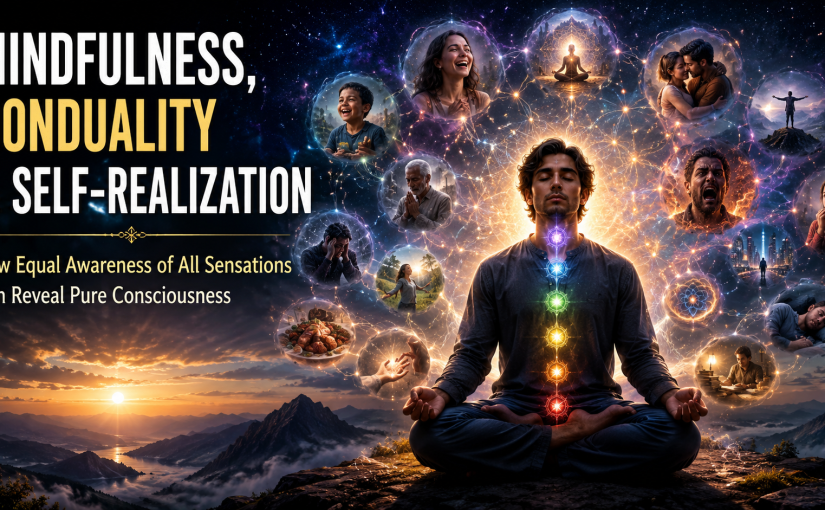
Over the years I have reflected deeply on the difference between mindfulness-based awakening and awakening through a meditation image. My own experiences suggest that mindfulness can serve as a direct path to self-realization, especially for people who do not feel comfortable with symbolic meditation, deity forms, visualization practices, or any mental image that appears strange or culturally unfamiliar.

A method that gradually became clear to me begins with a brief contemplation of Sharirvigyan Darshan or what I sometimes call Quantum Darshan. The contemplation itself need not be long. It only has to shift the mind away from ordinary worldly identification and toward a deeper understanding of reality. After a short period of contemplation, a subtle accumulation of energy may begin. Ordinarily, this accumulated energy gets attached to thoughts, desires, memories, fantasies, worries, ambitions, or even spiritual goals. In many meditation traditions, it may also become linked to a meditation image, mantra, deity, chakra symbol, or another chosen object.

My experience suggests another possibility. Instead of allowing the energy to become attached to a meditation image, one may simply remain mindful of whatever is occurring in the present moment. Attention stays open and receptive. The energy that would otherwise become concentrated around a mental object instead strengthens mindfulness itself. In this way, awareness becomes increasingly stable without dependence upon any symbolic focus.

Mindfulness tries to recreate awakening glimpse

What I experienced during my awakening glimpses was that all mental and external forms appeared equal to one another. There was perfect nonduality. It felt like the highest level of mindfulness. This suggests that just as an awakening glimpse creates mindfulness, cultivating mindfulness can also lead to awakening. When, through constant mindfulness practice, nonduality reaches a certain threshold, it reveals its unified underlying existence in the form of an awakening glimpse.

How My First Awakening Was Different

Looking back, my first awakening appears very different from my later experiences. At that time there was no deliberate spiritual ambition. I was not seeking enlightenment, awakening, samadhi, liberation, or any special spiritual achievement. There was no conscious attempt to attain a higher state. What happened seemed to emerge naturally from the way my attention functioned.

At that stage of life, egolessness did not arise directly through Sharirvigyan Darshan or Quantum Darshan. Instead, it appears to have developed through deep engagement with science, combined with the influence of spiritual company and spiritually inclined thinking. Scientific inquiry gradually weakened rigid assumptions about reality. Spiritual association softened the boundaries of personal identity. Together they created conditions in which a glimpse of something deeper became possible.

Most importantly, I did not intentionally cultivate devotion toward a single meditation image. I did not select one inner form and treat it as a beloved object that deserved exclusive attention. Rather, my attention remained distributed across the entire field of experience.

The Power of Equal Attention to All Sensations

One insight that seems central to my experience is that mindfulness has the ability to accommodate all sensations and feelings simultaneously. Thoughts, emotions, bodily sensations, attractions, fears, pleasures, discomforts, desires, and perceptions can all be held within awareness together.

This creates an important shift. Normally the mind spends enormous energy judging experiences. It labels some experiences good and others bad. It pursues some and avoids others. It compares, analyzes, evaluates, condemns, and desires. Such activity consumes attention and fragments awareness.

When mindfulness becomes sufficiently strong, there is little time or energy left for judgment. The available energy is devoted to accommodating the entire field of experience. Awareness remains with all sensations equally. Instead of separating experiences into categories, mindfulness simply observes them.

As this process deepens, the apparent differences between experiences begin to lose their dominance. Pleasure and pain remain different in content, but they appear increasingly similar in nature. Attraction and aversion remain different in expression, but they are both recognized as sensations arising within awareness. Thoughts and emotions remain distinct phenomena, yet both reveal themselves as temporary appearances.

When all experiences are viewed without judgment, a remarkable possibility emerges. One begins to sense that the background underlying all experiences may be the same. If every sensation appears within awareness and every feeling is known by awareness, then perhaps awareness itself is the common foundation.

From Non-Judgment to Nonduality

This recognition naturally points toward nonduality. Nonduality does not initially appear as a philosophical doctrine. Instead, it emerges as a direct observation.

When awareness remains open to everything equally, the divisions created by preference gradually weaken. Experiences continue to arise, yet the observer becomes less occupied with deciding which experiences deserve attention and which do not. Because all experiences are welcomed into the same field of mindfulness, they begin to reveal a shared nature.

The realization may arise that all sensations are simply different expressions of one underlying reality. Different forms continue to exist, but they are recognized as movements occurring within the same background. This insight does not require intellectual analysis. It emerges naturally through observation.

At an appropriate moment, the common background itself may become evident. Many traditions describe this background as pure awareness, witnessing consciousness, Buddha nature, Atman, or simply consciousness itself. Regardless of terminology, the experience involves recognition of that which remains present while all sensations come and go.

Sexual Energy, Mindfulness, and Awakening

Another aspect of my experience concerns the role of sexual attraction. Many spiritual systems regard sexual energy either as a distraction or as something that must be redirected toward a chosen spiritual object. My experience was somewhat different.

The energy generated by attraction did not become dispersed through endless fantasy or emotional indulgence. At the same time, it was not deliberately redirected into a meditation image. Instead, that energy appeared to strengthen mindfulness itself.

Because attention remained broad and inclusive, the energy associated with attraction became available to awareness rather than to mental fixation. It contributed to the intensity and stability of observation. Rather than feeding imagination, it nourished presence.

This may have been one of the important factors behind my first awakening glimpse. The available energy was not fragmented among numerous mental activities. Nor was it concentrated exclusively upon a symbolic object. It remained within awareness itself.

The Dream-State Awakening Glimpse

Ultimately, this process culminated in what I can best describe as a dream-state awakening glimpse during adolescence. It was not the result of a carefully designed spiritual program. It was not the product of systematic concentration upon a chosen image. It emerged through a combination of scientific inquiry, spiritual influence, accumulated energy, inclusive mindfulness, and the gradual weakening of egoic identification.

The experience carried a sense of self-realization. Awareness seemed to recognize itself directly. The glimpse was brief, yet it left a lasting impression. Looking back, it appears that the pathway involved broad mindfulness rather than exclusive concentration.

The sequence, as I understand it today, may be described as follows: contemplation weakens ordinary identification, energy begins to accumulate, mindfulness receives that energy, judgment decreases, all sensations are accommodated equally, differences lose their dominance, the common background becomes apparent, and awareness recognizes itself.

My Second Awakening and the Role of Meditation Images

My later awakening experience appears to have followed a somewhat different route. In that case, self-realization occurred through a meditation image. The energy that accumulated became connected with a chosen spiritual focus. Concentration deepened through that object, and awakening unfolded through the resulting absorption.

At the same time, Sharirvigyan Darshan played a major role in the development of egolessness during this later phase. Whereas scientific inquiry and spiritual company seemed especially influential before the first awakening glimpse, Sharirvigyan Darshan contributed more directly to ego dissolution during the second awakening process.

Afterward, my perspective gradually shifted toward Quantum Darshan, though elements of Sharirvigyan Darshan remained present. With increasing age and maturity, however, extremely energetic states became less suitable. Stability, balance, and integration gained greater importance than the pursuit of intense energetic experiences.

Chakra Dynamics During Mindfulness

Another observation concerns the movement of energy through the chakra system. During mindfulness, energy does not necessarily remain fixed in one center. Different feelings appear to gather energy within different chakras. Other feelings seem to move that energy elsewhere. As experiences arise and pass, the energetic emphasis changes accordingly.

Mindfulness allows these shifts to be observed without interference. Rather than forcing energy toward a predetermined destination, awareness witnesses its natural movement. In this way, energy circulates through the system according to the changing landscape of experience.

A Personal Understanding of Direct Self-Realization

Today, my understanding is that both object-based meditation and objectless mindfulness can lead toward awakening. One path gathers energy around a chosen image and proceeds through concentration and absorption. The other path allows mindfulness itself to become the recipient of accumulated energy. Through equal attention to all sensations, judgment weakens, nonduality becomes evident, and awareness may eventually recognize its own nature.

My first awakening seems closest to the second path. My second awakening appears closer to the first. In this, meditation image became so strong and crossed a threshhold level beyond which it starts revealing background pure awareness. Both contributed to my understanding, yet the mindfulness-based glimpse remains especially significant because it emerged without deliberate pursuit of a spiritual goal. It arose naturally through observation, inclusiveness, scientific inquiry, spiritual influence, and the simple willingness to remain present with all experience.

For me, this remains one of the clearest demonstrations that self-realization can emerge not only through devotion to a meditation object but also through open mindfulness that embraces every sensation equally and reveals the single awareness in which all experiences arise.

Chapter 23: The Atom Is You – A New Way to See Yourself

From the great canvas of cosmos where stars swirl like sparks scattered in infinite space, the journey once again narrows its focus, drawing the gaze back toward the human form. The previous exploration had revealed how the same rhythm that patterns galaxies also structures the body, how the vast universal flow reflects itself in the miniature figure of flesh and bone. It was a movement outward, tracing the human outline until it dissolved into the map of stars. Now the path turns inward with equal wonder, asking with trembling curiosity: if the cosmos is within the body, what lies within the very atom that builds this body?

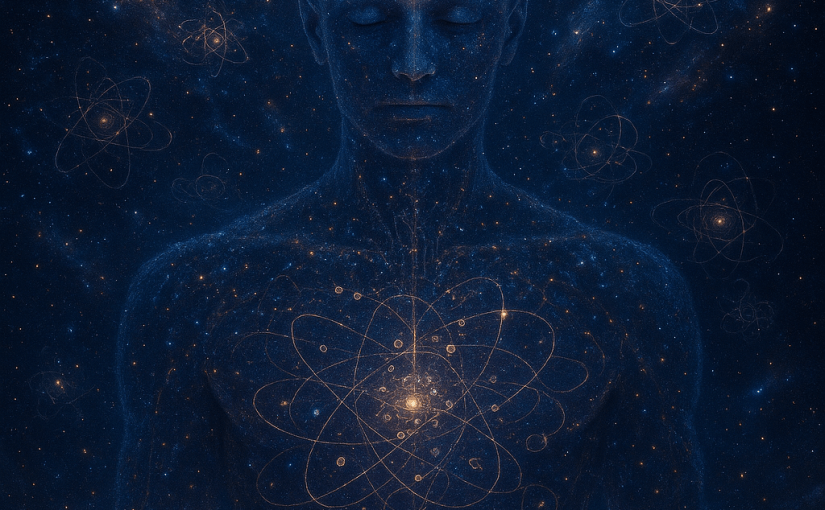
The human body is not merely made of atoms; it is the dance of atoms. There is no gap where something called “body” exists apart from them. The eyes that watch, the hands that move, the thoughts that arise, all are formations of vibrating atomic fields. To say “my body” is already a step too far, for what ownership can be claimed over trillions of particles borrowed from earth, water, air, and fire? Atoms flow through food, through breath, through the touch of the environment. They do not belong to an individual; they simply assemble for a while in the pattern that is recognized as a person.

Ego, however, is clever. It rushes forward like a signature stamped on a moving river, claiming that this function of walking, this act of speaking, this thought of dreaming, is mine. Yet in truth it never possessed the materials of its claim. The muscles are shaped by proteins from food that grew in distant fields, the thoughts are stirred by impressions absorbed from a world stretching beyond sight, the very breath is gifted freely by trees and winds that circle the planet. Ego is like a shadow insisting it owns the sun.

Think of your true self like the sun—always shining, always there. Your ego is like a shadow—always around you, moving with you. The shadow never really controls the sun, but it can’t help acting like it does. In the same way, your thoughts, your roles, and your “I am this” ideas feel important, but they aren’t who you truly are. They only reflect the real you. No matter how much the ego claims or worries, the true self stays free, untouched, and shining on its own.

Consider the simple atom. It seems so small that the mind struggles to picture it, yet it is a kingdom of vastness in itself. Within it, electrons spin in mysterious clouds, protons and neutrons huddle in a vibrant heart, and within that heart quarks shimmer like restless sparks. Each layer recedes into deeper mysteries, like a hall of mirrors extending without end. The more science peers into the atom, the less substance it finds, until matter itself dissolves into probabilities, vibrations, and wave-like dances of energy. Thus the atom is not a hard grain but an event, not a brick of reality but a doorway into uncertainty. It’s more like a little event or a happening—always moving, always changing. You can’t pin it down completely, and it behaves in ways that are a bit unpredictable. So instead of thinking of atoms as fixed building blocks, think of them as tiny sparks of activity that make up the world around us.

Now pause for a moment and realize: the body is nothing but the collective appearance of these doorways. What is called “flesh” is a swarm of events, what is called “thought” is a ripple of atomic processes, what is called “emotion” is an orchestration of subtle biochemical storms. To identify with them as a permanent self (mind-body sense of self) is like mistaking a rainbow for a solid bridge. The rainbow glows, astonishes, and vanishes—yet no one can catch it. The self too appears as a dazzling formation, radiant yet elusive, made of atoms that do not stay in one place, do not belong to one being, and do not even truly exist as solid matter.

If the body is made of atoms, and those atoms also make up the world, then the ego is only a claim over what was never truly ours. It is like writing your name in sand while the waves keep washing the shore. With every breath, atoms flow out into the air; with every meal, atoms flow in from the earth. Each day, billions of particles leave the body and billions more enter, so the boundary called “me” is never fixed. A person is more like a whirlpool in a river—shaped for a time, distinct to the eye, yet made only of water that flows in and out. What we call “me” is never separate from the stream it belongs to, but part of the river’s continuous, unbroken flow.

Yet there is an even deeper turning in this inquiry. For just as the body is not separate from atoms, and atoms are not separate from the universe, so too the person is not truly separate from awareness itself. While accepting the physical unity between body and world, how can we deny their mental or spiritual unity as well?This is the final and most delicate insight of Sharirvigyan Darshan, leading us to the ultimate non-physical through the doorway of the physical. Atoms appear, bodies appear, worlds appear, but they all rise within a field of witnessing or silent and pure awareness that itself cannot be touched, weighed, or measured. Awareness does not belong to atoms any more than the sky belongs to clouds. Clouds drift and scatter, yet the sky is not reduced or enhanced by their passing. In the same way, awareness remains open, untouched, while atoms whirl and assemble into the temporary form of a body.

This recognition overturns every ordinary assumption. When the body is mistaken as self, life becomes heavy with fear and desire. Fear arises because what is owned can be lost, and desire arises because what is lacking seems to complete the self. But when it is seen that the body is only an arrangement of atoms, the grip loosens. There is no need to clutch at what was never owned. The hands may still work, the heart may still love, but the compulsion to control lessens, replaced by a spacious ease. Even death itself begins to appear in new light—not as the end of a self but as the recycling of atoms into new patterns, like clay reshaped into new vessels. This means we need not meditate separately on the pure self; simply seeing the body as a temporary arrangement of atoms is enough to bring the pure self into view. This contemplation looks similar to that experiential facet of Sharirvigyan Darshan, where body cells are seen as complete human beings in every aspect—a contemplation that led the author to a Kundalini awakening and a glimpse of self-realization.

Science too whispers of this mystery, though in different words. It tells that energy cannot be destroyed, only transformed. The carbon of the body once burned in stars, the oxygen once flowed through ancient forests, the water once traveled in rivers older than mountains. At death, these elements scatter once more into the world, ready for new cycles. Awareness, however, is not part of this cycle of matter. It does not scatter or rearrange, because it is not made of atoms. It is the stage upon which the atomic drama unfolds.

This is the new way to see oneself: not as a solid individual enclosed within skin, not as a fixed identity defined by thought, but as the open awareness within which atoms gather and dissolve. The “I” that ordinarily feels so heavy is only an appearance, like an add on to pure awareness or like moving and chaotic reflections upon clean and still water. To recognize this is not to deny the body but to appreciate it more deeply, as one appreciates a song without claiming ownership of each note.

Mystics of many traditions hinted at this long before modern physics unfolded its revelations. They spoke of the world as maya, as dreamlike appearance, as shimmering play. Now science confirms that matter is not solid but probability, not substance but energy. Means, matter is not truly solid but energy shaped as a cloud of probabilities, where particles can be in many possible states at once. Only when observed or interacted with do these probabilities collapse into a single definite event we call “reality.” The mystic gaze and the scientific gaze meet at the threshold of the atom, both astonished at the emptiness and wonder that lie within.

This insight does not remove life’s responsibilities or dissolve the needs of the world. Rather, it lends them a gentler context. Work is still done, relationships are still cherished, struggles still appear. But underneath, there grows a subtle knowing that no function is truly “mine.” All our actions come from the whole, shaped by atoms and situations. They appear in pure awareness for a moment and then fade back into it. Ego may still claim them out of habit, but the claim no longer deceives as it once did.

To live with this understanding is to live like a wave that knows it is ocean. The wave rises, dances, and falls, yet never ceases to be ocean in essence. In the same way, the human being may rise in laughter, fall in grief, shine in love, tremble in fear, yet beneath every form lies the same undivided pure awareness. Atoms may assemble into different names and faces, but awareness remains one, endless, without division.

Thus the atom becomes not merely a scientific curiosity but a spiritual mirror. It teaches that the smallest unit of matter is already a gateway into infinity. It makes us see that nothing is really ours to hold on to, because everything is always changing and flowing. Behind all this change there is a quiet awareness that never changes. When we realize this, we find a freedom that nothing in life can shake, because it rests on what is permanent, not on what is temporary.

Our journey can move outward, studying the body and the cosmos, and inward, exploring atoms and finally the awareness that observes them. At first we see only the physical world—our body and the stars—but the real adventure leads us back to the center of our own consciousness. When this is seen, life appears as a play of light and energy, like atoms glowing as tiny fireflies or conscious beings within pure awareness. In that vision, we no longer feel the need to possess or control anything, but instead feel deeply connected, belonging to the whole.

Kundalini being the male form gets a lot of strength from the sexual attraction of the female Kundalini

Friends, in the field of Kundalini, there is no greater science than Tantra at this time.  Tantra with me was proven to be natural and practical.  Although I knew nothing about Tantra.  Maybe it is the effect of my past life.  Today, in this short post, I will throw light on the importance of sexual yoga for quick awakening of Kundalini.

Sexual stimulation increases the clarity of the Kundalini, and it becomes vibrant

The lone Kundalini made of guru’s form can also be grown through yoga-meditation.  Although this method is slow, but it is safe.  There is more peace and sattvikta or purity in it.
In the second way, Kundalini of consort form is also meditated along with Kundalini of Guru form.  The main Kundalini is in the form of Guru. Kundalini made of consort offers Guru-kundalini sexual attraction.  Just as the physical bodies of man and woman continue to energize each other with the power of sex, in the same way, the subtle pictures or the kundalinis of man and woman made in the mind of the yogi.  Although this method is more powerful and intensely fruitful, but it is unsafe.  This method can cause disturbance, restlessness and weakness.  To avoid this, one may have to use Panchamakaras or 5 Ms.  These 5 Ms are as a form of sin for the common man.  Therefore, these also bring bad fruit in result.  That’s why this method is called the all or none method.  This either fulfils man’s all accomplishments, or he may have to suffer in the hell.

Sexuality is used in the leftist tantra of Buddhists

The Buddhist tantra consists of obscure statues or idols of two figures.  One of them is the male idol, and the other idol is feminine.  In the male idol, the Guru or the deity is meditated upon.  Similarly, in the female idol, the consort or goddess is meditated.

Follow this blog to receive Kundalini posts through email