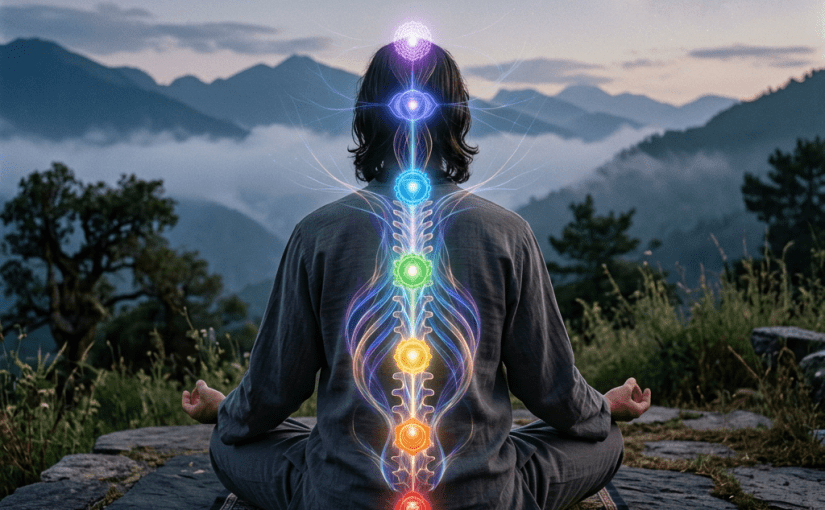
For long I have observed that deep meditation, or dhyāna, does not always arise merely through mental effort. It often appears that the body itself participates in preparing the mind for meditation. This repeatedly raised a question in my mind: does the nervous system have a much greater role in establishing dhyāna than we usually recognize? After numerous personal experiences, I have begun wondering whether certain physical sensations, particularly those originating in the throat and upper airway, may help establish the internal conditions necessary for effortless meditation. I do not present this as a scientific conclusion, but as a sincere observation that deserves careful scientific investigation.
Most discussions of meditation describe dhyāna as a purely psychological or spiritual process. Classical yoga emphasizes concentration, purification of the mind, and the gradual awakening of higher consciousness. Modern neuroscience explains meditation through changes in brain activity, attention networks, autonomic balance, and large-scale neural synchronization. It seems entirely possible that both descriptions are observing different aspects of the same phenomenon.
During my own practice, I gradually noticed that certain physical sensations seemed to make entering meditation significantly easier. This was not an isolated experience occurring once or twice. The same pattern repeated itself many times over months and years. Whenever a particular subtle sensation appeared in the throat, meditation frequently became effortless, deeper, and more stable.
Initially I wondered whether dhyāna itself actually deepens with physical sensations. The answer may not be as simple as saying that sensations cause meditation. Ordinary bodily sensations usually distract the mind. However, certain subtle sensations repeatedly appeared to coincide with the effortless establishment of meditation. This suggested that the nervous system itself might be participating in creating the conditions necessary for dhyāna. At the same time, this effect appears to become evident only when one actually sits for meditation after appropriate yogic practices. Without engaging in dhyāna, the benefit seems largely limited to a state of mental calmness and relaxation rather than progressing into deeper meditative absorption.
This led to a further thought. Perhaps certain groups of nerves, when stimulated appropriately, help prepare the nervous system for meditation. Instead of considering meditation solely as a mental event, it may be useful to view it as a neurophysiological state involving the brain, autonomic nervous system, sensory pathways, and consciousness simultaneously.
One particularly interesting observation did not occur only once but repeatedly over many occasions. During periods of mild acid reflux, a subtle scratchy sensation frequently developed in my throat. Although acid reflux itself is certainly undesirable and should never be considered a meditation aid, I repeatedly noticed that this particular throat sensation often made it easier to enter dhyana when I subsequently sat for meditation. Because the observation occurred consistently rather than as an isolated event, it became increasingly difficult to dismiss it as mere coincidence.
Looking back, I also recall that my first prolonged experience of kevala kumbhaka, approximately one and a half years ago, arose unexpectedly while I was sitting at a bus waiting shelter during an active phase of GERD. At that time, a similar throat sensation was present. However, this occurred against the background of an established daily practice of yogasanas, praṇayama, and meditation. This suggests that the throat sensation alone may not be sufficient to produce deeper meditative states. Rather, it may help facilitate the transition into dhyāna only when the nervous system has already been conditioned through sustained yogic practice. In individuals who have not undergone such long-term preparation, similar sensory stimulation may simply produce a calmer, more relaxed state of mind without progressing into deeper meditative absorption. This remains a personal observation and a hypothesis that merits systematic scientific investigation rather than a definitive conclusion.
However, this was not the only experience.
Over time I recognized that very similar throat sensations repeatedly occurred during traditional yogic cleansing practices such as dhauti, kunjal, and sutra neti. Each time these practices produced a mild scratchy or stimulated feeling in the throat or upper airway, meditation became noticeably easier and deeper. This repeated consistency immediately distinguished these observations from a single accidental experience.
The similarity between these different situations became increasingly difficult to ignore. Although the causes differed, the resulting throat sensation appeared remarkably similar, and the meditative response also seemed remarkably similar. Such repeated observations naturally raise important questions about possible underlying physiological mechanisms. It is conceivable that sleepless devotional vigils (jāgran), involving overnight singing and musical worship, may in some individuals produce mild gastritis and throat irritation. It is possible that these physiological changes contribute to a calmer mental state that may facilitate meditation (dhyāna). However, this remains a hypothesis rather than an established scientific fact. It is possible that the traditional advice to cultivate the habit of sleeping less was given for the same reason.
Modern neuroscience provides several possible directions for understanding these observations. The throat, pharynx, upper esophagus, and nasal passages contain rich sensory innervation through the vagus nerve, glossopharyngeal nerve, trigeminal nerve, and related autonomic pathways. Stimulation of these sensory pathways sends continuous information to brainstem nuclei, which in turn communicate with regions involved in autonomic regulation, attention, awareness, emotional balance, and sensory integration.
This does not mean that stimulation of a single nerve directly produces dhyāna. Present scientific evidence does not support such a conclusion. Rather, it suggests the possibility that activation of particular sensory and autonomic pathways may help establish a physiological state that supports meditation more readily. Dhyāna itself most likely emerges through coordinated activity involving multiple neural systems rather than one isolated structure.
These observations also invite a fresh interpretation of classical yogic teachings. Ancient yogic texts consistently describe practices such as dhauti, vaman dhauti, and sutra neti as methods for improving the flow of prāṇa and preparing the practitioner for higher stages of yoga. The traditional explanation uses concepts such as prāṇa, nāḍīs, purification, and energetic balance.
It is possible that these traditional descriptions accurately captured reproducible experiential effects while expressing them through the philosophical language available at that time. Ancient practitioners may have carefully documented what these practices consistently produced in experience without possessing the anatomical or physiological knowledge required to explain the underlying biological mechanisms. Their explanation of improved prāṇic flow may therefore represent the experiential side of a deeper physiological process that modern science is only beginning to explore.
This possibility should be approached with humility. It would be incorrect to state that prāṇa simply means nerve impulses or that prāṇic flow is identical to neural activity. Classical yoga and neuroscience describe reality using different conceptual frameworks. Nevertheless, there may be meaningful points of correspondence between the experiential language of yoga and the physiological language of neuroscience.
From an integrative perspective, one may cautiously hypothesize that yogic cleansing practices improve the physiological conditions supporting meditation by stimulating sensory nerve origins and autonomic neural pathways within the throat and upper respiratory tract. Traditional yoga describes the resulting experience as improved prāṇic flow. Modern neuroscience may eventually describe portions of the same process in terms of neural modulation, autonomic regulation, sensory integration, and altered brain states. These explanations need not compete; they may complement one another.
What makes this idea particularly interesting is not one isolated observation but repeated consistency. Across different situations—including yogic cleansing practices and occasionally other mild throat sensations—the transition into meditation repeatedly appeared easier and deeper. Such reproducibility makes the observation worthy of systematic investigation rather than casual dismissal.
Future scientific research could examine whether controlled stimulation of specific sensory pathways in the throat or upper airway influences the ease with which experienced meditators enter stable meditative states. Researchers could simultaneously study autonomic activity, vagal regulation, functional brain imaging, electroencephalography, respiratory patterns, and subjective depth of meditation. Such interdisciplinary studies could build meaningful bridges between neuroscience, physiology, contemplative science, yoga, and philosophy.
This possibility is not presented as proof of a new scientific discovery. It is offered as a careful observation arising from repeated personal experience, combined with an attempt to understand it using both traditional yogic knowledge and modern neurophysiology. Sometimes scientific progress begins precisely in this manner—with a simple, repeatedly observed phenomenon that initially appears too ordinary to deserve attention.
Perhaps ancient yogis discovered an important experiential principle long ago but understandably described it using the philosophical language available in their era. Modern science now possesses sophisticated tools capable of investigating mechanisms that were previously beyond observation. Whether these repeated experiences ultimately reveal a new understanding of meditation remains unknown. Nevertheless, they raise an intriguing question worthy of serious attention from neuroscientists, physiologists, meditation researchers, philosophers of consciousness, yoga scholars, and sincere practitioners throughout the world. If future research confirms even part of this hypothesis, it may deepen our understanding of how the nervous system participates in preparing the human mind for one of its highest states—dhyāna.