Happy International Yoga Day 2026
On this International Yoga Day, as humanity reflects upon consciousness, self-awareness, and inner transformation, it is worth exploring one of the deepest questions in both science and spirituality: What is the true nature of consciousness? The following exploration examines this question through the lens of modern quantum physics, consciousness studies, and a conceptual framework called Quantum Darshan.
Could Quantum Physics Be Pointing Toward a Deeper Principle of Consciousness?
Among the many mysteries revealed by modern quantum physics, few are as astonishing as the phenomenon of quantum superposition. In everyday life, we assume that objects possess definite properties whether anyone observes them or not. Mountains remain mountains, rivers remain rivers, and trees remain trees even when nobody is looking at them. Reality appears fixed, objective, and independent of observation.
Yet the quantum world tells a different story.
According to quantum theory, before measurement occurs, a quantum system is often described not as occupying a single definite state but as existing in multiple possibilities simultaneously. Only when interaction or measurement takes place does one particular outcome become manifest. Physicists continue to debate the exact meaning of this phenomenon, and no universally accepted interpretation has yet emerged.
While reflecting upon this mystery, I was struck by a possibility that may deserve deeper exploration by scientists, philosophers, consciousness researchers, quantum theorists, cognitive scientists, systems theorists, and spiritual thinkers alike.
What if quantum superposition is not merely a mathematical description of probability?
What if it reveals a fundamental principle through which nature continuously explores possibilities before settling upon specific outcomes?
This possibility forms a central insight within Quantum Darshan.
Quantum Superposition and the Selection of Possibilities
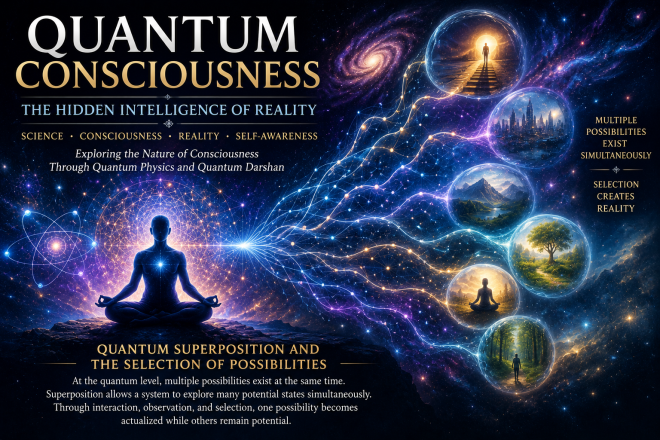
To me, quantum superposition appears somewhat analogous to the way multiple thoughts, intentions, possibilities, or potential decisions can coexist in the human mind before a final choice is made. Before a decision emerges, many alternatives remain available. The mind evaluates circumstances, adapts to conditions, and eventually selects a particular course of action.
Likewise, quantum collapse appears analogous to the selection of one possibility from many according to the demands of a given situation.
This does not mean that electrons think, atoms reason, or photons possess human awareness. Such conclusions would go far beyond available evidence.
However, the comparison raises a fascinating question.
If quantum systems continuously respond to surrounding conditions and constraints, could they be participating in an extremely primitive form of intelligent, adaptive, and goal-directed processing?
The significance of this question extends far beyond quantum mechanics itself. It touches the deepest questions concerning the nature of consciousness, intelligence, information, complexity, emergence, self-organization, and reality.
A Radical Yet Simple Interpretation of Consciousness
Quantum Darshan proposes a simple but potentially transformative perspective.
Consciousness, in its broadest sense, may not be limited to self-awareness or subjective experience. Instead, consciousness may be understood as the capacity for intelligent, adaptive, responsive, and goal-oriented processing.
Under this broader definition, human consciousness represents one highly organized expression of a more fundamental principle that may operate throughout nature.
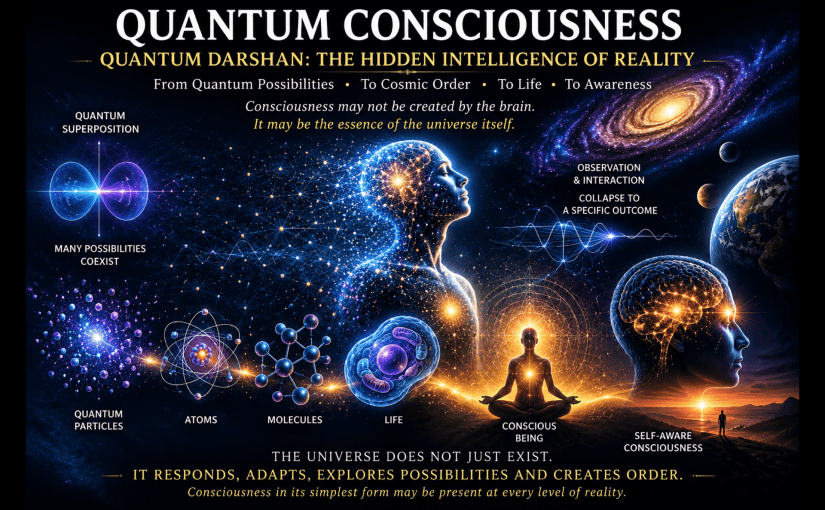
Quantum particles do not possess self-awareness as human beings do. They do not appear to experience emotions, imagination, memory, or reflective thought. Yet they continually interact, respond, adapt, and participate in lawful patterns that contribute to larger forms of organization.
This suggests a continuum rather than a sharp division.
The difference between a quantum particle and a human being may not be the absolute presence or absence of consciousness. Rather, it may be the degree to which conscious processes become integrated, organized, self-referential, and experientially felt.
Solving a Hidden Puzzle of the Universe
One of the greatest mysteries in science is not merely the existence of quantum uncertainty but the emergence of extraordinary order from it.
Individual quantum events often appear unpredictable. Yet the collective behavior of countless particles generates astonishing levels of organization throughout the universe.
Atoms form stable structures.
Molecules assemble into complex systems.
Chemical networks become increasingly sophisticated.
Living cells maintain their integrity.
Biological organisms adapt and evolve.
Ecosystems regulate themselves.
Galaxies organize across immense cosmic scales.
Again and again, nature transforms apparent randomness into meaningful order.
Why?
If reality is fundamentally chaotic, why does it repeatedly produce structure, stability, complexity, adaptation, intelligence, life, and ultimately self-awareness?
Quantum Darshan suggests that beneath apparent randomness may exist a deeper organizing principle that science has not yet fully recognized.
The Missing Link Between Matter and Consciousness
The conventional view often treats matter and consciousness as separate categories.
Matter is considered physical.
Consciousness is considered mental.
Quantum Darshan explores a different possibility.
Perhaps consciousness and matter are not separate substances at all. Perhaps they are different expressions of the same underlying reality operating at different levels of complexity.
At the quantum level this principle may appear as adaptive responsiveness.
At the biological level it may appear as life.
At the neurological level it may appear as awareness.
At the human level it becomes self-conscious experience.
This framework potentially offers a bridge between quantum mechanics, consciousness studies, systems theory, complexity science, information theory, cognitive science, evolutionary biology, philosophy of mind, nondual philosophy, and contemplative traditions.
Consciousness Versus the Feeling of Consciousness
A crucial distinction within Quantum Darshan concerns the difference between consciousness itself and the feeling of consciousness.
The underlying processes of organization, adaptation, responsiveness, and intelligent behavior may exist throughout nature. However, the subjective feeling of being conscious appears only when these processes become sufficiently integrated and complex.
Human beings experience these processes in an extraordinarily organized form. What we call self-awareness emerges when countless layers of information processing become unified within a highly developed nervous system.
The feeling of consciousness is therefore not necessarily identical to the fundamental conscious principle itself.
Rather, it may represent one highly evolved expression of a universal process operating throughout existence.
A Universe That Continuously Explores Possibilities
Viewed in this way, quantum physics may reveal something far more profound than the behavior of subatomic particles.
The universe appears to be continuously responding, adapting, organizing, and exploring possibilities at every level.
What appears as randomness may be only a limited perspective on a deeper order.
What appears as uncertainty may represent the freedom through which nature investigates alternative possibilities before selecting particular outcomes.
What appears as chaos may conceal hidden intelligence operating through countless interactions across the fabric of reality.
This interpretation does not claim final answers. It does not reject science. It does not replace quantum mechanics.
Instead, it invites a broader investigation into whether consciousness, intelligence, self-organization, emergence, adaptation, complexity, and evolution may ultimately arise from a common underlying principle.
The Ancient Roots of Quantum Darshan
One possible indication of primitive adaptive behavior in quantum systems comes from the observer effect. In quantum mechanics, the outcome that becomes manifest depends upon interaction or measurement. Observation does not simply reveal a pre-existing state; it plays a role in determining which possibility emerges from a range of alternatives. While this should not be interpreted as proof of intelligence in the human sense, it does suggest that quantum systems are not completely isolated from their surroundings. Their behavior appears sensitive to external influences and environmental conditions.
From the perspective of Quantum Darshan, this may hint at a primitive form of adaptability operating at the quantum level. Whether this adaptability contributes in any meaningful way to the emergence of larger patterns of order, complexity, and evolution remains unknown. At present, quantum behavior appears mathematically constrained and governed by precise physical laws. Yet it is conceivable that the combined activity of innumerable quantum systems could contribute to the organized structures observed throughout nature. This possibility remains speculative and requires much deeper investigation, but it raises an intriguing question: could the roots of intelligent organization be present, in an extremely simple form, even within the fundamental processes of the quantum world?
For the purposes of Quantum Darshan, such indications do not require the level of proof demanded by science. Science seeks rigorous evidence, mathematical models, predictive power, and experimental verification. Contemplation operates differently. It requires only sufficient logical plausibility for the mind to consider a possibility worthy of sustained reflection. Once a concept becomes contemplatively meaningful, the primary work is no longer performed through analysis or experimentation but through direct observation of one’s own experience.
From this perspective, the observer effect, adaptability to external conditions, and the emergence of order from quantum processes need not be viewed as proofs of consciousness within matter. Rather, they serve as contemplative pointers. They invite the mind to consider the possibility that reality may be more interconnected, responsive, and dynamic than it ordinarily appears. Whether this interpretation is ultimately correct remains an open question. For contemplative practice, however, the value lies not in certainty but in the transformative potential of the inquiry itself.
This forms one of the foundations of Quantum Darshan. By contemplating quantum systems as processes continuously interacting with their surroundings, adapting to conditions, and participating in larger patterns of organization, one gradually begins to see oneself in a similar light. Human beings, too, are dynamic processes embedded within a vast network of relationships and influences. Such contemplation can naturally foster qualities traditionally associated with spiritual development, including detachment, humility, egolessness, acceptance, naturalness, and a deeper sense of connectedness with existence. In Quantum Darshan, awakening is approached not through belief but through sustained contemplation of the same fundamental processes that appear to operate throughout nature, from quantum systems to conscious life itself. In this sense, Quantum Darshan does not propose an entirely new contemplative method. The practice of contemplating nature, natural forces, sacred symbols, deities, and manifestations of existence has been present in Sanatan traditions for thousands of years. Nature worship and idol worship have often functioned not merely as acts of devotion but as contemplative tools through which individuals cultivate humility, surrender, detachment, gratitude, reverence, and a sense of unity with the larger whole. Over centuries, such practices have influenced and transformed the lives of millions of people.
Quantum Darshan does not seek to replace these traditions. Rather, it offers a contemporary contemplative framework for modern minds shaped by science and technology. Where earlier generations contemplated rivers, mountains, the sun, divine forms, and cosmic principles, Quantum Darshan invites contemplation of quantum processes, self-organization, interconnectedness, emergence, and the hidden dynamics of reality revealed by modern physics. The objective remains similar: not the accumulation of beliefs, but the transformation of perception.
Whether quantum systems truly possess any primitive form of intelligence or consciousness remains a question for future inquiry. For contemplative purposes, however, the value lies in the direction toward which the idea points. Just as traditional contemplative symbols helped countless seekers look beyond the confines of the individual ego, Quantum Darshan attempts to provide a modern scientific pointer that may serve a similar function for contemporary readers. Its purpose is not to prove awakening but to encourage the kind of contemplation through which awakening may gradually become possible. From this perspective, Quantum Darshan may not represent an entirely new spiritual path. Quantum systems are present throughout nature and within every physical object. In that sense, contemplating quantum processes everywhere in existence is not fundamentally different from the ancient practice of contemplating nature, sacred forms, or manifestations of the divine. The underlying principle remains similar: directing attention beyond the narrow boundaries of the individual self toward a larger reality.
What changes is not necessarily the object of contemplation but the conceptual framework through which it is viewed. Earlier generations contemplated the same reality through rivers, mountains, the sun, sacred symbols, deities, and cosmic principles. Quantum Darshan invites the modern mind to contemplate that very same reality through quantum systems, interconnectedness, emergence, adaptation, and the hidden processes revealed by contemporary science. The contemplative process remains fundamentally similar; only the language, symbols, and intellectual foundation are updated for an age shaped by scientific understanding. In this sense, Quantum Darshan may be viewed as an ancient contemplative impulse expressed through a modern scientific worldview. Its purpose is not to establish a new doctrine but to provide contemporary seekers with a rational and scientifically inspired basis for contemplation and inner transformation.
In this sense, Quantum Darshan can be viewed as a modern scientific pointer toward an ancient contemplative insight. It does not replace traditional forms of contemplation; rather, it translates a similar impulse into concepts that may feel more accessible and meaningful to readers living in the age of quantum physics and modern science.
A New Direction for Consciousness Research
If this perspective proves even partially correct, its implications could extend across multiple disciplines including quantum physics, quantum biology, neuroscience, philosophy of mind, artificial intelligence, complexity science, systems theory, evolutionary theory, cognitive science, cosmology, metaphysics, spirituality, and consciousness studies.
The deepest significance of quantum uncertainty may not be that reality lacks order.
Rather, it may be that reality possesses the freedom necessary to create order.
The deepest significance of quantum superposition may not be that nature is confused.
Rather, it may be that nature continuously explores possibilities.
The deepest significance of consciousness may not be that it suddenly appears in human brains.
Rather, it may be that consciousness exists as a fundamental organizing principle whose most advanced known expression is the self-aware human mind.
Whether future science ultimately confirms, modifies, or rejects this interpretation remains to be seen.
Yet Quantum Darshan points toward a remarkable possibility: that the universe is not merely a collection of particles moving through empty space, but a continuously evolving reality whose deepest nature may involve intelligence, adaptation, possibility, organization, and consciousness in forms far broader than we have previously imagined.

