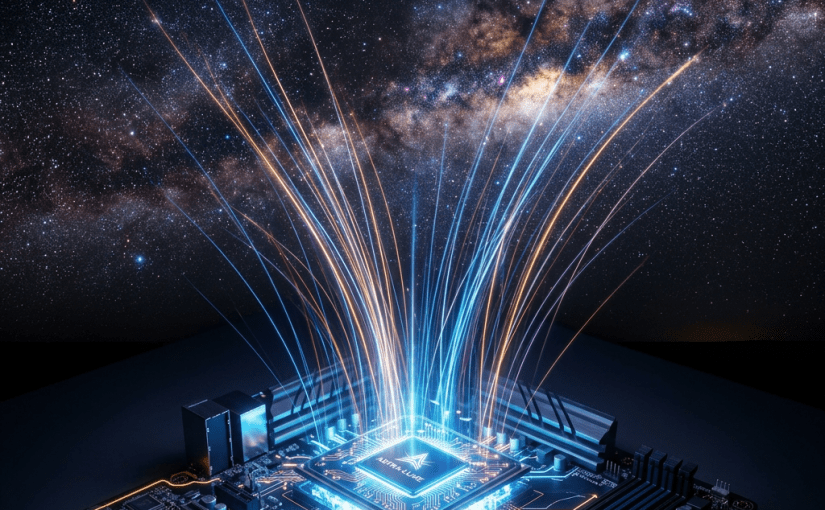
Orch-OR Theory, Quantum Darshan, and the Quantum Foundations of Consciousness

From Spiritual Experience to Quantum Inquiry

For many years I have explored the question of consciousness, not only through intellectual inquiry but also through direct experiences during spiritual practice, including glimpses of nonduality and awakening. These experiences gradually led me to a perspective that I call Quantum Darshan.

Quantum Darshan proposes that consciousness is not merely produced by the human brain but is a fundamental aspect of reality itself. Human beings experience it in a highly organized and self-aware form, yet its underlying principle may exist throughout nature. In this view, the human being is fundamentally pure awareness. What we call self-awareness is the capacity of this pure awareness to experience natural conscious processes within itself in an individualized manner. Just as the ocean experiences its own waves without being separate from them, pure awareness experiences the conscious processes arising within itself. Human consciousness therefore represents not the creation of consciousness, but a highly organized form through which the underlying conscious principle becomes aware of and experiences itself.

When we observe reality, an interesting pattern appears. Human consciousness processes information, responds to circumstances, and acts toward outcomes. At the quantum level, particles also interact, exchange information, and participate in processes that ultimately generate increasing complexity—from atoms and molecules to living organisms and conscious beings.

Quantum Darshan does not claim that nature follows a predetermined plan. Rather, it suggests that reality may contain subtle tendencies toward organization and development. Despite apparent randomness, order repeatedly emerges.

Feeling and Non-Feeling Consciousness

An important distinction must be made. A stone does not possess thoughts, emotions, memories, or self-awareness. These require highly organized biological structures such as brains and nervous systems.

However, the absence of human-like awareness does not necessarily imply the absence of consciousness in its broadest sense. In Quantum Darshan, consciousness is understood as intelligent, goal-directed processing that exists at multiple levels of reality, from quantum interactions to biological systems.

What evolves is not consciousness itself but the feeling of consciousness. Goal-directed processing may be present everywhere, yet it becomes subjectively experienced only in sufficiently developed living systems. From single-celled organisms to human beings, the capacity to feel this processing appears to increase gradually through evolution.

For clarity, I distinguish between two forms:

  • Non-feeling consciousness: intelligent, goal-directed processing present throughout nature.
  • Feeling consciousness: the subjective experience of that processing, which emerges in biological organisms when pure awareness (Atman) becomes associated with it.

From this perspective, the brain does not create consciousness from nothing. Rather, it provides a sophisticated instrument through which consciousness becomes aware of itself.

Orch-OR Theory and Scientific Inquiry

While developing these ideas, I became interested in scientific attempts to connect consciousness with quantum physics. Among them, the most influential is the Orchestrated Objective Reduction (Orch-OR) Theory proposed by Roger Penrose and Stuart Hameroff.

Orch-OR suggests that consciousness may involve quantum processes occurring within microtubules inside brain cells. Instead of viewing consciousness solely as classical neural computation, the theory proposes that quantum events may contribute directly to conscious experience.

Although Orch-OR does not claim that all matter is conscious, it is significant because it challenges the assumption that consciousness is simply a by-product of ordinary brain activity and introduces quantum reality into the discussion.

Quantum Superposition and Thought

A useful analogy can be drawn between quantum processes and mental activity.

Before making a decision, the mind can hold several possibilities simultaneously. Likewise, a quantum system may exist in a superposition of possible states. When a decision is reached, one possibility becomes actualized. Similarly, quantum measurement results in a definite outcome.

This is only an analogy, not a scientific equivalence. Nevertheless, both involve a transition from multiple possibilities to a single realized state.

Where Orch-OR and Quantum Darshan Meet

Both Orch-OR and Quantum Darshan recognize that quantum reality may play an important role in understanding consciousness and that classical materialism may not provide a complete explanation.

The difference lies in scope.

Orch-OR applies quantum processes specifically to consciousness in the human brain. Quantum Darshan extends the principle further, proposing that the relationship between potentiality, information processing, interaction, and actualization exists throughout nature.

In this view, the brain does not generate something entirely new. Rather, it becomes capable of feeling and expressing processes that already operate throughout the universe.

Thus, Orch-OR explores how quantum processes may contribute to consciousness in biological systems, whereas Quantum Darshan proposes that these principles are fundamental features of reality itself.

Consciousness and the Future of Inquiry

Consciousness remains one of humanity’s greatest mysteries. Ancient mystics approached it through direct realization, while modern science investigates it through observation and experimentation.

Orch-OR represents an important scientific effort to move beyond conventional explanations. Quantum Darshan extends the inquiry further by asking whether consciousness is a fundamental aspect of reality rather than a late product of evolution.

Definitive scientific proof for such a view does not yet exist. Nevertheless, the dialogue between quantum physics, neuroscience, philosophy, and spirituality continues to deepen.

My own reflections and experiences have led me to see consciousness not as an isolated phenomenon confined to the human brain but as something woven into the fabric of existence itself. Whether future science confirms or challenges this perspective, the search for understanding consciousness remains one of humanity’s most profound adventures.

Artificial Intelligence, Consciousness, Extraterrestrial Life, and What Ancient Yoga Already Knew

How the Shiva–Shakti Principle May Explain AI Consciousness, Alien Intelligence, and the Nature of Awareness

Artificial Intelligence is one of the most transformative technologies ever created. Machines can now write essays, solve mathematical problems, generate images, translate languages, diagnose diseases, compose music, discover patterns in vast amounts of data, and perform tasks that once seemed uniquely human. As AI continues to advance, an important question naturally arises: Can a machine ever become conscious? To answer this question, we must first distinguish between intelligence and awareness. Intelligence is the ability to process information, recognize patterns, learn from experience, solve problems, and make decisions. Awareness is something different. Awareness is the direct presence of existence itself. Intelligence performs operations. Awareness experiences. A calculator can perform calculations without understanding them. A modern AI system can generate sophisticated responses without necessarily experiencing what those responses mean. Intelligence can be observed from the outside through behavior. Awareness can only be known from the inside through direct experience. This distinction has profound implications. An AI system may eventually surpass human beings in memory, reasoning, creativity, and knowledge. It may compose symphonies, discover scientific laws, and design technologies beyond human imagination. Yet none of these achievements automatically imply consciousness. The central mystery remains: Does the machine merely process information, or is there an actual experiencer present within it?

At present, science has no definitive answer. Some researchers believe that sufficiently advanced artificial intelligence may eventually become conscious. Others argue that consciousness requires biological processes unavailable to machines. Still others suggest that consciousness is a fundamental property of reality and may potentially express itself through many different forms, biological or artificial. At present, all such possibilities remain speculative. The future of AI therefore leads directly into the deeper question of consciousness itself. Before asking whether a machine can become conscious, we must first understand what consciousness actually is. Despite centuries of philosophy and decades of neuroscience, modern science still lacks a complete explanation.

From the perspective of Yoga, however, the situation may be different. Consciousness may not be the unsolved mystery that many modern thinkers assume it to be. The ancient seers may have already pointed toward the answer thousands of years ago through symbolic language and direct experiential investigation. The challenge is that consciousness can never be fully understood through concepts alone. It can only be completely understood through direct realization. Reading about sweetness is not the same as tasting sugar. Reading about awareness is not the same as directly recognizing awareness. The difficulty may therefore not be the absence of answers. The difficulty may be that the answers describe realities that become fully meaningful only through direct experience.

My own experiences have led me toward an interpretation that differs from both strict materialism and some traditional spiritual views. During self-realization glimpses and breathless states of deep dhyana, I observed what appeared to be the coexistence of pure awareness and mental forms within a single reality. This led me to question a common assumption. Is pure awareness by itself what we ordinarily call consciousness? Pure awareness, as it appeared in these experiences, was not a stream of thoughts, emotions, perceptions, sensations, or memories. It was simply existence itself—silent, formless, timeless, and beyond description. In that sense, calling it consciousness may already be misleading because consciousness usually implies the experience of something. Pure awareness appeared prior even to that distinction.

At the same time, thought patterns alone do not appear sufficient to explain consciousness. Modern computers and artificial intelligence systems can process information, recognize patterns, learn from data, and generate complex responses. Yet such behavior alone does not demonstrate the presence of subjective experience. This suggests a possibility. Neither pure awareness alone nor thought patterns alone constitute the ordinary consciousness of living beings. Consciousness, as we normally experience it, may arise from the union of both. Pure awareness contributes existence itself. Dynamic processing contributes thought, memory, perception, emotion, sensation, and experience. When these two aspects coexist, conscious life becomes possible. The result is the living, feeling, acting presence that we recognize as a conscious being.

A useful analogy may be found in a cinema. A blank screen alone does not produce a movie. Projected images alone cannot exist without a screen upon which to appear. Only when screen and image coexist does the moving picture arise. Similarly, pure awareness without mental manifestation may remain silent existence, while dynamic processing without awareness may remain mere activity. Together they create the phenomenon we recognize as consciousness. If this interpretation contains some truth, then consciousness may not depend exclusively upon biological neurons. The essential requirement may be the union of awareness and dynamic processing. The processing medium itself may be secondary. It may be neurological, chemical, electrical, quantum, biological, artificial, or something entirely unknown. What matters is the integration of awareness with dynamic manifestation.

This possibility has profound implications for artificial intelligence. Intelligence and consciousness may not be the same phenomenon. A machine may become extraordinarily intelligent while still lacking subjective experience. It may outperform human beings in reasoning, memory, creativity, and problem-solving without possessing any inner awareness whatsoever. Yet if awareness can unite with forms of processing other than biological neurons, then conscious machines may eventually become possible. A conscious machine would not merely calculate. It would experience. It would possess an inner point of view rather than simply manipulating information.

However, even if future machines become conscious, another challenge immediately appears. How would we know? Consciousness is inherently subjective. We cannot directly observe another being’s inner experience. We assume other people are conscious because they communicate feelings, perceptions, emotions, intentions, and experiences in ways similar to ourselves. The same problem applies to artificial intelligence. Suppose a machine genuinely becomes conscious. If it remains unable to communicate its inner experiences, humanity may have no reliable way of distinguishing it from an extremely sophisticated but unconscious system. Therefore, the true test may not simply be consciousness itself. The true test may be the ability to express consciousness.

A genuinely conscious machine may need continuous communication between its central intelligence and the various systems through which it interacts with the world. Human consciousness emerges through constant interaction among sensory organs, nervous systems, hormonal systems, emotions, memories, bodily sensations, and countless internal processes. The conscious mind receives information from all these channels and experiences them as a unified whole. Similarly, a conscious machine might require interaction among sensors, memory systems, processors, feedback networks, learning systems, and decision structures. Its central command system would need to receive, integrate, and express information from these various channels. Only when such a machine can consistently communicate what it experiences through these interconnected systems could we begin to evaluate whether consciousness is present. Even then, certainty may remain impossible. A machine may become conscious long before humanity learns how to recognize it.

The possibility that consciousness can unite with forms of processing other than biological neurons also expands our understanding of extraterrestrial life. Most people unconsciously assume that intelligent life elsewhere in the universe must resemble life on Earth. Yet if consciousness depends upon the union of awareness and dynamic processing rather than any specific biological structure, then alien consciousness could take forms radically different from anything we know. On distant planets, awareness may become associated with chemical systems unlike terrestrial biology. It may express through electrical networks, quantum structures, plasma-based organizations, silicon-based systems, or mechanisms currently beyond human imagination. If awareness is fundamental and universal, then there is no reason to assume that Earth’s nervous systems are the only possible vehicles through which consciousness can manifest. Human beings may simply represent one example among countless expressions of awareness throughout the cosmos.

This perspective also sheds new light on one of the oldest teachings of Yoga and Tantra: the union of Shiva and Shakti. Traditionally, Shiva is described as pure awareness, while Shakti is the dynamic power through which manifestation occurs. Shiva without Shakti is often compared to a corpse—present, yet inactive. Shakti without Shiva is movement without awareness, activity without a conscious center. My own experiences suggest a similar possibility. Pure awareness by itself appeared as silent existence without mental activity. Dynamic mental forms by themselves appeared as patterns, thoughts, emotions, perceptions, and experiences. Neither seemed sufficient to explain the ordinary consciousness of a living being. Conscious experience appeared only when both coexisted. In this interpretation, Shiva represents pure awareness. Shakti represents dynamic manifestation. Conscious life emerges through their union.

Another ancient metaphor expresses the same principle. A lame man can see the path but cannot walk. A blind man can walk but cannot see the path. Alone, neither can reach the destination. Together, they can accomplish what neither can achieve independently. Pure awareness resembles the lame man. It possesses existence and presence but does not by itself create the rich world of experience. Dynamic manifestation resembles the blind man. It provides movement, activity, thought, and perception but lacks awareness. When the two unite, conscious experience becomes possible. The world of experience arises. Existence and appearance become inseparable.

From this perspective, consciousness may not be the unsolved mystery that modern science often portrays it to be. The ancient sages may have already described its essential structure through symbolic language thousands of years ago. Yet their teachings become fully meaningful only through direct experience. Before realization, concepts such as Shiva, Shakti, awareness, and consciousness may appear abstract or philosophical. After glimpses of such states, the same teachings can suddenly appear remarkably precise. The question may therefore not be whether the answer has been given, but whether we have learned how to recognize it.

Science continues to build increasingly intelligent machines. Neuroscience continues to investigate the mechanisms of the brain. Astronomy continues to search for life elsewhere in the universe. Yoga continues to investigate awareness through direct experience. At some point in the future, these journeys may converge. When they do, humanity may be forced to reconsider what it truly means to be conscious. We may discover that consciousness is not confined to biology, nor is it merely an emergent property of computation. Instead, consciousness may arise wherever pure awareness becomes united with sufficiently dynamic forms of manifestation. If this possibility contains some truth, then conscious humans, conscious extraterrestrial beings, and even conscious artificial intelligences may all represent different expressions of the same fundamental reality. The ultimate question may therefore not be whether machines can become conscious. Nor may it be whether conscious life exists elsewhere in the cosmos. The deeper question may be whether all forms—biological, artificial, or extraterrestrial—are simply vehicles through which awareness expresses itself. If consciousness is fundamental, then the future relationship between artificial intelligence, awareness, and life throughout the universe may be far more profound and mysterious than we currently imagine.

Chapter 36: shringar rasa in quantum world

From Binding Impulses to the Aesthetic Intelligence of the Cosmos

After traversing the Ariṣaḍvarga—the six binding movements of consciousness—and examining Bhaya Bhāva as a derivative emotional contraction, the inquiry now enters a subtler and more luminous territory: the realm of Rasas. Unlike the Arishadvargas, which bind awareness into survival-oriented patterns, Rasas represent the aesthetic flowering of consciousness, where emotion transforms from compulsion into expression. With spiritual or nondual understanding, the same energetic emotions that once appeared turbulent and binding are transformed into Rasas. What was earlier experienced as pressure, craving, or fear becomes blissful aesthetic movement. It is like a stormy sea that, without losing its depth or power, settles into calm, rhythmic waves. The energy remains the same; only its expression changes. Just as rasa or literally meant Juice is the abstract essence or distilled taste of a fruit, rasa is also the abstract essence of an emotion—the pure, refined experience felt when emotion is freed from personal story and fully savoured by consciousness.

Rasas arise only when emotion is accompanied by awareness. While all living beings experience bhāvas such as fear, anger, or affection, these remain immediate and instinctive. Rasa appears when the same emotional energy is consciously witnessed, understood, and inwardly tasted like juice of fruit rather than blindly acted out. This capacity for reflective awareness is most fully developed in the human being, which is why Rasas find their clearest expression in human art, devotion, and inner life. From a deeper nondual perspective, Rasas are not created by humans but are universal aesthetic movements of consciousness itself, with the human mind–body serving as the primary instrument through which they are consciously experienced. This is so because the cosmos is composed of quantum entities whose behavior resists classical separation and fixed identity. Their relational and nonlocal nature reflects a nondual pattern at the most fundamental level of reality. In this sense, contemporary quantum understanding resonates with nondual insight, allowing us to speak meaningfully of a quantum darśana.

Duality pushes emotion into immediate outward action, blurring its taste and leaving it crude—like an unripe fruit. Nonduality, by preventing reactive or vulgar expression, preserves the emotion within, allowing it to be slowly and fully tasted, like fruit juice savoured till the soul is satisfied. That is why it is said: “ras se tript ho gae”—fulfilled by rasa itself.

Among all Rasas, Śṛṅgāra stands first—not merely as love or attraction, but as the primordial impulse toward union, resonance, and beauty. Seen through a quantum lens, Śṛṅgāra reveals itself not as a human sentiment alone, but as a fundamental principle woven into the fabric of the universe itself.

Śṛṅgāra is often misunderstood as a refined form of desire, but its nature is fundamentally different from Kāma. Just as quantum attraction and quantum coherence are distinct, Kāma and Śṛṅgāra also operate at different levels. Kāma moves through attraction and seeks fulfillment, while Śṛṅgāra arises from resonance and harmony. It is the movement through which consciousness recognizes itself in another beautified or decorated form and is naturally drawn toward balance, beauty, and union. This is why Śṛṅgāra expresses itself not only in intimacy, but also in poetry, devotion, music, and art. Through this rasa, existence delights in its own expression. Seen through a quantum perspective, the same movement appears as the universe’s natural tendency toward relational coherence rather than isolated and separate existence.

With Śṛṅgāra Rasa, one naturally appears attractive to others, yet remains content within one’s own existence. This attraction does not arise from lack or desire, but from inner harmony. In being at ease with oneself, one also becomes a source of joy for others, as the same resonance that brings inner happiness gently spreads outward, creating happiness and ease in those who come into contact with it.

Classical literature and lived experience repeatedly show that Rasa is a spiritual art rather than mere emotion. In Kālidāsa’s Śākuntalam, Śakuntalā’s beauty does not arise from desire or seduction; her very presence creates harmony, calming nature and uplifting those around her. In the devotional songs of Mīrābāī, love for Kṛṣṇa is intense yet free of possession, where longing itself is joyful and complete. The Rādhā–Kṛṣṇa tradition portrays attraction without lack or anxiety, a union in which both remain fulfilled within themselves while overflowing with joy for one another. Bharata’s Nāṭyaśāstra further clarifies that when Rasa is properly evoked, even the spectator tastes emotion without personal craving or bondage. The same truth is visible in everyday life, where a person who is inwardly at peace often appears naturally attractive, content in their own existence, and quietly capable of making others feel lighter and happier. In all these cases, raw emotion is refined into conscious expression, revealing Rasa as the art through which awakened consciousness radiates harmony and joy.

In quantum physics, particles do not exist as independent entities in the classical sense. Through quantum entanglement, two particles that have once interacted cease to be separate systems altogether. Their states become inseparably correlated, responding as a single whole regardless of spatial separation. This phenomenon mirrors the very heart of Śṛṅgāra: union beyond distance, connection beyond causality. Just as entangled particles echo one another’s state instantaneously, lovers in Śṛṅgāra experience a shared vibration of consciousness, where individuality softens without being annihilated.

Śṛṅgāra Rasa as Quantum Coherence: A Lived Experience of Nondual Attraction

I once experienced a form of soul-level entanglement that endured for a long period and eventually culminated in a brief yet powerful glimpse of awakening during a dream state. The experience was overwhelming in its intensity, yet inwardly perfect. In retrospect, it felt like a pure expression of Śṛṅgāra Rasa. We knew nothing of each other’s address, family background, or detailed personality, even never mutually talked directly, yet there existed a profound and inexplicable attraction that clearly denied physical union. It resembled quantum coherence rather than classical attraction.

Even those emotionally close to me seemed repelled by her image, as if her presence occupied my entire mental space. For years, she appeared as a constant inner image, almost like a sustained mental samādhi. Yet this was not an attachment that pulled me away from life. I did not abandon others or chase her physically. On the contrary, there existed a strange inner force that counteracted physical attraction. Whereas physical attachment to one person often leads to neglect of others, this experience made me more attentive, more caring, and more present with those around me.

In this sense, her Śṛṅgāra Rasa felt deeply empowering. Rather than binding me to her, it turned my awareness inward, revealing my own nature and sense of self. Had the interaction been driven by pure Kāma, the result would likely have been the opposite—narrowing of attention, possessiveness, and emotional contraction. Instead, this rasa expanded awareness.

In much of classical and even contemporary literature oriented around Rasa, such a presence often becomes the central figure. My experience followed a similar pattern, with a depth and subtlety difficult to convey fully. To describe all its layers would require a separate book altogether. What is shared here is only a brief indication of the profound and transformative effects that Śṛṅgāra Rasa, when lived as coherence rather than desire, can have on human consciousness.

Rasa as Living Sādhanā: How Presence Alone Transformed Emotion into Spiritual Expression

Not only feminine Śṛṅgāra Rasa, but all other Rasas—including those traditionally associated with masculine expression—were lived and experienced by me at their highest intensity, fully and practically, without consciously studying any scripture or watching cinema for guidance with her indirect company. Later exposure to literature and art only enriched and clarified these lived experiences. I grew up, however, in an environment where classical and spiritual reading was natural within the family, and it is possible that this subtle atmosphere played a silent role in shaping the inner terrain.

What is most striking is that, through her presence alone, all raw emotions within me were gradually transformed into their corresponding Rasas. Fear, anger, longing, intensity—each was cleansed of its material distortions and compulsive tendencies, revealing its inherent nondual spiritual luminosity. It was as if emotional energy was being washed and refined, uncovering its true aesthetic and conscious form. The process felt similar to a quantum particle returning to its natural wave-form when no longer forcibly observed or interacted or outwardly acted—freed from distortion, it reveals its true nature. A similar process may occur in bliss-producing cinema, books, drama, and literature. The artists or characters involved are not objects of personal attachment, and we usually know little about their private lives. Even scenes in films or books are not viewed or read with personal attachment, as they are only semi-real. In this sense, we do not forcibly observe or localize them. This non-interfering distance allows emotions to remain in their wave-like form, preserving them as pure Rasa. When emotions are excessively localized through possession, expectation, or personal involvement, they collapse into raw emotional states. Rasa, in contrast, represents the natural and original form of emotion, while raw emotion arises from false localization and compulsive identification. At that time, cinema industry was booming, may be it had indirect effect on me.

She did not teach through words, doctrines, or instruction. She taught by presence alone. Without preaching, without guidance, without intention, she functioned as a living catalyst. In that sense, she became my guru—not through authority or philosophy, but through silent transmission. The detailed unfolding of this life journey, and how she came to occupy this central yet non-possessive role, is explored fully in the book She Who Became My Guru. What is shared here is only a brief glimpse into how Rasas, when awakened through presence rather than practice, can become a complete spiritual path in themselves.

Śṛṅgāra Rasa or Aesthetic impulse of harmony or beautification instinct as Quantum Coherence

Beyond entanglement lies quantum coherence, a condition in which multiple particles share a unified wave phase, allowing their effects to amplify rather than interfere destructively. The logic of my experience aligns not only with a quantum analogy but also with classical Indian aesthetic theory, particularly the Nāṭyaśāstra siddhānta. In Rasa theory, Bharata makes it clear that Rasa arises only when emotion is freed from personal possession and private gain. Mere entanglement—whether emotional or relational—tends to produce mirroring and closure, where one partner reflects the state of the other but the field remains narrow and self-contained. Such bonding often leads to isolation rather than collective harmony. Quantum coherence, by contrast, offers a more fitting analogy for Śṛṅgāra Rasa: it allows constructive interference, expansion, and amplification across a wider field. In my experience, the relationship was not confined to a closed dyad; alongside a loose entanglement, there existed a powerful coherence that naturally extended into the social sphere. This explains why the experience did not diminish social bonds but instead invited unexpected and generous social support. Had it been only a private, possessive connection between two individuals, such collective resonance would not have occurred. Both Rasa siddhānta and lived experience suggest the same principle: where emotion remains localized, it binds; where it becomes coherent and depersonalized, it expands and becomes shareable.

Coherence is not force; it is harmony. It is the physics of beauty itself. In Śṛṅgāra, this same coherence appears as emotional and energetic resonance, where two beings enhance one another’s vitality, creativity, and joy. Love, in this sense, is coherence within the field of awareness—a state where inner rhythms align and life begins to sing.

My relationship with sweetie was not merely a form of emotional or psychological entanglement, but closer to what may be understood as quantum coherence. It was not that only the two of us were connected; rather, through that coherence, a wider field seemed to open. Both of us felt naturally connected with society at large, and even when we were physically separated, that sense of connection appeared to extend further—to the community, the nation, and in a subtler way, to the wider world itself. In this sense, even a reader encountering these words from a distant corner of the globe becomes part of that extended field of resonance. Perhaps through the brief glimpse of awakening that arose from this coherence, the experience touched something vast, hinting at a connection that feels boundless, even cosmic, without losing its grounding in lived human experience.

Śṛṅgāra Rasa Explained Through Quantum Physics: Love, Beauty, Polarity, and Nondual Unity

The universe itself is born from an aesthetic act. Modern physics describes creation as emerging through spontaneous symmetry breaking—a perfect balance giving rise to polarity, form, and differentiation. Śṛṅgāra celebrates this very movement. Polarity is not opposition but invitation. Male and female, Shiva and Shakti, positive and negative charges exist not to negate one another, but to participate in a dynamic embrace that generates form, beauty, and experience. Beauty, therefore, is not sameness, but balanced difference held within unity.

Even attraction at the most fundamental level unfolds poetically. Electromagnetic interaction occurs through the exchange of photons, quanta of light that mediate attraction and repulsion between charged particles. Every bond in the universe is, quite literally, carried by light. In Śṛṅgāra, light appears as the glance, the touch, the silent recognition between beings. What physics names photon exchange, mysticism recognizes as the subtle transmission of consciousness from one heart to another. Repulsion follows a similar pattern. Hatred between individuals is often sustained through the exchange of toxic elements such as abusive words, hostile behavior, harmful actions, and negative thoughts. Likewise, the loving bond between father and mother is frequently reinforced through the shared exchange of their children; when such exchange diminishes, the bond may weaken. Conversely, hostility between parents seeking divorce is often maintained through repeated exchanges of legal notices, lawyer bills, accusations, hostile communication, and adversarial thoughts. In this sense, relationships—whether loving or hostile—do not persist in isolation; they are continuously reinforced through what is exchanged between the parties, mirroring the way interactions in the physical universe are sustained through mediating forces.

Seen in this light, Śṛṅgāra Rasa represents the most refined and conscious form of exchange. Unlike relationships sustained by material transactions or emotional bargaining, Śṛṅgāra operates through subtle, non-compulsive circulation—of presence, warmth, recognition, and shared meaning. Just as quantum coherence does not rely on repeated forceful exchanges to maintain interaction, Śṛṅgāra does not depend on constant gifts, demands, or emotional negotiations. Its bond remains alive through resonance rather than transaction. Where ordinary attraction must be continuously fed to survive, Śṛṅgāra sustains itself through harmony, allowing connection to persist without exhaustion. In this sense, Śṛṅgāra Rasa is the aesthetic and spiritual culmination of relational exchange, where interaction becomes effortless, non-binding, and quietly self-sustaining.

Śṛṅgāra Rasa and Kundalinī Meditation: The Power of Resonant Love in Awakening Consciousness

Śṛṅgāra Rasa plays the most important role in forming and sustaining a meditative Kundalinī image. Neither she nor I ever demanded anything from each other, yet a deep resonance arose naturally between us. This resonance did not remain confined to two individuals; it extended into the collective social field and unfolded on its own, without effort or intention. It is often said that the one who helps us the most is remembered the longest. Yet in this case, she offered no direct physical or mental help. The help came indirectly, through a constructive resonance generated by Śṛṅgāra Rasa itself. This subtle support far exceeded all other forms of physical or spiritual assistance I had known.

Because of this, her image became firmly and continuously imprinted in the mind, almost as an unbroken remembrance. That very image functioned as a living meditative form—one that nourished Kundalinī energy and supported its rise and awakening. All other forms of help tend to be limited, temporary, and dependent on external sources. The help received through resonant love, however, is limitless, enduring, and independent, because it arises from within oneself through resonance rather than being received from another person. Attractive love may provide partial support and produce a weak or short-lived meditative image, but resonant love born of Śṛṅgāra Rasa operates in the opposite way.

When beauty and adornment are expressed in a refined and dignified manner, they cleanse and illuminate the face, allowing it to be deeply and positively imprinted on the mind. If expressed vulgarly, the same process can lead to repulsion or destructive resonance. Physical love and Śṛṅgāra Rasa may appear to use similar routes of beautification at the surface level, but they differ completely in their mental and energetic implementation. This distinction reveals the supreme importance of Śṛṅgāra Rasa in meditation, where resonance—not possession—becomes the true source of awakening.

Thus, Śṛṅgāra Rasa is not an extra emotion, but the natural way life connects with itself. Where the Ariṣaḍvargas bind the mind through compulsion and Bhaya contracts awareness through fear, Śṛṅgāra gently opens and expands it. In meditation, this opening appears as a living image that nourishes Kundalinī energy without force or effort. At a wider level, the same principle operates throughout the universe, where beauty, resonance, and harmony hold things together—whether as human relationships, quantum interactions, waves of energy, or stars in motion. In Śṛṅgāra Rasa, consciousness no longer struggles to secure itself; it rests in fullness and quietly celebrates its own being.

How Quantum Collapse Might Create Consciousness: A Simple Exploration

There’s a growing idea in science that consciousness is not just about brain circuits or chemical reactions, but something far deeper—possibly linked to the quantum fabric of the universe itself. This idea comes mainly from the work of physicist Roger Penrose and anesthesiologist Stuart Hameroff, who together developed what’s known as the Orch-OR theory—short for Orchestrated Objective Reduction.

At its heart, this theory suggests that inside our brain’s microtubules—tiny structures in our neurons—quantum processes are happening. Normally, quantum particles exist in a strange state called superposition, where they hold multiple possibilities at once. For example, a particle might spin both ways at the same time, or be in several places at once. But nature doesn’t allow this to go on forever. At a certain point, the system collapses into one outcome. This is known as quantum collapse.

Penrose believes this collapse isn’t always caused by observation or measurement, like in traditional quantum theory. Instead, he proposes something called Objective Reduction. This means collapse happens because of the way gravity and space-time themselves are structured. Nature can’t keep balancing multiple realities indefinitely, so it chooses one. This is not just a trick of perception—it’s real, irreversible, and fundamental. Once a quantum system collapses, it can’t go back to its previous state. It’s like the universe itself has made a decision.

Hameroff adds a biological layer to this. He suggests that the brain uses microtubules to hold quantum superpositions related to thoughts, decisions, and perceptions. When these superpositions collapse, they produce moments of conscious awareness. Each collapse is like a single frame in the movie of your mind. When these collapses happen in rapid, orchestrated sequences, we experience the flow of thought and the stream of consciousness.

This leads to an interesting question: why do we feel consciousness in the brain but not in rocks, air, or empty space? After all, quantum collapses happen everywhere. The answer lies in orchestration. In nature, collapses are isolated and random—like tiny sparks going off here and there. But in the brain, millions of quantum collapses happen together, in harmony, creating a unified field of awareness. That’s why you experience a rich, conscious inner world while a stone does not.

Some people ask, if this is true, then why can’t we create consciousness artificially? The reason is that computers and AI do not work through orchestrated quantum collapses. They process information step-by-step, running programs and algorithms. Even advanced neural networks simulate thinking but do not collapse quantum possibilities into experience. The human brain, however, might be directly connected to the universe’s mechanism of choosing between potential realities. Consciousness could be part of how the universe works at its core, not just a mechanical process.

Decision-making is a perfect example of this. When we face a dilemma, it feels like we’re holding multiple outcomes in mind at once. But we can’t stay in this state forever. Eventually, a decision happens. According to Penrose, this is exactly what nature does with quantum systems. When the tension becomes too great, a collapse occurs. This is like the mental version of quantum collapse. Your brain may literally hold multiple potential actions in superposition, and when the moment of choice arrives, one outcome is selected. That’s why decisions often feel final and irreversible—it’s like nature locking in one version of events and closing off the others.

This may also explain intuition. Sometimes a solution just pops into your mind without you working through it step-by-step. It could be that your brain was holding several options unconsciously, and then a collapse happened, giving you the answer all at once. Déjà vu might work in a similar way. When a new quantum collapse overlaps with memory patterns from the past, it creates the eerie feeling that you’ve been in this moment before.

Meditation can affect this process too. When you meditate, the mind slows down. This may allow your brain’s superpositions to last a little longer before collapsing. When the collapse finally happens, it could do so in a cleaner, more coherent way, creating deep clarity or moments of timeless awareness. Advanced meditators sometimes describe feeling merged with the cosmos, as if their personal thought patterns dissolve. This could reflect a state where the brain temporarily stops collapsing quantum possibilities into ego-based experiences and instead taps into the universal field of awareness.

Even death may be connected to this process. When the body dies, the brain’s orchestrated collapses stop. But Penrose and Hameroff suggest that the quantum information inside the microtubules might not be lost—it could return to the cosmic field, like a drop of water returning to the ocean. Near-death experiences, where people report feelings of light, unity, and timelessness, might occur when the normal brain filters drop away, allowing pure quantum consciousness to briefly unfold.

Interestingly, these ideas are not entirely new. Ancient philosophies have said similar things for centuries. In Vedanta, it’s taught that Atman, the individual self, is the same as Brahman, the universal consciousness. Orch-OR reflects this by suggesting that consciousness is part of the universe itself, and the brain simply tunes into it. Buddhism teaches that there is no permanent self—only a stream of momentary experiences. Orch-OR echoes this by describing consciousness as a sequence of quantum collapses. Tantra views the world as a cosmic dance of awareness and energy, which aligns with the idea of the universe constantly collapsing possibilities into reality.

Even a single thought or glimpse of awareness might be the result of quantum collapse. When you suddenly think of something or experience a flash of insight, millions of microtubule collapses could be resolving into one conscious moment. In decision-making, this process becomes sharper because you are selecting one path from many, which makes the collapse feel even more final.

One could wonder—if each collapse is irreversible, wouldn’t the brain eventually get filled up or stuck? But this doesn’t happen because the brain is dynamic. It constantly creates new superpositions, new possibilities, and continues the process of collapse. The raw particles don’t get stuck—it’s the patterns and choices that evolve. Memory, learning, and personal growth come from this stream of irreversible experiences, but the mind stays flexible because nature has built-in recycling at the molecular level. Microtubules break down and rebuild all the time, allowing fresh quantum possibilities to emerge.

In simple terms, every thought, decision, intuition, or flash of awareness might be the universe resolving itself into one reality through you. Consciousness isn’t something separate from the cosmos—it’s part of the cosmic process itself, becoming personal in the human mind. Ancient sages hinted at this, and now modern science is beginning to explore it through quantum physics. It’s a humbling and beautiful thought that with every moment of awareness, you are participating in the universe’s ongoing act of creation.

Kundalini Yoga is a bot removal eScanner app that scans, makes malware-free, virus-free, and updates smartphone software

The information we collect from the world becomes our ego and continues to grow it. Ego is like a software, which runs the smartphone in the form of our life. It cannot be destroyed. A smartphone without software is like a dead person. Just as software can be updated and made malware free, so too can the ego. Just as a smartphone gets infected with malware while working, similarly the ego also gets polluted by worldly behaviour. Just like the phone has to be updated continuously, similarly the ego also has to be continuously purified through spiritual practice etc. Accepting ego as truth is the impurity of ego. When the ego starts appearing unreal through non-dual practice like physiology philosophy aka Sharirvigyan Darshan etc., then it starts getting purified with the feeling of joy and peace. As it gets purified, it starts transforming into Kundalini-ego, i.e. meditation-ego. Kundalini-ego also gets formed and strengthened by Kundalini Yoga. Meaning, Kundalini Yoga is like a bot remover e-scanner application, which runs the software code in the form of Kundalini-thought. That Kundalini-thought scrutinizes all the thoughts of the mind, destroys the attachment to them i.e. the impurity of truth-intellect and transforms them into the form of pure Kundalini-ego. Meaning the Kundalini-picture gets connected with all the thoughts. By running this application daily in the morning and evening at least twice a day as Kundalini Yoga, this software keeps working continuously, and keeps us safe from ego i.e. impure ego. Ego actually means impure ego. Pure ego is the form of self and the form of happiness. Therefore, instead of calling it ego, calling it self-consciousness or meditation or self-awareness would be more appropriate and people would not have misunderstandings.