Introduction
In yogic science, two terms often come up together: Ida–Pingala and Prana–Apana. Many seekers wonder:
“Are Ida and Pingala the same as Prana and Apana? Or do they represent something different?”
This post dives deep into how these energy channels and forces work together in awakening, breath stillness (Keval Kumbhak), and spiritual realization—while staying simple enough for a curious beginner or child to grasp.
🌀 The Yogic Energy System in Simple Words
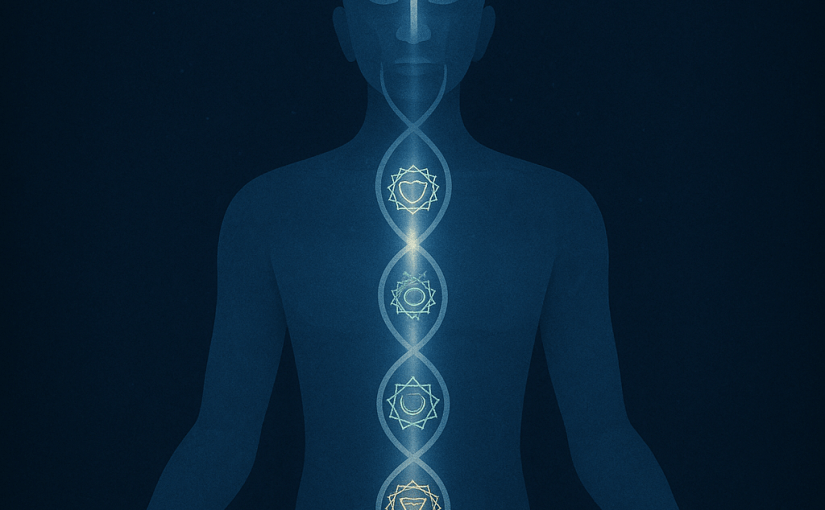
In ordinary life, Ida and Pingala—the two primary energy nadis—crisscross at each chakra. This means that even in average people, there’s some momentary merging at each chakra. However, the difference between an ordinary person and a yogi lies in awareness, intensity, and continuity:
- In ordinary life, the merging is occasional, unconscious, and often overshadowed by external desires.
- In a yogi, the merging is conscious, prolonged, and backed by focused inner practice. Over time, the whole Sushumna Nadi (central channel) becomes activated—not just at a few points.
This is when Ida and Pingala no longer appear as distinct currents; their merging becomes a continuous inner reality, and the double-helix pattern dissolves into unified stillness.
This merging isn’t just symbolic. In the deeper yogic sense, it reflects a shift in the internal flow of prana and apana that normally act in opposite directions. In higher states, these opposing energies begin to neutralize each other, leading to the awakening of the central channel—Sushumna Nadi.
🌬️ Prana and Apana: Two Key Inner Forces
Prana Vayu:
- Upward-moving energy
- Governs heart, lungs, perception, thoughts
- Related to Ida Nadi
Apana Vayu:
- Downward-moving energy
- Governs elimination, reproduction, grounding
- Related to Pingala Nadi
Even though they operate across the body, their tendencies match these nadis. So:
Ida ≈ Prana Vayu (inward, mental, cooling)
Pingala ≈ Apana Vayu (outward, physical, heating)
This mapping is not rigid but offers great practical value for meditative and breath-centered practice.
⚖️ Merging: The Real Game Begins
When Prana and Apana become equal and opposite, they cancel each other energetically. This doesn’t mean nothing is happening—rather, a new dimension opens:
- Breath stops naturally (Keval Kumbhak)
- Energy no longer flows outward
- Consciousness turns inward and rises
- Kundalini begins to move up through Sushumna
This silent movement is often not dramatic. Many sincere practitioners feel:
- No visions or sounds
- No sparks or shakes
- Just a subtle bliss rising silently, like a warm cord up the spine
🧘 Experiences During Keval Kumbhak
Many practitioners are confused why they don’t feel dramatic experiences or visions during Keval Kumbhak (breathless stillness). But here’s what actually happens:
- When the breath stops, awareness becomes like a still lake.
- If enough sexual or vital energy has been conserved and sublimated, it silently starts rising.
- This rising is not a rush. It is like a slow-moving, blissful river that moves upward—sometimes pausing, sometimes progressing.
You may not see lights or hear celestial sounds. That’s okay. In fact, deeper stillness often lacks sensory signs. Instead, you may feel:
- Expanded space within your head or body
- A rising coolness or subtle joy
- Whole spine occasionally lighting up like a blissful electric cord
These are signs of energy stabilizing into Sushumna.
👁️ The Role of Ajna Drishti (Upward Gaze)
When you gaze upward internally toward the Ajna Chakra (brow center) with closed eyes:
- Awareness naturally rises
- Breath becomes subtle or ceases
- A sense of infinite inner sky or spaciousness may appear
This is not fantasy—it’s your consciousness expanding beyond the limits of body and breath.
🔁 Double Helix and Beyond
Initially, Ida and Pingala crisscross like a double helix, touching each chakra. But once Sushumna is fully active:
- The duality dissolves.
- Ida-Pingala disappear as identities.
- What remains is oneness, a steady current of awareness.
That’s why in higher states:
No double helix remains. Only unified current exists.
This transition from dual energy to unity marks a yogi’s maturity. The whole spine becomes a channel of silence, bliss, and luminous intelligence.
📘 Are They the Same Thing?
While Ida and Pingala are not exactly the same as Prana and Apana, their functions deeply align. Ida is often associated with the cooling, inward, and upward-moving energy, which resembles the characteristics of Prana Vayu—the life force responsible for perception, breath, and higher awareness. Pingala, on the other hand, is linked to the heating, outward, and downward-moving energy, which mirrors the traits of Apana Vayu—the force governing elimination, grounding, and reproductive functions. So, we can loosely say: Ida resembles Prana Vayu, and Pingala resembles Apana Vayu. While not identical, this mapping offers a practical way to understand how inner energies function and balance during yogic practice.
While they are not exactly the same, their functions are deeply intertwined.
🧘 The Yogi’s Difference
In ordinary humans:
- Ida and Pingala briefly touch and activate chakras.
- Their merging is fragmented and short-lived.
In yogis:
- Ida and Pingala merge fully at each chakra.
- Eventually, their union rises through the entire Sushumna.
- The breath stills, mind becomes centered, and awareness ascends.
That’s the true yogic milestone.
🧬 Advanced Clarification: The Five Vayus
There are five major Pranic forces:
- Prana Vayu – Inward, upward
- Apana Vayu – Downward, grounding
- Samana Vayu – Digestive balance
- Udana Vayu – Speech and spiritual rise
- Vyana Vayu – Circulation, coordination
Though all exist throughout the body, Ida and Pingala mostly express the balance of Prana and Apana.
When these two are balanced:
- The body becomes light
- Breath may spontaneously suspend
- Consciousness detaches from lower centers and ascends toward the higher chakras
🧭 Final Takeaway:
- Ida ≈ Prana Vayu
- Pingala ≈ Apana Vayu
- Their perfect balance leads to Keval Kumbhak, where the mind, breath, and duality stop.
- Then Sushumna activates, and the path to true realization opens.
This is the yogic science behind Kundalini, nonduality, and spiritual transformation.

 Demystifying Kundalini