Chapter 30: The Ultimate Realization – The Universe Within

Hi friends,

I’m thrilled to share with you the final and concluding chapter of my series—now compiled and released as a brand-new book titled “Journey Beyond Earth: A Veterinarian’s Life on the Moon.”

This book has been a labor of love, imagination, and curiosity, blending the science of veterinary care with the wonder of lunar exploration. Through the eyes of a dedicated veterinarian stationed on the moon, the narrative takes you beyond the boundaries of Earth—into a world where healing, survival, and emotional resilience are just as vital in space as they are here at home.

In this concluding chapter, I’ve wrapped up the experiences, emotions, and lessons of life beyond Earth. It’s more than just a story—it’s a reflection on adaptation, empathy, and what it truly means to care for life, no matter the planet.

If you’ve followed this journey from the start, thank you for being part of it. And if you’re new here, you’re warmly invited to explore this imaginative tale from the beginning. The full book is now available, and you’ll find the official introduction at the end of this post to give you a feel for what lies ahead.

Your support, comments, and shares mean the universe to me.

Stay curious, and keep reaching for the stars!

The Ultimate Realization – The Universe Within

The vast, silent abyss stretched infinitely around them as the ship drifted through the cosmic void. The crew lay in their cryogenic pods, their bodies suspended between life and oblivion. Yet, even in this profound stillness, something stirred within Aryan Verma’s consciousness. It was not a dream, nor was it mere thought—it was awareness itself, floating free of form, untethered from the body yet deeply present.

As time lost meaning, an understanding dawned upon him: this was not death, nor was it the ultimate yogic samadhi. Cryogenic suspension was a state of subconscious dormancy, an artificial sleep that neither liberated the mind completely nor bound it to earthly chaos. It was like the twilight between waking and deep sleep—a space where the soul rested but did not dissolve.

“Had it been the final state,” his thoughts echoed in the infinite blackness, “then why would there still be a journey ahead?”

When he finally emerged from his frozen slumber, the first thing Aryan felt was an overwhelming sense of vastness—not of outer space, but within himself. His body awakened slowly, but his mind had already traversed distances that no spacecraft ever could. As he adjusted to the dim glow of the ship’s control panel, he saw Meera, Avni, and Ansh stirring in their pods.

Meera’s voice was the first to break the silence. “That felt like…dying. But not really.”

Aryan looked at her, his eyes carrying an inexplicable serenity. “Yes, stepping into cryostasis was like willfully surrendering to the unknown, much like the sages of old—Rishi Dadhichi, who gave up his bones for the gods, or King Shibi, who sacrificed his own flesh. It was a death of the known self, but not the end.”

Ansh, still groggy, yawned and stretched. “So…we’re still alive. But where are we now?”

Aryan turned to the ship’s navigation console. “Approaching the exoplanet,” he murmured, eyes scanning the displays. “But I feel as though I have already traveled further than any ship could take me.”

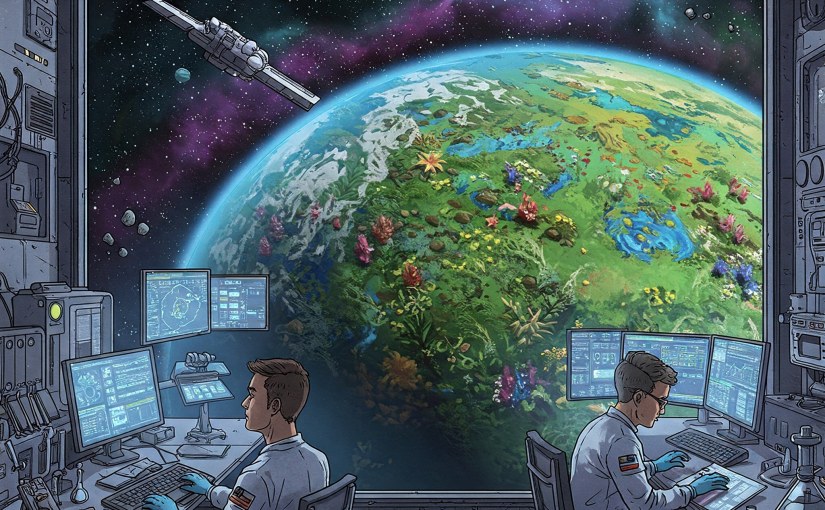
As the planet loomed ahead, its atmosphere shimmering like a mirage, Aryan’s thoughts drifted inward. Was this truly the final destination? Or was it only another mirage in the endless desert of existence?

Man had always sought new lands, new worlds, believing that space was his ultimate frontier. But space was not outside—it was within. The reason humans yearned for it was simple: the soul itself was space. It was infinite, boundless, and ever-expanding. To seek space outside was, in truth, an attempt to reunite with one’s own essence.

“Do you realize something?” Aryan said, turning toward his family, his voice carrying a quiet revelation. “Everywhere we have traveled, from Earth to the Moon, from the Moon to this distant world—what were we truly searching for? Space? We already have it within us.”

Meera nodded slowly, understanding dawning in her eyes. “Yet, where there is pure space, the body cannot survive. And where there are the resources for life, space feels distant because of the chaos of existence. It’s a paradox.”

“Exactly,” Aryan agreed. “But if we put in the right effort, we can create a space within ourselves that is untouched by chaos—a stillness that remains, no matter where we are. That is the true journey. Not outward, but inward.”

Avni, always the most skeptical, smirked. “So are you saying all of this was unnecessary? That we could have just stayed on Earth and meditated instead?”

Aryan laughed. “In a way, yes. But experience is the best teacher. Without this journey, would we have truly understood? Sometimes, one must travel outward to realize that the destination was within all along.”

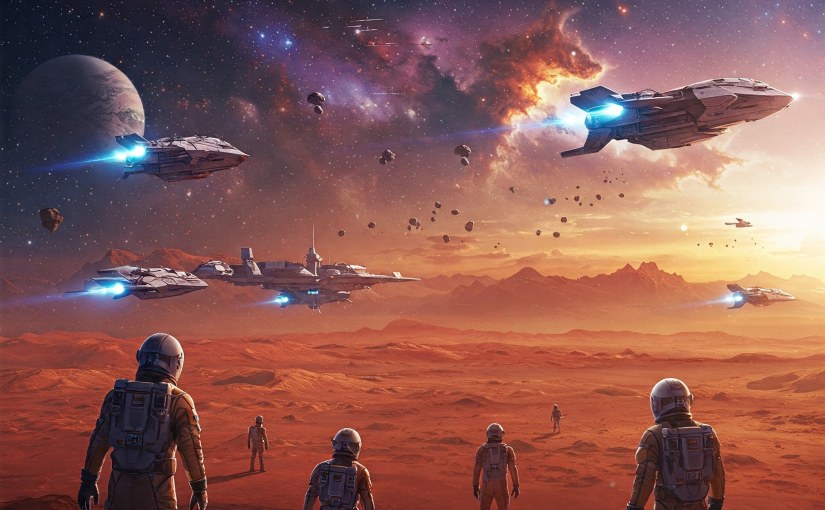
The ship descended into the exoplanet’s atmosphere, golden clouds swirling beneath them. But even as they prepared to set foot on a new world, Aryan knew the greatest journey had already been taken.

Everything, everywhere, was only space. The illusion of matter was but a fleeting ripple in the ocean of the infinite. And the ultimate realization? That the universe they had sought was within them all along.

As the ship touched down, Aryan closed his eyes for a moment. Not to rest, but to witness the cosmos unfolding within.

A thought lingered in his mind—where there is only space, survival is impossible; where there is life, space is hidden behind the veil of activity. But those who master the balance between both worlds attain true freedom.

The journey had ended.

And yet, it had only just begun.

Illustrator’s Note

As someone who has visually walked alongside the themes of this book, I couldn’t help but reflect on the paradox of renunciation. People who mock or resist it often don’t do so out of conscious defiance. Rather, they seem driven by a subconscious belief: that one must first accomplish something tangible—perhaps even awaken the Kundalini and attain self-realization—before taking the next step of renunciation. Otherwise, it feels hollow, like a shortcut taken too soon. In a way, they expect you to prove yourself in the physical world before choosing to transcend it.

Ironically, it’s often during that very pursuit—while striving and struggling in the material world—that energetic awakening begins to unfold on its own. Yet, most people can’t recognize a purely mental or inner awakening unless it’s accompanied by visible, physical achievement. Physical success is what the world readily acknowledges. Only a rare few see deeper—valuing an awakening that’s subtly blended with outer accomplishment more than mere worldly success alone. That’s where many misconceptions arise: we’re wired to believe only what we can see, touch, and measure.

As I illustrated these concepts, I found myself contemplating this quiet mystery—the way the spiritual and the worldly intertwine, often when we least expect it.

Book introduction

Life has a way of turning ordinary journeys into extraordinary adventures. Our family’s story is woven with countless road trips—long drives between home and work, where the car became more than just a vehicle; it was a space of bonding, laughter, and shared dreams. As our children grew, so did our conversations, shaped by the endless roads stretching ahead of us.

One day, during one such journey, a thought struck me—”Why not see everything as connected to space?” It was a simple idea, yet it sparked a wave of imagination in our travels, turning even the most routine landscapes into cosmic wonders. The sheer joy and satisfaction we felt in these discussions made the universe seem closer than ever. I think it was the open mind of the child journeying with us that inspired me to think beyond the ordinary and imagine all this.

And then, the idea of this book-cum-novel was born. It wasn’t something I planned or struggled with—it simply flowed, as if it had always been waiting to be written. This short novel is a unique combination of science fiction and autobiographical reality. Just like the dual nature of matter—both wave and particle—this story, too, holds two truths at once. It is as real as it is fictional. What one perceives, it becomes. It dances between fact and imagination, shaped by the reader’s own lens.

Interestingly, I had always written under a pen name, choosing to keep my identity undisclosed for various reasons. My son, though, was never really a fan. He’d tease me all the time, saying stuff like, “Papa, your pen name is totally lame!” All I could do was laugh and shake my head. So, for the first time, I made a different choice—I wrote this book in his name instead of mine. It felt like the perfect tribute to the youngest member of our family, who was just a little child—still in nursery and kindergarten—when we first stepped beyond the comfort of home and into a world of endless possibilities.

This book is more than just a story; it’s a reflection of our journey, a blend of love, curiosity, science, and dreams—and the belief that no destination is too far—not even the moon.

🚀 Just Launched!
My new eBook is now available worldwide on Amazon Kindle!
No matter where you are, you can grab your copy using this universal link:
👉 https://www.amazon.com/dp/B0F3PYFJ6Z

Or

https://mybook.to/uY0kt

📖 Dive in, enjoy the journey, and don’t forget to leave a review if you like it.
Your support means the world! 🌍✨

Chapter 29- The Last Message to Earth

Dr. Aryan Verma’s consciousness flickered like a distant flame, caught between the abyss of time and the pull of an unseen future. The deep silence of cryogenic sleep had no dreams, no sensations—only an eternal pause, a breath held by the universe itself. But something stirred in the depths of his being, a whisper that was neither memory nor vision, but something beyond.

He was weightless, yet he felt motion. A slow, gentle pull, like being carried by an invisible river. And then—a sudden awareness. Not of his body, but of his mind, awakening like the first rays of dawn breaking over an untouched world.

A soft chime echoed through his pod. Systems were engaging. Cryogenic stasis was ending.

His eyelids felt heavy, but he forced them open, blinking against the dim light of the spacecraft’s interior. The cold sensation faded as warmth coursed through his limbs, his body reanimated from its deep slumber. He inhaled sharply, a sudden rush of air filling his lungs. The process was seamless, yet unsettling—like waking from death itself.

One by one, the pods around him began to hum with life. Meera, Avni, and Ansh emerged slowly, their eyes fluttering open, confusion and wonder battling in their gazes.

“Dad?” Avni’s voice was hoarse. “We made it?”

Aryan swallowed, his throat dry. “We’re awake.”

Meera sat up, pressing her fingers against her temple. “How long…?”

A holographic interface flickered before them. The system’s voice, smooth and artificial, provided the answer: ‘Time elapsed: 27 years, 4 months, 13 days.’

A silence thicker than space itself settled among them.

Ansh was the first to speak, his voice barely above a whisper. “Twenty-seven years?”

Avni gasped. “That means… everyone we knew on Earth… they’ve aged. Some might not even be alive.”

The weight of time bore down on them. The world they had left behind had moved on without them, reshaped by years they had never lived.

Meera exhaled sharply, composing herself. “We knew this would happen. We prepared for it.”

“Yes,” Aryan said, though the words felt hollow. The mind could accept, but the heart resisted.

A sudden beep interrupted his thoughts. The interface projected a flashing message—one marked with a priority code from the Lunar Space Station. A relic from the past, waiting for them in the present.

“An old transmission?” Aryan muttered, accessing the file.

The screen flickered, and a familiar face emerged—a much older Dr. Raman, the director of the Lunar Colony. His hair had grayed, his eyes lined with time, but his gaze held the same intensity Aryan remembered.

“Dr. Verma,” Raman’s voice was calm, yet heavy with emotion. “If you are receiving this, then you have awoken. I do not know what awaits you, but I trust you have reached the edge of a new world.” He paused, his expression darkening. “Much has changed since you left.”

Aryan’s heart pounded. Something was wrong.

“The Earth…” Raman hesitated, as if struggling to find the right words. “It is not the world you remember.”

A chill ran through Aryan’s spine.

“In the decades after your departure, the planet faced trials beyond our worst fears. Climate shifts accelerated. Nations fought over dwindling resources. Technology advanced, but at a cost. The balance was lost. And now… the Earth you left behind is—”

The message cut off abruptly. Static filled the screen.

“Wait, what?” Avni leaned forward, panic flashing in her eyes. “That can’t be it!”

Aryan frantically scrolled through the data. The transmission had been interrupted. Whether by technical failure or deliberate action, they would never know.

Ansh’s voice wavered. “Is Earth… still there?”

A heavy silence stretched between them.

Meera closed her eyes, inhaling deeply. “Whatever happened, we cannot change it now.”

Aryan ran a hand through his hair, his mind racing. The Earth they had once known was now a mystery. Perhaps lost. Perhaps changed beyond recognition. But one thing was certain—if they had ever considered turning back, that door was now closed.

Avni looked at her father, eyes wide with a mixture of fear and determination. “What do we do now?”

Aryan met her gaze, steadying himself. “We move forward.”

As they prepared to leave behind their past forever, Aryan reflected on the nature of cryogenic sleep. It was not an experience of space, nor could it be compared to the ultimate yogic samadhi of mindlessness. If it were, there would be no urgency to race towards the unseen future. Instead, it was a suspension—a state of the subconscious mind lingering between existence and absence, neither here nor there. True stillness, as the great sages had taught, was not merely the absence of movement but the cessation of all longing, all seeking. And yet, here they were, still searching, still yearning for a new home.

And so, with the weight of the unknown pressing upon them, they turned their eyes toward the distant exoplanet—their new home. Whatever awaited them there, it was no longer just an exploration. It was a destiny they had no choice but to embrace.

The past was behind them. The future was uncharted. And the last message from Earth remained a whisper lost in the void, an unanswered question lingering in the vastness of space.

Chapter 28- The Final Journey to a New Home

Dr. Aryan Verma took a deep breath, his fingers tightening around the edge of his desk as he stared at the departure schedule glowing on the large screen before him. The moment had arrived—the final steps of their lunar existence before embarking on a journey unlike any other in human history. A distant exoplanet, carefully chosen for its habitability, was about to become their new home.

The air in their lunar habitat was thick with anticipation. Meera, his wife, paced slowly, her arms folded across her chest, lost in thought. Avni sat on the couch, her brows furrowed as she tapped absentmindedly on her tablet. Ansh, on the other hand, bounced excitedly on the balls of his feet, utterly fascinated by the idea of traveling beyond the Moon.

“You’re still sure about this, aren’t you?” Meera finally broke the silence, her voice softer than usual.

Aryan turned toward her, catching the unspoken emotions in her eyes—excitement, nervousness, a flicker of doubt.

He walked over, placing his hands gently on her shoulders. “We’ve made it this far, Meera. There’s no turning back now. But if you’re having second thoughts—”

She shook her head. “No… it’s just… leaving the Moon, our first step beyond Earth, everything we’ve ever known. It feels like a dream. Or maybe a dream within a dream.”

Avni looked up. “You mean like how the yogis say reality is just layers of perception?”

Aryan smiled. His daughter had a way of bringing philosophy into even the most scientific discussions. “Exactly,” he said. “And perhaps, we’re just peeling away another layer of reality as we step into the unknown.”

The room fell into a contemplative silence, broken only by Ansh’s enthusiastic interjection. “But we’ll still have Wi-Fi, right?”

A burst of laughter rippled through the family, dispelling the tension like sunlight breaking through a storm.

The final preparations had been meticulous. Their belongings had been reduced to the essentials—clothing designed for the new planet’s conditions, medical supplies, Aryan’s veterinary equipment, and a few personal mementos. The children had carefully selected items that reminded them of their lunar home: Avni had packed her sketchbook, while Ansh had insisted on bringing his stuffed dinosaur, Rexy, despite the teasing from his sister.

The departure schedule was precise. Aboard the Stellar Voyager, they would leave the Moon’s surface, dock with the interstellar ark stationed nearby, and then embark on the long journey to the exoplanet. The voyage itself would span years in cryogenic sleep, a reality both thrilling and unnerving.

As they stood at the embarkation bay, a sea of emotions swirled in Aryan’s chest. This was not just another relocation—it was a leap into the great cosmic unknown. His mind drifted to the spiritual texts he had read, the ancient sages who spoke of leaving behind the transient for the eternal. Was this journey a mere physical transition, or was it symbolic of something far greater?

A low hum filled the air as the ark’s engines powered up. The final boarding call echoed through the lunar station. With one last glance at the silent, grey expanse through the massive observation windows, Aryan took Meera’s hand. She squeezed back, her silent affirmation giving him strength.

As the family settled into their stasis pods aboard the ark, a thought struck Aryan with profound clarity. To step into cryogenic sleep was to willfully embrace a kind of death—a concept unheard of except among the greatest of sages. He recalled the tale of Rishi Dadhichi, who surrendered his bones for the benefit of the gods, and the ancient king (Raja Shibi) who gave his own flesh to compensate for the loss of meat. Here they were, surrendering their waking existence, trusting that they would rise again in a new world. This was not just science; it was a sacrifice, a test of faith in the unseen future.

Avni gazed at the starry void outside. “It’s beautiful,” she whispered, watching the Moon shrink in the distance.

Ansh leaned over. “I still think the new planet will be cooler.”

Aryan chuckled. “I hope you’ll say the same when we wake up there.”

The transition into cryogenic sleep was both fascinating and unnerving. Aryan felt his consciousness slip away, his last waking thoughts filled with wonder and anticipation. Would they wake up to a paradise or a challenge beyond comprehension?

The journey had begun, and the universe awaited.

Chapter 26- The Search for the Next Destination 

Part 6: A New Beginning and the Universal Truth

The Search for the Next Destination

Dr. Aryan Verma sat in the main research hub of the Moonbase, his fingers gliding across the holographic console. The decision had been made—humanity’s journey was far from over. Now came the next challenge: finding the right destination.

Meera entered the room, her eyes scanning the array of star maps and planetary data floating in midair. “So, where do we begin?”

Aryan smiled, his excitement barely contained. “We’ve been looking outward for years, Meera. But now, we truly have to think beyond the Moon, beyond Mars. Somewhere sustainable, somewhere we can call home for generations.”

Ansh, who had been silently observing from the corner, suddenly perked up. “Dad, have you checked Kepler-442b? It’s been on the list of potentially habitable planets for years! Its star is stable, it’s within the habitable zone, and—” He paused, flipping through data projections. “Look at this! It has a 97% probability of Earth-like conditions!”

Avni leaned over his shoulder, impressed. “So, we’re talking oceans, an atmosphere, and maybe even plant life?”

“That’s the hope,” Aryan confirmed. “But there’s more to consider. Distance. Resources. Feasibility of travel. The farther we go, the harder it gets.”

Meera folded her arms, ever the practical one. “And what about the unknown variables? We might be walking into an ecosystem that isn’t as friendly as we assume. What if we’re not alone there?”

A hush settled over them. The thought had always lingered in the background. Space was vast, and they had no illusions of being the only intelligent species in the cosmos.

Ansh, still glued to his screen, broke the silence. “We could send a probe first. AI scouts can map the planet, analyze its atmosphere, and even detect signs of advanced life.”

Aryan nodded. “That’s a logical step. But we must act fast. The Interstellar Expansion Initiative has other teams researching destinations, and we can’t afford to lag.”

Avni smirked. “So, it’s a space race? Good. I always wanted to be part of one.”

The next few weeks were a whirlwind of calculations, projections, and simulations. Aryan worked alongside some of the best minds on the Moonbase, analyzing planetary candidates one by one. Kepler-442b remained a strong contender, but there were other possibilities—Proxima Centauri b, a planet orbiting the closest known exoplanetary system, and Luyten b, which had conditions remarkably similar to Earth’s prehistoric climate.

During one of their late-night discussions, Meera noticed Aryan staring at the screen with an almost trance-like focus. She placed a warm hand on his shoulder. “You look like a man searching for something more than just a new planet.”

He exhaled deeply. “Maybe I am. You ever get the feeling that we’re being guided? That we’re not just choosing this path, but it’s choosing us?”

Meera considered his words. “You’ve always been drawn to the unknown, Aryan. But I think it’s more than that. You don’t just want to find a new home. You want to find meaning.”

He chuckled softly. “And maybe that meaning isn’t in a place, but in the journey itself.”

The first probe was launched toward Kepler-442b, carrying an array of instruments designed to analyze every aspect of the distant world. The transmission delay meant it would take time to receive detailed reports, but the first images sent back left them in awe.

A breathtaking landscape unfolded before them—a vast expanse of cerulean oceans, emerald forests stretching beyond the horizon, and towering mountain peaks glistening under an alien sun.

Ansh gasped. “It looks like Earth before civilization! This is incredible!”

Avni’s eyes gleamed. “No dust storms, no barren wastelands. Just pure, untouched nature.”

Meera, despite her initial hesitation, couldn’t help but smile. “It’s beautiful.”

Aryan, however, remained silent, staring intently at the data stream. The atmosphere was stable, oxygen levels were compatible, and there were clear signs of an active biosphere. But something felt… off. A presence. An unshakable sense that they weren’t just discovering this planet—it was watching them back.

“What is it?” Meera asked, noticing his change in expression.

“I don’t know,” he admitted. “But I feel like… we just stepped into something far bigger than we understand.”

As the final reports trickled in, a decision loomed. Kepler-442b was viable. It was everything they had hoped for and more. But something inside Aryan whispered caution. He had spent years learning to trust his instincts, and now they urged him to dig deeper.

One evening, as he wandered the lunar surface alone, the stillness of space pressing in around him, a realization struck him. The universe was not just a collection of rocks and gases—it was alive. And every step they took deeper into it was a step into a greater, unfolding mystery.

The question was no longer whether they could go. The question was whether they were truly ready for what they might find.

As Aryan turned back toward the base, he knew that the next chapter of humanity’s journey was about to begin. But this time, it was not just about survival or exploration.

It was about awakening.

Chapter 27- Convincing the Family & Making Preparations

Dr. Aryan Verma stood at the observation deck of the lunar colony, gazing at the vast, endless stretch of stars beyond the Moon’s horizon. The search for the next destination had opened doors he had never thought possible. The mysteries of the cosmos whispered through the silence, inviting him to step further into the unknown. But before he could embark on this new journey, there was one significant challenge—convincing his extended family back on Earth.

His desire for awakening was pushing him further and further away from earthly entanglements. The energy being dissipated in the chaos of worldly affairs could instead be channeled into dedicated efforts for spiritual realization. This was not unique to him—when one’s worldly pursuits ripen, a natural drift towards solitude begins, often disguised under various excuses. And when a deep spiritual longing is interwoven with these efforts, the pull becomes even stronger. Now, standing at the threshold of a cosmic journey, Aryan felt the inevitable call of both destiny and awakening.

His nuclear family—Meera, Avni, and Ansh—had already embraced the idea with excitement, eager to explore what lay beyond. But now, it was time to inform their loved ones on Earth, to seek their blessings, and to address their inevitable concerns.

He connected to the Earth communication link, and soon, the holographic images of his parents, Meera’s parents, and their closest relatives materialized in front of him. The warm familiarity of their faces made the moment even more poignant.

“Aryan, what’s this urgent family meeting about?” his father asked, his voice tinged with curiosity.

Aryan took a deep breath. “We’re leaving the Moon. We’re traveling further into space—to explore an exoplanet that might hold signs of life.”

Gasps echoed through the connection. His mother’s face turned pale. “Beta, you already left Earth, and now you want to go even further?”

Meera’s mother shook her head in disbelief. “Meera, do you really think this is safe?”

Meera reached for Aryan’s hand, steady and firm. “Yes, Maa. We have thought this through. We are prepared.”

Aryan’s father sighed. “But why? Haven’t you achieved enough? Isn’t the Moon far enough?”

Aryan smiled gently. “Baba, every great journey in history has always had people asking, ‘Why go further?’ But if no one had dared, humanity would still be confined to a single continent, let alone a single planet.”

His mother wiped a tear. “But what if something happens to you? What if you never return?”

Ansh, who had been listening silently, spoke up. “Dadi, we’re not running away. We’re moving forward, discovering new things, making history. And we’ll always be connected.”

Avni added, “And just imagine… one day, you might visit us on a whole new world!”

The elders exchanged uncertain glances. Aryan’s father finally sighed. “I won’t pretend to be happy about this. But I trust you. If this is what you must do, then go with our blessings.”

Meera’s mother, still hesitant, nodded. “Just promise us you’ll stay safe.”

Aryan smiled. “We promise.”

The Challenges for Avni and Ansh

After the initial shock settled, Aryan’s father raised another concern. “Aryan, what about the children? Their education, their social life? They’ve already changed schools, curriculums, and friends so many times. They’re like rolling stones, never settling anywhere.”

Aryan nodded, expecting this concern. “Baba, I understand. It hasn’t been easy. But do you realize how much they’ve learned? More than they ever could have back on Earth.”

Meera’s mother sighed. “But stability is important for children. They need roots, traditions, a familiar environment.”

Avni smiled. “Dadi, I used to think that too. But moving and adapting has made me stronger. I’ve learned how to make friends anywhere, how to handle change without fear.”

Ansh grinned. “And I’ve studied things most kids on Earth never even dream about! I’ve seen Earthrise from the Moon, learned how space agriculture works, and even studied planetary geology firsthand.”

Aryan added, “They aren’t just memorizing textbooks; they’re experiencing knowledge. Every new place, every challenge has taught them resilience, curiosity, and adaptability. These are lessons no school can provide.”

Aryan’s father was silent for a moment before he sighed. “I see your point. Still, I just want to be sure they’re happy.”

Meera reached out, touching the screen. “They are, Baba. They’re thriving.”

The Preparations Begin

Once the decision was solidified, preparations began in full force. Aryan and his family were fitted for advanced exo-suits that could adapt to fluctuating temperatures and atmospheric conditions. Their spacecraft, named Vyomnaut, was undergoing final testing. Supplies were being curated—everything from genetic seeds to emergency medical kits.

As they packed, Aryan found himself sitting with Avni and Ansh in the habitat’s observation dome, watching Earth as a distant, glowing orb.

Avni broke the silence. “Do you ever miss it? Earth, I mean.”

Aryan smiled. “Every day. But missing something doesn’t mean regretting leaving it.”

Ansh tilted his head. “Do you think we’ll ever go back?”

Aryan’s gaze softened. “Maybe one day. But for now, forward is the only direction.”

A Farewell to the Moon

As the launch date approached, the lunar colony gathered for a farewell ceremony. Their fellow scientists, researchers, and astronauts wished them luck, some envious, some relieved they weren’t the ones venturing into the deep unknown.

One of Aryan’s closest colleagues, Dr. Wei, pulled him aside. “Are you ready for this, Aryan? Really ready?”

Aryan nodded. “As ready as anyone can be when staring into infinity.”

Wei chuckled. “You always did have a way with words. Just… be careful. The universe is vast, and not everything out there will be welcoming.”

Aryan placed a hand on his friend’s shoulder. “Neither was the Moon at first. But we adapted. That’s what we do.”

The final night before departure, Aryan and Meera sat together, gazing at the stars through their dome window. She leaned against him, her voice barely above a whisper. “Promise me we’ll stay together, no matter what happens.”

He kissed the top of her head. “Always.”

As dawn—artificial as it was—rose over the lunar horizon, they boarded Vyomnaut. The engines hummed, systems activated, and the countdown began.

“Three… Two… One… Liftoff.”

As the lunar surface shrank beneath them and the vast unknown stretched before them, Dr. Aryan Verma knew one thing for certain.

Their journey beyond Earth had only just begun.

Chapter 25- The Call to Move Beyond the Moon

Dr. Aryan Verma gazed at the sprawling lunar horizon through the observation deck of their Moonbase. The events of the Great Space Exodus still played vividly in his mind—the chaos, the uncertainty, and the immense courage it had taken to leave Earth behind. But now, standing amidst the quiet hum of the station, his mind wandered beyond this grey, cratered expanse. He felt the call of something greater, something beyond the Moon, beyond all that humanity had known.

Meera, his ever-astute companion in this interstellar odyssey, noticed the distant gleam in his eyes. She approached him gently, her voice calm yet firm. “Aryan, I see it in your eyes again. That longing.”

He sighed, offering a soft chuckle. “Am I that predictable?”

“Only to those who love you enough to see past your silences.” She squeezed his arm. “Tell me what it is this time.”

He turned fully to her, his gaze deep and searching. “The Moon was never meant to be our final destination. We carved out a home here, but I still feel the pull of the unknown. Mars, maybe? Or even the exoplanet colonies that they say might be the next frontier.”

Meera studied him for a moment before nodding. “You sound like a man searching for something he can’t quite name.”

“Maybe I am. Or maybe it’s just that… even after all this, the silence of space whispers something more. Something beyond.”

Their conversation was interrupted as Avni and Ansh burst into the room, their faces glowing with excitement. “Dad, you’ve got to see this!” Ansh exclaimed, dragging him toward the main console.

A new transmission flickered on the screen—a classified message from the Interstellar Expansion Initiative. It spoke of an ambitious plan: the first human settlement beyond the Moon and Mars, out in the vast cosmic wilderness, where new worlds awaited their touch.

Avni, ever the bold one, grinned. “Looks like the universe just answered your call, Dad.”

Aryan’s heart pounded as he scrolled through the mission details. It was unlike anything they had attempted before. The Moon was a stepping stone, Mars had been theorized for decades, but this… this was a leap into the abyss, a voyage into the truly unknown.

Meera peered over his shoulder, her brow furrowed in concern. “This isn’t just exploration anymore, Aryan. It’s a journey into mystery itself. Are we ready for this?”

“Were we ever truly ready to leave Earth?” Aryan countered, his voice laced with both excitement and trepidation. “Yet we did. And look at what we’ve built here.”

Silence settled between them, heavy with the weight of decisions yet to be made.

That night, Aryan found himself wandering the lunar fields alone. The Moon, once so alien, had become home. He had learned its language, its rhythms, its stark yet haunting beauty. Yet deep within, he felt a pull—a force as ancient as time itself. He recalled the stories of sages and mystics, those who left the known behind, not for conquest, but for enlightenment. Was this any different? Was his yearning not just another form of that eternal seeking?

A voice interrupted his musings. “You know, Dad, you talk to yourself a lot when you think no one’s watching.”

Aryan turned to find Avni standing there, a playful smirk on her face.

“Comes with age,” he replied, grinning.

She joined him, gazing at the stars above. “Do you think there’s something waiting for us out there? Something more than just rock and dust?”

Aryan smiled, impressed by his daughter’s insight. “I think… space is more than what we see. Every step forward in exploration feels like an echo of something ancient, something we were always meant to find. Maybe it’s just more planets. Or maybe, just maybe, it’s something beyond what our minds can grasp.”

She exhaled deeply. “That’s what I feel too. Like we’re chasing something invisible, yet so real.”

He looked at her, his heart swelling with pride. “Then maybe we should follow that feeling.”

In the days that followed, the discussion within their family deepened. Ansh, the ever-curious scientist, poured over maps of potential exoplanets, his eyes wide with wonder. “Dad, there are planets with oceans of liquid methane, some with endless storms, some that glow in the dark! Can you imagine?”

Meera, ever the voice of reason, raised a practical concern. “But what about life here? We’ve established roots. We have a home. Would we abandon all of it for another unknown?”

Aryan met her gaze, his voice soft yet unwavering. “Or would we be honoring everything we’ve done by taking the next step?”

One evening, as they sat around their modest dining table, Aryan finally asked, “So, what do we do? Do we stay, or do we go?”

Avni, never one to hesitate, grinned. “I vote go. I mean, come on! How many people get the chance to be part of something this monumental?”

Ansh nodded vigorously. “Me too! Imagine the discoveries, Dad. New ecosystems, new life forms!”

Meera sighed, shaking her head with a fond smile. “I should have known I was outnumbered before this discussion even started.”

Aryan chuckled, reaching for her hand. “You don’t have to decide now. But let’s at least explore the possibility.”

And so, the preparations began. Aryan found himself consulting astronomers, engineers, and even spiritual thinkers. The more he learned, the more he realized that this journey wasn’t just about space—it was about evolution, not just of humanity, but of consciousness itself.

One evening, as he sat alone in the observation deck, he felt a presence beside him. It was Meera. “You know, there was a time I thought Earth was the only home we’d ever have. Then we came here. And now… the universe just keeps expanding, doesn’t it?”

Aryan nodded. “It does. And so do we.”

She took a deep breath, then smiled. “Alright. Let’s do it. Let’s go beyond the Moon.”

As they stood together, gazing into the infinite expanse, Aryan felt something shift within him. The call had been heard. The journey had only just begun.

Chapter 24: The Great Space Exodus

Many years have passed since the great space exodus, yet the echoes of that desperate journey still linger in the hearts of those who witnessed it. What unfolded during those days was both awe-inspiring and tragic—a tale of survival, longing, and the unbreakable pull of home. Even now, as we recount those moments, it feels as vivid as if it happened just yesterday.

Fading Footsteps in the Stars: Memories of a Distant Home

The silence of the moon felt heavier than usual. The news of the lockdown had sent ripples through the lunar colonies, and now, after the epidemic’s peak had passed, the real crisis had begun—an exodus unlike anything ever recorded in human history.

Dr. Aryan Verma sat by the large observation window of his lunar residence, watching Earth glow like an unreachable paradise in the infinite void. His wife, Meera, prepared synthetic tea in the small kitchenette, her movements betraying her unease. Avni and Ansh, their children, were unusually quiet, their young minds trying to process the chaotic events unfolding around them.

“Papa, why do they all want to go back?” Ansh finally asked, his small fingers tracing the edges of his space tablet. The news was filled with images of people struggling to leave the moon—some walking in space suits, others desperately clinging to the undersides of cargo shuttles.

“Because home is not just a place,” Aryan said, choosing his words carefully. “It’s a feeling, a memory, a deep pull of the heart. When everything feels uncertain, people want to be where they feel safe—even if the journey is dangerous.”

Meera sighed, placing a steaming cup in front of Aryan. “But Earth isn’t safe either. The lockdowns, the instability, the shortages… What are they really running towards?”

Avni, who had been scrolling through her holographic news feed, interrupted. “Some say the lunar government’s food and shelter aid isn’t reaching everyone. Others just don’t trust the system anymore. And then, some… they just miss the rivers, the wind, the real sky.”

Aryan took a sip of his tea, his mind wandering to the hundreds of patients he had treated in the last few weeks. The space epidemics had taken many lives, but this mass migration posed an even greater threat. With lunar travel restrictions still in place, desperate citizens were attempting the impossible—crossing space on foot.

The Walkers of Space

On the dark side of the moon, where government patrols were less frequent, clusters of people had begun their perilous journey toward Earth. Wearing outdated anti-gravity boots and cheap oxygen suits, they carried whatever food and water they could afford. Many had secured nano-oxygen capsules, hoping they would last the journey.

Aryan had seen them firsthand. Some of his old patients, mostly laborers and low-income workers, had bid him farewell with solemn faces. “Doctor sahib, we can’t stay here,” one had told him. “Better to die trying than wait for starvation.”

As the family watched the newsfeed, a shocking report came in—space migrants begging outside floating restaurants, their resources exhausted. Some had perished along the way, lost to the heat of the sun or frozen in the cold void. The most heart-wrenching cases were those who mistook abandoned space railway tracks as resting spots, only to be caught unaware when a high-speed shuttle approached.

An Unexpected Guest

That evening, as the family sat in quiet contemplation, their home alert system chimed. Someone was at their door.

Aryan opened it to find a young woman, her space suit tattered, her face pale from exhaustion. She clutched a small oxygen capsule in her trembling hands. Behind her stood a man, possibly her husband, supporting an unconscious child.

“Please… help us,” she whispered before collapsing.

Without hesitation, Aryan and Meera carried them inside. As a veterinarian, Aryan had limited experience with human medicine, but necessity made one adapt. With Avni’s help, he stabilized the unconscious child while Meera fetched energy supplements for the woman and her husband.

After some time, the woman stirred. “We tried to walk to Earth,” she murmured. “We… we thought we could make it.”

Aryan exchanged a glance with Meera. “How many others are out there?”

“Thousands,” the man croaked. “Some turned back. Some were caught by the patrols. Others… we don’t know.”

The Refugee Crisis in Space

In the days that followed, Aryan found himself involved in an underground effort to help stranded migrants. Some private space transporters had begun smuggling desperate travelers inside their cargo holds for exorbitant prices, evading the watchful eyes of the space administration. Meanwhile, a few innovative workers had created anti-gravity bicycles, allowing for a slightly faster and less exhausting journey through the void.

The lunar government had promised free shelter and rations, but the reality was starkly different. Aid distribution was chaotic, and corruption ran deep. The powerful hoarded supplies while the weak scavenged for survival. Together, Many people lost their jobs, and among them, many could never regain their lost employment.

One night, as Aryan sat in his clinic, a government official visited him.

“Dr. Verma,” the man said gravely, “We know you’ve been helping these people.”

Aryan tensed but met the man’s gaze steadily. “I’m a doctor. It’s my duty to help.”

The official sighed. “Look, I understand. But the situation is more complicated than you think. If too many people leave the moon at once, it’ll disrupt the entire interplanetary economy. We need stability.”

Aryan’s jaw tightened. “Stability for whom?”

The official had no answer. He simply handed Aryan a small data chip. “This is a list of people who have been granted emergency travel permits. If you know anyone eligible, tell them to register.”

As the man left, Aryan looked at the chip in his hand. It was something, but not enough.

The Mystic Wanderer

One evening, as Aryan walked the lunar surface, he came across an old sage-like figure meditating under the vast emptiness of space. The man, dressed in flowing robes unsuitable for lunar conditions, seemed unbothered by his surroundings.

Aryan approached cautiously. “Aren’t you cold?”

The man opened his eyes, revealing an unsettling depth of wisdom. “Cold and heat are illusions, my son. Just as life and death are.”

Something in Aryan stirred. “Do you believe these people will make it back to Earth?”

The sage smiled. “Those who truly need to return, will. Others… are meant to find a new home elsewhere.”

Aryan exhaled. “And what about me? I was never meant to be here.”

The sage chuckled. “And yet, here you are. The universe places us exactly where we need to be.”

With that, the old man closed his eyes again, dissolving into deep meditation as if he had merged with the cosmos itself.

A Decision

Back at home, Meera and the children awaited Aryan’s return. He entered, placing the data chip on the table. “We can help a few people leave. But we can’t save them all.”

Meera placed a hand over his. “But we will do what we can.”

Avni and Ansh nodded. They were just children, but they understood something profound—that in an unfair universe, kindness was the only true rebellion.

And so, under the artificial glow of the lunar domes, as the Earth continued to call its lost children home, the Verma family made their choice. They would help those they could, and for the rest, they would offer something just as precious—hope.

Though years have passed, the memories of that space exodus remain etched in the hearts of those who lived through it. The desperate footsteps across the void, the silent cries for help, the flickering hope in the darkness—each moment lingers like a distant echo, never fully fading. Some reached home, some found new destinies among the stars, and some were lost forever in the endless abyss. But one truth remains unshaken: no matter how far we travel, the call of home never truly leaves us. It is the pull of the familiar, the embrace of belonging, the whisper of the past that still finds us, even in the vast silence of space.

Chapter 23: Space Epidemics & Lockdowns

Just as the dust from the industrial expansion began to settle, bringing a fragile sense of balance, an unforeseen crisis loomed on the horizon. What had started as whispers in the medical quarters soon spiraled into a full-scale emergency—something far more insidious than environmental disruptions. The Moon, once a beacon of human progress, was now facing a silent, invisible enemy.

The Moon had always been a symbol of hope and expansion, a testament to human resilience in the face of the unknown. But now, an invisible enemy threatened its fragile ecosystem. A new kind of crisis loomed over the colony—an outbreak unlike any before.

The First Signs

It started with whispers in the corridors of the lunar medical unit. Patients arriving with symptoms that defied common lunar ailments—fever, dizziness, and difficulty in breathing within the Moon’s artificial atmosphere. Initially, it was dismissed as minor respiratory distress caused by recent industrial expansion. But then, the cases surged.

Dr. Aryan Verma sat at the dinner table, his face lined with worry. His wife, Meera, set down a bowl of steaming soup. “You’ve barely spoken today,” she said softly.

Aryan sighed. “Something’s happening, Meera. Cases of an unknown respiratory illness are rising fast. The med teams can’t figure out whether it’s a bacterial infection or some mutated lunar virus.”

Avni, their elder daughter, raised an eyebrow. “Mutated lunar virus? That sounds serious. How did it start?”

“No one knows yet,” Aryan admitted. “But it seems linked to the excavation sites.”

“The same ones where they found those strange energy fluctuations?” Meera asked, her voice tinged with concern.

Aryan nodded. “Exactly. We might have awakened something… and now it’s spreading.”

The Lockdown Begins

Within a week, panic set in. The Lunar Administration declared a full-scale lockdown. Colonists were confined to their habitation domes. The once-bustling corridors of the Moon’s industrial hubs were now eerily silent. Robotic drones patrolled the streets, broadcasting safety messages in calm, mechanical voices.

Aryan’s hospital dome became the epicenter of crisis management. The medical team was overwhelmed, with no clear treatment protocol.

Ansh, Aryan’s younger son, tapped on his father’s wrist communicator. “Dad, why can’t we just go outside in suits? If the atmosphere inside is bad, wouldn’t that help?”

Aryan ruffled his son’s hair. “It’s not just the air, beta. This virus—if that’s what it is—spreads even in sealed environments. It’s in the recycled oxygen, in the surfaces, maybe even in the water. We need to understand it before we fight it.”

Avni bit her lip. “So we’re stuck here? Just like Earth during the pandemic?”

Meera nodded grimly. “History repeats itself. First on Earth, now on the Moon.”

The Battle Against the Unseen Enemy

As the days stretched into weeks, tensions rose. Supplies ran low, and fear ran high. The Lunar Colony’s central AI was programmed for emergencies but had never faced a biological crisis of this scale.

Aryan and his team worked tirelessly, analyzing samples. Then, a breakthrough came—

“It’s a hybrid organism,” Aryan explained to the council. “A mix of ancient microbes from the Moon’s deep crust and something synthetic, likely from industrial waste. It’s airborne but also spreads through surface contact.”

The Director of Lunar Health rubbed her temples. “And the cure?”

Aryan exhaled deeply. “We need an antibody synthesis. But we’re running out of time.”

A Glimmer of Hope

Amidst the chaos, Aryan noticed something unusual—animals in the research labs, despite exposure, remained unaffected. His veterinarian instincts kicked in. “Maybe their immune systems hold a clue.”

With a stroke of insight, Aryan proposed a radical idea: using genetic markers from lunar-adapted animals to engineer a counter-virus.

Days turned into nights of relentless work. Avni and Ansh helped set up sample simulations in their living quarters, while Meera coordinated food supplies for the struggling community.

Then came the breakthrough—

“We did it!” Aryan exclaimed, rushing into the room. “We’ve developed a counteractive serum. It’s experimental, but it works!”

The Healing and the Awakening

The first doses were distributed. Slowly, the colony began to recover. But with healing came a deeper realization.

One evening, Aryan and Meera stood near the observatory, looking at the Earth in the distance.

“It’s as if the Moon itself warned us,” Meera murmured. “We disturbed its balance, and it pushed back.”

Aryan nodded. “Yat pinde tat brahmande… Whatever happens inside us, happens outside. The Moon, like the body, needs harmony. If we exploit it without understanding, it retaliates. Just as the body’s inflammatory response can turn its own healthy biology against itself and its constituents like body cells, the relentless excavation and industrialization of the Moon were triggering transformations that were seemingly against the Moon itself and its constituent inhabitants, the moonites as well as the settlers. One such consequence was the awakening of a dormant system—an environment now ripe for disease, where unseen germs found the perfect conditions to emerge and spread.”

As the colony returned to life, Aryan knew one thing—this was not just a medical crisis. It was a lesson. One that humanity needed to learn before venturing deeper into the cosmos.

As Aryan gazed out at the vast lunar landscape, now returning to its usual rhythm, his mind drifted back to the days of the great lunar quarantine. The silence of that time had been different—heavy, uncertain, and filled with an eerie stillness. Even though the disease was over and vaccines had restored normalcy, the memories of isolation, fear, and resilience still lingered like shadows on the Moon’s surface.

“As Aryan sat in quiet contemplation, his mind began to drift. Slowly, the present faded, and he found himself reliving those harrowing days—word for word, moment by moment—the great lunar quarantine unfolding once more before his eyes.”

The Great Lunar Quarantine

The moment the Lunar Administration declared a complete halt on all space travel, the realization struck like a cold wave—Moon’s inhabitants were now prisoners on an alien world. No one could leave. No one could come. Even in dire emergencies, there was no way back to Earth.

At the spaceport, final announcements echoed in cold, mechanical tones:

“Attention: All transport between Earth and the Moon is indefinitely suspended. No exceptions. Stay indoors. Maintain safety protocols.”

Dr. Aryan Verma stood frozen at the window of the medical dome, staring at the now-defunct space shuttles. Meera, standing beside him, clutched his arm.

“So, that’s it?” she whispered. “Even if someone’s dying back home, we can’t go?”

Aryan exhaled. “We’re stranded, Meera. The whole Moon is on lockdown.”

Their children, Avni and Ansh, sat quietly at the dinner table, the usual laughter missing from their home.

“But why can’t we just send people back?” Ansh asked. “Earth has better hospitals, better doctors. Can’t we at least send the sick ones?”

Avni shook her head. “It’s not just about us, Ansh. If whatever is spreading here reaches Earth…” She trailed off, letting the horror sink in.

Aryan nodded. “That’s why they’ve cut us off. The Moon has become a sealed environment—a test case for survival.”

Fear and Isolation

Days turned into weeks. The usual buzzing comm channels between the Moon and Earth fell silent, with only official broadcasts coming through. Lunar citizens grew restless. Families were separated, messages delayed, and the overwhelming sense of isolation gnawed at everyone.

The markets were eerily empty, automated dispensers rationing essentials. Video calls to Earth became short and censored. “Network congestion,” they said. But Aryan suspected it was something more—an attempt to contain panic.

Meera scrolled through the news updates on her holographic device. “They’re saying the lockdown could last months. Maybe years.”

Aryan looked up from his medical reports. “The Moon was never designed for long-term isolation. Our supplies, our mental health—everything depends on that Earth connection.”

Avni sighed. “No one thought we’d ever need a ‘plan B’ for something like this.”

Ansh frowned. “This isn’t fair. What if grandma gets sick? What if—” He hesitated. “What if something happens to us?”

Meera wrapped her arms around him. “We stay strong, Ansh. That’s all we can do.”

The Psychological Toll

As the quarantine stretched on, people changed. Some became reclusive, afraid to step out of their domes. Others protested, demanding answers from the authorities. Many struggled with the weight of an uncertain future.

Meera, a naturally social person, found herself restless. “Aryan, I feel like a caged bird. I can’t breathe in this confinement.”

He touched her hand gently. “You’re not alone, Meera. Everyone’s feeling the strain. Even I…” He hesitated. “Even I sometimes wonder if we were meant to be here at all.”

At the hospital, Aryan saw the toll firsthand—insomnia, anxiety, depression. It wasn’t just a medical crisis anymore. It was a crisis of the soul.

One night, he sat with Avni and Ansh, looking at the Earth through their dome’s observation panel.

Avni sighed. “It looks so close, yet it’s unreachable.”

Aryan nodded. “Like a dream just out of reach.”

Ansh tilted his head. “Papa, do you think the Moon is testing us?”

Aryan smiled faintly. “Maybe, beta. Maybe this is its way of asking if we’re truly ready to be here.”

Meera added softly, “Yat pinde tat brahmande… as within, so without. Just like the body fights an infection, maybe the Moon is doing the same.”

And with that thought, they sat in silence, watching the distant, unreachable Earth—waiting for the day the quarantine would end.

Breaking the Cycle

Days turned into months. The quarantine reshaped life on the Moon, testing the endurance of its people. The isolation, the uncertainty, and the fear gnawed at everyone. Supplies were stretched thin, and psychological stress mounted. Some residents adapted, finding solace in small routines, while others spiraled into despair.

Aryan saw it all—from the patients who came in with stress-related illnesses to the silent, weary looks exchanged in the corridors of the medical dome. Even the animals in the lunar biosphere seemed affected, as if they too sensed the unease in the air.

One evening, as he sat with Meera, Avni, and Ansh, gazing at Earth through their dome’s observation panel, he finally spoke the words that had been weighing on him.

“This isn’t just about a virus,” he said. “It’s about control, about fear. The Moon is mirroring our inner struggle. Just as our bodies fight disease, the Moon is reacting to its own imbalance.”

Meera nodded. “Yat pinde tat brahmande… The chaos outside reflects the turmoil within.”

Avni sighed. “But how do we break the cycle?”

Ansh, ever the dreamer, whispered, “Maybe by choosing not to be afraid.”

Aryan smiled. “Maybe that’s the key. If fear is the disease, then understanding is the cure.”

The Turning Point

As time passed, a breakthrough arrived—not from Earth, but from the Moon itself. Scientists discovered that the so-called ‘space epidemic’ wasn’t behaving like a traditional virus. It was something more complex, something intertwined with the very fabric of lunar life.

The quarantine had been imposed out of fear, but in truth, the Moon wasn’t rejecting its inhabitants—it was adapting to them. The strange biological shifts were not signs of a plague but of transformation. The human body, the lunar soil, even the biosphere—they were all evolving together.

Aryan shared his realization with his fellow scientists. “We came here thinking we could impose our way of life on the Moon. But what if the Moon is reshaping us instead?”

The Lunar Administration finally lifted the lockdown, cautiously allowing the first flights back to Earth. Families reunited, and hope rekindled. But something had changed. Those who had lived through the quarantine would never be the same.

As Aryan and his family stood watching the first shuttle depart, Meera whispered, “We survived. But more than that, we learned.”

Avni smiled. “The Moon tested us, and we adapted.”

Ansh looked up at his father. “Do you think we passed?”

Aryan chuckled, placing a hand on his son’s shoulder. “I think the real test has just begun.”

And with that, the Verma family turned away from the observation deck, stepping into a new chapter of lunar life—one where fear no longer ruled, and understanding led the way.

“A gentle touch on his shoulder pulled Aryan out of his thoughts. He turned to see Meera, her eyes filled with warmth and quiet understanding.

‘You were lost in the past again, weren’t you?’ she asked softly.

Aryan exhaled, a faint smile crossing his lips. ‘I was visualizing everything—word for word—reliving the great lunar quarantine as if it were happening all over again.’

Meera squeezed his hand reassuringly. ‘But it’s over now. The Moon pandemic is gone, just like that. There’s nothing to fear anymore.’

Aryan nodded, glancing once more at the endless lunar horizon. The Moon had endured, and so had they.”

Chapter 22: The Industrial Boom & Consequences

Aryan Verma stood by the observation dome, gazing at the sprawling lunar colony that had evolved beyond recognition. Once a silent, barren world, the Moon was now a thriving economic hub, its surface littered with industrial complexes, research stations, and mining rigs. It was a marvel of human ambition—a testament to their ability to mold nature to their will.

And yet, something felt profoundly wrong.

The Moon was changing. Not just in a material sense, but in ways that defied conventional understanding. Reports of unexplained energy surges, structural anomalies in mining shafts, and strange behavioral patterns in both animals and humans had begun surfacing. Scientists dismissed them as effects of altered circadian rhythms and low gravity, but Aryan knew better.

As a veterinarian, he had learned to read the unspoken language of life, the subtle cues of nature. And now, the Moon itself seemed to be sending signals—distress signals.

But was anyone listening?

Anomalies Beneath the Surface

“Aryan, you need to see this.”

Dev, a young geologist, led him and Meera through the corridors of Outpost Theta, the settlement closest to a major excavation site. Entering the underground facility, Aryan immediately felt an odd pressure in his head—a vibration, not of sound but of something more fundamental, as if space itself were resonating.

“Seismic activity?” Aryan asked.

Dev shook his head. “That’s the problem. There’s no tectonic movement here. But watch this.”

They stepped into the mining tunnel, where the usual jagged lunar rock had given way to something unnatural—perfectly smooth walls, laced with intricate, vein-like patterns. When the lights were turned off, an eerie glow emanated from these formations, pulsating in rhythmic patterns.

Meera inhaled sharply. “That looks… biological.”

Aryan touched the surface. A tingling sensation coursed through his fingertips, triggering a cascade of images in his mind—visions of structures forming and dissolving, civilizations rising and crumbling, an unbroken chain of energy flowing through time.

A living network.

“This isn’t rock,” Aryan murmured. “It’s a conduit—an energy system.”

Dev nodded. “We analyzed the mineral composition. It’s unlike anything found on the Moon. In fact, it’s not found anywhere in known geology.”

Meera frowned. “Are you suggesting it’s artificial?”

“Not artificial,” Aryan corrected, his voice barely above a whisper. “Organic.”

A Conscious Moon? The Science Behind the Myth

Aryan’s mind raced. Could the Moon itself be a sentient entity? It sounded absurd, yet the evidence before him suggested an intelligence embedded within its very structure.

Mainstream science had long assumed celestial bodies were inert, lifeless rocks. But what if that assumption was flawed?

Modern physics had already ventured into the idea that space-time itself might be a living, self-organizing field. Biocentrism, a theory proposed by Dr. Robert Lanza, suggested that life and consciousness were fundamental to the universe—not mere byproducts of evolution. Quantum mechanics had revealed that observation could alter physical reality, hinting that consciousness was deeply woven into the fabric of existence.

Could the Moon be part of an ancient, cosmic intelligence—one that responded to human activity?

Aryan thought of the human nervous system, where neural pathways transmit information in patterns resembling the glowing veins beneath the lunar surface. The parallel was undeniable.

“Yat Pinde Tat Brahmande”—what exists within the body exists within the universe.

The Moon wasn’t just a celestial rock; it was a body, a macro-organism, with pathways akin to nadis in yogic science. Humanity’s drilling and mining were like puncturing vital meridian points in acupuncture, disrupting an equilibrium that had existed for eons.

The industrial boom had triggered a response.

But was it a warning… or something else?

The Echoes of Forgotten Civilizations

As the vibrations in the tunnel intensified, the walls began shifting. The glowing patterns rearranged themselves, forming symbols that pulsed like a heartbeat. Then, suddenly—

Darkness.

A flood of visions struck Aryan’s mind. He saw civilizations long before humans had set foot on the Moon. Advanced beings, perhaps from other stars, had once mined these depths, only to vanish without a trace. Their downfall was not due to war or catastrophe, but something more subtle—an imbalance they failed to correct.

The Moon had absorbed them, just as it was now absorbing humanity’s presence.

Not out of malice.

But because that was its nature.

Like a body rejecting a foreign substance, the Moon was simply responding to disturbance. If humanity continued its unchecked exploitation, it risked the same fate as those before them—dissolution into cosmic silence.

The vision faded. Aryan gasped, his mind reeling.

“The Moon remembers,” he whispered.

Meera grasped his arm. “Aryan, what did you see?”

“Not just history… a warning.”

The Path Forward: Harmony or Collapse

Aryan sat in silence back in their colony, his thoughts aligning with the rhythm of his own breath. If the Moon was alive, then humanity could not treat it as an object to be conquered.

They had two choices:

  1. Continue exploiting it blindly, forcing the lunar system into deeper imbalance, risking a future where the Moon would erase them as it had others.
  2. Align with it, harmonizing their existence with its natural order, much like how yogic science teaches one to align inner energies with the cosmic flow.

It wasn’t about abandoning industry, but about evolving industry—developing technology that worked with the Moon’s natural state instead of against it.

Perhaps electromagnetic mining instead of deep drilling. Perhaps structures built to channel, not block, the Moon’s energy currents. Perhaps even a new field of research—Lunar Energy Dynamics—to study and decode the planet’s living network.

But was humanity ready?

Meera, watching him, finally spoke. “You’re thinking about how to convince them, aren’t you?”

Aryan exhaled. “If they don’t understand soon, the Moon will make the decision for them.”

She nodded solemnly. “Then we start with ourselves.”

He looked at her, realizing the truth in her words. Change begins within. If they could embody the harmony they sought, others would follow.

The Moon had spoken. Now, it was up to them to listen.

Conclusion: A Cosmic Reflection

The industrial boom had brought humanity to the precipice of something far greater than economic expansion. It had led them to the realization that they were not separate from the universe, but deeply intertwined with it.

Just as a human being cannot exist in isolation from their environment, Earth’s children could not exist on the Moon as mere invaders. They had to become part of it.

For in the end, the Moon was not just a celestial body.

It was a mirror.

A reflection of humanity’s own consciousness.

And how they treated it… would define their future.

The Moon’s Wounds and the Art of Healing

After witnessing the damage firsthand, Aryan sat at his desk, in the small, dimly lit chamber of their lunar habitat, lost in thought and troubled by what he had seen. The images from the excavation sites haunted him—vast craters left open, their interiors raw and exposed, like wounds never meant to heal.

Meera placed a cup of warm herbal infusion on the table beside him. “You’ve been quiet since we came back. What’s on your mind?”

Aryan ran a hand through his hair. “It’s the Moon, Meera. I can’t shake the feeling that we’re hurting it more than we realize.”

Avni, their daughter, had been listening from the corner. “You mean the mining sites? But isn’t that necessary for the colony’s survival?”

Aryan sighed. “Necessary, yes. But the way we’re doing it… We’re digging deep, taking what we need, and leaving the wounds open. It reminds me of an injured animal. If a wound isn’t properly treated—if you just cover it with a superficial layer without real healing—what happens?”

Avni thought for a moment. “It festers. Infection sets in. The animal weakens over time.”

“Exactly.” Aryan leaned forward. “The Moon isn’t just a lifeless rock. There’s a balance here, just like in a living organism. And we’re disrupting it.”

Ansh, his younger son, frowned. “So what do we do? Stop mining completely?”

Meera shook her head. “That’s not realistic. But we can change how we do it. Back on Earth, when forests were cut down for development, responsible communities replanted trees, ensuring nature could recover. Why can’t we do the same here?”

Aryan nodded. “Every site we excavate must be restored. We can’t just move on and leave craters behind. The Moon needs its structural integrity—just like a body needs proper healing after surgery.”

Dev, the geologist, had just arrived and caught the last part of the conversation. “You’re suggesting lunar rehabilitation?” He raised an eyebrow. “That’s… a bit out there, Aryan.”

“Is it?” Aryan countered. “Think about it. On Earth, ecosystems are self-sustaining. Disturbances, when left unchecked, cause chain reactions—droughts, erosion, even collapses in entire food chains. Who’s to say the Moon doesn’t have its own equilibrium?”

Dev rubbed his chin. “Theoretically, lunar regolith could be re-compacted, radiation shields could be built over disturbed areas… but that would mean extra resources and time.”

Meera crossed her arms. “Wouldn’t that be a small price to pay compared to the potential risks of destabilizing something we don’t fully understand?”

Ansh grinned. “So, basically, we fix what we break. Like when I accidentally knock over Avni’s books and have to stack them back properly before she notices?”

Avni smirked. “If only you were as careful with my things as you want people to be with the Moon.”

Aryan chuckled but turned serious again. “We don’t know what kind of damage we might already be causing. Yat Pinde Tat Brahmande—the same principles that govern our bodies govern the universe. If we mistreat our own health, our bodies deteriorate. If we mistreat the Moon… what if it deteriorates in a way we’re not prepared for?”

Dev exhaled. “Alright. Let’s say you’re right. How do we convince the industrial board? They only care about efficiency and output.”

Meera smiled. “By showing them that efficiency and sustainability don’t have to be opposites.”

Aryan’s eyes lit up. “Yes! We restore one site first. A pilot project. If we can prove that maintaining balance benefits both the Moon and industry, they’ll listen.”

Dev smirked. “You really believe the Moon is alive, don’t you?”

Aryan didn’t hesitate. “Not alive like us. But alive in a way we don’t yet understand. And if we ignore the signs, we might regret it.”

The room fell silent, each of them contemplating the weight of Aryan’s words.

Finally, Meera reached for Aryan’s hand. “Then let’s get to work.”

Chapter 21- Economic Growth vs. Tranquility

Dr. Aryan Verma sat by the large window of his lunar habitat, gazing at the vast stretch of silver dust bathed in eternal twilight. The stillness of the Moon contrasted sharply with the bustling economic projects that had begun taking shape around their settlement. Mining operations hummed in the distance, robotic arms tirelessly extracting lunar minerals, while massive greenhouse domes glowed faintly under the artificial spectrum of simulated sunlight.

Meera walked up behind him, placing a gentle hand on his shoulder. “You seem lost in thought, Aryan.”

He smiled, covering her hand with his. “Just observing the paradox we’ve created, Meera. Economic growth has reached even the Moon. But I wonder, are we losing something vital in the process? Tranquility, perhaps?”

She sat down beside him. “You mean the peace we felt when we first came here? The untouched silence, the almost meditative stillness?”

“Exactly.” He nodded. “There was a time when our minds were free to explore the inner universe, where our days were filled with awe, not numbers and statistics. But now—” He gestured at the domes beyond. “—it’s all about efficiency, productivity, expansion.”

A soft chime interrupted their conversation. The holo-communicator flickered, and Avni’s voice came through. “Dad, you should see this. There’s something strange happening near the mining site.”

The urgency in her tone sent a shiver down Aryan’s spine. Within moments, he and Meera were suited up and heading out with Avni and Ansh towards the excavation zone.

As they approached, they saw a group of workers standing around a peculiar structure that had emerged from the excavation site. It wasn’t a natural rock formation—it was an ancient, geometric structure, almost crystalline, pulsating with an eerie blue light.

“This… isn’t human-made,” Aryan whispered, feeling the weight of discovery pressing upon his mind.

Ansh, wide-eyed, moved closer. “Do you think it belonged to an ancient civilization? Something that lived here before us?”

Avni examined the structure with her scanner. “No known composition matches this material. It’s neither metal nor stone as we know it. It’s… something else.”

A sudden gust of invisible force emanated from the structure, and for a fleeting moment, Aryan felt his mind pulled into a vortex of light. Visions flickered before him—tall, ethereal beings walking under a moonlit sky, surrounded by luminous energy fields. Their civilization thrived not on conquest or industry but on a deep connection to the cosmos itself.

And then, just as suddenly, he was back. He staggered, gasping.

Meera caught him. “Aryan, what happened?”

He gripped her hand, his pulse racing. “I saw them… The ones who were here before us. They weren’t driven by material growth like we are. They lived in harmony with the universe itself.”

The words hung in the air, resonating deeply with each of them. They had come to the Moon seeking progress, but in their relentless pursuit, had they overlooked the very essence of existence?

As they stood in contemplative silence, the ground beneath them vibrated faintly. The structure’s glow intensified, and a wave of warmth enveloped them, filling them with an inexplicable sense of peace. It was as if the Moon itself was whispering an ancient truth: Growth without harmony is chaos, but balance births eternity.

Ansh, always the curious one, reached out, his fingers barely grazing the crystalline surface. A deep hum reverberated through their suits, and for a split second, they felt weightless, as if they were no longer bound by gravity or time.

Avni’s voice quivered with awe. “Dad… this is more than just a relic. It’s a message. A reminder.”

Aryan met his daughter’s gaze, his heart swelling with realization. “We’ve been so focused on building outward that we’ve forgotten to build inward. Maybe that’s why we found this now—so we can choose a different path.”

Meera smiled, the weight of understanding settling upon her. “Then let’s make sure our progress includes both worlds—the economic and the spiritual. We don’t have to lose one to gain the other.”

As they walked back, the luminous structure pulsed once more before fading into stillness, as if satisfied that its message had been received.

The Moon continued its silent vigil, watching over those who dared to tread its surface, whispering its ancient wisdom to those willing to listen.

As they returned to their habitat, the conversation continued over dinner.

“This reminds me of Duryodhana,” Aryan said, pushing his plate aside. “In the Mahabharata, he had immense wealth, yet his arrogance blinded him to spiritual wisdom. He tortured his own brothers, thinking power alone would sustain him. But where did it lead him? To ruin.”

Ansh’s eyes widened. “Like Ravana too, right? In the Ramayana, he had everything—golden palaces, powerful armies—but his obsession with wealth and power made him blind to Lord Rama’s divinity. And he lost everything.”

Meera nodded. “And both of them had warnings. Saints, sages, even their own family members tried to make them see reason, but they ignored spiritual wisdom. In the end, material wealth couldn’t save them.”

Avni leaned forward thoughtfully. “So, history keeps repeating itself? We chase wealth without wisdom, and it leads to destruction?”

“Not always,” Aryan said. “There’s another way. The Isopanishad teaches us balance—‘Avidyaya mrityum tirtva, vidyaya amritam ashnute.’ It means, through material knowledge, we transcend mortality, but only through spiritual wisdom do we attain immortality. True progress isn’t rejecting wealth—it’s about balancing it with inner wisdom.”

Ansh furrowed his brows. “But Dad, isn’t that what’s happening here? I mean, look at the social issues developing on the Moon. Crime rates among settlers have increased because people are competing ruthlessly for wealth. There are already disputes over mining zones.”

Avni added, “And let’s not forget how the environment is suffering. The Moon was once silent and pure, but now the endless pursuit of resources is turning it into just another battleground for corporate greed. The dust storms caused by unregulated excavation have already affected visibility and habitat stability.”

Meera sighed. “And psychological issues are rising too. People are working day and night to meet quotas. Anxiety, depression, isolation—it’s all taking a toll. Without spiritual grounding, this place is turning into a soulless machine.”

Aryan exhaled, his gaze drifting to the lunar horizon. “This is why we must find a way to integrate wisdom into our progress. The Moon doesn’t have to become another Earth, plagued with the same mistakes. If we listen, if we learn… we can create a future where growth and tranquility coexist.”

A comfortable silence filled the room as the weight of these realizations settled in their hearts. Outside, the stars shimmered above the lunar surface, as if silently affirming their newfound understanding.