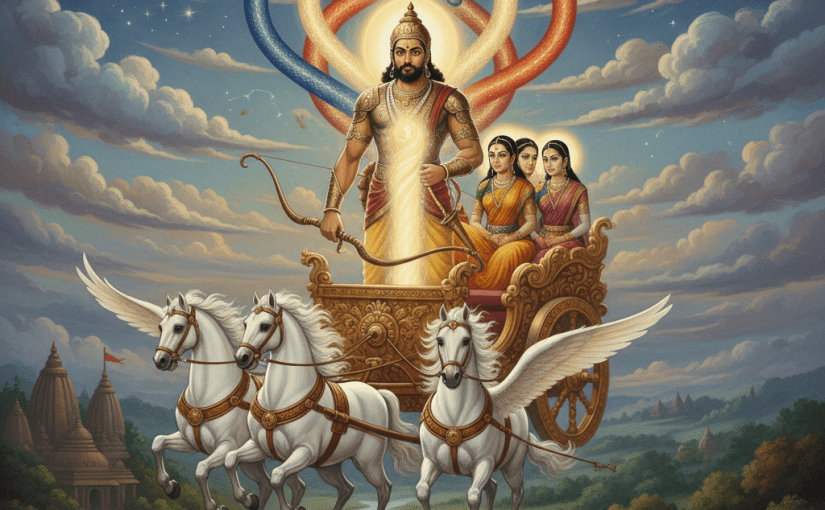
The story of Bhishma abducting Amba, Ambika, and Ambalika is one of the most famous episodes in the Mahabharata. On the surface, it speaks of politics, duty, and human emotions. But when viewed through a yogic lens, it reveals subtle lessons about Kundalini energy and the journey of consciousness.
1. Bhishma: The Will That Guides Energy
Bhishma, with his unwavering determination, goes to bring the princesses to Hastinapur. In Kundalini terms, he represents the force of discipline and strong will that helps awaken and guide energy upward. Just as in yoga, Shakti cannot rise by itself—it requires direction, intention, and focused effort.
2. Vichitravirya: The Passive Consciousness
Vichitravirya, the young king, is passive and does not act on his own. He symbolizes receptive consciousness, the awareness that is ready to receive the awakened energy. The energy brought by Bhishma is meant to integrate with him, just as Kundalini rises to merge with higher awareness.
3. The Princesses: Different Types of Energy
- Ambika and Ambalika represent energies that cooperate, integrate smoothly, and contribute to the continuation of life—just as balanced pranic channels support inner growth. Ida and Pingla matches them.
- Amba, however, resists. She represents blocked or delayed energy, the kind that cannot merge immediately but requires purification, patience, and sometimes an entirely different pathway to awaken fully. Sushumna is having similar chracteristics.
4. The Abduction: Initiating the Energy Flow
Bhishma’s act of carrying the princesses away can be seen as a metaphor for initiating the upward movement of energy from lower to higher chakras. But force alone—whether physical, mental, or yogic—cannot guarantee complete integration. However it helps. But the inner energies must be ready to rise.
5. Rejection, Knot, and Transformation
Amba’s rejection by both Vichitravirya and Salva reflects a granthi—a knot of resistance inside the system. Blocked energy stores immense potential. It’s actually like meditation supporting object or dhyana alamban of Patanjali yoga to focus upon continuously to achieve samadhi or awakening. Over time, this energy transforms and goes up in a new, powerful form. Salva represents the lower chakras, and Vichitravirya represents the upper chakras of Bhishma. The energy of the Sushumna is stuck between them, reaching neither. Bhishma has given it upward motion, but not enough for it to reach the upper chakras as he is a celibate. Therefore, the energy returns to the lower chakras, but the petty worldly society now interprets her visiting the upper realms—even with the support of a celibate—as a sign that she has been defeated, seized, and loved by him. It is often seen in the layman-dominated society when an prior-known but now-turned intellectual is ignored by it and so he going to lonliness. Consequently, her past lover Salva rejects her. She has no way but to return to Bhishma and asks him to marry her, since only tantric force can elevate her to the top chakra, representing the Shiva-Parvati marriage or union. However, Bhishma, proud of his celibacy, rejects her offer, leaving her enraged. This celibacy is the result of spiritual sanskāras imparted by his father and family. The imprint of purity is so strong that he takes a solemn oath never to marry.
Amba eventually reincarnates as Shikhandi, whose presence becomes the cause of Bhishma’s fall. Symbolically, this represents how blocked energy eventually overcomes rigidity, merging at the right time, in the right form, only after purification.
Shikhandi confronting Bhishma symbolizes the moment when dynamic, transformed energy overpowers rigid, ego-driven will, allowing spiritual progress under the guidance of Arjuna (higher consciousness).
Yogi Bhishma — The Unsung Hero of Mahabharata
The story reflects a subtle truth about highly disciplined people. Like Bhishma, many celibates or individuals of strict discipline often reject potential partners, citing duty, career, culture, or moral codes—even when they have the strength or opportunity to accept them.
This rigid refusal creates a blocked emotional image in the heart chakra. The denied feminine energy becomes a subtle androgynous or eunuch-like mental imprint—male in its inability to act in a worldly sexual way, yet feminine in emotional tone. Over time, this blocked energy slowly transforms the disciplined mind, softening the rigid ego, turning the person more romantic or emotional, often leading them eventually into relationships and family life. However, this image remains like a eunuch Shikhandi for a long time and eventually dissolves after imparting realization. In this sense, it is also the “killing” of Bhishma by Shikhandi, because after the realization, a second birth is considered.
It means eventually, the once-stuck energy, purified through resistance and patience, rises to the brain, manifesting as guru-like image, wisdom, awakening, or divine consciousness.
The myth shows that rigid good will, when imposed on natural desire, stores great energy—but that energy eventually purifies, transforms, and expresses itself in a higher form.
Amba, Ambika, Ambalika as Yogic Channels
Amba can be understood as the Sushumna channel, while Ambika and Ambalika correspond to Ida and Pingala. Through forceful discipline, a yogi can manage Ida and Pingala—using asana, prāṇāyāma, and effort to push energy upward that can help to align sushumna as well but up to a limit.
But Sushumna is different:
- Ida and Pingala can be controlled through practice.
- Sushumna cannot be forced open.
For Sushumna to awaken, one must surrender, cultivate a balanced inner and outer life, heal buried impressions, and patiently wait.
Yogi Bhishma believed he could master Amba (Sushumna) by first controlling Ambika and Ambalika (Ida and Pingala), her two sisters.
He succeeded only partially—until he resolved his heart knot, transforming his inner image of Amba into image of guru, god etc. This shows that awakening requires inner transformation and the softening of rigidity—not just discipline. He started supporting the image of Amba in his mind later on, breaking his steadfast bow of celibacy, in a way leaning in front of destiny, and being tired of avoiding it, which signifies a confrontation with Shikhandi, the inner energy form of the outer Amba.
Ultimately, divine will must be accepted, and surrender becomes essential.
6. The Hidden Message
The Mahabharata teaches that:
- Not all energies respond to force.
- Purification, surrender, patience, and guidance are essential.
- Blocked energy, when transformed, becomes a powerful force for realization.
- The rigid ego must yield for true spiritual progress.
Conclusion
The Bhishma–Princesses episode is not only a story of kings and kingdoms—it mirrors the subtle dynamics of Kundalini within the human system. Bhishma represents willpower, Vichitravirya represents consciousness, and the three princesses symbolize energies waiting to awaken. Some integrate easily, some resist, and some transform through trials.
In the end, the tale teaches that effort and discipline alone are not enough. Awakening requires openness, surrender, inner healing, and divine timing.
Everyone often reflects upon their own mythological namesake, and perhaps the same has happened with me.
Recently, a new meaning revealed itself—one that seems to resonate strongly with the story of my own life.
That is why I expressed it without hesitation.
Perhaps this is the very influence of the name, and maybe this is its true meaning as well.
All of this is merely my personal experience and perspective.
The real truth is what the reader discovers within themselves.
If there is any error, it is mine; and if there is any essence, it is by the grace of the Divine.
 Demystifying Kundalini