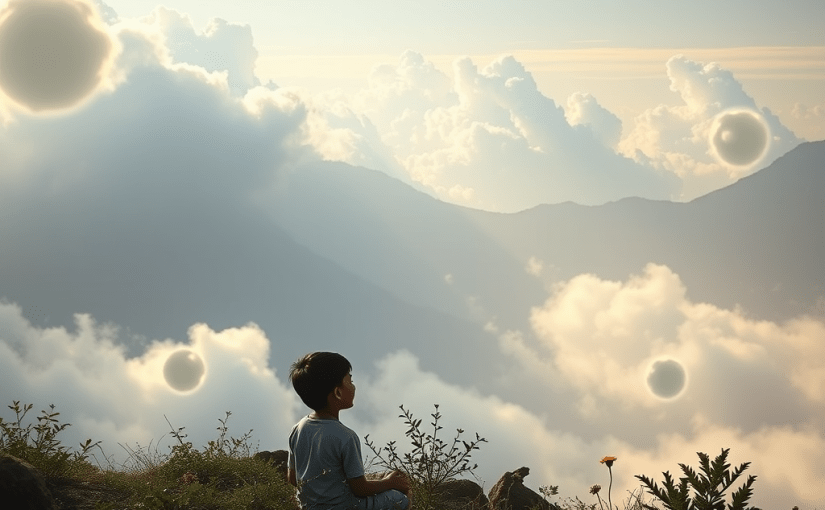
Hi friends,
Love, in its deepest essence, is not merely a romantic emotion—it is a portal to transcendence. “She Who Became My Guru” is not just a story of teenage tenderness or cosmic coincidence; it is a soulful narrative of transformation, where divine love (prema) and spiritual awakening walk hand in hand through the corridors of everyday life.
This blog series is based on lived experience, contemplative memory, and mystical insight. It tells the story of an introverted student from a remote village whose life changes forever upon meeting a girl in a disciplined, army-controlled senior secondary school. What begins as a casual friendship for a quiz competition soon ripples into a deep undercurrent of emotional and spiritual evolution.
She was not a teacher. She was not a saint. Yet, her mere presence activated a current within the boy’s being that would slowly rise, oscillate, and eventually explode into a full Kundalini awakening. All without rituals, dogmas, or conscious pursuit—just the raw purity of presence, emotion, and silent grace.
Through dialogues, vivid scenes, mystical moments, and subtle humor, each chapter brings to life the boy’s inner journey. From the shy exchanges in a schoolroom to the surreal experiences on the Moon (yes, truly!), this story is both grounded in Indian mysticism and painted with the colors of futuristic imagination. Tantra, Samadhi, Puranic echoes, modern education, arranged marriage, sexual energy, and cosmic vision—all unfold as living characters in this spiritual adventure.
This is not just a novel. It is a window into what modern love can truly become when blessed with awareness. It is also a gentle challenge to outdated spiritual orthodoxy, proving that even the silent longing of a village boy can unlock the gates to Savikalpa Samadhi.
Why Read This Series?
- To explore the mysteries of Kundalini and self-realization in a relatable, story-driven format.
- To discover how spiritual experiences unfold in the most unexpected moments of modern life.
- To reflect on the roles of feminine presence, ancestral wisdom, and inner control on the path of awakening.
- To immerse yourself in a story that is simple yet profound, poetic yet real.
Each chapter is written in easy-to-understand language, deeply emotional, and filled with thought-provoking reflections—all embedded within a suspenseful, engaging narrative. The characters may be fictional in name, but their souls are rooted in real experiences—mine, and perhaps yours too.
So, dear reader, walk with me. One chapter at a time.
Let this journey begin.
Chapter 1: The Boy from the Quiet Hills
In the cradle of the lower Himalayas, where clouds brushed treetops like old friends and time slowed to the rhythm of rustling pine needles, there lived a boy named Ishaan. His village—silent, scattered, and serene—seemed etched more in spirit than in stone. It was a place where the morning mist carried the dreams of its people, and the twilight melted into tales told by flickering hearths.
Ishaan was a child of that hush. To the world, he was quiet—almost invisible—wandering through school corridors with the stillness of snowfall. Teachers marked his presence; classmates overlooked it. Yet, beneath that silence breathed a spirit wide awake.
At home, Ishaan transformed. He spoke with candor and a flicker in his eyes, revealing the poetry of a mind that saw beyond what was seen. His mother often said that his silences weren’t empty—they were full, like the sky before rain. To his siblings, he was a storyteller, a mimic, a thinker who asked why the stars trembled and where dreams went after waking. But in public, words betrayed him. They halted on his tongue, unsure, unready, often unspoken.
He had just passed his matric exams from the modest village school—a single-story building shaded by deodars and discipline. His marks, quietly earned and quietly celebrated, opened a new door. His father, a stern yet sensitive man of the soil, decided it was time Ishaan stepped out of the cradle. A senior secondary school awaited in the town across two rivers and one dusty highway—a place that promised better education and, perhaps unknowingly, solitude of a different kind.
As they packed his modest belongings—a steel trunk, a water flask, a photo of Lord Shiva, and the tight hugs of a home—something shifted. Ishaan was leaving not just geography behind, but the language of comfort and known patterns. His village was more than a place; it was a rhythm he had memorized. Now, it would become memory.
The morning of his departure, the hills stood still, as if listening. His mother’s silence was heavier than her tears. His younger brother clung to his kurta. His father said little—just a firm nod, a pat on the back, and a gaze that meant everything. Ishaan sat on the rickety bus, watching the pines retreat like waving elders.
That bus ride was the first chapter of an inward journey—one that wouldn’t just carry him to a school, but toward a self still forming, still hiding. He felt a strange loss—not of people or places—but of something nameless, a quiet certainty that used to live within him. The fields grew flatter, the air warmer, and the silence inside him louder.
There’s a peculiar loneliness in growing. Not the loneliness of absence, but of shedding. As the bus wound down the mountains, Ishaan felt he was not simply going somewhere—he was being unmade, so he could be made again.
That was the first lesson the hills taught him:
You don’t grow by adding; you grow by leaving.
And so began his life beyond the quiet hills. He didn’t yet know that the roads he took would soon bend into strange meetings, that the stillness in him would find an echo in someone unexpected—a presence that would awaken, guide, and undo him in ways no school ever could.
But that is for another time. For now, Ishaan sat in silence, a boy uprooted, gazing at a world he didn’t yet belong to, unaware that he was already on the path—not just to knowledge, but to a silent revolution within.
 Demystifying Kundalini