At the dawn of the universe, there was no here or there. The first particles were not settled in any fixed place. They existed as clouds of possibility, spread like mist across the vastness. To ask “where” they were was meaningless, because they were everywhere and nowhere at once.
This is the strange nature of quantum position. A particle before collapse is not a dot on a map but a haze of probabilities. Only when it interacts, only when it “decides,” does it appear at a particular spot. In that instant, a position is chosen, and the many vanish into the one.
The First Footsteps
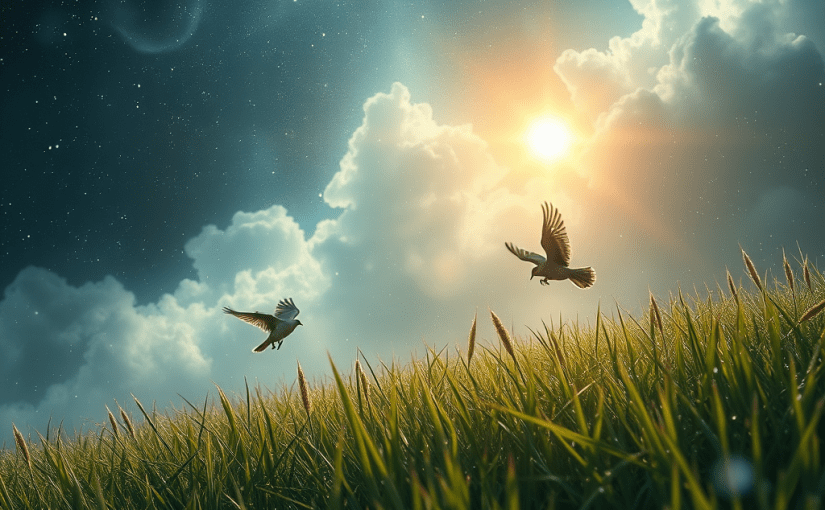
Imagine a great empty field covered in soft dew. Countless birds hover above, each uncertain where to land. Suddenly, one descends on a blade of grass. Another chooses a twig. Another settles by the riverbank. Slowly, the field fills with definite presences.
In the same way, the first particles collapsed into positions. One appeared here, another there. What was once a uniform mist became a patterned arrangement. The seeds of galaxies were scattered across space like stars across the night sky.
It seems similar to bird instinct—when one bird settles somewhere, others also follow and occupy the surrounding spots, rather than choosing isolated places. In the same way, quantum particles may also seek different forms of “social security” such as protection, interaction, cooperation, division of labour, and many other collective behaviors. In this sense, they appear almost living, depending on how they express their liveliness through different modes. One thing is certain: they are not bound by the strict patterns that define life in the conventional biological sense. Perhaps the yogic principles of detachment and non-duality partially emerged by observing such natural phenomena, which were worshipped in Vedic culture.
Those choices — small, random, delicate — shaped everything that followed. A particle a little closer here made matter gather. A particle a little farther there left emptiness behind. Out of those uneven gatherings grew stars, planets, and the stage on which life would walk.
The Cosmic Mosaic
Think of making a mosaic. You have colored stones spread loosely in a basket. Where you place each stone decides the picture that emerges. A stone here may form the curve of a flower. A stone there may form the outline of a face. The picture is nothing but the sum of all placements.
Creation too is such a mosaic. Quantum particles, by collapsing into specific positions, drew the outlines of the universe. One placement led to density, another to emptiness, another to symmetry, another to asymmetry. Together, they painted the grand design of existence.
The Indian Darshana Parallel
In Indian thought, space is not a void but a living principle — Akasha. It is the first element, the womb in which all other elements arise. Yet Akasha is not filled until particles take their positions. Only then does space find its rhythm, its structure, its meaning.
Just as the choice of deśa (place) in yoga influences how smoothly the mind becomes quiet, the location of a quantum event determines where a particle finally appears, yet both operate on entirely different planes. In dhyāna, the mind returns to the original Ākāśa, the silent field of pure awareness, where no physical settling occurs; there is only dissolution into stillness. In contrast, the settling of a particle during quantum collapse is a material process within space-time, governed by physical conditions rather than consciousness. The analogy works only in a metaphorical sense: a supportive sacred space like temple helps the mind stabilise, just as certain dense regions of the cosmos allow matter to gather, while vast empty stretches remain like neutral spaces where nothing settles. This comparison highlights a resemblance in behaviour without confusing their foundations — one belongs to inner consciousness, the other to outer matter.
A temple is a concentrated field of pure consciousness, and therefore it naturally attracts the minds of meditators to merge with it. Similarly, a dense region of space is a concentrated field of particles, and it attracts the surrounding quantum waves to collapse into particles and join that cluster.
Chance or Play?
Science tells us that the particle “chooses” its place according to probability. Where the wave is stronger, the chance of collapse is greater. To the human mind, this looks like chance.
But Indian darshana reminds us: what seems random is also play — Lila. Each collapse is like a dancer choosing a step, not planned, not rigid, but part of a spontaneous unfolding. Out of those steps, the dance of the cosmos arises.
In cosmic psychology, quantum collapse can be seen as the mind of the universe choosing a definite experience from infinite possibilities. Each quantum quality—such as spin, charge, or position—unfolds on the same single probability wave, unaffected by the outcomes of the each others. The higher the amplitude of the probability wave, the stronger its pull on creation’s attention—like a thought or desire that repeats until it manifests. Collapse then is not random chaos, but a weighted selection, where the cosmos tends toward the possibilities most charged with energy, while still allowing even faint possibilities to occasionally become reality.
Layman’s Metaphor: Children in a Park
Picture a park where children are playing hide and seek. Before they run, you do not know where each will hide. Every bush, every tree, every bench is a possibility. But as the game begins, each child chooses a spot. One hides behind the slide, another under the tree, another by the fountain. Suddenly, the empty park is filled with presence, pattern, and life. The fun of the game comes from their choices. The universe too was like that park. Particles chose their hiding spots, and from those choices, the drama of galaxies and stars began.
If we look a little deeper, a child chooses the hiding spot that appears most strongly in his mind. This means his inner energy-wave rises higher toward the brain when he imagines that particular place. If he suddenly notices another, safer spot, the energy-wave remains the same, but the thought related to the previous choice sinks towards the muladhara chakra—a site of lower amplitude—while the new thought for the newer hiding place rises to the sahasrara chakra, a site of peak amplitude of the energy-wave. Because he has no time to analyse further, he quickly collapses into that choice.
The same play of rising and falling of every choice or expression on the amplitudes of the kundalini energy-wave operates in every living organism, much like in a quantum particle. Time also becomes a factor in determining the collapse, for if the time available is short, the best possible outcome that may be available later might not be selected.
A man who craves one motorcycle today may crave a different model tomorrow. When this happens, the thought of buying the earlier model sinks into the darkness of the Mūlādhāra, while the thought of buying the new model rises and shines in the brain. Yet exceptional circumstances—such as a low budget, an unwillingness to borrow money, or emotional or cultural factors—may still force him to buy the earlier, less-preferred model, because that thought is not fully in the zero-amplitude region of the Mūlādhāra. However, he will never buy a scooty if he naturally dislikes it, because the thought of buying it sits in the true zero-amplitude region of the Mūlādhāra, which corresponds to zero probability.
A similar situation can occur in quantum events, where the wave may collapse in a lower-amplitude region due to environmental interactions. Although the probability of this remains low, it never collapses into a zero-amplitude region, because the probability of finding a particle there is exactly zero.
It is like the spin character of a quantum particle with two outcomes: spin-up and spin-down. Suppose spin-up corresponds to the peak amplitude-height and spin-down to a mid-height of amplitude, while the “no-spin” or “both-spin” state corresponds to zero amplitude-height—something known to be impossible. Here, spin-up is like the new motorcycle model, spin-down is like the older model, and the scooty corresponds to the impossible “both-spin or no-spin” situation.
Similarly, a quantum state such as momentum can have many possible outcomes spread across the wave at various amplitude-heights: the highest amplitude level giving the highest probability, the lowest amplitude level giving the lowest probability, and intermediate level heights giving intermediate probabilities. The same dynamic operates in the human mind when many options are present.
A highly attractive motorcycle model may occupy one’s heart; another, slightly lower in preference, may focus energy on the navel chakra; a still lower option may settle around the Svādhiṣṭhāna chakra; and a problematic choice may rest in the Mūlādhāra. This means thoughts corresponding to each motorcycle model settle in a particular chakra after being analysed by the mind. The top model may focus energy on the Ājñā or Sahasrāra chakras. That is why there is a common Hindi saying for something deeply liked: “sīr chaṛhkar bolī hai”—it has risen to the head. It has the highest probability of being expressed or chosen. But it is also a famous saying that Hearth speaks more truth.
Dull localisations in the lower chakras are easy to ignore, but the shining leaps of energy in the higher chakras are hard to overlook. This is māyā—the illusion or attraction created by this shining and joyous thrill. If studied deeply, it may reveal profound psychological secrets about how humans behave and how they are propelled by the subconscious and by external environments.
Seeing this, the similarity between the living world and the quantum world appears astonishing and almost complete. The only major difference is that the quantum world is fully detached, non-dual, and completely unaffected and unbound — unlike the living world. If that is so, is it possible for human beings to share even a small portion of that freedom while still living? Perhaps nature worship and its personification in the Vedas were developed for this very purpose.
A yogi’s mind being like an innocent child is attuned to the cosmic mind because of his detached and nondual attitude. It functions like a quantum probability wave, naturally tending to choose the most uplifting and harmonious outcome for expression — just as a quantum wave has the highest probability of collapsing into a particle at the peak of its amplitude. This is because they have no bias toward any particular outcome. However, even if they must maintain a bias in order to run the world, it is not a real bias, because their attitude remains detached and nondual. That is why most of a yogi’s decisions appear wise and beneficial to all. However, there remains a negligible chance of a lower or less ideal decision, much like the faint probability of a quantum wave collapsing at a lower amplitude — but such instances are rare and cause little harm.
Position as the Seed of Diversity
Why is position so important? Because where something is decides what it can become. A seed in dry soil may wither. The same seed in fertile earth may grow into a tree.
So too with particles. A proton alone in emptiness is only a proton. A proton near an electron can become hydrogen. Many hydrogen atoms close together can become a star. Thus, the placement of each particle set the chain of possibilities that would follow. Similarly, a man digging alone, away from a group of people who are also digging, cannot complete a well on his own within a practical period of time.
One choice of position led to emptiness. Another led to clustering. From clustering came stars, from stars came elements, and from elements came us.
Humans also share the same tendency. They prefer to build homes and settle in already existing colonies or villages rather than in empty forests. As a result, these colonies grow increasingly populated, interactive and vibrant — just as stars cluster together, leaving the vast empty spaces of the cosmos untouched.
Quantum Collapse as the Engine of Creation
Here lies the heart of the mystery: creation is nothing but collapse. Before collapse, everything is a possibility. After collapse, something is real. Without collapse, the universe would remain a silent fog of probabilities, never stepping into form.
Collapse is the invisible engine that drives becoming. Each time a particle “decides” — to be here, to be there, to be this, not that — the world gains a new detail. Collapse is the moment when the unmanifest takes birth.
The rishis said, “From the unmanifest, the manifest arises.” Physics calls it collapse. Unmanifest means everything is there in superposition, not manifested in any outcome. Darshana calls it creation. Both point to the same truth: the world exists because probabilities bow down into realities.
In the same way, the soul decides where and in what form to express itself in a new birth, according to its hidden mental waves — the subconscious imprints. This corresponds to the peak of amplitude, meaning the peak of experience. The form with which this peak of experience aligns determines the soul’s next birth — some become human, others take form as animals, birds, and so on — together filling the Earth to enable the interactive and harmonious living of all creatures with one another and with nature.
Closing Reflection
So when you walk across the earth, remember: every grain of soil beneath your feet is there because a particle long ago chose that place. Every star shining in the sky is there because ancient collapses scattered matter into its seat.
Position is not a trivial thing. It is the silent artist, arranging particles like beads on a cosmic thread. Without those choices of “where,” there would be no “what,” no galaxies, no rivers, no bodies, no breath.
Closing Verse (Mantra-style)
From the cloud of maybes, a single point arises.
From the unseen spread, a place is chosen.
Position is the brushstroke of the cosmos,
Painting stars, weaving bodies, grounding life.
O choosy collapse, O silent hand —
You are the engine that made creation real.
 Demystifying Kundalini