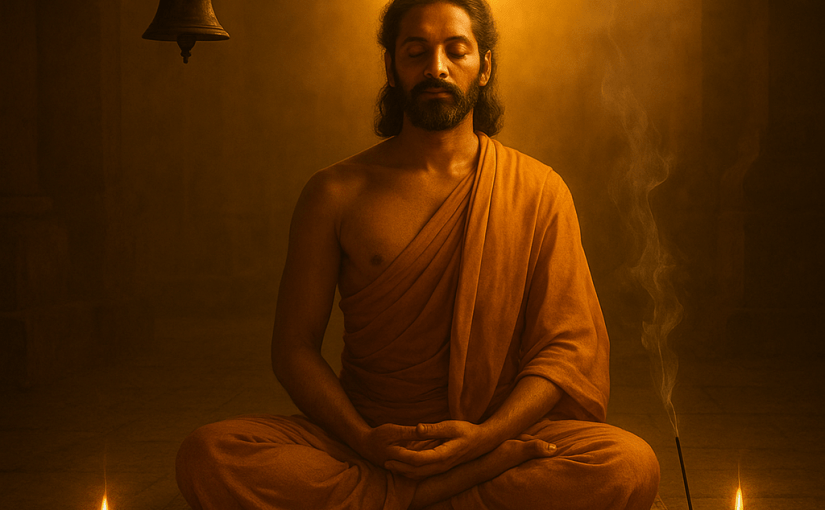
Many people try to meditate or attempt Keval Kumbhak (effortless breath stillness) when they’re tired — often at night or after long work. Naturally, they end up slipping into sleep. But the real secret is to do it when the body is fresh and the mind alert — so that mindlessness doesn’t become unconsciousness, but a doorway to living awareness.
This is something I’ve observed from my own experience: Keval Kumbhak is not about sleep or suppression. It’s about entering a deep stillness where thoughts dissolve, yet you remain fully aware. And for that to happen, a sattvic environment is essential — one that keeps the inner flame of awareness gently burning.
That’s when I realized something profound:
The rituals in religious ceremonies — which we often take for granted — serve this exact purpose. They are not distractions, but guardians of awareness.
Let me explain how:
🔔 Bell Sounds
The sharp ring of a temple bell cuts through the fog of the mind. In one instant, attention is brought back to the now. It jolts us out of dullness — like a spark lighting dry wood.
📯 Conch Blowing
The deep vibration of the conch doesn’t just purify the space — it resonates within the body, harmonizing breath and energy. It’s like a natural pranayama, awakening subtle prana and driving away heaviness.
🕯️ Incense
The gentle fragrance of dhoop or agarbatti soothes the senses, especially the breath and mind. The olfactory sense is linked directly to the brain’s limbic system — and the right scent can anchor awareness softly in the present.
🔁 Mantra Japa
The rhythm of mantra is a bridge between breath and thought. It draws both into harmony, making the breath quiet and mind steady. Over time, the mantra fades, and silence arises — but now, conscious and alert silence.
📖 Shloka Recitation
Shlokas carry vibrational power and invoke both devotion and awareness. They stir the intellect and heart together, helping one enter dhyana with bhava and clarity rather than sleepiness.
I then saw clearly: this is how ancient yogis lived. Not in silence alone, but in environments carefully designed to support sattva. Temples weren’t just for worship — they were energetic tools. The very air around a yogi helped keep their awareness alive even when thoughts stopped.
Even in solitude, a yogi surrounded himself with:
- The distant echo of mantras
- The subtle glow of a lamp or sunrise
- Fragrant air from sandal or tulsi
- The inner rhythm of breath and awareness
Such environments helped them stay in Keval Kumbhak naturally, without forcing breath or suppressing thought. This is why it seemed as if yogis lived in meditation — because the outer world supported their inner silence.
In today’s times, when the mind is easily distracted and the body fatigued, sattvic rituals are not outdated — they are essential. Bells, conchs, incense, chanting — these are not mere cultural leftovers. They are keys that can unlock deep meditative states — especially Keval Kumbhak with full awareness.
To sum up:
When the outer is tuned to sattva,
the inner doesn’t fall into tamas — it rises into Samadhi.
Even if you practice alone, try lighting a lamp, ringing a bell, chanting a few mantras, or simply sitting in a fragrant, pure space. You may find that awareness remains awake, even as thoughts vanish. And that’s the doorway to the real stillness yogis speak of — the living silence of Keval Kumbhak.

 Demystifying Kundalini