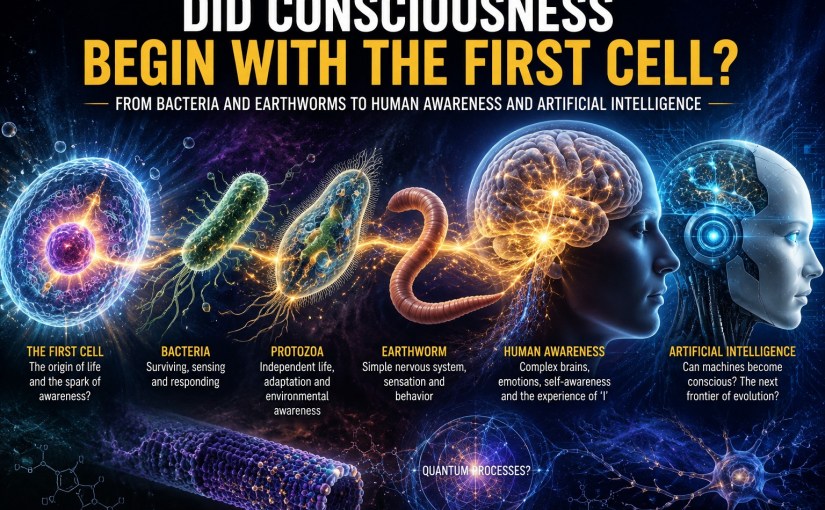
The Real Mystery Is Not Consciousness but Its Artificial Creation
Modern discussions about consciousness are often dominated by neuroscience, artificial intelligence, and computational theories of the brain. Many researchers argue that we still know very little about consciousness and that we are surrounded by data without possessing a unifying theory. Some point to Gerald Edelman’s Extended Theory of Neuronal Group Selection (TNGS), Neural Darwinism, and the Darwin series of neurorobots as the most promising route toward understanding consciousness and eventually creating conscious machines. These robots demonstrated perception, categorization, memory, learning, and adaptive behavior in the real world rather than in simulated environments. The suggestion is that by reproducing the essential functions of biological brains, consciousness may eventually emerge in machines.
However, there is another perspective. Consciousness itself may not be the mystery. Ancient contemplative traditions have already explored consciousness in great depth through direct experience. The unanswered question may not be what consciousness is, but how consciousness can be artificially generated or expressed through a physical system. A theory may succeed in creating a superintelligent machine, but that would still leave an important question unanswered: why should consciousness arise within that machine at all?
Intelligence and Consciousness Are Not the Same Thing
A superintelligent robot may one day outperform humans in every intellectual task. It may write books, solve scientific problems, design technologies, and manage societies. Yet the existence of intelligence does not automatically explain the existence of consciousness. The two may be fundamentally different phenomena.
An earthworm provides a useful example. It possesses only a simple nervous system and a primitive nerve ring compared to the extraordinarily complex human brain. Yet most people would intuitively agree that an earthworm possesses some form of subjective experience. It responds to danger, seeks favorable conditions, and adapts to its environment. If consciousness exists in such a simple organism, then high intelligence cannot be the essential requirement for consciousness.
This observation raises doubts about theories that equate consciousness with computational complexity alone. Intelligence may evolve separately from consciousness. A machine may become extremely intelligent without becoming conscious, while even simple organisms may possess awareness.
Biology May Be Essential for Consciousness
This line of thought naturally leads to another question. If consciousness is not simply a product of intelligence, perhaps biology itself plays an essential role. Theories such as the Orchestrated Objective Reduction (Orch-OR) model proposed by Roger Penrose and Stuart Hameroff suggest that quantum processes within biological structures contribute to conscious experience. According to this theory, microtubules inside cells may be important sites where consciousness-related quantum events occur.
Even if Orch-OR is not completely correct, it raises a fascinating possibility. Perhaps living biological systems possess characteristics that current artificial systems lack. The challenge is not merely to create intelligence but to understand what is unique about living matter.
The Puzzle of Microtubules and Consciousness
An interesting complication arises immediately. Microtubules are not present only in brain cells. They are found throughout the body and indeed throughout many living organisms. If microtubules are directly responsible for consciousness, then why are all cells not equally conscious?
One possible answer is that the mere presence of microtubules is not sufficient. Evolution may have developed specialized biological structures capable of organizing and integrating these processes in unique ways. Certain neural networks may have become linked to conscious experience because such integration provided a survival advantage.
Yet this still leaves open a deeper question. Why should consciousness be restricted to specialized neural systems at all?
The Earthworm and the Challenge to Brain-Centered Theories
The earthworm once again becomes relevant. If a tiny nervous system can support some form of awareness, perhaps consciousness is more fundamental than currently assumed. Intelligence clearly increased throughout evolution, but consciousness may have appeared much earlier. The key question may therefore be not how intelligence emerged but how consciousness became associated with certain biological organizations.
This observation challenges many modern theories that focus almost exclusively on the brain. It encourages us to consider whether consciousness may have deeper roots within life itself.
Single-Celled Organisms and the Origin of Consciousness
The discussion becomes even more intriguing when we consider bacteria and protozoa. These organisms have survived independently for billions of years. They locate nutrients, avoid harmful conditions, adapt to changing environments, communicate chemically, and reproduce successfully. They accomplish all of this without brains or nervous systems.
One possibility is that consciousness is not blocked in single-celled organisms because they require it directly for survival. A free-living cell must independently sense and respond to its environment. It cannot rely on other cells, organs, or systems for protection. This may suggest that the cell itself is the fundamental site where consciousness emerges.
Mainstream science generally interprets bacterial behavior as biochemical information processing rather than conscious experience. However, this interpretation does not completely settle the matter. Bacteria cannot verbally report their experiences. They cannot tell us that they feel hunger, fear, attraction, or discomfort. Yet neither can many animals. The inability to communicate subjective experience does not necessarily prove the absence of subjective experience.
The Problem of Proving Cellular Consciousness
One of the greatest challenges in consciousness research is that subjective experience is private. Even among humans, we cannot directly observe another person’s consciousness. We infer it from behavior, communication, and biological similarity.
The same difficulty applies to bacteria. They may possess some primitive form of subjective experience, or they may not. At present there is no definitive way to prove either position.
This leads to an important philosophical observation. Adaptive behavior alone does not prove consciousness. However, neither does the absence of verbal reporting prove the absence of consciousness. The question remains open.
Why Feelings May Be Fundamental to Life
An additional insight emerges when we consider the role of feelings. Human life is guided by hunger, thirst, pleasure, pain, curiosity, fear, desire, and countless other subjective experiences. These feelings are not merely decorations added to biological processes. They appear to provide a direct survival advantage.
If a human completely lost all feeling and awareness, survival would become extremely difficult. Feelings motivate action, guide decisions, and help organisms respond effectively to their environment.
This raises an important question. If feelings provide such an advantage in humans, why should primitive forms of feeling not also exist in simpler organisms?
Feeling as an Evolutionary Advantage
A person with strong feelings, motivations, interests, and desires is often more active and engaged with life than someone whose feelings are greatly diminished. Feeling may therefore be understood as an adaptive tool that enhances survival.
Applying this principle to biology leads to an interesting hypothesis. Cells within a multicellular organism exist in a highly protected environment. They receive nutrients, oxygen, and support from the larger body. They may therefore require less direct feeling or awareness.
By contrast, a free-living unicellular organism must constantly monitor its surroundings, locate food, avoid danger, and adapt to changing conditions. Such an organism may require a richer form of primitive feeling.
An analogy can be found in human society. A financially secure person can often afford to be relaxed and easy-going because many needs are already met. A struggling entrepreneur, on the other hand, must constantly remain alert to opportunities, risks, and threats. Similarly, a free-living cell may need greater sensitivity to its environment than a protected cell within a larger organism.
A Continuum of Consciousness Across Life
This leads to a broader possibility. Perhaps all living cells possess some degree of feeling or proto-consciousness, but the intensity and complexity vary according to need.
Under this view, consciousness does not suddenly appear when brains become sufficiently complex. Instead, consciousness exists along a continuum. Simple cells possess extremely primitive forms of awareness. More complex organisms integrate these experiences into larger and more sophisticated forms.
The human body could then be viewed as a hierarchy of awareness. Individual cells possess minimal forms of feeling. Groups of cells coordinate into tissues. Neural networks integrate information across the body. The brain then generates the unified conscious experience that humans recognize as the sense of self.
In this framework, consciousness resembles life itself. A bacterium is alive. A human is alive. Human life is not fundamentally different from bacterial life but rather a vastly more integrated expression of the same underlying principle. Likewise, a single cell may possess a tiny spark of subjective experience, while a human may possess an immense and integrated field of awareness.
Conclusion: Did Consciousness Begin with the First Cell?
The continuity of evolution suggests that consciousness may also have evolved continuously. Rather than suddenly appearing in advanced nervous systems, consciousness may have been present in increasingly complex forms throughout the history of life. Intelligence may have expanded dramatically during evolution, but consciousness may have deeper biological roots.
Whether consciousness ultimately arises from quantum processes, microtubules, cellular organization, neural integration, or something more fundamental remains unknown. Yet the existence of adaptive, independent, and persistent life at the cellular level raises a profound possibility. Perhaps consciousness did not begin with the brain. Perhaps the brain is simply the most sophisticated organizer of a property that has been present in life from the very beginning.


