My post

Chapter 18- The Concept of Chakras and the Cosmos Within

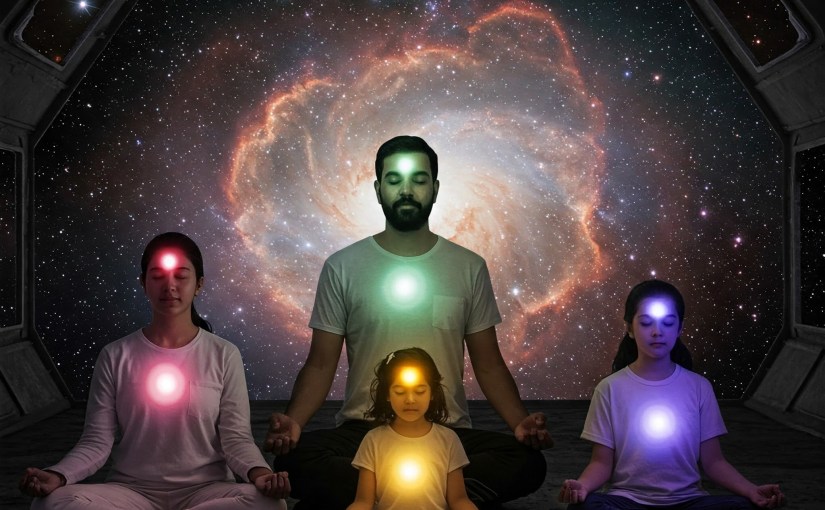
As the lunar habitat hummed with a soft, rhythmic pulse of life-support systems, the Verma family sat in a dimly lit meditation chamber, their minds eager yet calm. The revelations from the space mystic had left a profound mark on Dr. Aryan Verma, and now his wife Meera, daughter Avni, and son Ansh had joined him in an extraordinary journey—one that led not outward to the stars, but inward, into the vast cosmos within.

Their first collective meditation session had been tentative, but something magical had happened. As they focused on their chakras, an unspoken harmony emerged between them, weaving their energies together like an unseen celestial tapestry. Day by day, the effects became more tangible, more exhilarating. It was as if they had unlocked an ancient portal within, a gateway into dimensions unseen.

The Dance of Energy: Root to Crown

Aryan structured their practice systematically, guiding each family member through the seven chakras, each attuned to their own resonance. Colored grains, sacred bija mantras, and visualization techniques became their tools, transforming their mundane lunar existence into an experience of profound self-discovery.

At the Muladhara, the root chakra, a deep red glow seemed to emanate from their beings. Ansh, the youngest, was the first to feel it vividly.

“Papa, I feel like I’m sinking into the Moon’s surface!” he exclaimed, eyes still closed. “But it’s… nice, like I’m part of it.”

Aryan smiled. “That’s grounding, son. Stability, security. You’re becoming one with the foundation of existence.”

Meera, initially skeptical, found her doubts dissolving. “It’s strange,” she admitted. “I feel like I can actually sense an invisible energy anchoring me. It’s not just imagination.”

As they moved to Svadhisthana, the sacral chakra, Avni suddenly gasped. “The color orange—it’s not just in my mind. It’s… radiating around me!”

Indeed, the more they meditated, the more they began seeing faint auric hues, subtle yet undeniable. With each session, their senses sharpened, their perception extending beyond the ordinary. The sterile lunar base, once devoid of life’s vibrancy, now felt alive with an unseen force.

By the time they reached Manipura, the solar plexus chakra, their bodies grew noticeably warmer. Ansh giggled, clutching his stomach. “It’s like there’s a tiny Sun inside me!”

Meera opened her eyes, amazed. “How is this possible? We’re just meditating, and yet… I feel an actual fire within, fueling my thoughts, my willpower.”

Aryan nodded. “Because that’s exactly what this chakra represents. Strength, determination. It’s the fire that makes us who we are.”

With Anahata, the heart chakra, emotions surged unexpectedly. One evening, after a particularly deep session, Avni broke down in tears. “I don’t know why I’m crying,” she whispered, wiping her eyes. “But it feels… good. Like my heart just opened.”

Meera, too, felt an overwhelming wave of warmth, a love beyond words. “I understand now. Love is not just emotion. It’s energy. It has weight, movement, color. It’s real.”

At Vishuddha, the throat chakra, their voices changed. It was subtle at first, but soon undeniable—words carried new power. Ansh, usually reserved, found himself expressing thoughts he had never articulated before.

“I always wanted to talk about space like Papa does,” he admitted one evening. “But I was scared I’d sound stupid. Now… I feel like my words matter.”

Meera and Avni also noticed a shift. Conversations became deeper, richer. The family felt more connected than ever before.

Ajna, the third eye chakra, was where reality itself seemed to bend. Their meditations grew immersive, filled with visions not of imagination, but something beyond. Avni described seeing fractals of light, shifting like sentient constellations. Meera felt as though she could sense thoughts before they were spoken. Ansh, with childlike innocence, simply stated, “I see the Moon glowing blue, but only when my eyes are closed.”

And then came Sahasrara, the crown chakra. The true test.

The Threshold of Bliss

One fateful evening, as the family meditated in unison, something extraordinary occurred. A collective vibration coursed through them, as though their energies had synchronized to a singular frequency. The familiar sense of self began dissolving. Their awareness expanded—not just outward, but inwards, stretching into an infinite expanse where time and space held no dominion.

Meera suddenly whispered, “Aryan, I… I feel like I’m floating. But my body’s still here.”

Avni’s voice was distant, awed. “I think… I understand what the mystic meant. The universe isn’t out there. It’s in here. We carry it. We are it.”

Ansh giggled, his laughter carrying a strange echo. “I’m everywhere! I’m the stars and the Moon and… everything!”

For a brief, immeasurable moment, the family existed in pure awareness—a state eerily close to savikalpa samadhi. It was not the final stage, not the enlightenment of saints, but it was a glimpse. A taste of something far greater than any of them had imagined possible.

As the experience faded and their normal senses returned, they opened their eyes, staring at one another in disbelief. Meera, the ever-logical one, was the first to break the silence.

“Aryan,” she whispered. “What… just happened to us?”

Aryan exhaled, still feeling the afterglow of the experience. “We touched something ancient, something eternal. And this… is just the beginning.”

A New Way of Life

From that day on, meditation was no longer just a practice—it was a way of life. The family naturally gravitated toward their sessions, each drawn to the bliss, the clarity, the peace it brought. They experimented with different meditation objects, each choosing a symbol that resonated most deeply with their being—Meera, a glowing lotus; Avni, a celestial wheel; Ansh, a tiny pulsating star.

Their understanding deepened, but they also knew the path was long. The final awakening, the true transcendence, would require more than just fleeting glimpses. It would demand patience, devotion, surrender. And so, they embraced the journey, letting it unfold at its own divine pace.

On the barren Moon, where silence stretched for eternity, the Verma family had discovered a symphony—the soundless, luminous music of the cosmos within.

They had ventured beyond Earth, beyond space, and now, beyond the self. And as they meditated beneath the eternal gaze of the stars, one truth became undeniable:

The real voyage was never about reaching the Moon. It was about discovering the infinite universe within.

Chapter 17- Meeting a Space Mystic

Dr. Aryan Verma stood at the entrance of the lunar temple, its ancient stones bathed in the soft glow of Earth’s distant light. The temple, perched on the rim of a crater, was unlike anything he had ever seen—a structure that seemed both futuristic and deeply ancient, a bridge between worlds. The carvings on its walls shimmered faintly under his helmet light, their inscriptions whispering secrets of ages long past.

“Are you sure about this, Aryan?” Meera’s voice crackled through his earpiece, concern evident in her tone. She was back at the habitat module, watching over Avni and Ansh. “You don’t even know who—or what—you’ll find in there.”

“I have to, Meera,” Aryan replied, his breath steady despite the weight of anticipation pressing against his chest. “Something led me here. I need to see where it takes me.”

Taking a deep breath, he stepped inside. The moment he crossed the threshold, a strange silence enveloped him, as if the air itself had thickened. The walls of the temple, covered in intricate carvings of celestial bodies and unknown symbols, pulsed faintly with an ethereal light. A deep hum resonated through the chamber, filling him with an odd sense of familiarity. It was as if he had been here before, in another lifetime.

At the heart of the temple stood a figure—tall, cloaked, radiating a presence that felt both calming and otherworldly. The figure turned slowly, revealing a face marked by time yet luminous with an inner glow. His eyes, deep and knowing, met Aryan’s with an intensity that sent shivers down his spine.

“Welcome, Dr. Verma,” the sage said, his voice resonating through the chamber. “I have been expecting you.”

Aryan swallowed hard. “You… know me?”

A gentle smile played on the sage’s lips. “Names are but fleeting echoes of the past. What matters is the essence within. You have traveled far—not just across space, but within your soul.”

Aryan felt an inexplicable pull, a sense that he had arrived at the exact place he was meant to be. The vivid dreams, the cryptic messages that had guided him here—it was all leading to this moment.

“I’ve been having visions,” he admitted. “They led me to this place.”

“The universe whispers to those who listen,” the sage said. “Dreams, intuitions… they are all part of the great cosmic dance. You have heard the call. Now, you must understand it.”

Aryan glanced around the chamber, absorbing its sheer vastness. “What is this place? Who are you?”

“This temple is a sanctuary, a bridge between the terrestrial and the cosmic. It was built by seekers long before your kind set foot on this moon. They knew that true wisdom does not reside in the stars alone, but in the silence between them. As for me, I am merely a traveler, much like yourself, seeking understanding across realms.”

A wave of emotions washed over Aryan. “I always believed in the interconnectedness of life—the delicate balance of ecosystems, the unspoken bond between beings. But here, on the Moon, surrounded by emptiness, I feel… disconnected.”

The sage studied him, his gaze penetrating yet compassionate. “The Moon may seem barren, yet it holds profound wisdom. Its silence invites introspection; its desolation challenges you to find life within. Just as you cared for creatures on Earth, nurturing their well-being, you must now tend to the inner landscapes of your spirit.”

Aryan thought back to his work as a veterinarian—the long hours spent healing, understanding the silent suffering of animals. Perhaps, he mused, the same attentiveness was required to hear the whispers of the universe.

“In the vastness of space, it’s easy to feel insignificant,” the sage continued. “But consider this: every atom within you was forged in the heart of a star. You are not separate from the cosmos; you are its living, breathing manifestation.”

The words settled deep within him. He thought of Meera, Avni, and Ansh, their faces floating in his mind like distant constellations. The distance between them felt more than just physical—it was a chasm of experience, of transformation.

“How do I bridge the gap?” Aryan asked, his voice laced with emotion. “Between who I was and who I am becoming? Between me and those I love?”

The sage placed a reassuring hand on Aryan’s shoulder. “Love is the thread that weaves through time and space, binding souls across dimensions. Share your journey with them—not just in words, but in presence, in understanding. Let them see the universe through your eyes, and you through theirs.”

A moment of silence passed, thick with meaning.

Then, with a twinkle in his eye, the sage added, “And remember, even in the vastness of space, never underestimate the power of a good joke. Laughter is a universal language, after all.”

Aryan chuckled, the sound echoing softly in the chamber. It felt good, grounding him in the here and now.

His earpiece crackled to life. “Aryan, are you okay?” Meera’s voice was laced with worry.

“Yeah,” he said, smiling. “Better than okay. I think I just found what I was looking for.”

As he prepared to leave, he turned back to the sage. “Will I see you again?”

The sage’s smile was enigmatic. “The universe has a way of bringing together those who seek. Trust in the journey.”

Stepping out of the temple, Aryan gazed at the Earth—a luminous blue orb hanging in the velvet darkness. He felt a renewed sense of purpose, a deeper understanding of his place in the cosmos. The path ahead was uncertain, but he was ready to walk it, embracing the mysteries and marvels that awaited.

As he made his way back to the habitat, Meera, Avni, and Ansh were waiting for him, their faces filled with a mix of relief and curiosity.

“Dad, what happened in there?” Avni asked eagerly.

Aryan smiled, placing a hand on her shoulder. “Something wonderful. And I can’t wait to tell you all about it.”

As they stepped inside the habitat module, the air was filled with warmth, love, and the sense of an adventure only just beginning.

As they settled into the habitat module, the warmth of family surrounded Aryan, yet his mind remained tethered to the profound encounter in the temple. The sage’s words echoed within him—Trust in the journey. He knew that his exploration of the cosmos had only just begun, not in the physical sense, but in the depths of his consciousness.

Later that night, as the others rested, Aryan sat by the observation window, gazing at the infinite expanse of space. A peculiar sensation stirred within him—a pull, not outward toward the stars, but inward, into the vast universe of his own being. The stillness of the Moon amplified the silence within, and for the first time, he truly listened.

A vibration coursed through his spine, subtle yet undeniable. His breath slowed, his awareness expanding beyond the confines of his body. The same hum that resonated in the temple now filled the space around him. The Moon itself felt alive, as though whispering secrets too ancient for words. He closed his eyes, surrendering to the sensation.

Visions emerged—not dreams, but glimpses of something beyond time. He saw beings of light moving through celestial pathways, knowledge encoded in the very fabric of existence. He felt the interconnectedness of all life, stretching beyond Earth, beyond Luna, into the boundless expanse of the cosmos. The temple had merely been an entry point—what lay ahead was a spiritual voyage unlike any he had ever imagined.

A soft chime from his communicator pulled him back to the present. It was Meera. “You’re not asleep?” she asked, her voice tender.

“No,” Aryan replied, still staring at the stars. “I think… I think something has awakened within me.”

Meera sat beside him, looking up at the vast sky. “You’ve always searched for meaning, Aryan. Maybe this is where you find it.”

He took her hand, feeling the warmth of their shared journey. “Or maybe, Meera, this is only the beginning.”

Chapter 16- Dream Visitations & Messages from the Beyond

Dr. Aryan Verma sat on the moon’s rocky surface, gazing at the vast cosmic canvas stretched infinitely before him. It was a night unlike any other. The stillness around him carried an unspeakable depth, an invitation into something beyond time and space. Little did he know, this night would open the gates to the unknown.

Two years had passed since his grandmother left her earthly form. Her departure had been bittersweet, shrouded in both sorrow and cosmic mystery. He recalled the helplessness of not being able to visit her frequently during her final days. The long travel distance between Earth and the moon had been an obstacle too vast to cross at will. His uncles and parents had cared for her well, but Aryan couldn’t be by her side when she was still fully conscious. The circumstances of his last visit remained etched in his memory.

On the night she passed, he and his family had been en route to Earth, but a violent space storm forced them to seek refuge at the space house of a relative—a space railway employee working on the interstellar transit routes. The raging cosmic winds and meteor showers had made travel impossible. Even their space car, with its advanced shielding, could have been torn apart in the chaos. Heavy rains of liquefied nitrogen threatened space highways, and potential landslides on floating asteroids could have made passage lethal. They had no choice but to wait till morning.

As dawn broke, the space courier arrived with an unexpected parcel—a sacred offering from a space pilgrim, a packet of holy rice grains infused with cosmic blessings. It was a divine coincidence, meant for those on the verge of leaving their physical forms, a final gift for their journey beyond. Aryan rushed with his family to his grandmother’s bedside and carefully placed the grains into her mouth. She tried to murmur something, her eyes searching for him with longing, but words failed her. Tears rolled down her frail cheeks as she tried to convey something profound. Within a few hours, she took her last breath.

Ten days later, she came to him. It was because he already had a heightened awareness, allowing him to perceive the subtle world with ease due to his recent awakening.

In his dream, an ethereal darkness surrounded him—not the absence of light, but a sentient void glowing with an enigmatic luminescence, like stardust shimmering in the depths of nothingness. It was familiar, yet otherworldly. Within this vastness, her form materialized—not solid, but an essence, a presence that spoke without words.

“I was afraid of what would happen after death,” she said. “But I am fine here.”

Aryan, immersed in the celestial dreamscape, absorbed her words with a strange clarity. Yet, he could feel the layers of attachment still binding her to the remnants of her earthly existence. Her state was vast, tranquil, and self-sustaining—like the expanse of space itself—but he could sense the imprints of her past life lingering.

“You are in a peaceful state,” he said gently. “But it is not complete liberation.”

Her presence flickered, absorbing his words. Perhaps she had reached out to him seeking confirmation—seeking to know if the holy rice grains, the blessings of the space pilgrim, had truly delivered her to salvation. He felt a deep knowing within—her journey was still unfolding, and she was seeking direction.

Then she whispered something unexpected. “Many of your ill-wishers are speaking against you behind your back.”

Aryan’s mind reeled for a moment. Even beyond life, she was protective of him. He smiled and reassured her, “You are closer to the divine than I am now. If you feel it is right, pray for my well-being.”

She agreed, and the connection between them began to fade. The glowing darkness dissipated, and Aryan awoke, drenched in the weight of something ancient and inexplicable.

Encounters Beyond the Veil

Months later, she came again—but this time, not in peace.

She appeared in a terrible state, her form reflecting the suffering she must have felt at the time of her passing. Aryan saw her sitting motionless in the verandah of their ancestral home on Earth, her eyes distant, as if weighed down by some unspoken sorrow. The vision was unsettling, foreboding. She tried to speak, but no words came.

The next day, an incident shook him. A venomous space cobra—one of the experimental specimens kept for venom research—escaped from the containment unit and slithered near the observation deck of the moon colony. His assistant barely escaped its lethal strike. Aryan couldn’t shake off the feeling that his grandmother had tried to warn him.

The Subtle Body’s Journey

As time passed, her appearances became more refined. Once, he saw her at a family gathering in a celestial dimension, surrounded by an inexplicable bliss. She seemed lighter, as if shedding the last fragments of her earthly burdens. He gently reminded her of the divine, and as if responding to an unspoken call, she slowly moved away, dissolving into the luminous air, disappearing into the grand structure of the unknown.

The last time she visited, she was radiant. Clothed in bright white, her aura shimmered with tranquility and joy. The weight she once carried was gone. She smiled at him, her presence filling him with an indescribable warmth.

“Where have you been?” she asked playfully.

“I was in Haridwar,” Aryan replied.

Her eyes twinkled with familiarity. “Have you not been there before?”

He understood what she meant. Haridwar, the gateway to liberation on Earth, mirrored something deeper—her journey beyond. She walked past him, stepping through the doors of their ancestral home, her form dissolving into the golden light. And then, she was gone.

Beyond the Known

Aryan sat in his meditation chamber on the moon, absorbing the cosmic revelations his grandmother had gifted him. Life and death, dream and reality, the physical and the astral—everything was intricately woven in a tapestry beyond human comprehension.

He had once questioned the validity of dream visitations, but no more. The soul, unbound by physical limitations, continued its journey, reaching out across dimensions, seeking closure, guidance, and connection. Whether it was the space pilgrim’s holy rice, his grandmother’s karmic unfoldment, or the sheer force of love, something had tethered them across realms.

He closed his eyes, surrendering to the boundless cosmos. Somewhere, out in the vastness, she was still traveling—perhaps watching over him, perhaps soaring towards the final liberation.

And in that thought, he found peace.

Chapter 15- Cosmic Energy & Awakening Experiences

Part 4: Spiritual Awakening & Self-Discovery

Cosmic Energy & Awakening Experiences

Dr. Aryan Verma gazed out of the Moonbase observatory, watching the endless void of space stretch beyond the gray, barren surface of the Moon. He had returned alone this time, leaving his wife Meera and daughter Avni on Earth to tend to a sick family member. His son, Ansh, had stayed with him, his curiosity about space and life beyond Earth growing with each passing day.

The low gravity had always intrigued Aryan. It was as if his body had shed the burdens of Earthly existence, allowing his mind to expand, to reach beyond the confines of physical limitations. It made meditation easier, more fluid, almost as if the very fabric of the cosmos was guiding him into deeper states of awareness.

Tonight, as he closed his eyes in the solitude of his chamber, something extraordinary happened. His breath slowed, his thoughts dissolved, and he felt himself merging into the infinite. The observer, the observed, and the act of observation became one. A surge of energy coursed through him, lifting his consciousness beyond the mundane into a realm of pure existence. It was a moment of unshakable unity, an immersion in cosmic consciousness, where bliss and oneness were absolute. That experience felt like an entry into Nirvikalpa Samadhi.

Ansh, always inquisitive, had been watching his father’s strange demeanor over the past few days. Finally, unable to contain his curiosity, he asked, “Papa, you seem… different since you came back from Earth. You spend so much time just sitting and staring into space. What are you thinking?”

Aryan smiled and ruffled his son’s hair. “Ansh, have you ever felt like you’re part of something much bigger? Like when you stare at the stars and feel like they’re calling to you?”

Ansh nodded eagerly. “Sometimes, when I look at the stars, I feel like I’m floating with them. But then I blink, and I’m back here.”

“That’s exactly it,” Aryan said. “Imagine if you didn’t blink. Imagine if that feeling of floating with the stars lasted forever. That’s what I experience sometimes—like I’m not just looking at the universe, but I am the universe.”

Ansh’s eyes widened. “That sounds amazing! But also kind of scary. What if you get lost in it?”

Aryan chuckled. “That’s a good question. Long ago, I might have been afraid of losing myself. But now I understand—it’s not about losing myself; it’s about finding something much greater.”

As Aryan spoke, his thoughts drifted to the past, to moments when his relationship with Meera had been on the verge of breaking, even before marriage and a few times afterward. He had once thought love was fragile, fleeting, something that could be lost with a single misstep. But now, after years of shared experiences, joys, and struggles, their bond had not only survived but transformed into something deeper. The same relationship that had once been a source of turmoil was now blooming into an awakening.

He had always sought enlightenment in solitude, in silence. But what if enlightenment wasn’t just about isolation and meditation? What if true awakening was found in love, in connection, in embracing the imperfections of life? His journey had been one of seeking, of struggling to balance his scientific mind with his growing spiritual awareness. Yet, here he was, standing on the Moon, feeling more connected than ever—not just to the stars, but to his family, to his own heart.

His experiences on Earth flashed before him—the moment at a family gathering when the presence of a well-wishing relative had triggered an intense awakening. He had felt an overwhelming surge of energy, a pressure inside his head that was not painful but expansive. It was as if his consciousness was being stretched, transformed into a swirling river of light, flowing beyond the confines of his brain. The sensation had been so intense that for a few moments, he had lost all sense of personal identity. He had become pure awareness, a consciousness whirl spinning through infinity. The observer, the observed, and the observation had all merged into one, accompanied by a feeling of ultimate bliss, oneness, and egolessness. He no longer felt separate from the trees, mountains, valleys, sun, people, or anything else; rather, all appeared as inseparable waves within the infinite ocean of consciousness. These words were merely hints and could never truly describe that, for that was entirely experiential. That experience felt like an entry into Savikalpa Samadhi.

And now, on the Moon, he was feeling it again. But this time, there was no fear. There was only acceptance.

Ansh tugged at his sleeve. “Papa, will I ever feel what you feel?”

Aryan knelt to his son’s level. “One day, maybe. But you don’t have to rush. Just keep your heart open, keep questioning, keep wondering. The universe has its way of revealing itself to those who are ready.”

Ansh smiled, satisfied with the answer, though his mind was already buzzing with a million more questions.

As they walked back into the Moonbase, Aryan felt an overwhelming gratitude. For the stars. For his journey. For his family. And for the great mystery that continued to unfold before him.

chapter 14- A Space Pilgrimage

As the lunar dawn cast its ethereal glow over Tranquility Base, Dr. Aryan Verma gazed out of the observation deck, the vast expanse of space stretching infinitely before him. The recent chaos surrounding the blocked space highways had been a stark reminder of the unpredictability of life beyond Earth. Yet, amidst all the challenges, a deep stirring within urged him to embark on a different kind of journey—not one of mere distance, but of the soul.

Seated beside him, Meera sensed his introspection. “Penny for your thoughts?” she asked, her voice gentle.

Aryan smiled faintly. “Do you remember the stories my grandparents used to tell about the four great pilgrimage sites scattered across the Milky Way?”

Meera nodded, her eyes reflecting the soft luminescence of the stars. “The Galactic Char Dham,” she murmured. “Places of profound spiritual energy, each located at the cardinal points of our galaxy.”

“Yes,” Aryan affirmed. “As a child, I was carried to these sacred sites by my family. Though I was too young to comprehend their full significance, the serene and mystical environments left an indelible imprint on my consciousness. Completing this pilgrimage was considered highly auspicious, and those who undertook it were deeply respected—even revered. The spiritual energy of these places propelled me, at a subconscious level, onto the path of self-inquiry. I became self-led in my quest to find answers to the most sacred and mystical questions of the soul.”

Avni, their ever-curious daughter, looked up from her holo-book. “Papa, can you tell us about these places? I’ve read snippets, but I’d love to hear it from you.”

Aryan’s gaze softened as he began, “The first of these sacred sites is Mount Kailash on Earth. Revered across multiple religions, it is believed to be the abode of Lord Shiva. Pilgrims undertake the arduous journey to circumambulate the mountain, seeking spiritual enlightenment and purification. The journey is challenging, but the serenity and sanctity of the place offer profound peace.”

Ansh, with a mischievous glint in his eye, quipped, “So, it’s like the ultimate hiking trip with a spiritual bonus?”

Meera chuckled. “In a way, yes. But it’s less about the hike and more about the inner transformation.”

Aryan continued, “The second site is Santiago de Compostela on Earth. It marks the end of the Camino de Santiago, a vast network of pilgrim routes leading to the shrine of Saint James. Pilgrims from around the world walk these paths, seeking personal reflection and spiritual growth. The sense of community and shared purpose along the way is truly transformative.”

Avni mused, “Walking such long distances must be tough. But I guess the journey itself becomes a meditation.”

“Exactly,” Aryan replied. “The third site is the Char Dham in India, comprising four sacred destinations: Badrinath, Dwarka, Puri, and Rameswaram. Each holds its own significance, and undertaking a pilgrimage to all four is believed to help achieve moksha, or liberation. The diverse landscapes and cultural richness encountered during this journey add to its profound impact.”

Ansh leaned forward. “And the fourth?”

Aryan’s eyes twinkled with mystery. “Ah, the fourth is unique. It’s not on Earth but on a distant exoplanet named Manasarovar Prime, located in the Andromeda sector. Discovered during the early days of interstellar travel, explorers were astonished to find a lake mirroring Earth’s Lake Manasarovar. The planet exudes an inexplicable spiritual energy, drawing seekers from across the galaxy. Pilgrims believe that meditating by its shores brings unparalleled clarity and enlightenment.”

Meera raised an eyebrow. “A pilgrimage site beyond Earth? That’s fascinating. But why hasn’t it been colonized?”

Aryan sighed. “That’s where things get even more mysterious. Settlers have tried, but none have been able to stay. It’s said that an unseen force compels outsiders to leave after a short stay, as if the planet itself rejects prolonged habitation. Some believe it is divine intervention, ensuring that Manasarovar Prime remains purely a place of pilgrimage rather than settlement. Others think it has to do with the planet’s extreme cold, which makes long-term survival impossible without extensive infrastructure.”

Avni shivered slightly. “So people can only go there for short visits?”

“Exactly,” Aryan confirmed. “Pilgrims travel to Manasarovar Prime only for brief meditative retreats. The journey itself is rare, with space travel to the planet highly restricted due to its hazardous location. The space roads leading there are narrow and fraught with dangers—meteoroid storms, gravitational distortions, and unpredictable cosmic radiation make navigation extremely difficult.”

Ansh, always excited by the mechanics of space travel, asked, “Are there even regular space buses going there?”

Aryan chuckled. “Back in the early days, space buses were slow, inefficient, and far from comfortable. Pilgrims had to endure grueling journeys, often waiting for years due to the long booking queues. Even today, despite advances in space travel, access is still limited. The intergalactic authorities regulate travel to ensure that only the most dedicated pilgrims make the journey.”

Meera shook her head in amazement. “So, it’s a place that calls to seekers but refuses to be claimed. That makes it even more special.”

Aryan placed a reassuring hand on his son’s shoulder. “Whether we traverse the stars or delve into the depths of our own souls, the essence of pilgrimage remains the same—to seek, to learn, and to grow.”

As the family sat in contemplative silence, the vastness of space seemed to echo their inner reflections. The journey ahead was uncertain, but with hearts attuned to the whispers of the universe, they felt prepared to embrace whatever lay beyond the stars.

Chapter 13- Blocked Roads & Space Highway Conditions

Dr. Aryan Verma leaned back in his chair, gazing at the holo-screen in his lunar home. Reports of space highway conditions flashed across the display, painting a grim picture of deteriorating infrastructure, floating debris, and frequent accidents. The aftershocks of the recent political tensions between Earth and the Moon had trickled down to daily life, making space travel an unpredictable and hazardous ordeal.

Meera entered the room, carrying a cup of steaming lunar chai. “Another accident on the space highway?”

Aryan sighed. “Yes, and this one’s serious. A cargo transporter collided with an old, abandoned satellite near the Earth-Moon corridor. Three people injured, and the whole route is blocked. It’s getting worse every day.”

Avni and Ansh, overhearing the conversation, joined in. “Papa, why don’t they just clean up the space highways? It’s not like they don’t have technology for it,” Avni questioned.

“They do, beta,” Aryan explained, “but politics and bureaucracy slow everything down. Earth is supposed to fund most of the cleanup, but after the recent tensions, they’ve reduced their contributions. The Moon’s government is struggling to maintain basic trade routes, let alone clear decades-old debris.”

Ansh frowned. “So it’s like potholes on Earth’s roads, but in space?”

Aryan chuckled. “Exactly! But here, a single piece of debris can cause catastrophic damage. Imagine if one of those high-speed meteoroids smashes into a passenger shuttle—it’s a disaster waiting to happen.”

Meera shook her head. “It wasn’t like this when we first arrived. I remember smooth rides, well-maintained travel routes, and no constant fear of collisions. Now, every journey feels like an obstacle course.”

“You’re right,” Aryan said, leaning forward. “The problem is the exponential increase in space travel. More people, more vehicles, and no proper management. Jupiter’s trade ships, Martian mining convoys, Mercury’s research missions—it’s all too much for the system to handle.”

As Aryan observed the chaotic remnants of forgotten space routes on the holographic screen, a deep realization surfaced within him, carrying the weight of a truth he had long known but rarely pondered deeply. Aryan remembered his Dada Guru’s words echoing like a cosmic whisper, “Outer routes can be blocked or destroyed, but the inner path to realization remains untouched—it is not built, it is inherent. Always open, always accessible. Ignore it, and one remains lost despite all travels.” As he gazed at the infinite expanse of the cosmos, he felt the truth of those words seep into his being. Space highways crumbled, civilizations rose and fell, yet the journey within remained untouched, eternal. In that moment, he understood—no matter how far one ventured into the galaxies, the only voyage that truly mattered was the one that led inward, beyond time, beyond space, into the unchanging self. But the reality of the moment pulled him back—no matter how eternal the inner journey, the struggles of outer existence demanded attention. The failing highways, the stranded cattle, the suffocating travelers—all were reminders that survival in space was a delicate balance between science and fate.”

Just then, Aryan’s communicator buzzed. It was his colleague from the veterinary department, Dr. Nair. “Aryan, I need your help urgently! A bio-transport module carrying rare lunar cattle got stuck in a debris storm. One of the animals is injured, and the whole shipment is stranded on the route to Lunar Base 7. If we don’t get them out soon, their oxygen supply will run out.”

Although one spoon of solidified nano oxygen could last for weeks or even months for a single body as it was a marvel of science. Yet, demand for it was also very high. However, the nano oxygen supplement was not a complete alternative to oxygenated domes. It supported sustenance but not growth, so it was mainly used in emergencies and outdoor activities. Cattle stranded on deteriorating space highways suffered the most, as their oxygen reserves dwindled quickly, leaving their caretakers scrambling for emergency supplies.

Aryan sprang into action. “I’ll be there, Nair! Send me the coordinates.”

Meera put a reassuring hand on his shoulder. “Be careful. With all this debris and unstable roads, even your rover ride could be risky.”

Aryan nodded. “I’ll take the reinforced pod. It has an advanced shield. Ansh, Avni, track my route from here. If anything goes wrong, inform the Lunar Transport Authority.”

The journey was treacherous. Aryan’s pod trembled as he navigated through bumpy, poorly maintained space corridors. The gravitational distortions from nearby celestial bodies added to the challenge, making it feel like driving through an invisible storm. His screen flashed warning signs—floating metallic fragments from an old space battle, chunks of rock from mining blasts, and even an abandoned satellite tumbling dangerously close.

“No wonder accidents are frequent,” Aryan muttered. “This is a ticking time bomb.”

After a tense ride, he finally reached the stranded module. The cattle inside were restless, their bio-suits covered in micro-punctures from debris impacts. One of them, a rare genetically modified breed, was bleeding. Aryan wasted no time, applying a specialized space-grade healing gel to stop the bleeding while helping the transport crew restart their engines.

“You’re a lifesaver, Aryan!” Nair exclaimed as the module powered up again.

“Just doing my job,” Aryan replied, still scanning the route ahead. “But we need a long-term solution. If this keeps up, not just animals, but people will start losing their lives in these unpredictable conditions.”

Back home, Avni and Ansh eagerly awaited his return. The moment Aryan walked in, Ansh blurted out, “Papa, there was a holo-news update! Some scientists are proposing an AI-controlled cleanup crew for space highways. They say smart drones could clear debris and even fix broken routes.”

Aryan smiled. “That’s a brilliant idea. But let’s see how long it takes for governments to agree. Meanwhile, we need to adapt and survive.”

Meera handed him another cup of chai. “And maybe write to the Lunar Council? After all, people listen to veterinarians more than politicians these days.”

They all laughed, but deep inside, Aryan knew that space travel was at a critical turning point. Either they found a way to restore order, or the space highways would become impassable, turning the dream of interplanetary travel into a nightmare. The battle wasn’t just against debris; it was against time, bureaucracy, and the unpredictable chaos of the universe.

Chapter 12 – Space Wars and Political Tensions

The glow of lunar lanterns from the recently concluded festival still flickered in the air, their soft hues blending with the distant shimmer of Earth in the black cosmic sea. Dr. Aryan Verma and his wife Meera strolled through the moonlit corridors of Lunagrad, still reminiscing about the joyous chaos of the festival—the laughter of children, the floating decorations, and, of course, the grand parade that had left the city illuminated with an ethereal glow.

His arrival on the meditative Moon often marked the beginning of deep reflections on the moments he had cherished on Earth, surrounded by his loved ones.

But this time, beneath this beauty, an unsettling tension had begun to seep into lunar society. Aryan, a veterinarian turned lunar diplomat, could sense it—like the silent vibrations of an approaching storm. He had received classified whispers of brewing unrest between Earth’s governments and the newly formed Lunar Federation. The space highways were no longer just packed with festival-goers; they were now shadowed by military fleets, their dark forms lurking ominously over lunar domes.

Meera, sensing Aryan’s silence, gently tugged at his arm. “You’re thinking about it, aren’t you?”

Aryan nodded, his eyes fixated on the shimmering Earth. “The space lanes are being watched more than ever. The embargoes, the secret military movements—something is about to happen.”

Avni and Ansh, their children, ran ahead, their laughter momentarily dissolving the tension. But even they had started to notice the growing changes—ships being detained longer at checkpoints, visitors from Earth being subjected to intense scrutiny, and the increased presence of security personnel even in the educational institutes.

A Brewing Conflict

The tensions had begun subtly—a few political disputes here and there. Earth’s governments had always viewed the Lunar Federation as an extension of their dominion. However, as Lunar colonies flourished, self-sustenance had made them independent. They no longer relied on Earth for water, oxygen, or food. The artificial biospheres had made them self-reliant, and with new energy sources discovered in deep lunar craters, the Moon no longer needed to be tethered to its parent planet.

But Earth’s corporations and political leaders were unwilling to relinquish control. The Moon was too valuable—its helium-3 reserves, its unique minerals, and most importantly, its strategic location as a gateway to Mars and beyond. Trade negotiations had turned into veiled threats.

Aryan had witnessed one such meeting firsthand.

“The Moon belongs to humanity,” declared an Earth ambassador during a recent interplanetary conference. “And by extension, its resources must be shared fairly.”

The Lunar representatives, including Aryan, had exchanged knowing glances. Shared fairly? That had always meant Earth taking the lion’s share, while the Moon remained a mere outpost.

“The Moon is no longer just a colony,” a lunar delegate had countered. “We have our own people, our own governance. We won’t be dictated to anymore.”

Mars, watching the power struggle from afar, played the mediator’s role, but with a hidden agenda of its own. Jupiter, with its enormous corporate syndicates, began backing Earth, fearing the loss of its lucrative trade routes. Meanwhile, Mercury, the silent observer, offered intelligence and technology to the highest bidder.

It was a cosmic chessboard, and the pieces were being moved with careful precision.

The First Sparks of War

One fateful evening, Aryan received an urgent transmission from his friend, Commander Raghav, a high-ranking officer in the Lunar Defense Corps.

“You need to see this,” Raghav’s voice crackled through Aryan’s communicator. “A fleet of Earth’s military vessels has been spotted just outside our neutral zone. They are scanning our cargo ships. We might be looking at an imminent blockade.”

Aryan’s blood ran cold. A blockade meant suffocating lunar trade, cutting off vital resources like spare parts, medicine, and even critical technology.

He rushed to the main observatory, where a live feed from deep-space satellites showed the eerie sight—Earth’s warships floating like silent predators in the void.

Meera, who had followed him, gasped. “They’re really doing it.”

Aryan clenched his fists. “They want to strangle us into submission.”

Daily Life in the Shadow of War

The effects of the blockade rippled through Lunagrad. Supplies grew scarce, prices skyrocketed, and a quiet panic began to spread among the settlers. The once-thriving markets now buzzed with hushed whispers of war, traders unsure if their shipments would ever arrive.

Avni, who had always been curious about politics, questioned Aryan at dinner. “Papa, are we going to be okay?”

Aryan hesitated but nodded reassuringly. “We have to believe in our people. We’ve built this home with our own hands. We won’t let it be taken away.”

Ansh, though younger, sensed the seriousness. “What if they attack?”

Meera interjected, her voice firm. “Then we defend. We are not just moon settlers—we are moonites.”

The Battle for Lunar Independence

As the days passed, the blockade tightened, and soon, the first act of aggression occurred. A lunar cargo vessel, attempting to break through, was fired upon. The ship barely made it back, its hull scorched from laser fire. The news sent shockwaves through the colony.

That was the moment the Lunar Federation knew—they had to fight back.

Advanced lunar warships, sleek and agile, were deployed. Unlike Earth’s bulky fleets, the lunar ships were built for speed and precision, utilizing electromagnetic rail guns and cloaking technology. The first battle in space was swift, calculated, and shocking—Earth had underestimated the Lunar Defense Corps.

Aryan and his family watched the news unfold in real-time. The lunar forces had managed to disable two Earth warships without a single casualty. It was a victory, but a warning shot had been fired—both sides now knew there was no turning back.

The Hidden Hand and a Mystic Revelation

Amidst the chaos, a mysterious transmission was intercepted. It wasn’t from Earth, Mars, or Jupiter. It was from deep space—an unknown entity observing the conflict.

Aryan, ever the seeker of knowledge, found himself drawn to this transmission. The message was cryptic, yet deeply familiar, almost as if it resonated with an ancient knowing inside him.

“Division is illusion. The cosmos is one. The struggle of ownership is the struggle of the ego.”

He stared at the screen, his heart pounding. Who was watching them? And why did it feel like a message meant for him?

A Decision That Will Change Everything

The war was escalating, and Aryan knew that the choices made in the next few days would decide the fate of the Moon forever. He looked at his family—Meera’s determined eyes, Avni’s curiosity, Ansh’s innocence.

Would he take the role of a peacemaker? Or would he stand as a warrior for lunar freedom?

One thing was certain—the journey beyond Earth was no longer just about survival. It was about destiny, evolution, and the unraveling of a cosmic mystery far greater than any of them had imagined.

And so, as the Moon braced for its most defining moment, Aryan Verma found himself at the very heart of it all.

When Lord Rama had a war with space Ravana

Amidst the war-torn chaos, Aryan gazed into the vast lunar sky, its silvery glow casting a serene yet mysterious aura over the Moon’s surface, as if whispering an ancient truth waiting to be realized. As he walked along the ridge near the university with Meera, Avni, and Ansh, he recalled an ancient tale that had been passed down for generations—a legend so bizarre, so unfathomable, that it seemed to be pulled from the depths of cosmic history itself.

“There used to be a fearsome entity,” Aryan murmured, his voice carrying the weight of mystery. “A space demon known as Space Ravana. Long ago, he descended upon the Moon and seized it as his dominion, turning it into his dark kingdom.”

Meera looked at him curiously. “A space demon? You mean like in the Ramayana?”

Aryan nodded. “Yes, but this tale takes a different turn. The Space Ravana was no ordinary being. He wielded unimaginable powers, his knowledge of the cosmos vast, his strength unmatched. He had stolen Lord Rama’s wife from Earth and declared himself the supreme ruler of the Moon.”

Avni’s eyes widened. “But how did Lord Rama even reach the Moon?”

“Through his self-designed cosmic highway,” Aryan said, his voice thick with awe. “With the help of extraordinary beings—humans, monkey-like warriors, and even bear-like cosmic creatures—he constructed a grand celestial bridge spanning dimensions, a marvel of cosmic engineering.”

Ansh, fascinated, asked, “And then there was a great battle, right?”

Aryan smiled. “Indeed. A battle so fierce that it shook the very fabric of space. Space Ravana’s army clashed with Rama’s celestial forces, an epic war waged among the stars. But what made this battle truly extraordinary was that it wasn’t just fought with weapons—it was fought with mind, breath, and energy.”

Meera frowned, intrigued. “What do you mean?”

Aryan looked at her with a knowing smile and replied, “At that time, yogic practices were so advanced that warriors could suspend their breath for months. They could survive without air, food, or water, existing purely on cosmic energy. That was how they made themselves cosmic travelers. The battle was not just physical—it was spiritual, mental, and energetic.”

The wind howled through the lunar expanse as if echoing the ancient war cries of that forgotten time. Aryan continued, “Rama, with his unparalleled wisdom and divine power, finally defeated Space Ravana. But instead of destroying him, he transformed him into a godly being, seized the throne and did something unexpected—he handed it over to the Chandravanshi lineage, the lunar dynasty.”

Avni’s face lit up with wonder. “So that’s how the Moon came to be ruled by them?”

“Yes,” Aryan confirmed. “But the real lesson came afterward. The cosmic battles of the past served as a reminder that power struggles only bring destruction. The great sages of that era realized that true supremacy lies not in war, but in transcendence. They transformed the Moon into a center for meditation and spiritual awakening.”

Meera smiled. “So, in the end, there was peace.”

Aryan nodded. “Yes. And perhaps history is urging us to follow the same path now.”

The group fell silent, gazing at the Moon’s horizon, where the twinkling lights of lunar cities blended with the infinite cosmos beyond. The echoes of ancient battles had long faded, leaving behind a timeless truth—peace, wisdom, and self-mastery were the greatest victories of all.

The very next day, Aryan found himself standing in the grand negotiation chamber, where the leaders of the Moon and Earth had gathered. With the same passion and clarity, he recounted the ancient tale he had shared with his family the night before, hoping that its wisdom would guide the tense discussions toward peace. As Aryan’s voice carried through the tense chamber, the echoes of the ancient war between Lord Rama and Space Ravana seemed to come alive in everyone’s minds. The leaders of Earth and Moon, who had been on the brink of all-out destruction, now listened in silent contemplation. This story reminded everyone that the Earth and the Moon were close partners, sharing beliefs that helped reduce tension between them.

Meera, who had been holding her breath, finally spoke. “Isn’t it ironic?” she said softly. “We thought we were waging war for justice, but in reality, we were no different from Space Ravana—consumed by ambition and blinded by conquest.”

A stillness settled over the war council. The generals of both sides, hardened warriors who had been eager for battle, now glanced at each other uncertainly.

Then, a deep, resonant voice broke the silence. “If history has taught us anything, it is that war only breeds more war,” said an aged lunar sage who had remained quiet until now. His presence was commanding, as if the wisdom of centuries radiated from his being. “Even Lord Rama did not conquer for power—he restored balance. If we continue this path, we are doomed to fall into the same darkness as Space Ravana.”

Aryan felt a shiver pass through him. This war had started as a political conflict, but now it was clear that it was something far greater—a battle for the very soul of civilization.

A transmission from Mars came through, the Martian Chancellor’s voice urgent yet hopeful. “This war is foolishness,” he said. “We on Mars have watched in silence, but no longer. If this war continues, it will not be Earth or Moon that wins—it will be ruin that triumphs over all. We propose a ceasefire. A new beginning.”

The room buzzed with murmurs. The generals of Earth clenched their fists. “And what do you propose instead? Do we surrender?” one of them asked, his voice tinged with reluctance.

But Aryan, standing with a newfound conviction, shook his head. “Not surrender—transformation.”

He turned to the Moon’s council. “Both Earth and Moon have been at odds for too long, but what if we built a bridge instead of a battlefield? What if this war could end not in bloodshed, but in wisdom?”

Silence. The weight of his words settled on the chamber. Then, something unexpected happened.

From outside, the great lunar sky suddenly shimmered with a celestial light. A planetary alignment—so rare that it only occurred once in thousands of years—was unfolding before their very eyes. Jupiter, Mars, Mercury, and even the distant glow of Saturn lined up in perfect harmony.

The lunar sage took a deep breath and closed his eyes. “It is a sign,” he whispered. “The cosmos itself speaks to us.”

The leaders of both sides, hardened by war but now softened by realization, exchanged glances. Then, one by one, they lowered their weapons, their voices trembling with the weight of history.

A new treaty was signed that day—a pact of peace and cooperation. No longer would Earth and Moon stand as enemies. Instead, trade, knowledge, and even spiritual teachings would be exchanged freely.

As Aryan stepped outside, his family by his side, he looked up at the vast expanse of space. The war that had nearly torn apart civilizations had instead become the catalyst for unity.

“So, it’s over,” Avni whispered, still awestruck by the celestial display.

Aryan nodded. “Not just over—something new has begun.”

And in the distance, as the planets aligned in cosmic harmony, the universe itself seemed to smile.

Chapter 11: Festivals and the Space Traffic Jams

Part 3: Adventures and Challenges in Space Travel

Festivals and the Space Traffic Jams

Dr. Aryan Verma sat by the large observation window of their lunar home, watching Earth shimmer like a divine lamp in the vast darkness. The sight always struck him with a mix of nostalgia and reverence. Tonight, it looked even more radiant—the glow of Diwali celebrations illuminating the continents, a dazzling web of golden lights flickering like countless diyas.

But the festival’s grandeur wasn’t just limited to Earth. Out here, in the ever-expanding frontier of space travel, Diwali had brought its own kind of chaos. The commercial spaceports were packed with travelers from Mars, Venus, and the asteroid colonies, all eager to return to Earth to celebrate with their families. The result? The biggest space traffic jam in history.

“Another delay?” Meera asked, placing a warm cup of herbal tea beside Aryan.

He nodded, rubbing his temples. “Third time today. The shuttle from Mars was supposed to dock at Luna Station two hours ago, but it’s still in a holding pattern. Too many crafts, too few docking bays.”

Meera chuckled. “Who would’ve thought Diwali traffic would become a problem in space too?”

Aryan smiled, but his thoughts were elsewhere. His grandfather’s words from their last conversation still lingered in his mind—the old man’s spiritual realization had stirred something deep within him. “Aryan,” he had said, “the vastness you see above is no different from the vastness within. The true journey is always inward.”

His grandfather had passed away shortly after, leaving behind an inexplicable void. And yet, Aryan felt his presence more than ever, as if the old man’s essence had dissolved into the cosmic expanse.

Just then, a loud thud echoed through their habitat. Avni and Ansh, who had been decorating their living space with floating lanterns, ran in excitedly.

“Papa! An asteroid just hit the outer shield!” Ansh exclaimed, his eyes wide with excitement.

Aryan frowned. “Are you sure it was an asteroid?”

“I don’t think so,” Avni said, glancing at the surveillance console. “It looked like a space pod… but an old one, not one of the commercial ones we see these days.”

Aryan’s pulse quickened. Unidentified pods near lunar habitats were rare, but not unheard of. Sometimes, rogue explorers or forgotten AI crafts from the early days of space colonization drifted into orbit. But something about this felt… different.

Meera tapped into the security feed, and the holographic display revealed the pod—a small, battered-looking craft with markings in a language Aryan couldn’t immediately recognize.

“Looks ancient,” Meera murmured. “And it’s just… sitting there, like it was meant to reach us.”

For a moment, a strange silence settled between them. Then Aryan made up his mind. “We need to check it out.”

Within minutes, Aryan and Avni suited up and stepped out onto the lunar surface. The pod sat half-buried in the dust, its metal casing dented and worn, as if it had traveled across centuries. Aryan ran his gloved fingers over the markings.

“Looks like… Sanskrit?” Avni whispered, puzzled.

Aryan’s heart skipped a beat. The symbols were not just Sanskrit but an ancient form, reminiscent of inscriptions found in prehistoric temples on Earth. How had they ended up on a derelict space pod?

With careful precision, Aryan activated the pod’s outer hatch. A low hum resonated through the metal, and the door creaked open. Inside, there was no pilot. Only a small, intricately carved wooden box sat in the center.

Aryan exchanged a look with Avni before reaching for it. As his fingers made contact, a strange warmth pulsed through his hand—a feeling not of heat, but of something… alive.

Slowly, he opened the box. Inside lay a single manuscript, its pages glowing faintly under the lunar light.

“Papa… what is this?” Avni whispered.

Aryan’s breath caught. The text was unmistakable—ancient yogic scriptures, but with diagrams unlike any he had ever seen. They depicted not just the chakras and energy pathways but an intricate map of consciousness that extended beyond the body, linking to celestial grids.

It was as if the document detailed not just spiritual ascension, but interstellar navigation through inner dimensions.

Back inside their habitat, Aryan carefully placed the manuscript on the table. Meera, now deeply intrigued, ran her fingers over the aged pages. “This explains something I read years ago,” she murmured. “Some ancient mystics believed that enlightened beings didn’t just transcend the mind but could travel beyond Earth… not through technology, but through consciousness itself.”

Aryan nodded slowly, his mind racing. “Could it be that ancient rishis had already mapped interstellar travel—through the power of their own awareness?”

Ansh, who had been quietly listening, suddenly piped up. “So… maybe space isn’t just physical. Maybe there are highways in our minds too!”

Aryan ruffled his son’s hair, smiling. “You might not be wrong, Ansh.”

A thought occurred to him. His grandfather’s last words—“The true journey is always inward.” Could this be what he meant? That humanity’s real space travel wasn’t through metal ships, but through unlocking deeper dimensions of existence?

A message alert beeped, interrupting his thoughts. Meera glanced at the screen and laughed.

“The Mars shuttle is finally cleared for landing.”

Aryan chuckled. “Looks like the space traffic jam is over.”

But in his heart, he knew that the real journey—the one that had just begun—was far beyond any traffic delays. It was a journey into the very fabric of existence itself.

And perhaps, just perhaps, the answers had been waiting for humanity all along, hidden in the wisdom of those who had walked the path long before rockets ever touched the sky.

As the shuttle carrying Mars passengers finally docked at Luna Station, the congestion in the space lanes began to ease. The announcements blaring over the intercom signaled clearance for private space vehicles, including Aryan Verma’s personal spacecraft, Indra Vimana.

“Finally, it’s our turn,” Aryan sighed, glancing at Meera, who was busy securing their luggage.

Avni, barely able to contain her excitement, grinned. “I can’t believe we’re going home for Diwali! Real diyas, real fireworks, real sweets—”

“Real traffic jams,” Ansh muttered, rolling his eyes. “Even in space.”

Aryan chuckled as he powered up the Indra Vimana. Unlike public space shuttles, which followed strict scheduled routes, their private cruiser gave them the freedom to travel at their own pace. The streamlined craft, equipped with the latest gravity stabilizers and panoramic observation panels, felt less like a spaceship and more like a home gliding through the cosmos.

As the docking bay doors slid open, Aryan carefully steered the spacecraft into the vastness beyond. The Moon’s surface shrank behind them, its silver plains fading into the endless black.

The Celestial Highway

The moment they entered the Earth-bound corridor, the real spectacle began. The traffic was worse than usual, with space yachts, cargo ships, and passenger liners creating a long line of glowing streaks against the void. Even with AI-assisted navigation, maneuvering required skill.

“Looks like everyone had the same idea,” Meera observed, watching a convoy of Mars settlers heading toward Earth.

“Yeah, well, Diwali on Mars just isn’t the same,” Aryan said. “They tried artificial gravity fireworks last year, but half of them exploded sideways.”

Avni laughed. “I saw those videos. Imagine a rocket zooming past your ear instead of the sky.”

Ansh tapped on the control panel, zooming in on a glowing mass ahead. “What’s that?”

Aryan checked the data feed. “Looks like an asteroid belt is shifting near the corridor. Space authorities must’ve rerouted some ships, causing the delay.”

Meera sighed. “Even the universe has traffic jams.”

Despite the congestion, the journey was breathtaking. As they cruised through the solar wind streams, the Indra Vimana passed by celestial wonders—brilliant auroras shimmering on the edges of the magnetosphere, a meteor shower trailing luminous streaks, and even a rare sighting of an interstellar comet, its icy tail stretching for miles.

For a while, everyone sat in awe, soaking in the cosmic beauty.

“This,” Aryan whispered, “is why I never get tired of space.”

Meera rested her head against his shoulder. “And yet, we’re traveling all this way to celebrate something so simple—light in the darkness.”

Aryan smiled. “Maybe that’s the whole point.”

Diwali on Earth – A Homecoming Like No Other

As they entered Earth’s atmosphere, the festival greeted them before they even touched down. The entire subcontinent was alight with flickering diyas, creating a golden glow visible from space. Even the oceans reflected the shimmer of firecrackers exploding in the sky.

The Indra Vimana smoothly descended onto their private landing pad, away from the bustling spaceports. The moment they stepped outside, the warm, fragrant air of India enveloped them—the scent of fresh marigolds, incense, and deep-fried sweets filled the night.

Their family members rushed to greet them, pulling them into tight embraces. Aryan’s mother, her eyes brimming with joy, placed a tilak on his forehead.

“You’ve returned like Lord Rama from exile,” she teased.

Aryan chuckled. “More like from the Moon, Ma.”

Meera was immediately whisked away by the elders to the kitchen, where preparations for the grand feast were in full swing. Avni and Ansh ran off with their cousins, setting up rows of diyas along the garden pathway.

As night fell, the celebration reached its peak. Fireworks painted the sky in dazzling colors, temple bells echoed in the distance, and the laughter of family filled the air.

Aryan stood on the terrace, watching the glowing lamps sway in the breeze. His father joined him, his face calm yet filled with wisdom.

“You travel across the stars, but don’t forget, true light is within,” the old man said softly.

Aryan nodded, remembering his grandfather’s spiritual realization. Maybe it wasn’t just about reaching new worlds—it was about carrying light wherever they went.

The Journey Back – A New Perspective

After days of celebration, it was time to return. The goodbyes were emotional, but there was no sadness—only warmth.

As the Indra Vimana lifted off, leaving behind the twinkling lights of Diwali, Aryan glanced at his family. They weren’t just traveling back to the Moon. They were carrying something far greater—a reminder of home, of love, of the eternal light that guided them through every journey.

And as the stars stretched out before them, he knew one thing for certain—no matter where they went, the festival of light would always live within them.

Chapter 10: Grandfather’s Wish & His Spiritual Realization

Aryan and Meera were walking along the silent pathways of Lunar University, the gentle blue glow of Earth casting a surreal light over the lunar surface. The night was endless here, timeless. Yet, within Aryan’s mind, memories flowed like an unbroken stream, pulling him into the past.

He had received the news long ago—his grandfather had passed away on Earth. But he hadn’t been there. His training schedule had kept him here, on the Moon, unable to return in time. Even now, the thought gnawed at him, leaving a strange emptiness.

But was his grandfather truly gone?

The Spiritual Priest Who Walked His Own Path

Aryan was raised in a Vedic Brahmin family, yet he was a realized Tantric who had awakened both his Ajna Chakra, represented by bijmantra Sham of Sharma, and his Swadhishthan Chakra, represented by bijmantra Vam that seems aligning with the word Verma. For this reason, he embraced both surnames as his own. Moreover, he naturally mingled with people from all sections of society, breaking conventional barriers with ease.

“But he commonly used the surname Verma, as he had ascended to the Ajna Chakra through the Swadhishthan Chakra, rather than directly.”

Along with, Aryan’s grandfather had been a self-made Brahmarishi, much like Vishwamitra—not by birth, but through sheer self-effort and karma. He was a spiritual priest, performing yajnas and rituals, but unlike the orthodox elite, his heart always beat for the downtrodden.

“Krinvanto Vishvam Aryam,” he would often say. “Make the whole world noble. But how? By lifting those who are at the bottom first.”

Most of his yajmanas were the poor, the neglected, the socially discarded. But he never cared for status. To him, everyone was a soul on their journey, and he treated them with the same love and respect.

He never used emotional blackmail, something Aryan had seen in so many traditional families. Some elders manipulated their children, family, relatives, lovers and even other common people through guilt, but his grandfather never did. “Emotional blackmail, not just within families but even in public life, where those in higher positions manipulate and pressure those below them.” He didn’t impose his will—he simply guided, even sought guidance without any ego from whoever was available—poor or rich, elder or younger—valuing wisdom over status.

“Each person grows at their own pace,” he once told Aryan. “You don’t force a bud to bloom. You give it sunlight, water, and patience.”

And yet, he wasn’t a detached saint. He deeply valued family and was always present for them. He was selflessly dedicated to his family. But he had a unique balance—he embraced the modern world while never losing his ancient wisdom.

His First Journey to the Moon

Aryan smiled to himself as he recalled one more old memory.

His grandfather had once visited the Moon with his grandmother when Aryan was still a student here. It was a short trip, but an unforgettable one.

His grandmother, who had never even flown in an airplane, had been absolutely stunned during space travel.

“Hai Ram! We are floating!” she had gasped, gripping the seat tightly in the zero-gravity cabin of the space bus.

His grandfather, on the other hand, had been calm, fascinated, and deeply introspective.

“Look at this silence,” he had murmured, staring at the vast emptiness outside the window. “This is the peace that sages seek in deep meditation.”

For those few days, she had explored the lunar surface with him. His grandmother, always the traditional homemaker, was more worried about food than anything else.

“Beta, what do you even eat here? How do you digest this artificial food?”

His grandfather, however, had been intrigued by the Moonites—the ancient, breathless beings who lived here. He had spent hours observing their ways, meditating among them.

Why He Loved the Moon

During his longer stay at Lunar University initially during Aryan’s settling days, his grandfather had started feeling a strange connection to the Moon.

“I would love to settle here,” he had once told Aryan. “Maybe buy a small rice field and live in peace.”

Aryan had laughed. “Rice fields on the Moon? Grandfather, that’s impossible.”

But his grandfather had smiled. “The impossible is only what we haven’t yet understood.”

The Moon had a special kind of peace, a spiritual silence unlike anything found on Earth. It was also home to great karmayogis and spiritual seekers, beings who had transcended the cycle of breath.

His grandfather had always been fond of breathless practices—pranayama, deep meditation, kriya yoga. Perhaps that was why he resonated with the eternal non-breathers of the Moon.

Here, there were two kinds of Moonites:

  1. The Eternal Non-Breathers – They had transcended breath forever. They were like the limitless sky—unaffected by the cycle of life and death.
  2. The Subtle Breathers – They had stopped breathing, but the impression of breath still lingered in their subconscious. Even in silence, they were not fully free.

His grandfather had once told him:

“Even when breath stops, its memory remains. True liberation is beyond both breathing and non-breathing.”

Maybe that was why he loved the Moon so much—because it reflected his own spiritual journey.

A Man of Action, A True Karmayogi

Despite his spiritual depth, his grandfather was not a passive mystic. He believed in karma yoga—action with detachment. He never wasted time.

“One who never sits idle lives a hundred years,” he would often say, quoting the Vedas.

Yet, he did not reach a hundred. His body, weakened by years of austerity and self-neglect, had failed him. He never cared much about nutrition, rest, or personal comfort.

But in his passing, he left behind something greater than years—he left behind wisdom.

The Moonites and the Illusion of Separation

As Aryan strolled across the lunar landscape, a peculiar thought crossed his mind. The Moon had always been the land of the non-breathing moonites—eternal beings who existed beyond the realm of breath and survival instincts. They needed nothing, desired nothing, and were unaffected by space, time, or the conditions of any planet. Unlike the breathers, who required air and sustenance, these beings could live anywhere in the cosmos, yet they always chose the Moon as their home.

But things had changed. With the rise of artificial oxygen domes, breathing moonites had started appearing on the Moon. Technically, they weren’t true moonites—at least not in the traditional sense. They were visitors from planets rich in oxygen, where life depended on the constant rhythm of breath. Yet, drawn by the Moon’s mysticism and the wisdom of the non-breathing beings, they had begun to settle here, adapting to an existence that was foreign to their nature. However, later on many native moonites had also learned breathing from those settlers.

Of course, some non-breathing moonites, those with a deep craving for breath, and not getting a chance to learn from settlers would often embark on long journeys through space in their super-advanced vehicles, seeking out oxygen-rich worlds. No distance was too great for them, no star too far. They wandered across the cosmos, tasting the thrill of breath, only to return home—again and again—to the Moon, their eternal sanctuary.

And then there were those who had never breathed at all. Beings so deeply entrenched in their non-breathing state that they were completely beyond the pull of breath’s illusions. They were like the endless sky—undivided, unaffected. The breathers, in comparison, were like fleeting patterns in the clouds, appearing and disappearing, but never truly separate from the vastness that contained them.

Just as the sky appears divided when seen through a grill, yet remains whole, so too is the illusion of separation among beings”, once his grandfather had told him.

Aryan chuckled to himself. If anyone else had been listening to his thoughts, they might have dismissed them as absurd. But here, on the Moon, where the boundaries between the material and the mystical blurred, such reflections felt completely natural.

His grandfather had always pondered these mysteries. And now, standing on this silent lunar plain, Aryan felt closer to those truths than ever before.

Meera’s Awakening

“Aryan?”

A gentle voice pulled him out of his thoughts. Meera was standing beside him, looking at him with concern.

“You’ve been lost in thought for a while,” she said.

Aryan exhaled slowly.

“I was just remembering Grandfather.”

Meera nodded. She had just woken from a strange dream—a dream where she had relived their past, their time on Earth, his grandfather’s visit to the Moon, his wisdom, his humor.

“I saw him,” she whispered. “Smiling at us. As if… he never left.”

Aryan turned to look at her, then at the endless lunar horizon.

Perhaps, in some way, his grandfather had never truly left.

Not on Earth. Not on the Moon.

But in the eternal silence that existed beyond both.

Wisdom Beyond Loss: Grandfather’s Journey from Struggle to Spiritual Riches

As Aryan shook off the remnants of his deep thoughts, he and Meera continued strolling through the serene lunar landscape near the university. The silver-hued terrain stretched endlessly under the soft glow of artificial domes, casting ethereal reflections on the smooth, cratered ground. A gentle hush prevailed, broken only by the rhythmic sound of their footsteps and the occasional distant hum of a passing lunar transport. Above them, the cosmos shimmered with a clarity unseen on Earth, each star appearing like a guiding beacon in the boundless void. The tranquility of the moon, untouched by the chaos of Earthly life, made it the perfect place for contemplation—a silent monastery in the vast temple of the universe.

Meera looked intrigued. “Interesting,” she said. Then, without pause, she asked, “Didn’t your grandpa once renounce a government job offer?”

Aryan nodded. “Yes. He had proudly said, ‘I would rather employ servants than become one.’ He wasn’t against work, but he had a different idea of dignity. He wanted to live on his own terms.”

“But after the Mujayra Act, most of his land went to the cultivating laborers, right?”

“Yes, and that changed everything. With most of his land gone, he had to work hard just to sustain the family. Religious work and farming became his only sources of livelihood. Some saw that phase as his ‘strict era’ because he had to be tough to keep things running. But it wasn’t strictness—it was helplessness. I was too young then, so I don’t remember much of that struggle.”

Meera glanced at him thoughtfully. “But when you grew up, he was different?”

Aryan smiled. “Completely. By the time I was old enough to understand him, he had changed into someone almost ascetic. He had no complaints, no regrets—just a quiet wisdom. He would spend hours reading the Puranas to my great-grandmother.”

“She was very old, wasn’t she? Did she still understand those stories?”

“Oh, more than anyone else. She used to say, ‘No matter how old you get, the heart still longs for stories of gods and warriors. They remind us of who we are.’

Meera’s lips curled into a smile. “And your grandfather? What did he say?”

“He believed he had gained far more than he had lost. He used to say, ‘What I lost in life is nothing compared to what I have gained through these scriptures.’ He thought everyone should read them—not just as stories, but as a way to understand life itself”. 

“He recognized that awakening within me and was overjoyed, seeing it as a fruition of the deep spiritual environment he had nurtured at home, mainly frequent reading and listening to puranas daily “.

“In the later part of his life, he also felt a sense of repentance for having lived under the constraints of higher orthodoxy, realizing that he had let go of many opportunities that could have helped him grow—mainly living away throughout the majority of his life from those Puranas and scriptures, which were full of insights that aid in all-round development. That’s why he once said to me during my university days, when I was among gruesome cosmic creatures, “Mix among and adapt to those you fear, while always keeping your vision fixed on your true nature.”

Meera nodded. “That explains why he was always so calm. Even when life wasn’t kind, he had something unshakable inside him.”

Aryan looked up at the endless sky of the moon, his mind still lingering in the past. “Yes,” he said softly. “That’s exactly why.”

Chapter 9 – Space Travel Between Earth & Moon

Since this time Aryan was traveling alone, he opted for public transport—a space bus—rather than taking his personal space car. It was impractical to carry an entire vehicle for just one person, not to mention uneconomical. The space bus, though not as private, was comfortable, efficient, and offered a quiet time to reflect.

However, when traveling with his family—Meera, Avni, and Ansh—every two to three months, they always preferred their own space car. The journey was not just about reaching Earth; it was an adventure in itself. They would take their time, stopping at various space hotels and floating restaurants to refresh themselves before continuing ahead.

Every two to three hours of continuous travel, they made a stop at one of their favorite space lounges—places that had become a part of their routine over time. There, they would sip on steaming cups of tea or coffee, enjoy snacks, or have a full meal, depending on the time of the journey. These brief halts were not just about food but also about relaxation and stretching out after the long hours of weightless travel.

The children always loved these breaks. Stepping into the artificial gravity gardens attached to these space hubs, they would run around, playing for a while, marveling at the way gravity could be adjusted to mimic Earth’s pull. Aryan and Meera would take slow strolls, enjoying the unique sight of gardens floating against the backdrop of deep space, the stars twinkling like diamonds beyond the protective domes.

Each stay lasted about an hour to an hour and a half, enough to refresh, recharge, and prepare for the next leg of the journey. For them, the journey wasn’t merely about getting from one planet to another—it was about cherishing the experience, savoring the moments of togetherness, and making memories that would last a lifetime.

Getting back to the second home

Aryan stepped off the space bus, his feet adjusting to the Moon’s artificial gravity field. He had just returned from one of his frequent visits to Earth—a journey that, despite its familiarity, always left him with mixed emotions.

The moment he stepped into the colony, a familiar voice called out.

“Back already?” Meera stood outside their living dome, arms crossed but a smile tugging at the corners of her lips.

“Time flies when you’re running between two worlds,” Aryan said, setting down his travel case. His suit still carried traces of Earth’s air—a scent he had come to miss in the sterilized, processed environment of the Moon.

Before he could take another step, Ansh and Avni came running, their excitement bubbling over.

“What did you bring us?” Ansh asked eagerly, his eyes wide with anticipation.

Aryan chuckled and reached into his bag. For Ansh, he had picked up the latest holographic gaming console, something that had just launched on Earth. For Avni, a delicate bracelet containing real Earth flowers, preserved inside a transparent capsule—something she could wear as a piece of their home planet. Meera received something simple but cherished—a small vial of pure sandalwood oil, its fragrance carrying memories of her childhood.

As they stepped inside, Aryan sank into his chair with a content sigh. “Public transport was fine, but space buses aren’t as enjoyable as our trips together. It’s just transport—no fun, no adventure.”

Meera nodded, reminiscing. “It’s different when we travel as a family. Stopping at those space hotels, taking breaks at floating restaurants, drinking tea in orbital gardens… It’s not just about getting somewhere, it’s about the journey itself.”

Aryan smiled. “Exactly. When I’m alone, I just want to reach the Moon as fast as possible. But with you all, the journey becomes something else entirely.”

It was true. Every two to three months, when the whole family traveled to Earth, they took their personal space car instead of public transport. Those trips were filled with laughter, music, and the joy of making stops at uniquely designed space hotels and restaurants.

“Remember our last trip?” Avni piped up. “We stopped at that place with floating gardens and zero-gravity swings!”

Ansh grinned. “And that restaurant where food floated in mid-air until you caught it!”

Aryan laughed. “Yes! That place was something else. And remember how we used to take breaks every couple of hours? Stopping at our favorite restaurants, sipping tea while walking in their green parks… It’s those little things that make a journey memorable.”

Meera sighed. “I wish we had more time for such trips. Lately, everything seems to be changing too fast.”

Aryan followed her gaze out of the window. The Earth hung in the sky, its blue glow ever-present, but here on the Moon, a new world was forming. Something was shifting—both in their colony and in the hearts of those who had made the Moon their home.

The Rise of Worship on the Moon

The Moonites, breathless and selfless, had long served the earthly settlers without expecting anything in return. Their pure awareness and detached compassion made them different from humans. Yet, a silent but powerful force was driving them toward change—breathing.

Breathing was an external flashing chasm, a tempting transformation. Unlike the breathless state, which was eternal yet subtle, breathing had an undeniable charm—an immediate, transient pleasure. More and more Moonites were learning to breathe, drawn to the experience like moths to a flame. The problem was clear: if their numbers increased beyond control, the Moon’s resources would collapse before terraforming was complete.

A radical solution emerged—one that no one had anticipated. The settlers began worshipping the Moonites.

It started subtly. The colonists realized that if they saw the Moonites as pitiful beings, they would instinctively try to “help” them—teaching them to breathe, feeding them, integrating them into human society. But if they elevated them, if they considered them sacred, it would remove the idea of inferiority. The Moonites themselves would no longer feel “lesser.”

Thus began the Vedic Yuga on the Moon.

Temples were built. Elaborate idol worship started. Moonites, whose presence was once unnoticed, were now revered as divine entities. The settlers invited scholars from Earth—Vedic pundits who performed prana pratishtha on the idols, invoking breath within them through sacred rituals.

“Isn’t it ironic?” Meera had once laughed. “On Earth, humans pray to idols, breathing life into them through faith. And here, we are performing rituals for actual living beings who don’t breathe!”

Aryan saw the deeper wisdom behind this shift. It was a psychological and spiritual strategy. By treating Moonites as more than human rather than less, they subtly discouraged their desire to change. Even in a sense, it was true, for they were pure awareness. A Moonite, now revered as divine, had no reason to crave the ordinary pleasures of breath, food, and attachment.

Jyotish & The Cosmic Balance

This transformation wasn’t just religious—it extended into the realm of celestial sciences.

Jyotish (Vedic astrology) flourished on the Moon. The settlers observed that reading celestial bodies in the morning expanded prana, mixing it with apana, binding individuals deeper into the cycles of karma and existence. Jyotish Shastra had always proclaimed that planetary alignments influenced destiny, and now, on the Moon, it was more evident than ever.

Modern astronomy, too, was evolving rapidly. The settlers studied not just the Moon and Earth but the entire cosmos, looking for greater truths hidden in the fabric of space. This obsession wasn’t without reason—understanding celestial mechanics was another way to control prana flow and balance the increasing presence of breathers.

Aryan found it both fascinating and ironic. The deeper humans went into space, the more they returned to the wisdom of the ancients. The more they sought the future, the more they rediscovered the past.

Exploitation & The Looming Revolt

Despite all these developments, one undeniable fact remained: Earth was exploiting the Moon at an alarming rate. The settlers took and took, never thinking of consequences.

The Moonites’ selflessness was not a lack of awareness. They weren’t ignorant of what was happening. Their detachment and desireless nature did not mean they had no instinct to preserve their existence.

Their patience was vast—far greater than that of any breathing beings. But patience had limits.

Aryan had seen it before in history. Societies that took too much without giving back always faced backlash. Colonization, resource extraction, oppression—these things had played out countless times on Earth. Now, history was repeating itself on the Moon.

While pondering these lingering thoughts for weeks, “A revolt will come one day,” Aryan whispered to himself as he boarded the spacecraft for his next visit to Earth. “Not today, not tomorrow. But one day.”

The journey back to Earth was smooth. Space travel had come a long way since the early days of lunar colonization. Ships now used gravitational slingshots and antimatter bursts to reduce travel time, making the trip in mere hours instead of days.

As Aryan settled into his seat, he found himself staring at Earth again, that ever-familiar blue sphere.

It was his home. Yet, the Moon had changed him. He no longer belonged entirely to Earth.

Would there come a day when he would look at Earth and feel like an outsider?

Would the Moonites ever look at humans and see them as intruders rather than guests?

He closed his eyes. The answers lay in the future. And the future was coming fast.