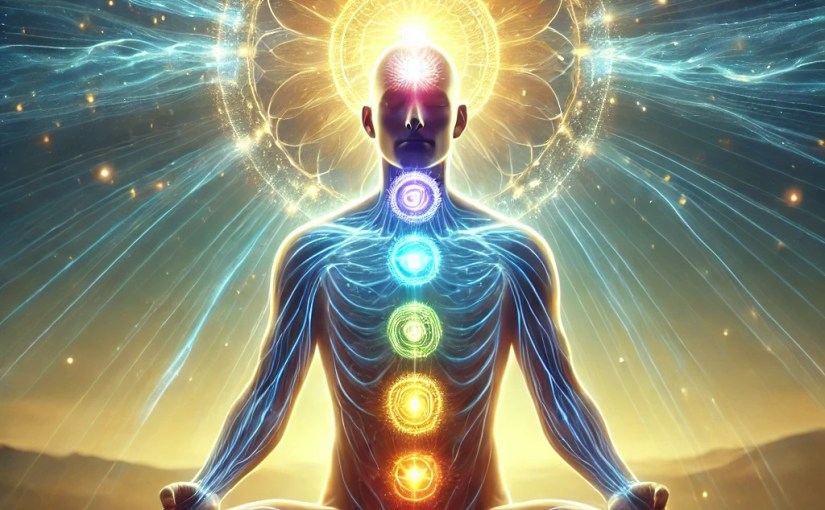
In my meditation journey, I have always felt that prana and breath regulate themselves when meditation is deep enough. I have noticed moments during worldly activities where a slight attention to Sharirvigyan Darshan (body-science observation through holographic principle) triggers a spontaneous shift—first a gasp of breath, followed by slower, deeper, and more regular breaths. When this happens, prana seems to move naturally to the brain chakras, where a stable meditation image emerges, accompanied by relaxation and bliss.
However, when I applied the same method during more intense, struggling work, the breath still became regular, but this time faster and shallower. Instead of reaching the highest chakras, it seemed to pour prana somewhere between Vishuddhi and Anahata chakras. This is also because I was working with my arms and the arms get prana from this location. The meditation image was still present but less blissful and positioned at a lower level, while relaxation was also lesser.
From this experience, I realized that prana flows naturally to the chakras most engaged in a given moment. Breath and prana are self-controlling when meditation is the guide. This meditation-led prana regulation is much more satisfying than the reverse approach, where forced breath is used to induce meditation. Forceful breath control feels like filling a vessel from the outside, giving temporary energy but not necessarily leading to deep, inner pranic movement.
I have always preferred the meditation-to-prana approach over the prana-to-meditation approach. However, I have explored various styles, understanding that every technique can serve a purpose. Meditation itself is independent, just like human beings—it does not like to be forced. The meditation image, when allowed to arise naturally, thrives and stabilizes over time. Forcing it too soon is like forcing a plant to grow faster—it may not take deep roots.
This realization led me to believe that in the beginning, meditation should be allowed to stabilize naturally through worldly meditation like Sharirvigyan Darshan. After years of nurturing this process, a time may come when the meditation image can be forcefully awakened through deep and structured Tantric meditation. The foundation must be firm before intensifying the practice.
I have also wondered whether everyone develops a single meditation image. Some may, but they might hesitate to share it. Others may not yet have a fixed image due to an unstable pranic flow, intellectual doubts, or lack of deep absorption. Even those with a stable image may sometimes wander unguided, unable to hold on to it in daily life. This wandering can happen due to weak fixation, scattered prana, overanalysis, or inconsistency in sadhana.
To stabilize the meditation image, one must develop deep trust, allow effortless absorption, and maintain consistent practice. Over time, as prana refines itself, the image becomes clearer, stronger, and more magnetic.
I firmly believe that the road to the ultimate goal always passes through a single meditation image. Regardless of the spiritual path—whether Bhakti, Jnana, Tantra, or mindfulness—a single-pointed focus is necessary to dissolve into deeper states. Without it, the mind scatters and struggles to enter deep meditation.
While I have not yet achieved the ultimate realization, I have observed these natural movements in my practice. My belief is not based on theory but on direct experience. I am still exploring and refining my approach, ensuring that my meditation becomes self-sustaining and deeper over time.
In the end, meditation is not something to be forced; it is something to be nurtured. When we let it unfold naturally, it leads the way—breath and prana follow effortlessly, and the journey becomes self-directed, blissful, and deeply fulfilling.
 Demystifying Kundalini