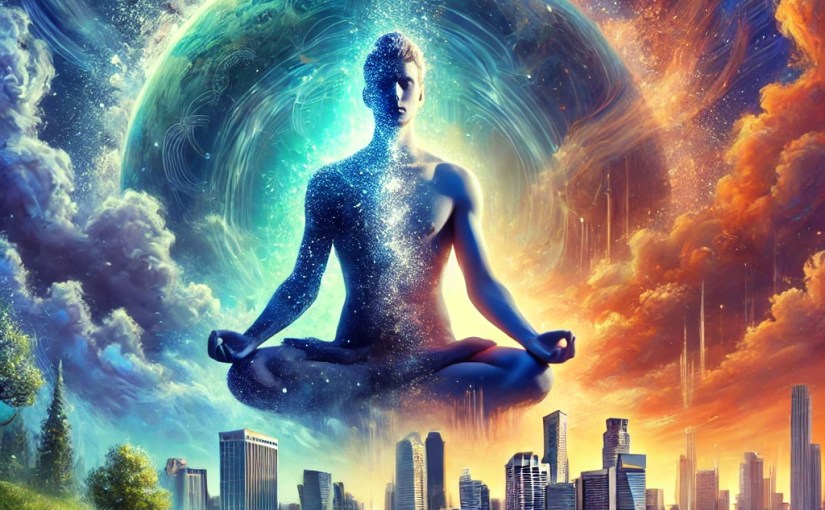
For those who have glimpsed enlightenment, the journey does not always lead to immediate liberation. Instead, it often raises an even deeper question: how does one integrate this profound realization into daily life? My own experiences have taken me through different dimensions of awakening, from adolescence to my later years, shaping a unique perspective on spirituality, renunciation, and engagement with the world.
A Glimpse Beyond the Mind
The first significant brush with enlightenment came in my adolescent years through a dream-state experience. It was a powerful realization—one that connected me to the limitless cosmos. Yet, it left me with a lingering craving for fulfillment, suggesting that the experience, though transformative, was not complete liberation. Years later, a more conscious awakening occurred through a combination of Kundalini Yoga and Tantric sexual yoga, leading to an even more intense moment of self-dissolution. This time, the craving was minimal, but I found myself bringing the energy back down intentionally, fearing the irreversible shift towards renunciation.
This conscious grounding of energy led me to explore the delicate balance between spiritual transcendence and worldly engagement. Unlike some who fully embrace monastic life after such experiences, I felt compelled to remain in the world while sustaining my awakening.
Does Enlightenment Guarantee Liberation After Death?
A common question that arises after a glimpse of enlightenment is whether it guarantees liberation post-death. Various traditions offer different answers. Some suggest that even a single deep realization creates an irreversible imprint, ensuring that the soul moves toward liberation, even if rebirth occurs. Others argue that full stabilization of enlightenment—either in this life or at the moment of death—is necessary to break free from samsara entirely. My perspective aligns with the idea that even a temporary experience of the ultimate truth provides a direction after death, ensuring a well-guided transition, if not immediate liberation.
Renunciation or Integration?
Experiencing profound states like Savikalpa Samadhi naturally leads to the question of renunciation. Does one leave the world to deepen into Nirvikalpa Samadhi, or is there a way to maintain realization while living a worldly life? Initially, I leaned toward integration, choosing to stabilize awareness while engaging in responsibilities. Over time, I noticed that my energy remained centered in the Ajna Chakra, creating a state of Pratyahara—a withdrawal from external distractions while still being functional in the world.
However, this also led to reduced engagement with lower chakras, affecting worldly interests. To counterbalance this, I consciously applied Panchamakara practices in minimal amounts, using them as a tool for grounding rather than indulgence. This strategic approach allowed me to retain awareness without losing myself in worldly entanglements.
A Structured Approach with Kriya Yoga
While my earlier awakening experiences were rapid and unstructured, I later explored Kriya Yoga, appreciating its systematic approach. Unlike my initial methods, which focused on direct energy ascension, Kriya Yoga emphasized gradual refinement through Dharana, Dhyana, and Samadhi. I found that my earlier practice had already developed these states, but in a spontaneous way rather than in a staged progression. Now, Kriya Yoga serves as a structured refinement tool rather than a new revelation.
However, I also discovered a practical challenge—deep breathing exercises after a full stomach were showing possibility of increasing my GERD-related issues, including sleep apnea. Adjusting my practice to 4-5 hours after meals removed this possibility, reinforcing the importance of aligning spiritual techniques with bodily conditions.
Key Takeaways
A glimpse of enlightenment shapes the post-death journey, but full liberation may require further stabilization.
Balancing nonduality with worldly life is possible but requires conscious grounding techniques. The philosophy of Sharir Vigyan darshan (mythological bidy) is amazingly helpful in this, which I created for myself but is now available to everyone everywhere.
Kriya Yoga provides a systematic approach but does not necessarily reveal anything new for those who have already experienced direct awakening.
Pratyahara naturally occurs as awareness stabilizes in higher chakras, but intentional grounding helps maintain functionality in the world.
Physical factors like GERD can affect spiritual practices, requiring mindful adjustments.
The Road Ahead
Rather than seeking another grand experience, my focus now is on sustaining the clarity of awakening without getting lost in either spiritual absorption or worldly distractions. I remain open to refining grounding techniques while ensuring that my sadhana continues to evolve. In the end, enlightenment is not about a single peak moment—it is about maintaining unwavering awareness, whether in meditation or in daily life.
For those walking a similar path, the key lies in understanding one’s unique energetic tendencies and shaping a practice that balances both inner realization and outer existence. True liberation is not about escape—it is about realizing that whether in the world or beyond, the awakened state remains unchanged.
 Demystifying Kundalini