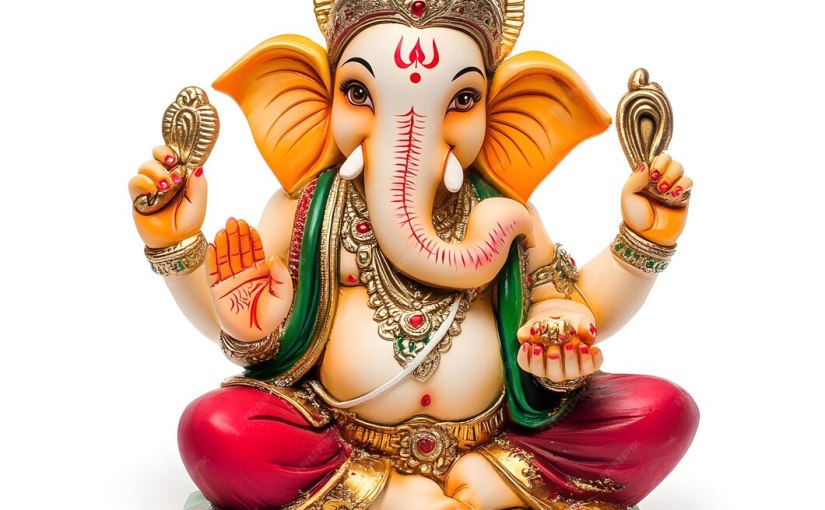
Friends! For a long time, life circumstances were not conducive to writing. For writing, a person should be completely stress-free and worry-free. There should be such a feeling in the mind that whatever is happening is happening for the right reason. A person should not be too reactive, otherwise the energy that was to be used for writing, gets spent in reacting.
I feel that the Kundalini picture of my mind is getting transformed. It seems that now Lord Ganapati is taking the place of Guru. It is not that now Guru is no more. It means that Guru himself is appearing in the form of Ganapati. Shankaracharya ji has also told about this Samadhi transfer in his commentary of Patanjali Yoga Sutra. It means that Samadhi is transferred from one picture to another. Perhaps this is also happening because my Guru himself was a famous idol worshipper and I too have been bathing a small bronze idol of Ganapati daily, applying Tilak and showing it the sun at the time of Suryargh. However, I have never been involved in too many formalities.
Lord Ganapati is the God of Gods. He is worshipped first in any ritual. His body itself contains countless teachings. He is a great writer who never gets tired of writing. This is because he remains happy like an elephant, meaning he is not very reactive. It is said that he was the one who wrote down all the Puranas, Maharishi Ved Vyas only spoke words to make him write. His long trunk is indicative of the front nadi going straight down from the Ajna Chakra. It is also indicative of his excellent sense of smell. Actually, it is the smell that creates attraction between people, especially between lovers. This is also scientifically proven. But we do not know this. The seed of attraction is hidden in the smell itself. That is why in matters of marriage, excellent fragrant incense sticks are used. This creates attraction even without wanting it. And everyone knows that attraction is the seed of Kundalini Samadhi.
Similarly, Gajanan’s trunk is a symbol of detachment. It means that he does not taste the worldly pleasures, he only smells them. It is a symbol of subtle lust. The word ‘vaas’ or ‘baas’ from which the word ‘vasna’ is derived, is used for smell only. Lust is the subtlest form of worldly troubles. It means that Yogi Ganesh keeps this trouble to a minimum level even while being in a complete household with the power of continuous sadhana. It is not possible to get rid of it completely while living in the world. But the advantage of this is that if needed, it becomes easy to destroy it with a little extra sadhana. Which is necessary for liberation. If a man remains immersed in gross materialism all the time, he will not be able to destroy it easily.
The big ears of Ganesh ji mean that he collects as much information as possible from the world, listens to everyone, speaks less. That is why he is able to write so much. Gajanan is also called the god of leadership. His big ears are a symbol of this leadership ability. A good leader collects all kinds of information about the country and the world. With that, he is able to lead the people well. The stronger the spy network of a leader or a country, the more powerful he is considered. A good leader keeps the secrets of his country or society secret, but finds out everyone’s secrets with his sharp ears.
Ganesh’s big belly does not mean that he is obese. Rather, it means that he takes long and deep breaths while fully ballooning his belly. Such breaths are yoga breaths. His right tooth is broken. This means that he is equalizing and balancing his Ida and Pingala Nadi, that is, the left body and the right body, because in normal life the right part of the body is more active and stronger than the left. The big, clear and equal ears on both sides of his head also draw attention towards themselves and make Ida and Pingala equal, which is very important for meditation.
The picture of Lord Ganapati is increasing in the mind. I don’t know when it will awaken. It will be fine when it awakens, because due to the worldly affairs and health issues, I don’t have the strength to do intense sadhana anymore, and along with that I don’t have the attraction towards awakening any more. But this will definitely prove that the idols of gods considered lifeless can also be awakened easily. I have no doubt about this scriptural statement anyway, but those who spread hatred and negativity by calling idol worship the work of infidels, conservatives and backward people etc. and commit atrocities, vandalism and bloodshed, can definitely get good sense. There is a possibility of this, but it is less, because the belief which is firmly established in the mind without thinking is very difficult to remove.
It is definitely true that the Kundalini picture gets hold of and grows with the worldly affairs. But when the time of awakening comes after a long period of growth, by then the person does not have the strength to do intense sadhna for awakening due to old age, illness or other reasons. Many times the person remains entangled in the world till the last moment of life and despite many efforts, he is unable to save time and strength to give the Kundalini the momentum or escape velocity of liberation. That is why it is said that the younger the age at which Yoga is started, the better it is.
Although, if a person leaves worldly affairs and starts Kundalini sadhna with full strength and devotion, then it does not take much time for awakening. It can happen in a few months to a few years. The time taken depends on how much of the worldly affairs he has left and how much strength and time he has put into sadhna. But doing this is rarely practical, if it is practical then it is only for a few people and for a very short time and only with many favorable circumstances. Out of these few people, some very rare people get awakened. In the olden days, many people used to get awakened because awakening used to be the main goal of their life, and for this, they used to leave their homes and go to the forest to do penance and return home only after attaining knowledge. In the scriptures, the word ‘knowledge’ is mostly used. It is the awakening of the Kundalini, because it is the extraordinary and direct knowledge. Ordinary knowledge is limited to worldly matters. It cannot give the experience of the soul, no matter how much and of what kind it is. Even if someone keeps collecting knowledge about spiritual scriptures throughout his life but is unable to achieve awakening, then it cannot be considered complete or real knowledge. Kundalini awakening is also knowledge, but it is the knowledge of one’s own soul. All other knowledge is about things other than oneself. That is why awakening is called knowledge in short. The scriptures, mainly the Puranas, are made keeping in mind the interests of all types of people. They know that not all the people who read the Puranas will be Yogis. Because the Puranas are made for the general public. Therefore, if a completely illiterate person cannot understand the real meaning of knowledge, then at least he will understand it as material knowledge. This will also improve his material life because if there is knowledge, there is life. Now if it is written Awakening or Kundalini Awakening and the common man is unable to understand it, then his reading will be useless. Or it is possible that something opposite may get embedded in his subconscious mind. Everything is a game of the subconscious mind. If the word knowledge gets embedded in the subconscious mind, then it will lead to Awakening someday or the other because everything is knowledge. In the scriptures and in the ancient Aryan civilization, the unparalleled dedication towards knowledge is the culmination of dedication towards Kundalini. Nowadays the main goal of life is worldliness, then how will Awakening be achieved.
Deities of different shapes and sizes have been created because the atmosphere of man’s life is sometimes of one kind and sometimes of another kind. Similarly, one person likes one particular image, while another likes another. So that suitable deities are available to all types of people for sadhna at all times. That is why Sanatan culture is polytheistic. Of course it is also monotheistic because all gods ultimately lead to one supreme God.







 Demystifying Kundalini