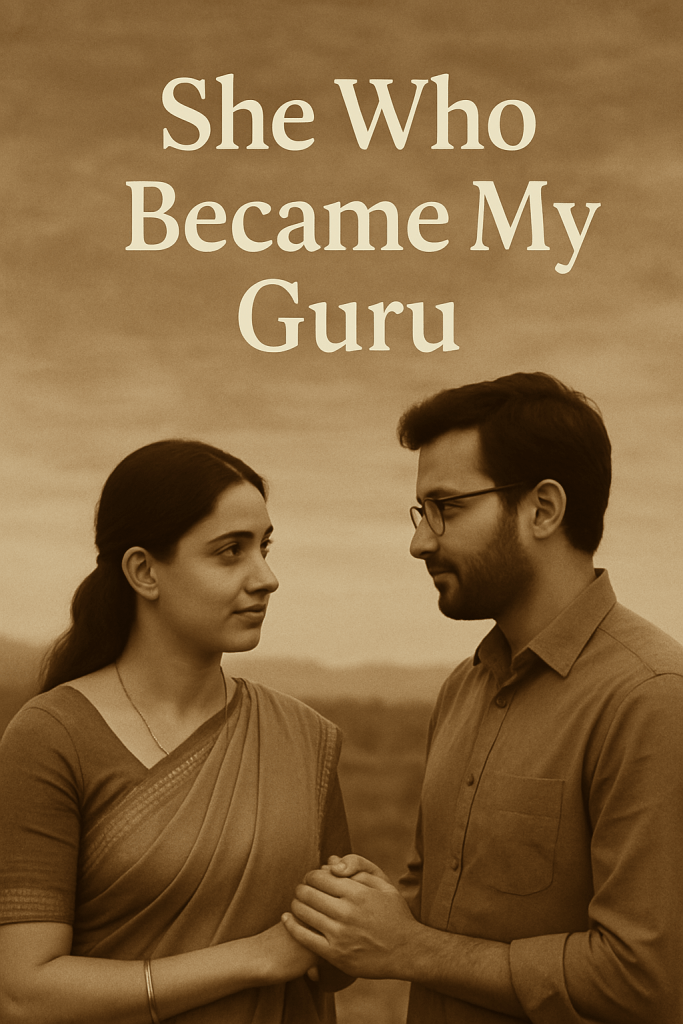
My post

Chapter 16: The Ancestors’ Abode

Ishaan reached the sixteenth chapter while scrolling slowly through the weathered pages of She Who Became My Guru, seated on the edge of a boulder near a clear Himalayan stream in Himachal—his native land. The breeze carried the scent of pine and wildflowers, and the hush of the mountains gave the words on the page a living pulse. His fingers paused for a second on the heading, The Ancestors’ Abode, and a strange pull of nostalgia coiled around his heart. The water rippled before him, as if mirroring the grey valleys of the moon. And as he began reading, the line between memory and moment dissolved effortlessly.

Returning to the Moon wasn’t like revisiting a city or an old neighbourhood—it was like stepping into a dream you had once woken up from, only to find yourself dreaming it again, but wiser this time. Ishaan Sharma, now a seasoned veterinarian with a weather-wrinkled gentleness in his smile, stood once again on the soft dust plains of Pitru Loka, where shadows walked slowly and the silence carried songs of the past.

The Moon had changed since his student days at Lunar University, or maybe he had. Back then, his limbs were lighter, his mind more restless, and his heart flared with the intense and nameless flame of longing. Myra. Her image, back then, had been seared into the grey landscape of the Moon like a mantra. It wasn’t just memory; it was meditation. Her soft gaze, her unspoken words, her sudden silences—they had all danced in his consciousness, bathed in lunar tranquility.

Yet even amidst the deep pull of that image, something else had arisen—his Dada Guru. Whenever the image of Myra would intensify in that moonlit solitude, so would the vision of his Guru, standing silent in ochre robes, his eyes like twin moons of ancient wisdom. The Moon, after all, was Chandraloka, the realm of the ancestors, a place where meditating on lineage, legacy, and liberation came as effortlessly as breathing. Ishaan had often felt as if the Moon itself held the contemplative power of thousands of rishis and grandfathers whispering through its valleys.

Now, two decades later, Myra’s image had softened, like a perfume clinging faintly to an old letter. His wife Vedika and children Diya and Ruhan filled the space where earlier only one name had echoed. Yet, as he stepped once again onto the Moon’s surface, he felt the subtle shimmer of Myra returning—not as a woman, nor as a memory, but as a reflection of his own soul. She was no longer someone separate. She had dissolved into the great sacred fluid of his being, becoming part of what he now called awareness.

“Funny,” he once wrote in a margin, “how one who stirred the storm becomes the stillness itself.”

Back then, Ishaan remembered struggling with those overwhelming visions. To still the whirlpool, he had meditated on Govind, his cousin brother who had once lived in their home, an enigmatic figure full of spiritual curiosity. Merging Govind’s moral strength with the image of Myra created a strange alchemy—a divine Yin-Yang. Myra’s gaze turned prophetic; her silence began speaking the truths of the cosmos.

Even his Pine Crest days came back to him. He would often see Mr. Dutt, his old science teacher, in his dreams on the Moon, carrying a celestial blackboard and scribbling formulas that dissolved into Upanishadic verses. Vinod, his intelligent classmate, now a researcher in dark matter, had once joked, “Ishaan, you don’t need a spaceship. You are a spaceship.”

The Lunar University corridors had once echoed with Gagan’s voice, singing retro Bollywood while Ishaan secretly stared out the window, thinking of Myra’s absent presence. Ranjana, his cousin sister, had sent him voice notes back then, filled with homemade advice and cheerful rebukes, urging him to eat well and not let his head get lost “in those Moon books.”

But this return was not merely academic—it was spiritual. The Moon had been officially designated as a psychospiritual habitat, and Ishaan’s posting wasn’t to treat space cows or lunar llamas—it was to explore how ancestral energies affected the psychic health of settlers. He was part vet, part mystic psychologist.

One evening, while examining a Lunar Hawk—an alien-like bird adapted for low gravity flight—he saw them. Far away on the horizon, silhouettes danced. Not human. Not alien. Not ghost.

They were… energy drinkers. Beings that fed not on blood or flesh, but on contemplative energy. They shimmered like dew caught in starlight. These beings relished the deeply meditative aura of Pitru Loka. When Ishaan would sit in dhyana, meditating on the intertwined forms of Guru and Myra, he would feel his thoughts lift like incense, and in those moments, he sensed them dancing—graceful, distant, never intruding, but always feeding. And in turn, they gave back something inexplicable. A deeper stillness. A broader silence.

He recorded these experiences in a log but never sent them to Earth Control. Some truths must grow roots in silence.

Reading these pages now, Ishaan chuckled softly. “Why did I never propose to Myra, despite burning inside?” he had once asked himself.

The answer had unfolded slowly through years.

There were too many walls: cultural, social, and perhaps most formidable—the silence between them. Years had passed without a single word exchanged. Ishaan had once considered breaking that silence, but the imagined effort of convincing her, her family, his family, the rituals, the explanations, felt more exhausting than uplifting.

So he chose an arranged marriage, not because it was easier, but because it was possible.

He had written once: “Why diminish the joy of an upcoming arranged marriage by openly mourning an inaccessible love?”

Still, divine love stories from the Puranas whispered their answers to him. Radha never married Krishna. Shiva married Parvati only after years of austerity. These stories weren’t just stories—they were energy blueprints. Ishaan realized the seers had deliberately embedded love tales in scriptures so that even a flicker of romantic energy could be sublimated into a full-fledged path of awakening. Romantic memory merged with spiritual devotion, and something beyond the two emerged—something powerful and liberating.

He remembered one particular night.

A meditation session had reached an unexpected intensity. Myra’s form appeared before him not as a girl, but as a celestial goddess, her outline flickering with cosmic fire. Then it shifted, merging with the image of his Guru. Myra’s gaze became his Guru’s. Ishaan had cried then—not from sadness, but from awe.

He had understood.

Myra was not outside him.

She never was.

The chapter neared its end. Ishaan lifted his eyes from the page. The sun had dipped low over the mountains, casting orange-gold light through the tall pines. Birds fluttered back to their nests. A cowbell rang faintly from a distant pasture. Somewhere nearby, children laughed, their voices carried on the breeze like echoes from a simpler time.

He let the book rest on his knees and looked up at the sky. The Moon had just begun to rise, its faint arc glowing like a half-drawn smile. He whispered aloud, “Pitru Loka isn’t just on the Moon. It’s anywhere your soul touches its lineage… and bows.”

In the distance, the stream sang its eternal song, as if echoing his prayer: Jai Guru Dev, Jai Myra Dev, Jai the Self that was never separate.

And with that, Ishaan closed the chapter—not just in the book, but in his heart, which had never been broken, only opened a thousand times to newer skies.

He leaned back, eyes distant, memory stirring.

“I still remember the day I decided to leave the Moon,” he murmured to himself. “The medical facilities there—limited, cold, clinical—weren’t enough for an aging body like mine. I was growing old, and strangely, I found myself yearning for the things I once took for granted: the smell of soil after rain, the warmth of sunlight filtering through leaves, even the chaos of crowded streets.”

A smile flickered at the corner of his lips.

“That hunger brought me back. I took early retirement and returned to Earth. Because in the end, no matter how far you travel… home is home, and Earth is Earth.”

Chapter 15: The Lunar Posting

The morning light slanted through the window, spilling softly across the wooden floor as Ishaan reached Chapter 15 of his book She Who Became My Guru. The garden outside his Himachal home lay bathed in a serene, misty glow. The silence was not empty—it felt watchful, as if the trees themselves leaned in to listen.

His fingers slowed over the pages as the words awakened the images, not from memory, but as though the past had arrived, knocking gently at the doors of the present. It wasn’t just reading—it was reliving.


After years of earthly veterinary practice, Ishaan Sharma, now a quiet yet inwardly glowing man in his forties, found himself standing at the threshold of an unimaginable transition. An official letter from the Interplanetary Veterinary Alliance confirmed his posting to a lunar animal research center. The moon colony, once a scientific fantasy, had now grown into a peaceful sanctuary of learning and experimentation.

Ishaan didn’t hesitate.

With Vedika by his side, and their children—twelve-year-old Diya, a budding stargazer with a laugh like chimes in the wind, and five-year-old Ruhan, mischievous and wide-eyed—they climbed into their family space vehicle. The personal space car hummed quietly like a purring cat, its dashboard filled with soft-glowing panels. It wasn’t like boarding a rocket—it was more like taking a road trip through stars.

They flew over the Earth’s atmosphere, past its blue cocoon, then slipped into the milky silence of space. The children giggled at the floating toys and bubble-like drinks. Vedika leaned back, silent, her eyes filled with shifting light. Ishaan looked at her, her form silhouetted against the cosmos. So much had passed between them, and yet something had begun to flower anew in the silent understanding they now shared.

While Ishaan, Vedika, Diya, and little Ruhan floating through the velvet stretch of space in their cozy family space car, the journey felt more like a celestial vacation than a relocation. They made joyful halts at floating restaurants shaped like glowing lotus petals, where gravity played tricks and food gently orbited plates. Parks hung like magical bubbles in space, filled with soft, bouncing air-cushions and starry swings. In one dome, Diya danced in zero gravity while Ruhan giggled, chasing space bubbles. Vedika clicked pictures, and Ishaan, for once, let his heart soak in the joy—his family’s laughter echoing gently in the silence of the stars.

The Earth became smaller and smaller. And then— the moon rose, not from a horizon, but from deep within Ishaan’s chest.

As they descended toward the lunar habitat nestled on the inner curve of the Copernicus Crater, Ishaan felt an inexplicable shift. A presence.

His ancestral guru.

Not Myra. Not anymore. That image, once so blinding in its charm, now gently dissolved like moon mist in morning sun. Myra’s contemplation had dimmed day by day ever since they left Earth’s pull. And now, in this ancestral land—Pitru Loka as whispered by ancient texts—the guru of his bloodline seemed to reawaken.

“I don’t know why,” Ishaan said to Vedika one night after settling in, looking out the porthole at the glowing expanse, “but I feel like this is where he used to sit. Like… like the moon cradled him.”

Vedika smiled, wrapping a blanket around Diya who had fallen asleep on the reclining seat nearby. “Then maybe that’s why you’re here—to sit where he once sat, and see what he once saw.”

They had not brought their pasts with them. That chapter had gently closed back on Earth, in those quiet talks and opened hearts. Now, they were not trying to belong to each other. They simply were.

The moon colony was unlike any place Ishaan had imagined. Not silver, not sterile. It was alive in silence. There were bio-domes filled with blue-green vegetation, and soft artificial gravity gardens where animals from across galaxies were studied and healed. Ishaan worked at the Interplanetary Veterinary Research Lab under the mentorship of Dr. Laisha, a gentle lunar woman whose calm voice reminded him of Anjali’s—the same silence that did not demand, only listened.

There was something oddly freeing about space. You couldn’t carry your emotional baggage here; the void simply wouldn’t let you. It burned it away.

Gagan pinged him through interspace once with a cheeky message: “From Pine Crest School to Pet Moon School! Proud of you, space monk!”

Even Mr. Dutt sent a message, his voice aged but firm. “You always walked differently, Ishaan. I’m glad to see where that path led.”

Vinod, still sharp and full of data, had sent him a detailed analysis on lunar soil effects on quadrupedal muscle composition.

Govind had recently retired. Ranjana, now a joyful grandmother, had laughed during a video call, saying, “You always belonged among stars, Ishu.”

Yet, despite these distant voices, the moon had given Ishaan something he didn’t expect—stillness without loneliness.

One moonlit evening, while watching Diya draw little constellations on the frosted window, and Ruhan pretending to be a gravity-cowboy, Ishaan suddenly found himself thinking of Pine Crest School again—not the bricks or the uniforms—but the boy he was. The one who had stared too long at stars. The one who’d first heard Myra’s name like a bell inside the cave of his being.

“Myra was the flame,” he thought, “but Dada Guru was the wick.”

The insight struck not like lightning—but like moonlight. Gentle, cool, sure.

A few weeks later, while meditating in the transparent lunar chapel—a place designed for spiritual silence regardless of one’s faith—Ishaan had a vision. His grandfather, seated calmly on a rock, looking out over a field of light. Not a word spoken, but a hand raised in benediction. That was all. And everything.

He rose from that meditation with tears in his eyes.

Not sorrow.

Not joy.

Just… release.

Vedika met him in the corridor. She didn’t ask what he had seen. She only held his hand.

“I’ll cook tonight,” she said softly. “Even if the ingredients taste like moon potatoes.”

He laughed. “As long as there’s Earth masala, I’ll survive.”

Life on the moon was not perfect. But it was perfectly theirs.

They had adjusted to shifts in gravity and the delays in messages from Earth. Diya had made friends with a Martian girl named Nyra. Ruhan had adopted a small, shape-shifting pet that squeaked like a rubber duck. Vedika had started teaching yoga to fellow colony members—her classes were known for laughter and unexpected wisdom.

And Ishaan—he worked. He healed. He listened to animals who didn’t speak with words. Sometimes he sang ancient mantras while tending to injured lunar wolves. Sometimes he simply sat with them in silence, and they seemed to understand.

Slowly, imperceptibly, his sense of Self expanded.

He was no longer the seeker who needed fire to burn his doubts. He was the fire. He was the moon.


As Ishaan turned the last page of Chapter 15, the clouds over his garden lifted. A cool wind rustled the leaves. The birds were quiet, as if listening.

He closed the book slowly, placing it on his lap.

The wind carried the scent of earth and pine.

Somewhere in the sky, the moon waited.

    Did Buddha Enter Nirvikalpa Samadhi? A Seeker’s Honest Reflection

    One day, a question naturally arose in me:

    Did Gautam Buddha directly enter Nirvikalpa Samadhi while sitting under the Bodhi tree?
    Did he attain keval kumbhak—the effortless suspension of breath?
    Did he pass through Savikalpa Samadhi, where forms and ideas are still present, before going beyond?

    This wasn’t just a curiosity. I asked this from my own lived journey. I’ve touched a deep state of Savikalpa Samadhi—where the sense of “I” dissolved completely, and only pure consciousness remained. It didn’t feel like something I was imagining. It felt absolutely real. Blissful. Expansive. Still, I couldn’t stay in it. I consciously brought myself back—out of fear, maybe, or a sense that the experience was too much to hold. I massaged my forehead and intentionally lowered the energy to the Ajna Chakra, perhaps to stay grounded in worldly life.

    I haven’t experienced Nirvikalpa Samadhi yet—the complete absorption beyond all ideas, forms, even bliss. I haven’t reached keval kumbhak permanently either. But I’ve had a glimpse, and that glimpse continues to guide me. So I wanted to understand—what really happened under the Bodhi tree? Did Buddha walk the same path I’ve been walking?

    From what I’ve read and understood, Buddha passed through deep meditative states that closely resemble the stages of Samadhi described in the yogic tradition. In Buddhism, these stages are called Jhanas. They begin with focus and joy, move into silence and pure awareness, and go further into formless states—like infinite space, infinite consciousness, and finally, neither perception nor non-perception. These are not imagined states—they are real, lived inner experiences.

    In yogic terms, these states are like Savikalpa Samadhi leading into Nirvikalpa. In both systems, the mind becomes still, the ego dissolves, and a pure, unborn awareness remains. Some call this Self. Others, like Buddha, avoided calling it anything at all.

    That brings me to a deep doubt that arose within me:

    If Buddha denied the idea of a permanent soul or self, then how is Nirvana—which he attained—said to be permanent?

    The answer lies in how Buddha approached truth. He didn’t deny the ultimate. He denied that anything we think of as “me” or “mine” is ultimate. He didn’t say there’s nothing beyond—he simply refused to give it a label, refused to trap it in words. Because any word would have become another idea, another attachment. He was silent not because there was nothing, but because what is cannot be spoken.

    In that silence, there is no contradiction. Nirvana is not a “thing” that lasts forever. It is the end of all becoming, all clinging, all identification. It’s not the presence of something new—it’s the cessation of all illusion. It’s the stillness when the winds of craving stop blowing.

    So is Nirvana the same as Nirvikalpa Samadhi? Maybe not in name, but in essence, they seem to meet. One path says, “I am That”—the timeless Self. The other says, “There is no I”—only the cessation of becoming. But in both, the seeker dissolves. What remains is not “something.” It’s the background silence that was always there.

    I know I haven’t reached that silence permanently. I still feel the pull of the world. I still ground myself when energy goes too high. I use some techniques, even earthy ones, to stay balanced. My sadhana isn’t perfect, but it’s deepening. My curiosity is alive. And more importantly, my honesty is alive.

    Sometimes I wonder if that early adolescent dream-state I had—which brought more bliss and detachment than anything since—was a preview of what’s to come. Or maybe it was a gift, reminding me what I’m seeking, what I’ve momentarily touched again through tantric sadhana and now through Kriya Yoga.

    One thing I’ve learned: the journey is not always upward. Sometimes the energy rises, sometimes it settles. I no longer cling to either. I’ve realized that even bringing the energy down has its own sacredness—its own intelligence.

    Here’s a simple reflection that came through this process:

    The yogi dissolves into stillness and calls it Self.
    The Buddha dissolves into silence and says nothing at all.
    One says “I am That.”
    The other says “There is no I.”
    But both sit in the same unmoving stillness, beyond joy and sorrow, beyond life and death.

    Maybe it doesn’t matter what we call it. What matters is living in a way that moves toward that silence, that freedom. Not with force, not with fear, but with surrender, awareness, and love.

    To those walking a similar path—between glimpses and grounding, between depth and daily life—this reflection is for you. I haven’t finished the journey. But I’m walking it with eyes open and heart awake.

    And in the hush between two breaths, I sense something vast. Not mine. Not even “me.” Just what remains when all else falls away.

    Chapter 14: An Earthly Union

    The amber sun lazily kissed the mountaintops as Ishaan Sharma, now in his early fifties, sat at his favorite hillside retreat. A small tea stall nearby whistled a nostalgic tune, mingling with the pine-scented air. A familiar worn-out book rested on his lap—She Who Became My Guru. He wasn’t just reading it; he was reliving it. Each page moved not as print and ink but as a breathing echo of his past.

    As the breeze gently flipped the paper, his eyes met the title of the next chapter—
    An Earthly Union.
    And the story flowed back into him like a forgotten dream stirring awake.

    Years ago, after the cosmic intensity of Pine Crest and the silent wound left by Myra’s absence, Ishaan had found himself burning—not from pain, but from an overwhelming inner fire that refused to settle. No mantra, no meditation seemed to douse the intensity. His mind, often serene, was now flooded by Myra’s image—her laughter, her silence, the light she had once become within him.

    It wasn’t romantic longing—it was something deeper, yet dangerous. A kind of spiritual ache that refused to dissolve.

    His family began to worry.

    One of his close relatives, noticing his silent decline, suggested an arranged match. A girl named Vedika—a poised, kind, and independent woman from a distant connection in the extended family.

    Ishaan had never met her before. And with his inner fire still unextinguished, he wasn’t in a space to be picky or romantic.

    So there wasn’t much waiting time for Ishaan to select the best match, as usually happens in selective arranged marriages where one tries to choose the best fit like picking out the right attire from a bundle. He simply agreed—more out of exhaustion than enthusiasm.

    He didn’t do it for love. He did it like one reaches for water in a forest fire. A survival instinct. A hope that maybe this earthly bond would balance the heaviness of his unending contemplation. It wasn’t a step toward love, but a strategy of defense.

    The marriage happened quietly, almost too quickly.

    Vedika entered Ishaan’s world with her soft grace and subtle wisdom. She didn’t expect fireworks. But neither did she expect the coldness that followed.

    For months, Ishaan remained aloof. Not cruel—but disconnected. He didn’t even realize it at first, but Vedika could feel it in the way he’d look through her instead of at her.

    And then, slowly, his detachment turned into quiet control.

    Not by intention—but by inner pressure.

    He began instructing her on how to arrange things, how to speak, how to pray, how to carry herself in front of guests. He wasn’t trying to dominate—but the fire of Myra’s haunting presence was still flickering in his mind, making everything else appear dimmer, duller.

    Myra’s image—mystical and radiant—had become his subconscious standard. And though he never spoke her name, the echo of her presence made Vedika feel as if she was being compared to a goddess she couldn’t see.

    Unintentionally, Ishaan became a little dictator in the household, ruled not by ego but by the ghost of contemplation still clinging to his inner vision. He didn’t know how to shut it off.

    One day, after a quiet argument over something trivial, Vedika packed her things and left for her mother’s house.

    She didn’t shout. She didn’t cry. She just left—with dignity and silence.

    That evening, Ishaan sat alone. The room was clean, calm, and lifeless.

    And that’s when it hit him.

    The stillness was not peace—it was punishment.

    He looked around and found her slippers still near the mat. Her unfinished book on the side table. Her half-written grocery list on the fridge.

    And then something inside him cracked open—not loudly, but like dry earth splitting quietly before rain.

    He realized he had pushed away a person who had entered his life with nothing but sincerity. Not because he didn’t care—but because he hadn’t healed. Although he let her rest at her birthplace for a week, the very next week he went there himself, unable to bear the silence of her absence. With a softened heart and humbled spirit, he gently apologized for his behavior and requested her to return home, not out of duty, but because her presence had unknowingly become a part of his healing.

    Standing in the threshold of her childhood home, he looked at her and said, “I was wrong. Not in words, but in spirit. I never meant to hurt you. I think I was punishing myself… and you got caught in it.”

    Vedika looked at him—not angry, but unsure. Still, something in his eyes made her return.

    Not out of fear. But hope.

    After that turning point, a quiet shift entered their lives.

    The distance between them became a bridge rather than a wall.

    Yet, for years, neither spoke of their past love stories. It was an unspoken agreement—not out of fear, but because the moment hadn’t yet arrived. They lived with greater ease, greater respect. Still, there was something unsaid—something resting quietly between them.

    Then one day, much later, something unexpected happened.

    Ishaan experienced another glimpse of awakening—this time, not alone under stars or beside lakes, but through Vedika herself.

    It wasn’t dramatic. It was tender. A look she gave, a phrase she whispered, something about her presence cracked open another layer of his being. And in that silent opening, he felt his purpose with her had somehow been fulfilled.

    After awakening with Vedika — even stronger than before — the game turned over. He dismissed many people’s idea that Mayra would have been the best match for him, for now he believed Vedika was the best match. With her help, he had attained the highest awakening, which meant that his real aim was centered on awakening; all other goals were secondary. It was not only with him, but in fact, awakening is the real and final aim of everyone.

    And it was only then, after that soft awakening, that the past could be shared.

    One evening, sitting quietly on their rooftop beneath a golden sky, Ishaan turned to her and said, “There was someone in my life. She helped open something in me… I never understood what it was, but it changed me forever.”

    Vedika smiled gently and said, “There was someone in my life too. It ended peacefully, long ago… but he shaped a part of me.”

    They didn’t ask too many questions. They just listened.

    And in that honesty, something melted. As if the past, which had been frozen in their silences, finally began to flow.

    From that moment onward, something precious shifted.

    They began allowing each other to live more freely—without pressure or expectations. There was still respect, still care—but no more invisible bondage.

    They loved each other now in a new way—legally together, yes, and within human boundaries—but spiritually free. As if they were testing the truth of unforced love.

    In those days, they reconnected with a few old companions—not to return to their past, but to dissolve it completely. To free themselves from the invisible layers of conditioning that silently shaped them.

    A strange and beautiful thing happened.

    Their love deepened—but in a completely unexpected way.

    They didn’t become romantic in the usual sense. But they became truly loving.

    Without attachment.

    Without dependency.

    They remained together but detached—loving each other without asking, needing, or expecting anything.

    Now, as the last light of dusk dimmed across the sky, Ishaan closed the book softly and placed it against his chest.

    The deodars swayed above him like old monks whispering prayers.

    He smiled—not with pride, but with peace.

    What began as a marriage of necessity had become a love beyond all conditions.
    Not because they held on—but because they finally let go.

    And in that letting go, they found a bond that no fire could burn.

    The Silent Descent into Formless Bliss — A Layman’s Glimpse Beyond Thought

    This blog post is not written to boast, teach, or declare attainment. I haven’t reached Nirvikalpa Samadhi yet — but what I share here is unfolding naturally in me. It is a journey, not a conclusion. I write this in simple, heartfelt language — straight from lived experience, not borrowed knowledge.

    Evening Silence — Where It All Begins

    I found that while sitting and gently placing attention on breathing in the evening, the breath gradually becomes still. With that, thoughts also almost stop. It’s amazing how strength of thoughts immediately reflect on strength of breath. Breath and thoughts linked together undeniably. When I become physically tired of sitting in a single posture, I shift my posture — and something mysterious happens.

    Blissful energy rises from the lower chakras to the head through the backbone. It almost feels as if a lack of oxygen in the head is being compensated by this rising energy. When the head receives enough of it, the breath again slows down — almost stops — along with thought. This cycle of energy movement and mental stillness continues for hours, until I fall asleep sitting, usually late at night.

    This process feels especially effective when done around 2-3 hours after a light meal. I began noticing this pattern ever since I started practicing Kriya Yoga breathing through the spine in the early morning — doing it for a long time, until my head feels heavy.

    In that breathing, I only use Om — and the whole experience remains entirely smooth. There’s no jerkiness or force. Just flow.

    Now, I feel that Nirvikalpa Samadhi might unfold on its own through this process — not by willpower, but by inner refinement.

    Dhyan Chitra: The Inner Image That Moves

    A new phenomenon has started arising. Some thoughts that emerge during meditation automatically transform into a dhyan chitra — a meditative image — at the Ajna Chakra. Sometimes Dhyan chitra is needed to bring to agya chakra by focusing on centre of eyebrows by little blinking both eyes and twitching both brows. When I try to consider even this image as not separate from me, not as an object, but as my own being, something subtle shifts.

    The image moves backward — toward the Sahasrara Chakra point. This point isn’t exactly on the crown, but a little inside the head, just below the superficial point on top. It brings more bliss. Head pressure shifts from the front of the brain to the mid-region, offering noticeable relief. It feels like the energy rises through backbone and cleanly and gently drops to this Sahasrara point as compared to agya chakra point.

    If I recognize this dhyan chitra, even at Sahasrara, as just another wave within my formless self, then it starts fading. What remains is a fleeting taste of pure, formless existence — a state beyond thought and image. But it is transient.

    Soon, another thought comes. It again transforms into a dhyan chitra. If I do not attentively hold it at Sahasrara, it slips back to Ajna. The cycle continues: form arises, gets internalized, dissolves into formless, and re-arises. Now I understand why my dhyan chitra appeared shifting to agya chakra during my ten seconds glimpse kundalini awakening when I massaged my forehead and deliberately tried to revert to kingdom of mental formations. Also now I know why I intuitively used to rotate dhyan chitra in my head clockwise and anticlockwise in its periphery like a farmer ploughing a field. With this rotation dhyan chitra used to rest at sahasraar point itself for little or more time.

    And yet, this to-and-fro oscillation like pendulum is not frustrating. It feels like nature refining itself.

    From Fire to Fragrance — A Comparison

    This current state is not like the full-blown, intense Kundalini awakening I once had, where self-realization dawned for ten seconds in a flash of overpowering energy. That experience was fire.

    What’s happening now is fragrance — refined, passive, and non-dramatic. It’s not a storm but a breeze. It doesn’t shock the system; it gently guides the being.

    Earlier, it was a sudden break into Savikalpa Samadhi through a powerful energy surge, temporarily burning through ego identity. That was brief, dramatic, and intense — hard to hold.

    Now, the process feels stable, nervous-system-ready, and subtle. Kriya Yoga and inner stillness are dissolving form, not through force, but through tenderness. It feels like Nirvikalpa is slowly approaching, not as a peak to be reached, but as an absence to be realized.

    What Happens When Bliss Fades?

    As this state deepens, the most noticeable change is a reduction in craving. Craving used to arise from a strong sense of lack — from identity with the one who seeks. But now, the awareness itself is becoming self-satisfied. Even bliss is not being craved. That, to me, is contentment without object.

    No mental addiction to movement. No hunger for more. Just a subtle resting in being.

    This doesn’t mean I’m established in Nirvikalpa. Not yet. But the grip of form is weakening. Desire is thinning. The I-sense is becoming transparent.

    Even when dhyan chitra forms, I watch it as a wave inside myself. It fades, and formlessness peeks through. But when I try to hold that too, it slips. And another wave arises. And the cycle of refining continues.

    Inner Map: The Cycle in Simple Terms

    • A thought arises.

    • It transforms into a dhyan chitra at Ajna Chakra.

    • I perceive it not as separate — it shifts to Sahasrara.

    • Bliss grows, head pressure centers, awareness expands.

    • Recognizing it as a wave in my formless self, it fades.

    • Pure formless awareness glimpsed.

    • A new thought arises, and the cycle restarts.

    This cycle is not an obstacle. It’s grace polishing the mirror.

    In Conclusion

    I don’t claim anything final. Nirvikalpa hasn’t stabilized in me. But it’s near — not as a goal, but as an underlying silence that occasionally reveals itself.

    This blog is just a sharing — one seeker’s simple unfolding. If you’re on a similar path, let this reassure you: enlightenment doesn’t always come as thunder. Sometimes, it descends like dusk — quiet, gradual, and full of stillness.

    And in that stillness, everything unnecessary begins to fall away.

    With folded hands and an open heart,A fellow traveler

    Chapter 13: The cosmic campus

    The evening sun slanted through the golden pines that lined the path behind Pine Crest School, where Ishaan Sharma often wandered after classes. The leaves rustled in a familiar way, whispering secrets of boyhood afternoons, half-sketched dreams, and the echo of Myra’s laughter when she’d once walked beside him there.

    It had been years since that chapter—The Dream Realization—closed with the breathless hush of the cosmos pressing down on Ishaan’s heart, whispering a purpose too vast to contain within earthly boundaries.

    Now, under the subdued glow of a rising moon, he sat quietly beside a small pond near the school’s old library, a spot once frequented by Gagan and him. The pond was overgrown, the water lilies curled with age, but the silence still held that same haunting calm. A perfect place for old memories to rise unbidden.

    “You always dive too deep,” Myra had once teased, poking his arm as he stared too long at an obscure Vedic manuscript. “One day you’ll get lost in those depths and forget to come back.”

    But he had smiled, his eyes dancing with an invisible light. “Maybe that’s where the real truth lies—in the places most are too hurried to enter.”

    That was the nature of Ishaan’s study—not just of books, but of the soul of things. He didn’t study about the stars, he entered them; he didn’t read about consciousness, he listened to its breath between words.

    Even now, his fingers still carried the warmth of old pages, and his heart pulsed with a reverence most people reserved for temples.

    The world, however, doesn’t always understand reverence.

    His scores were good—solid—but not meteoric like Vinod’s. When applications opened for Baikuntha Vidya Mahavidyalaya, a cosmic-tier university on a lush exoplanet, Ishaan’s name was never whispered in the hallways of probability.

    Not because he lacked potential, but because his kind of brilliance didn’t scream; it murmured, it bloomed slowly like an ancient tree, rooted deep, unnoticed by those looking for shooting stars.

    Instead, Vinod got in. Gagan had cheered, not knowing Ishaan had also applied in secret.

    Ranjana noticed, though.
    She always did.

    “You’re not hurt because you weren’t selected,” she said, offering him a steaming cup of tulsi chai one evening. “You’re hurt because you respected the material too much. And the world only respects speed, not depth.”

    Ishaan half-smiled. “I studied with my heart and soul, not just my brain. I honored every word as if it carried life. Maybe that made me too slow to shine.”

    “No,” she said softly, “It made you eternal. There’s a difference.”

    Months later, just as Ishaan had accepted that perhaps his journey would follow a quieter trail, a silver-hued envelope arrived in the mail—marked with the insignia of a crescent moon cradling a lotus:

    Chandra Vidya Vishwa — The Moon’s First Interstellar University

    He sat frozen on the edge of his bed, the letter shaking in his hands.

    Myra’s name flashed in his mind like a lighthouse through fog.
    She would’ve known this was coming.
    She always did.

    He arrived on the Moon not with fanfare, but with wide eyes and a suitcase full of hand-written notes, crystals Gagan had gifted him for “good vibes,” and a photo of Pine Crest’s old classroom—Mr. Dutt scribbling metaphysics on the blackboard while pretending not to care that no one understood.

    As he stepped onto the campus dome, his breath caught.

    This wasn’t Earth.
    And yet, it was.
    Only more.

    Silver gardens floated in airless pockets, their vines curling around invisible supports. Classrooms shifted dimensions with lessons—one moment an amphitheater, the next, a floating disc above Saturn’s rings.

    Cultures from across galaxies mingled freely: luminous beings from Orion who spoke in pulses of color, meditative monks from Venus who had no mouths but sang directly into the soul, and even playful time-surfers from the Andromedan fringe who claimed to live every moment backwards.

    But none of this overwhelmed Ishaan.
    It called to him.

    Because here, depth wasn’t hidden.
    Here, soul was not secondary.

    On his third night, while walking alone near the anti-gravity observatory, Ishaan found a corridor marked only by a single character: .

    He followed it, his feet pulled by something both ancient and futuristic.

    Inside sat an elderly woman—her silver hair braided with stardust, her eyes ageless. She wore a robe that shimmered like night water, and her presence felt eerily familiar.

    “Ishaan Sharma,” she said without looking. “You’ve arrived late, but right on time.”

    He blinked. “I don’t understand.”

    “Few do at first.” She turned to him now, her eyes smiling. “You were meant for Baikuntha, yes. But Baikuntha is for the brain. Here—Chandra Vidya—is for those who carry the weight of galaxies in their heart.”

    He hesitated. “Who are you?”

    She smiled. “I am the echo of your Guru, the whisper of every moment you listened instead of speaking. I am the reminder that your journey never depended on outer recognition.”

    He felt the space inside him shiver, expand.

    She motioned to a portal behind her. “Inside is your first real test. It is not written, and it cannot be solved. You will only pass by being what you’ve always been—yourself.”

    The portal shimmered.
    He stepped in.

    Suddenly, he was back in Pine Crest.
    Classroom 4B.

    Gagan was waving a paper. “Ishaan, I aced it! Vinod says he hacked the test.”

    Mr. Dutt raised an eyebrow. “Hacked the universe, more like.”

    Anjali turned, whispering to Myra, who looked straight at Ishaan.

    And in that look, it all returned—
    The dream,
    The realization,
    The Guru.

    He remembered that she was not just his first love or his spiritual compass—she was his mirror, his haunting, his call toward awakening.

    He walked slowly toward her.

    “Was this all… real?” he asked, his voice barely above breath.

    She tilted her head. “Does it matter? If the dream brings you closer to truth than waking life, isn’t that the realest thing of all?”

    His eyes stung. He hadn’t realized how deeply he had missed her presence.

    “You became my Guru.”

    She smiled. “And you… became your own.”

    The scene shimmered.

    He came to on a marble bench inside the observatory, the stars above sharper than ever.

    The elder was gone.
    But in her place, a crystal pendant lay glowing—a perfect balance of moonstone and obsidian.
    Attached was a note:

    “The departure is not from Earth, but from illusions. The journey is not to the stars, but through the soul.”

    Ishaan clutched the pendant tightly, breathing in its silent wisdom.

    Back in his quarters, Gagan had just called through the interstellar line.

    “Bro! You’re literally on the Moon! Don’t forget us Earthlings, haan?”

    Ishaan chuckled, feeling grounded by the mischief in Gagan’s voice.

    “Never. You’re still my dumbest connection to sanity.”

    “Vinod said you’d probably meditate your way into a blackhole.”

    “I probably will,” Ishaan replied, laughing softly, “and come out on the other side with answers no one asked for.”

    “Sounds like you.”

    That night, before sleeping, he opened his old diary.
    The one Myra had once doodled in.

    A dried petal from their favorite Bodhi tree slipped out.

    He placed it carefully inside his new textbook—Consciousness and Celestial Beings.
    Because some wisdom must travel with you.
    Across planets.
    Across time.
    Across memory.

    And so began Ishaan’s truest journey—not away from Earth, but deeper into the galaxies of his own spirit.
    Every departure, after all, is also a return—to something we forgot we were always seeking.

    And as the Moon cradled him in her luminous silence, Ishaan smiled.
    Not because he had all the answers.

    But because he finally knew what questions truly mattered.

    Chapter 12: The Departure

    The dusk wind had quieted.

    Ishaan sitting cross-legged under the Peepal tree, eyes closed, face turned towards the sky now painted in deep amethyst hues. The poem had left his lips like a sigh from the soul. That leaf he had held had long blown away into the silence, yet its weight still lingered in his palm like a message from the past.

    And with that soft pull only memory can give, Ishaan found himself drifting backward again.

    It was late March. The school bell had rung its last for the session. Pine Crest’s red-brick buildings shimmered in the late afternoon heat. Mango buds were bursting open, and the seniors had already vanished into the folds of exam halls.

    But Ishaan Sharma, for once in his life, wasn’t among them.

    He sat alone beneath the old deodar tree behind the staff room, the same place where Myra once laughed about Anjali’s obsession with overboiled tea and where Vinod would mimic Mr. Dutt’s booming speeches with unmatched accuracy. Gagan had stopped asking why he wasn’t showing up for exams. Even Mr. Dutt, with his stern concern, had only patted his shoulder and said, “Life has different tests, Ishaan. Don’t worry about the ones printed on paper.”

    And Ishaan had smiled. That strange smile he carried since the dream.

    Something in him had uncoiled. Something that would never rewind again.

    “You’re not coming?” Myra had asked one afternoon, her tone half-casual, half-not. They were at the school terrace, feet dangling over the edge.

    “To the exam hall?” he replied, feigning ignorance.

    “To… life,” she said, after a long pause.

    He looked at her. Really looked.

    She wore that sky-blue kurta again, the one with tiny mirrorwork dots that flickered in sunlight. Her hair was loosely tied, a few strands escaping onto her cheek. There was something unspeakably beautiful in her restraint.

    “I don’t know,” he finally said. “Maybe this year I’ll stay back and… just listen to the wind.”

    She laughed, but her eyes didn’t.

    “You sound like a sadhu.”

    “Maybe I’m becoming one.”

    They sat in silence, only the birds filling in the spaces their hearts couldn’t.

    Myra was leaving for college. Delhi. Psychology Honours. Anjali had already started preparing her farewell speech in the drama club. Ranjana was busy with pre-med coaching. Gagan was buried in his IIT dreams. Vinod had cracked every mock test Pine Crest had thrown at him.

    And Ishaan?

    He was floating somewhere between worlds.

    He would walk to school, attend classes without speaking. He would sit through poetry lectures and forget to take notes. Sometimes he would be found staring at the school wall like he was waiting for it to open up and speak.

    One day, while drawing the Chakras absentmindedly on the back of his notebook, Mr. Dutt walked up to him and said, “You know, Ishaan, not every spiral leads upward. Some carry us inward. That too, is a journey.”

    Ishaan had nodded slowly. He hadn’t told anyone that sometimes, even in broad daylight, he felt as if he was watching everything from behind a soft veil—as if he had died and come back, but hadn’t quite remembered how to live yet.

    The last day before her departure, Myra didn’t meet him. Not in school. Not by the deodar tree. Not even on the road where they sometimes shared roasted peanuts during winter walks.

    There was no goodbye.

    No letter. No message. Not even Anjali knew why.

    For a week, Ishaan kept checking the school gate.

    Then he stopped.

    “You okay?” Gagan had asked once, tossing a cricket ball up and down in the field.

    “Define okay,” Ishaan smiled, lying on the grass.

    “Still writing poems to the wind?”

    “These days, even the wind is quiet.”

    Gagan lay down beside him. “I miss her too.”

    They didn’t say who.

    They didn’t need to.

    At home, his cousin Ranjana watched him with gentle suspicion.

    “Bhaiya, did you take something?”

    “Like what?”

    “I don’t know. You just… don’t look real anymore.”

    He grinned, ruffling her hair. “Maybe I became a dream.”

    She shook her head, muttering, “You’re becoming weirder than the sadhus on YouTube.”

    Yet even she noticed how he no longer snapped at taunts, how his eyes stayed soft even during arguments. How he would sometimes sit still for an hour, doing nothing, saying nothing, not even meditating—just being.

    The exam results came. Ishaan had officially failed.

    Principal Madam called him into her office.

    “Ishaan, you’re a bright boy. What happened?”

    “I think,” he said with a peaceful smile, “I passed in something else this year.”

    She looked at him, baffled. Then sighed.

    “Come back next year. We’ll keep your seat.”

    He bowed slightly. “Thank you.”

    That summer, he walked barefoot more often. Sat under trees. Watched ants build their tiny homes. Spoke to flowers. Once he even wrote a letter to the moon, folded it into a paper boat, and left it in the village stream.

    He wasn’t lost. He wasn’t broken.

    He was just… tuned to another frequency.

    Years later, when Myra would write her first research paper on altered states of consciousness, she would unconsciously describe Ishaan without naming him.

    And when Ishaan would read it online, decades later, he would smile.

    A strange ache and peace would rise in him again, as always.

    But by then, he would understand:

    That some departures are really initiations. That not every silence is an absence. And that sometimes, the Guru leaves not to abandon you—but to make space for your real becoming.

    Back under the Peepal tree, Ishaan opened his eyes.

    A koel called out.

    The wind stirred the leaves above.

    He was not that boy anymore.

    But the journey of that boy still lived within him—not as memory, but as light.

    A departing light that had never truly left.

    Chapter 11: The Dream Realization

    It was a quiet Sunday morning.

    The kettle hissed faintly as steam curled toward the sunlight spilling into Ishaan Sharma’s modest study. His Himalayan home, now his spiritual retreat, lay nestled between deodars and silences. The world had changed. The pace had quickened, technology had taken strange shapes, people no longer paused. But Ishaan… he had slowed down. Deliberately.

    At 52, his salt-peppered beard curled gently over his kurta collar, his eyes still sharp but wrapped in softness—the kind that life bestows only on those who have wept deeply, loved truly, and died inwardly more than once.

    As he sipped from his brass cup of tulsi-chai, he opened his old leather-bound journal—one of the many from his Pine Crest School days. And without effort, memory poured in—not just as thoughts, but as living breath.

    He closed his eyes.

    And the dream began again.

    He was sixteen. Or perhaps seventeen. Those years blurred. What remained sharp was that night—a night soaked in longing, ripe with ache, saturated with purity he hadn’t earned but had somehow stumbled into.

    He had cried himself into sleep with Myra’s final letter pressed to his heart. Her handwriting still felt warm. The candle had danced one last time before surrendering to darkness.

    And then, it happened.

    In his dream—or what he now knew wasn’t a dream at all—he had stood at the edge of a garden humming with mist. Not the school’s garden, not Dadaji’s orchard—but a strange otherworldly space drenched in jasmine. The air had shimmered. The path had glowed. And he—still a boy—had walked barefoot, weightless, toward a spiraling tower made of living light.

    Now, as he sat in the quiet of his study, he whispered aloud, “I still don’t know if I walked up that tower… or if it rose within me.”

    Each chakra had unfolded like a memory:
    Muladhara—the base—was that childhood shame, that moment he’d failed to protect a wounded bird.
    Swadhisthana—his adolescent desires, his first confusion about love and purity.
    Manipura—the fire of rebellion, the pride of outshining even Vinod in a science project.
    Anahata—the sacred wound of loving Myra, and letting her go.
    Vishuddha—his silence during Dadaji’s funeral, and the truths he couldn’t voice to anyone.
    Ajna—the flash of insight during Mr. Dutt’s last lecture before retirement: “Every question that burns in you is a forgotten answer trying to rise.”
    Sahasrara—the summit. The dissolution.

    He had floated in light. And then they appeared—his Dadaji and Myra, not as themselves but as a radiant union. In the dream, they merged until they were indistinguishable—one soul, one light.

    Ishaan still remembered their words, as if whispered in his ears just yesterday:
    “You were not walking toward us. You were walking into yourself.”

    That sentence had unraveled everything. All searching, all yearning—it had never been about someone else. Not Myra. Not God. It was always the Self, waiting in silence.

    He remembered waking up that morning and just knowing—not intellectually, not even emotionally—but in every cell: Kundalini had risen.

    There were no visions that day, no levitation, no miracle. Just a calm that pierced bone. A stillness that didn’t need a name.

    At school, Gagan had teased him mercilessly, “Oye Ishaan, you’ve turned into a perfect baba overnight? Should we start touching your feet?”

    They’d all laughed. He had laughed too. But deep inside, something had crystallized—something ancient and irreversible.

    Even now, as he stared at the tea swirling in his cup, he smiled faintly. “You were right, Gagan. I did become a baba. Just didn’t wear orange.”

    That afternoon after the dream, he’d gone to Mr. Dutt.

    He still remembered the quiet exchange beneath the old Bodhi tree.
    “I saw her,” Ishaan had said.

    Mr. Dutt had kept watering the tree without looking up. “And did she show you who you are?”

    “Yes,” Ishaan had whispered, “And also who I’m not.”

    Mr. Dutt had paused, looked at him, and said, “Some dreams are not dreams. They are the soul’s way of skipping linear time.”

    Back in the present, a breeze blew through the window. Pages of the journal fluttered like wings.

    Ishaan ran a hand over the entry that began, “She Who Became My Guru”—his first attempt to capture what Myra had truly meant to him. Not as a teenage muse. Not as a romantic flame. But as a living portal—the very image of divine shakti who tricked his ego into surrender.

    She didn’t teach him in the traditional sense. She was the teaching.

    He had loved her fiercely. But what she awakened in him went beyond name and form. Beyond gender. Beyond story.

    Now, five decades wiser, he no longer craved her return. She never left. She was there in every mountain breeze, every silent tear during meditation, every unexpected burst of joy while watching a child chase butterflies in the fields.

    That evening, Ishaan walked to the far edge of his land, where an old peepal tree stood. He sat cross-legged beneath it, just like in his school days.

    Far below, the village was beginning to light its evening diyas. The temple bell rang once. A distant cow mooed.

    He closed his eyes—not to meditate, but to listen.

    Not to seek, but to remember.

    And from within, rising like the soft breath of dusk, came her voice:
    “You don’t need to look for me anymore, Ishaan. You became me the day you let go of me.”

    He smiled.

    His breath deepened.

    The sky faded into indigo.

    And from the silence of a well-lived life, a boy’s dream whispered again.

    Some memories do not belong to the past.
    They are portals.
    To our beginningless Self—
    Waiting always,
    In the garden of Light.

    Chapter 10: The Silent Requiem

    The air of the lunar veterinary university was starkly different. There were no city horns, no temple bells, no school giggles echoing in hallways. Only the lowing of animals, the rhythmic shuffling of hooves, and the mechanical murmur of scientific instruments marked the days. Amid this unfamiliar music, Ishaan had been relocated, like a verse torn from a familiar poem and set into an alien stanza. Yet, the verse retained its rhyme, and in it, he tried to rediscover his meter.

    The moonlit nights at the university were long and silent. Ishaan often found himself walking alone between the tall, whispering eucalyptus trees lining the campus boundary. In the silence, his inner symphony grew more profound. A strange peace had started dawning upon him—not the peace of having attained something, but the peace that comes after letting go. Myra’s face still floated through the gaps of the past like a musical note in a forgotten tune. Not vivid, not sharp, but soft like a memory of fragrance, or the shadow of a smile one saw in childhood.

    At times, he’d sit on the lonely bench near the cattle shed, where even the moonlight barely reached. And there, he would sink into deep contemplations, eyes half closed, posture calm, breath aligned with the winds. The cows, buffaloes, even the silent dogs—his fellow spectators—seemed to watch him like disciples witnessing a sage’s trance. Myra had not left his heart entirely, but she had changed form. She was now like a mantra repeating within him, not to be desired, not to be reached, but to be understood and dissolved in.

    Once, during a psychology seminar hosted for cross-disciplinary growth, a young lady professor presented a lecture on trauma and memory retention. She spoke of how unresolved relationships sometimes haunt the subconscious in the form of dreams, repeated emotional patterns, and contemplative echoes. Ishaan listened silently, nodding within, for he recognized himself in those very examples. His trauma was not one of violence or rejection. It was the trauma of a love that never happened fully, that remained partly born, like an infant never allowed to cry.

    That evening, as the campus walked under stars, Ishaan stood still. The stars were clear, sharp, untouched by city dust. Looking up, he whispered something within—not words, not prayers, but a resonance. He felt Myra’s eyes again, not in longing, but in stillness. The memory did not sting anymore. It just rested in him like a lotus on a quiet lake.

    One day, a senior professor, an old man with a background in Sanskrit literature and Ayurvedic animal science, saw Ishaan scribbling in his notebook under a neem tree. The professor walked up, sat beside him, and without asking what he was writing, said, “Do you know, Ishaan, the sages never considered detachment as ‘not feeling’? Detachment was the highest form of feeling—so intense that it couldn’t cling to just one body or name.”

    Ishaan smiled faintly. “I think I’m beginning to understand that, sir.”

    “Good. Then you must write. Write her story, write yours. Let the pain become poetry, and the love become light,” the professor said, placing a fatherly hand on his shoulder.

    That very night, Ishaan began to write what would become the first draft of She Who Became My Guru. Not with the ambition of publishing. Not even to be read. But just to allow his inner world to be born outside. The first chapter he wrote was not their beginning, but their end. Their last silent meeting. How he had met her after his awakening, and how her eyes were still filled with hurt.

    He wrote how, when their eyes had met, his mind had dipped into a profound silence, while hers still struggled in storms. She was not less evolved; she was just not finished with her journey. Perhaps her anger, that silent wrath expressed only through brows and gaze, was her final trial. And he could not interrupt it. To explain anything would have been violence. To give her a spiritual lecture would be like pulling open the cocoon of a butterfly yet to be born. And so he had walked away.

    The book began to write itself. Page by page, like rain dripping from monsoon leaves. Ishaan poured out his contemplations, his dreams, his childhood laughter with her, and the mischief they never dared. He wrote about the quiz competition, about Anjali’s village bus rides, about Gagan’s quiet company, about the silly chit joke that flushed cheeks and paused time.

    He even wrote of the time Myra had, in a moment of misunderstanding, suspected him, and then immediately softened into remorse—how that one scene had taught him about the frailty of perception. That what we see is not always what is, and what we feel can deceive what we know. And yet, in that very fragility, there was something divine. A reminder that love, like fire, must be handled delicately.

    Months passed. The book grew, and so did Ishaan. He didn’t become a sage, nor a saint. But he did become silent. Not outwardly, but inwardly. Even in laughter, he carried a pause. Even in crowds, he felt the company of the unseen. He began to notice the depth in others’ eyes, the sadness behind jokes, the longing in the teacher’s voice when narrating stories of idealism.

    Then came a spring morning.

    A message from an old friend—a mutual acquaintance from school—shared the news. Myra was now married. Settled in a semi-urban township near Delhi. Two children. Teaching in a small school. Active on social media, but rarely posting personal things.

    Ishaan smiled. It wasn’t jealousy, nor regret. Just a nod. Like two ships that sailed the same river once, now parting into different oceans. He closed his eyes and sent a silent blessing—not in her name, but to the universal soul she carried within.

    That night, he lit a single diya in his room, not for ritual, but as symbolism. Then he wrote the last line of his book:

    “And when her name faded from my lips, it found a home in my silence.”

    He did not know whether she would ever read the book. Whether it would reach anyone. But the act of writing had already fulfilled its purpose.

    From that moment, Ishaan no longer awaited anything. Not reunions, not recognitions. He just continued doing what he had always done—drifting with the flow. But now, his flow had no resistance, no turbulence. Only grace.

    And in that grace, Myra still lived. Not as a woman. Not as a lover. But as the pulse of his spiritual journey.

    She had indeed become his Guru.

    Chapter 9: The Silence That Spoke

    It was the summer of slow endings—the kind where petals fall not with a breeze, but with time itself stretching like a languid yawn. The school corridors had started to feel strangely hollow, though still alive with young laughter and occasional mischief. Yet for Ishaan, something had shifted. A deeper silence had nestled within him—a silence not born of absence, but of arrival. Something had arrived within him, and that something was peace.

    Myra, on the other hand, seemed to have grown sharper in her expressions. Her face was now a canvas of contradictions. Where once there had been a gentle mischief and honeyed glances, there now remained a flicker of questions—unasked, unanswered, and perhaps even unanswerable. Their meetings had become few and far between, but when they happened, they carried the density of a thousand untold dialogues.

    Once, in a fleeting encounter at a local temple fair, their eyes met again—those familiar eyes that had once dreamed in harmony. Myra’s face hardened momentarily. Her brows knit together, not out of fury, but as if trying to read something that had faded from the surface of a long-weathered book. She did not speak. Neither did Ishaan. The moment passed like a cloud covering and uncovering the sun in the span of a heartbeat.

    But within that silence, Ishaan saw the pain. Not hers alone, but a collective pain—the kind birthed by beautiful things that time had quietly unraveled. Her eyes whispered accusations that her lips didn’t voice, as though she wanted to ask him why he had let go of something so pure, and why he now looked at her with the stillness of a monk instead of the yearning of a lover.

    He did not blame her for the suspicion she had once flung through her expressive silence—the suspicion of being molested, hurt, or betrayed. That moment, long past, had stung him deeply. Not because of guilt, for he knew he had done nothing wrong, but because it fractured something sacred: trust. And yet, she had recoiled the dagger of suspicion almost as soon as she had drawn it, her eyes softening with a remorse he could never unsee.

    He remembered that strange moment vividly, as though it had occurred only yesterday. She had said nothing explicitly, but her body had momentarily stiffened, her posture withdrawn, eyes flashing with an ancestral warning. A moment later, guilt overtook her face like an eclipse, and she looked at him with the mercy of a goddess who had erred. That duality—of being feared and forgiven in a single breath—had struck him like lightning cleaving an ancient tree.

    Yet even then, Ishaan had not spoken. Silence had become his language. He had begun to understand the essence of Krishna, who dances with love, yet never clings; who smiles from within a distance, never forcing nearness. Like Krishna, Ishaan had become adept at appearing involved, while internally dwelling on the mountaintop of contemplation. His was no longer the love of the world—it was the love of the soul seeking the Self.

    And Myra—she had once been his mirror to the world. Her laughter had reminded him of the first rains, her encouragement had pushed him toward knowledge, and her rebukes had awakened him more than any scripture. In every sense, she had played the role of a living guru, unknowingly shaping the currents of his inner evolution.

    He recalled those early school days when Biology madam would praise him in class. Myra, sitting amidst her friends, would beam with pride, her smile wider than her words. “He deserves it,” she’d say, loud enough for others to hear, as if endorsing his genius before the world. Her faith in his capabilities had fueled a fire in Ishaan to strive not for marks alone but for meaning.

    Her guidance hadn’t always been sweet. Sometimes, she’d drop a heavy truth masked as jest: “People waste time in illusions. Build a career if you really want to be taken seriously.” She had said it once in front of the entire class, her voice dipped in a mix of sarcasm and concern. For Ishaan, that sentence became a mantra—not for the rat race, but for the cultivation of purpose. That day, she wasn’t a girl with doe-eyes and mischief; she was a sage disguised in a school uniform.

    But Ishaan’s contemplations had not only been about her. They were deep-rooted, extending far into his childhood. He had once shared a bond of great friendship with Govind, a cousin brother who had lived in their home. That boy had been a firecracker of energy—naughty, hard-working, curious. When he moved away, Ishaan’s heart had ached silently. Strangely, when Myra entered his life, he found her carrying shades of that boy. Her liveliness, her spark, her subtle rebellion—it was like the soul of his cousin had returned in a new form, a feminine avatar. The continuity of contemplation simply changed its object.

    In all these emotional symphonies, Ishaan had restrained himself. Even as others joked, teased, or poked fun about his feelings, he never openly confessed, never proposed. He used to think he would wait until he became ‘something’—stable, independent, worthy. Sometimes, he believed his restraint was noble. Other times, it felt like cowardice. But the truth lay somewhere in between: he was torn in a subconscious tug-of-war. The soul whispered wait; the world shouted act. He obeyed the whisper.

    Eventually, life carried him forward. Degrees were earned, careers built, and responsibilities accepted. He even entered the domestic stage of life through an arranged marriage. But none of it dulled his inner longing for a spiritual completeness. For Ishaan, real success meant awakening the Kundalini, attaining that which even desire cannot dream of. And when it happened, years later, in the silent solitude of his meditation, he knew he had arrived—not at a destination, but at a beginning.

    In that state of self-realisation, everything dropped away—lust, fear, ego, ambition. The memories of Myra were no longer tinged with yearning or sorrow. They became sacred—a part of the scripture of his life. He saw her not as a lost love but as an embodied lesson. Their story, however incomplete in form, had been complete in essence.

    Fate brought them together one last time, in a quiet by-chance meeting on a street shaded with gulmohar trees. She looked at him, brows slightly drawn, lips unspeaking. Her face bore a shadow of annoyance, maybe even pain, but no words came. Ishaan didn’t explain, didn’t justify, didn’t apologize. Not because he didn’t care—but because he cared enough not to interfere with her journey.

    He knew: awakening could not be gifted or taught—it had to rise like a phoenix from one’s own ashes. And if her path held such a moment, it would arrive at its own pace. His role was over. He had fulfilled his dharma not as a lover, but as a witness.

    And so, he let go—completely. No clinging to possibilities, no replays of what could have been. Life had chosen its tide. She drifted on her course; he on his. But the ocean remained one.

    Soon after, Ishaan was selected to a far-off lunar university for advanced studies—a place as surreal and distant as his own mind had become. He accepted the offer not as an escape, but as an unfolding. Just as rivers don’t resist their flow, he surrendered. Little did he know that, after reexperiencing life on Earth, he would once again travel to the moon in the future—not as a student this time, but as a researcher. And with that, a new chapter in his cosmic journey would begin. In fact, like attracts like; it’s the law of attraction.

    He didn’t write to Myra. Didn’t search her on social media. Didn’t leave breadcrumbs for her to follow. Because when love transforms into spiritual fire, it no longer demands union—it simply illuminates.

    And somewhere, perhaps in another corner of the world, Myra stood still with unanswered questions. But someday, when silence will descend on her like dusk on a restless lake, she might feel the same truth—not in words, not in visions, but in a sudden stillness.

    In that stillness, Ishaan will be there—not as a memory, but as a vibration.

    Not as the one she loved, But as the one who became.