Mythology, Consciousness and Ancient Wisdom
Indian mythology is a vast and fascinating world of gods, sages, kings, celestial beings, extraordinary births, unusual events, divine interventions, and stories that move between the profound, the mysterious, and the amusing. The Vedas, Puranas, epics, and regional folk traditions preserve not only religious beliefs and philosophical ideas but also imaginative narratives filled with humour, irony, surprising twists, and unconventional portrayals of divine and legendary figures. This series explores these diverse dimensions of ancient wisdom, looking beyond familiar religious interpretations to discover the human, psychological, philosophical, and sometimes unexpectedly comic aspects of traditional stories.
One of the distinctive features of Indian mythological literature is its capacity to combine profound spiritual ideas with narratives that can appear humorous, strange, exaggerated, or even absurd when viewed through the lens of modern everyday experience. Some stories describe extraordinary events surrounding birth and childhood, while others portray gods, kings, celestial beings, and sages caught in unusual circumstances involving desire, jealousy, promises, deception, pride, or unexpected consequences. Such narratives invite readers to look beyond their surface details and consider the imaginative, symbolic, psychological, and cultural dimensions of storytelling in ancient India.
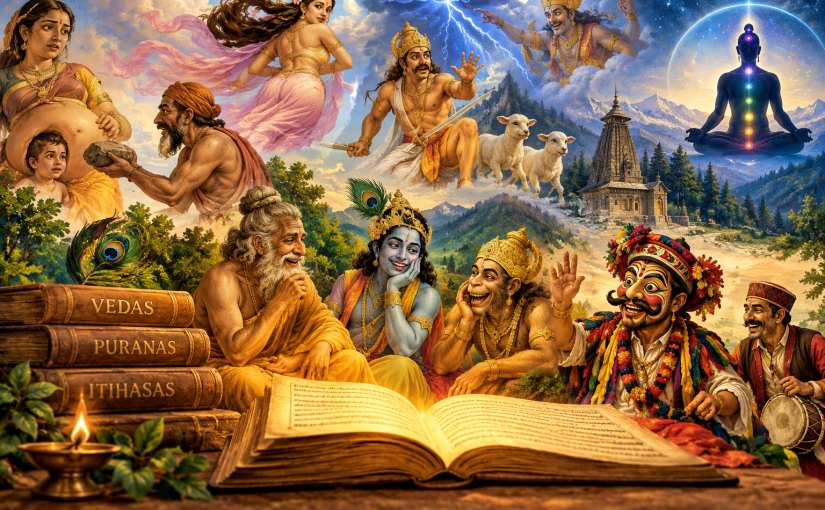
For example, a narrative in the Bhagavata Purana describes the extraordinary birth of Ashmaka, whose mother carries him in her womb for twelve years before he is prompted to emerge through an unusual intervention involving a stone. Another traditional narrative tells of a king who promises to protect an apsara’s two lambs and never appear naked before her. When the lambs are stolen, the king rushes out with his sword to rescue them. Indra creates a flash of lightning that exposes the king, causing the apsara to leave. Stories of this kind combine divine intervention, human attachment, unexpected turns of fate, and elements that can be appreciated through a comic lens. Their unusual details also raise questions about how ancient narratives use exaggeration, humour, and imaginative storytelling to convey ideas about human behaviour and the world of the divine.
The comic dimension of mythology is not confined to written texts. It also lives in regional performance traditions, where gods, legendary characters, and familiar mythological situations may be presented through humour, satire, dramatic exaggeration, and earthy observations about everyday life. The Kariyala folk theatre of Himachal Pradesh, for instance, offers a distinctive setting in which divine and legendary figures can be portrayed in comic styles. Such performances bring mythology closer to ordinary people, allowing sacred narratives to become a source of entertainment, social reflection, and cultural continuity. They also demonstrate that traditional religious culture can accommodate reverence, laughter, criticism, and playful reinterpretation.
Yet humour is only one dimension of this rich literary and cultural world. Beneath the extraordinary events and entertaining situations lie questions about consciousness, desire, attachment, ego, duty, destiny, morality, and the relationship between the individual and the larger order of existence. A story about a king, a sage, a god, or a celestial being may also provide an opportunity to examine familiar patterns of human behaviour. Pride can lead to unexpected consequences, attachment can cloud judgement, desire can disrupt commitments, and seemingly insignificant events can change the course of a life. Through such interpretations, mythological narratives become a means of exploring spiritual psychology and the complexities of everyday experience.
The series also approaches ancient stories through the broader perspectives of yogic wisdom, non-duality, detachment, self-realisation, and inner transformation. Rather than treating every narrative as a literal historical account or insisting on a single fixed interpretation, it considers how stories can be understood at several levels. Their literal events may entertain, their symbolism may suggest deeper meanings, and their psychological implications may illuminate the workings of the human mind. Their philosophical dimensions may, in turn, invite reflection on consciousness, identity, and the nature of reality.
This approach allows traditional wisdom to enter into a meaningful dialogue with contemporary life. Ancient characters and legendary situations can be examined not only in their original cultural and religious contexts but also in relation to modern psychological understanding, human relationships, social behaviour, and the search for inner freedom. Even a seemingly ridiculous or exaggerated story may become a starting point for serious reflection, while a profound philosophical narrative may reveal a lighter, more accessible side when viewed from an unconventional perspective.
By bringing together mythology, humour, symbolism, folk performance, spiritual psychology, and philosophical inquiry, Mythology, Consciousness and Ancient Wisdom offers a broad exploration of India’s narrative heritage. The series welcomes both the profound and the playful, recognising that ancient traditions contain multiple ways of looking at existence. It encourages readers to question familiar assumptions, appreciate the creativity of traditional storytelling, and discover connections between divine legends, human nature, and the inner journey of consciousness.
Ultimately, these books invite readers to approach ancient wisdom with curiosity, openness, and a willingness to explore different interpretations. Whether through the extraordinary episodes of the Puranas, the philosophical depths of ancient literature, the humorous portrayal of legendary figures, or the living traditions of regional folk theatre, mythology becomes more than a collection of old stories. It becomes a continuing field of exploration in which humour and contemplation, cultural memory and personal experience, and ancient imagination and modern understanding can meet.

