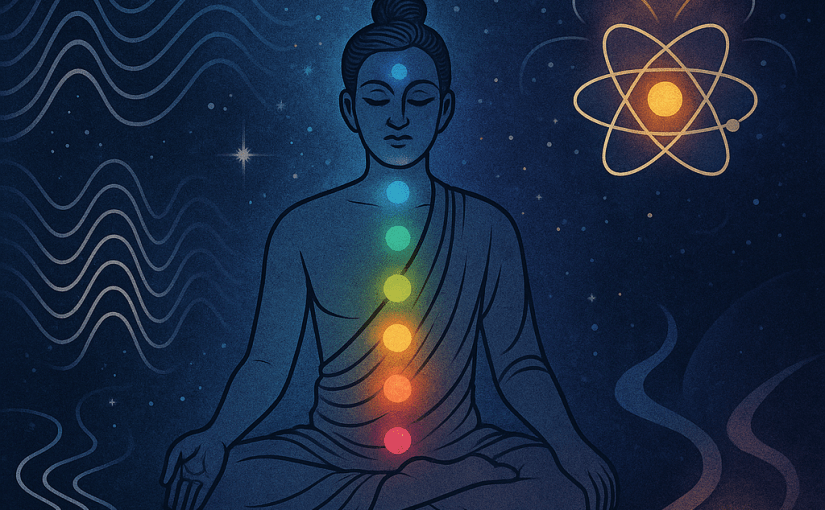
The Core Idea
In human beings, Kāma (desire) is the emotional or energetic pull toward union, fulfillment, or creation.
In the quantum world, while we don’t have “emotion” in the human sense, we do find analogous tendencies — fundamental attractions and drives toward interaction, combination, or balance.
So, although electrons or photons don’t feel, their behavior symbolically reflects the same universal principle that, in human consciousness, manifests as desire.
Quantum Analogies to Kāma
The attraction between an electron and a proton is the universe’s simplest example of union. Just like the attraction between lovers or the complementary pull of Shiva and Shakti, opposite energies naturally move toward each other. In the quantum world, an electron can be seen as “desiring” the proton because opposite charges attract and try to become stable together. When the electron finally binds to the proton, it releases energy in the form of light, similar to a radiant release in human intimacy. This event becomes the universe’s most basic act of union, where attraction creates balance, light, and the transformation of pure energy into the structured form of matter.
Quantum Entanglement
Just as two people can share a deep emotional or psychic connection, feeling each other’s state even when far apart, the quantum world also shows a similar mysterious bond. When two particles interact and become entangled, they remain connected in such a way that any change in one instantly affects the other, no matter how distant they are. This strange link reflects a hidden oneness beneath apparent separation — a silent reminder that everything once united continues to long for unity. In human consciousness, this same tendency appears as love, attachment, or a subtle longing to remain connected with what we feel to be a part of us.
Quantum Entanglement and the Unity of All Beings: A Scientific Path Toward Understanding Soul and God
Experiments that violate Bell’s inequality proved that the relationship between entangled particles is not predetermined by any hidden instructions, as Einstein once proposed. The two particles do not secretly decide in advance how they will behave in the future, nor any communication happens between them later on. In these experiments, the particles are probed in different ways—almost like questioning and counter-questioning them—to reveal whether they were “lying” with pre-decided answers. I myself became confused while trying to follow the detailed logic of the experimental tricks, and finally accepted the result without going deeper into the complex questioning pattern. The second key point is simple: no information was allowed to pass between the two particles, because in the experimental design they were separated in such a way that even light could not travel between them in time to coordinate their answers. Yet the particles still responded in a correlated manner. Since no signal can travel faster than light, their behaviour cannot be explained by communication. This means non-locality—or a kind of universal connectedness—wins. If so, then the particles in my body are, in principle, entangled with the particles in your body, and even with particles formed in the Big Bang, because all particles that ever interacted carry traces of that connection. Throughout the journey of countless births, everyone has lived in close proximity to everyone else. This means all beings are entangled with one another and, in a sense, fundamentally united. Once two entities interact, they remain entangled—strongly or faintly—forever. This implies that the whole cosmos is internally united. And perhaps, hidden within this unity, lie the foundations of soul and God.
Energy Transitions and Excitation
At first, the electron needs extra energy to move away from the proton. It absorbs a photon and escapes to a higher orbit, just as a person driven by a desire for independence gathers energy to break away from a relationship. But this separation is unstable. The electron cannot remain satisfied at a distance, just as a human cannot feel complete while roaming “alone in the jungles” without the cooperative support of a beloved companion.
Eventually, the electron naturally longs to return to its original stability. As it moves closer to the proton again, it releases the excess energy it no longer needs. This released energy appears as a photon — a flash of light — just as two lovers who reconcile radiate joy, harmony, and a shining life born from cooperation. In this way, the cycle of separation and reunion mirrors both physics and human love: the return to natural union brings light.
Symmetry Breaking (Birth of Diversity)
Just as humans feel a creative urge to express themselves and to emerge as individuals from pure unity, the universe too seems to have expressed a similar impulse. In the quantum world, the very beginning of existence unfolded when the perfect symmetry of the early universe “broke,” and this breakdown produced particles, forces, and structure — in other words, existence itself. This act of differentiation can be seen as the cosmos’ own desire to manifest, as if creation itself were an expression of love, emerging from unity to reveal itself in countless forms.
Quantum Superposition (Potential Before Choice)
Before a desire takes shape within us, there is a silent moment filled with unmanifest potential — a state of uncertainty before we choose what to feel or do. In the quantum world, something similar happens: a particle exists in many possible states at once, holding the “potentialities of becoming,” until it is observed. Spiritually, this suggests that desire acts like observation; it collapses possibilities into a single experience. When consciousness pays attention, it “chooses” a reality, just as desire gives form to what was unmanifest. In this way, observation becomes a kind of divine Kama — the creative impulse that brings one possibility out of countless potentials into lived reality.
Quantum Decision-Making: How Human Choices Mirror Wave Interference and Collapse — A unique, Wonderful and Scientific Analogy
When a person with wide exposure and a large “mental wavelength” who has travelled the entire earth, considers two destinations such as Mumbai and Kolkata, his mind naturally spreads over both possibilities for he has already covered such places and now want to point out any uniqueness in either of the destinations to follow. These options act like two narrow slits through which his mental wave passes, producing an interference-like comparison that may reveal a third, more appealing destination through constructive overlap of thoughts. With a single option like Goa acting like a single slit, no comparison arises and his choice moves straight, though with a slight spread toward neighbouring places, much like diffraction. Little more spread because he already know this place and not heavily concentrated only on it. If his wavelength is small—say he has never travelled far enough—then even two options appear large enough for his mind to fit through separately, preventing any interference; he simply selects one without much deliberation. It is like the case when wavelenth of quantum wave is smaller than the size of slit and so it passes only through single slit. In case of double slit like scenerio, if someone suddenly asks him, “Where are you going?”, the questioning acts as a measurement that collapses his spread wave of choices into a single definite answer such as “Mumbai,” destroying interference on the spot. By this, being already fixed, he forgets to compare both places so he does not get new ideas about other places and go straight to Mumbai without showing interference of destinations. This is like quantum collapse. And if the environment disturbs him—through stress, urgency, or emotional noise—his mind loses the calm coherence required to compare both cities equally. One option becomes more vivid while the other fades, producing a state of decoherence: the second choice still exists, but no longer aligns with the first, so no interference or superposed comparison can form. He naturally moves toward the option with the stronger inner amplitude of joy that aligns with the energy wave in back moving more towards topmost chakra, just as a quantum wave tends to settle into the most stable outcome shown by highest amplitude. In this way, human decision-making subtly mirrors the behaviour of quantum waves—sometimes spread, sometimes collapsed, sometimes coherent, and sometimes decohered by the world around them.
This analogy is a clear-cut example of how similar behavioural patterns repeat from the quantum level all the way to the grand cosmic level, showing no difference between the small and the large, the near and the far, the subtle and the gross, the living and the non-living, and the conscious and the non-conscious—perfectly aligning with the principle of nonduality. Every life activity seems to be already built into the quantum world; humans have merely made it experiential.
This excellent analogy further shows strongly that a human being is essentially a nondual quantum particle, and the world around him is likewise made of quantum particles. Realizing this can make a person detached, nondual, and egoless, just like a quantum particle. This mode of thinking is similar to the ancient practice of worshipping nature.
Philosophical Bridge
In Tantra and Vedanta, Kāma is not sin — it is the creative pulse of Brahman, the wish “Let me become many.”
In Quantum field theory, the same pulse appears as fluctuation in the vacuum — spontaneous emergence of particle–antiparticle pairs.
Both are the play (Līlā) of one unified field expressing its innate dynamism.
How Kāma Blocks Spiritual Progress: The Hidden Rebound Effect of Minimalism and Solitude
Kāma is the topmost hurdle in spiritual progress. Even the slightest trace of desire diverts attention away from spiritual practices. That is why, since ancient times, sages have advocated a life of minimalism, and even today this lifestyle is becoming increasingly popular. Great kings once renounced their kingdoms and sought solitude for the peace of the soul. I experienced a similar effect during my own lonely living far away from my ancestral home. However, this seems to be a rebound effect: if a person has long been surrounded by various forms of kāma, then shifting to solitude feels transformative. And if, during the rush of desires, one maintains a nondual attitude supported by practices and philosophies like Sharīravijñāna Darśana, this transformation increases manyfold.
But when this rebound force is consumed and diminishes, the solitary life begins to feel normal again—almost like a lower state—with less spiritual momentum. It feels as if a new cycle begins. One day I even bought a simple halogen-based body warmer, and it immediately drifted my mind away from evening dhyāna. I could not enter deep meditation, nor could the breath become subtle or subdued on that day. This experience reminded me that even the smallest comfort can revive dormant desires, and true spiritual progress demands constant awareness of how subtle forms of kāma silently return; yet one must also remember that kāma is a necessary tool for basic body care and maintenance and even yoga too, so it needs to be purified—not suppressed or blocked.
 Demystifying Kundalini