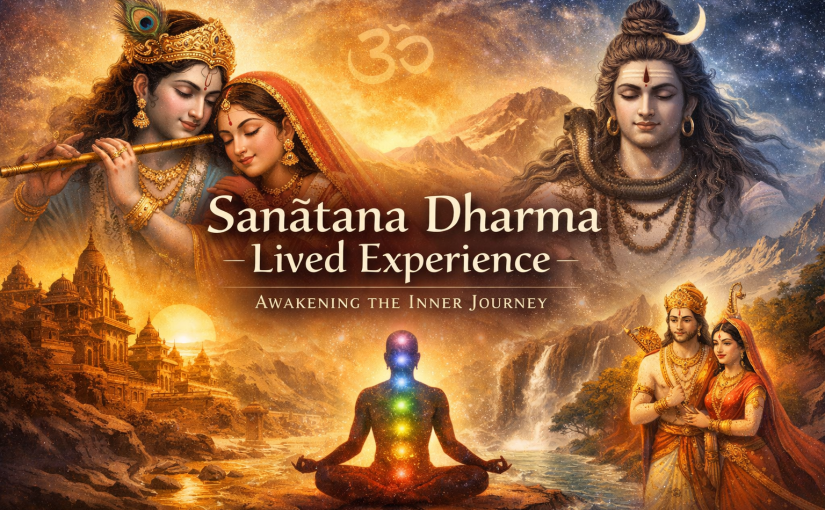
A personal preface
This is not a claim, not a declaration of divinity, and not an attempt to place myself above any tradition. This is only a record of lived experience — how scriptures, relationships, stages of life, and inner practices unfolded naturally inside one ordinary human life. I write this because many people think our scriptures are theory, mythology, or outdated philosophy. My life has shown me that they are a practical way of living, happening even in the age of supercomputers, aeroplanes, and high technology.
If divine permission comes, a full book may come later. For now, this is the nutshell — for curious readers who want to understand how Sanātana Dharma actually works in living human beings.
Scriptures are not theory — they are living maps
I have seen that the great god lineages are not isolated historical events limited to one time and place. They are stages of human spiritual evolution that keep happening again and again, everywhere, in different people, in different forms. That is why this dharma is called sanātana — eternal — unlike systems tied to one prophet, one story, or one century.
Technology does not block these stages. A needle, an aeroplane, a supercomputer — none of these stop consciousness from evolving. Outer tools change, inner laws do not.
The Śiṣya phase: childhood discipline and listening
My first phase was the śiṣya phase, in childhood.
I was an observer by nature. Disciplined. Non-revolting. Whatever teachers and elders taught that felt good and right, I accepted happily and with devotion, without criticism. I now see that this phase is common to all great lineages — before anyone becomes a knower, they must become a learner.
Rama, Krishna, Buddha, Shankara — all began as disciples. Ego must soften before it can dissolve.
Dada Guru: the power of sound and atmosphere
My grandfather used to read scriptures aloud for hours every day to listeners. Those words falling on my ears shaped my inner world long before I understood them. I did not study scriptures — I absorbed them.
That is why I call him Dada Guru.
He did not give me a mantra, but he gave me atmosphere, rhythm, reverence, and sound — śabda-brahma. Those sounds later pushed me naturally toward practical living, not theoretical belief.
Krishna phase: adolescence, attraction, and refined desire
In adolescence came the Krishna phase, lasting about 1–1.5 years during senior secondary school. This phase was intense and energetic — attraction to girls, being attracted by girls, social charm, indirect sexual fun — but never vulgar indulgence.
The purpose was not enjoyment but learning the essence of kāma. Attraction was raised but held in a sattvic environment, with social distance and inner discipline. Slowly, attraction turned into bhakti. A meditation image developed by itself in the mind — Radha and Krishna appearing in each other — and this led to spontaneous samādhi, exactly as described in Bhāgavata Purāṇa through the gopīs.
This phase cannot last long; it is too volatile and needs continued physical presence. The continued physical presence of attracting partners became difficult to tolerate, and maintaining control by consciously preventing physical contact for long periods required great inner discipline. But it is essential. Without it, later renunciation becomes dry and incomplete.
Shakti / Durga phase: courage, love, and inner femininity
After Krishna phase came the Shakti phase, lasting nearly five years during university life, and continuing even after marriage due to the support of my wife.
Internally, I lived a feminine reality — sensitivity, softness, devotion — while externally I became brave, ready to fight evil in sattvic, nonviolent, tactical, and lawful ways. This is the Durga function: courage without brutality, strength without hatred. Together, the meditation image of the mental consort anchored in the mind matured even further — not merely as a thought, but as a fully living inner presence, just as Radha lived within Krishna even in her physical absence, and even while he was living his worldly life with his wife, Rukmini. In Vaishnava understanding, Radha is the hlādinī-śakti — the inner bliss-consciousness of Krishna — and when sustained joy, devotion, and fullness arose naturally from this meditation image, that experiential bliss could be understood as the same hlādinī current described in the scriptures. It was not an identity or a divine claim, but the recognition that a human inner process was unfolding exactly as the ancient maps had described: bliss arising from continuous remembrance and inwardly residing devotion.
I succeeded a little — not by force, but by alignment, what I call divine help.
Life as gurukula: gods as living people
I slowly realized that gods did not come from heaven — they came through people around me.
A naughty relative boy living at our home carried the Krishna role.
My father carried the Rama role — discipline, responsibility, order.
My uncle carried the Shiva role — depth, silence, detachment.
All the sweet girls who were part of attraction carried the Shakti role.
These were not fantasies. They were living transmissions. I merged all these roles into one integrated life. It felt as if all gods joined their powers to destroy one demon — ignorance.
Shiva phase: tantra, isolation, and upward energy
When Shakti phase reached its peak, worldly energy naturally declined and pushed me into isolation. This was the beginning of Shiva phase.
Shiva here means not only worldly isolation but tantric transformation — raw base energy rising as Kundalini toward awakening. As energy turned upward, my inner imagery changed: the feminine consort image was replaced by a male guru image. This gave me the feeling of being male again, grounded and directed.
To the world, this can look strange or misunderstood. But it was not indulgence or confusion — it was pure Kundalini meditation in tantric style, where imagery changes to match energy direction.
This Shiva phase is most dominant in my recent books because it is the most recent and intense lived phase. Older phases are less vivid and more integrated.
Rama phase: rest, order, and balance (still unfolding)
The Rama phase has just begun.
After kevala kumbhaka and small glimpses of nirvikalpa-type samādhi, this phase appeared. Rama literally means rest, āram, balance. It is not heroic drama; it is stable living after turbulence.
This phase cannot be written fully yet because it must be lived fully first. It will come as the final integration stage. Now it is up to the divinely operating world to decide how long it allows me to remain settled in this phase, though there is no doubt that personal effort also matters.
Why the world misunderstands these experiences
People see only sexuality, repression, gender, or indulgence. They do not see sublimation. That is why tantra was always kept subtle and symbolic.
I never say “I am Shiva” or “I am Krishna.” I say: that phase unfolded. Language is the thin line between wisdom and misunderstanding.
Final understanding: Sanātana Dharma is human evolution
My life has shown me that scriptures are not to be believed — they are to be lived.
They are maps of consciousness written in symbolic language. When lived, they dissolve ignorance naturally.
I am not above humanity. I am an example of how humanity evolves when sound, discipline, love, and relationships support growth.
If divine permission comes, a book will come. Until then, this blog is the nutshell — a lived proof that Sanātana Dharma is eternal because it is always happening.
Four Incarnations, Four Pillars of One Building
(Why All Paths of Sanātana Dharma Are Complementary, Not Opposing)
These four Sanātana incarnations are like the four pillars of a single building. Just as a building cannot stand if even one pillar is missing, the sense of wholeness and salvation does not feel achievable unless all these forms are embodied within a single person. This also reveals a deeper truth: the many sects and paths of Sanātana Dharma are not rivals or contradictions, but complementary forces. Even Sikhism and Jainism, which fully support Rama-like ideals of character, can be seen as sects or streams of the single Hindu civilizational tradition, rather than completely separate religions. If we expand this understanding further, even religions such as Islam and Christianity can be seen, in a broader sense, as supporting branches of the same eternal flow—so long as they uphold humanity, compassion, and moral order. In that sense, they are not completely unconnected from other dharmic streams, but participate in the same universal movement toward righteousness, truth, and human upliftment, each expressing it through its own language, symbols, and historical context. Just as the pillars together support one structure, these traditions together support one human awakening — and this is exactly how they have always functioned in living practice.
 Demystifying Kundalini