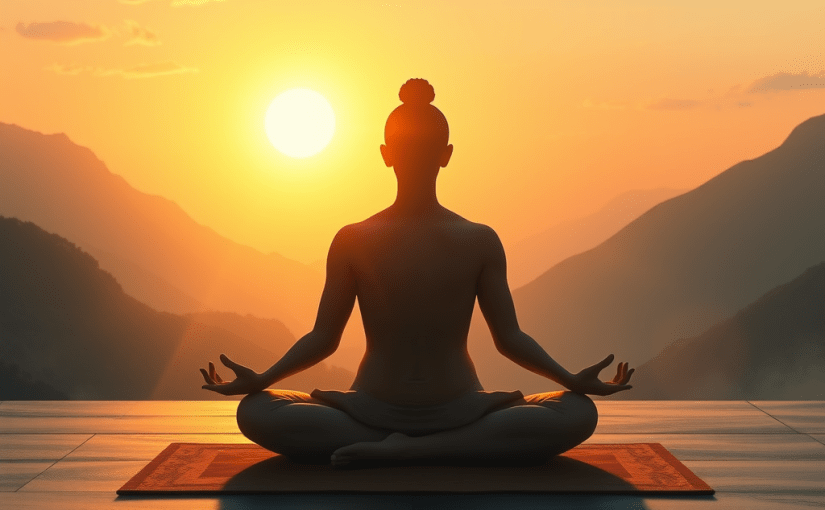
I have come to realize that Samadhi is not something to be locked inside a meditation room or reserved only for those rare moments when the world is quiet. For me, it has become a rhythm — like breathing in and out — flowing through the morning, afternoon, evening, and even into the busiest parts of the day. It’s not just about the cushion; it’s about carrying that awareness like a fragrance that lingers wherever I go.
My mornings begin with yoga, the body stretching and opening like the petals of a flower at dawn. The energy starts to hum in the spine, and before it dissipates, I let it settle in meditation for a full hour. This is not a forced concentration, but more like stepping into a quiet lake and letting the ripples fade on their own. The body is still, the mind settles, and the space between thoughts becomes more vivid than the thoughts themselves. I can feel the energy in the Ajna Chakra — steady, blissful — and this alone is enough to keep the mind detached from the usual noise of the day. Morning energy work creates a potential that lasts throughout the day, making it easier to enter deep dhyana during later meditation sittings, and sometimes even bringing brief, samadhi-like naps at intervals throughout the day.
Afternoons are different. Just after lunch, I sit in Vajrasana for about 30 minutes. This is a calmer, grounding period — digestion for both the body and the soul. Vajrasana itself is steadying, and I find that meditating right after a meal in this posture helps the body stay relaxed while the mind quietly tunes itself. It’s not as intense as morning practice, but it carries a deep, homely stillness, almost like a midday nap for the inner being — except you stay fully awake. I feel the downward spinal breath is more prominent during eating dhyana due to the downward movement of life force aiding digestion. However in early morning when belly is empty, the upward movement of breath seems more prominent.
Evenings are my favorite. About three hours after dinner, just before sleep, I give myself another hour. Here, there is no need to prepare the mind — the day has already done its work of tiring the body and mind. I simply sit, and the awareness slips into its place like a familiar old friend returning home. Often, this is the deepest session of the day because the body has nothing left to demand, and the mind knows there’s no more work to be done. The transition into sleep from this state feels like slipping from the banks of a quiet river into the open sea. When you fall asleep directly, the mind may stay restless, leading to light sleep and vivid dreams, which prevents full mental rest. But if you first slip into dhyana and then let sleep come naturally, the mind is already calm and inwardly settled. This allows sleep to be deeper, more blissful, refreshing, and satisfying.
But it doesn’t end with these sitting periods. My way of Karma Yoga — through Sharirvigyan Darshan — has become the thread that keeps it all stitched together. While working, I remain aware of the body as if it were an atom: the brain as the nucleus, the electrons as shifting personalities, thoughts as orbiting patterns that I don’t need to catch or control. The body works, the mind thinks, but I stand a little apart, like the witness. In this way, the practice is not interrupted by activity; it is activity that becomes part of the practice.
There is a sweetness in this rhythm. Morning freshness, afternoon grounding, evening melting into stillness — and in between, the flowing stream of Karma Yoga. Each session is like cleaning a window so that the view stays clear. Over time, I have learned that Samadhi is not only found in long stretches of sitting but also in these shorter, daily touchpoints that keep the awareness polished and alive. When combined, they become a continuous current, humming quietly beneath the surface of everything I do.
It is important to understand that while dhyana or samadhi itself is not dependent on the mind, the mind is still required to prepare the ground for it. In the early stages, mental focus and clarity are essential to enter the state. This is why being fresh, alert, and well-rested allows dhyana to establish more quickly and with greater depth. Once true samadhi is reached, it becomes self-sustaining — the mind in that state neither tires nor drifts into drowsiness or sleep over time. By contrast, if one attempts meditation in a dull or drowsy condition, the practice is likely to slide into yoganidra or ordinary sleep rather than samadhi.
Public demonstrations such as being buried underground for days cannot be equated with samadhi. These feats are often the result of advanced pranayama skills such as keval kumbhak (effortless breath retention) or other survival-oriented techniques. While impressive, they do not necessarily reflect inner absorption, and the ego investment in performing such displays can become a subtle obstacle to genuine spiritual advancement. True samadhi, as described in the yogic tradition, is free of exhibition and rooted in inner stillness.

 Demystifying Kundalini