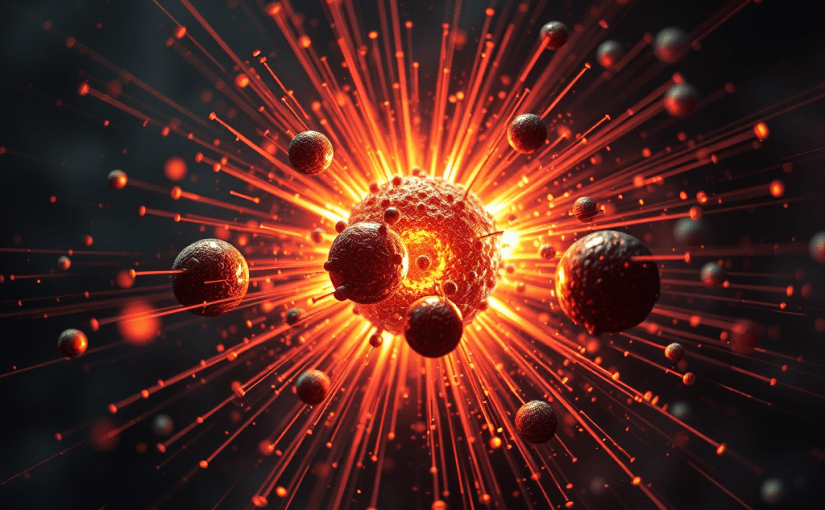
Krodha, in its profoundest sense, is not merely an emotional eruption but a cosmic principle of resistance. Just as Kāma expresses itself as the drive toward union, Krodha emerges as the force that confronts, opposes, and fractures anything that obstructs the cosmic flow. In the language of physics, this duality is mirrored in the fundamental interactions that hold the universe together—attraction and repulsion. If Kāma corresponds to the gravitational and electromagnetic pull that binds particles, stars, and even living beings, then Krodha can be seen as the repulsive quantum force that prevents collapse, preserves identity, and destroys what blocks equilibrium. At the subatomic level, this resistance manifests in the Pauli Exclusion Principle, nuclear repulsion, and opposing spin states that forbid particles from occupying the same quantum space. Without such repulsive dynamics, matter would merge into a featureless mass and the cosmos would have no structure. Thus, Krodha is not a negative force; it is the fierce protector of balance, the destroyer of excess, and the guardian that upholds individuality within the universal play.
1. Electron–Electron Repulsion (Pauli Exclusion Principle)
In quantum physics, no two electrons can occupy the same quantum state or crowd too closely together. This resistance is not accidental but a fundamental expression of nature’s law known as the Pauli Exclusion Principle, which manifests as a fierce repulsive force preserving individuality at the subatomic level. In human psychology, anger often arises in the same manner—not as blind aggression, but as a boundary-restoring impulse that protects one’s identity, personal space, or energetic integrity. Just as electrons repel to prevent collapse of matter into a formless mass, anger emerges to prevent the collapse of the self into submissiveness, exploitation, or erasure. Thus, Kāma and Krodha play complementary roles: Kāma seeks to unite what is separate, while Krodha separates what must remain distinct. Love without boundaries dissolves into chaos, while anger without the memory of love becomes destructive. When understood together, they form a balanced polarity that sustains both cosmic order and psychological wholeness.
2. Matter–Antimatter Annihilation
In the quantum realm, when matter encounters its perfect opposite—antimatter—they do not merge, negotiate, or coexist. Instead, they annihilate one another in an instant, releasing a burst of pure energy in the form of gamma radiation. This dramatic event echoes a subtle inner phenomenon within human consciousness. When opposing forces within us—such as ego and truth, desire and reality, or illusion and clarity—collide without harmony, the result is often an explosive surge of emotion, most commonly anger. Yet this anger is not merely destructive; it is a radiant conversion of contradiction into awareness, just as annihilation transforms dense particles into light. At its deepest core, anger becomes the soul’s rage for truth, a force that burns away falsehood, hypocrisy, and self-deception. What seems violent on the surface is, in essence, an alchemical process: a transformation of emotional density into pure insight, much like matter turning into luminous energy.
When elders suddenly prohibit youngers from their actions they become angry as there wrong action collide with the right action. They think elders as source of anger and get annoyed with them. But when they are tactfully guided towards right action, still little anger is produced in them but it’s gradual, controllable and its energy well transformed into right action. In former case they are scolded and prohibited from doing, not guiding them to right action. So their freed energy don’t get channelised but becomes source of anger.
3. Quantum Fluctuation Instability
In the quantum vacuum, energy is never quiet. Even in what appears to be empty space, virtual particles constantly flash into existence and disappear again, creating a ceaseless turbulence. These fluctuations are normal, but when they grow too intense, they disrupt the stability of entire systems. This same principle operates in the human mind. When the manas, the subtle mental field, is stirred by unmet desires or unresolved needs, its energy begins to oscillate restlessly. If this inner fluctuation becomes excessive, it breaks through as irritation or anger. In essence, anger is the restless vibration of energy trying to restore balance, much like unstable quantum fluctuations seeking equilibrium. In yogic terms, such anger can be understood as Kundalini striking against obstructions in the nāḍīs, attempting to clear pathways for a smoother flow of consciousness.
Just as physics describes virtual particles as momentary fluctuations of a quantum field—not real objects popping in and out of existence—anger too is not a real entity inside the mind. It is simply a temporary disturbance in the mental field, a spike of energy created when desire, fear, or resistance disrupt inner equilibrium. Quantum fields ripple when pushed from balance, and the mind-field does exactly the same: a small fluctuation passes unnoticed, but a strong one rises as irritation and, if amplified, appears as anger. In both cases the “thing” is illusion; only a transient pattern exists. The moment the field regains stability, virtual particles disappear back into silence, and anger also dissolves into clarity—revealing that neither ever had solid, independent existence.
Quantum fluctuations and human anger share the same dual nature: both can create or destroy depending on their intensity. In physics, gentle quantum fluctuations seeded the early universe with tiny density variations that later grew into galaxies—creation born from subtle disturbance. But when fluctuations become too strong, they destabilize fields, trigger phase transitions, and can tear apart atomic bonds, as seen in high-energy collisions or during cosmic inflation—destruction born from excess disturbance. The mind behaves the same way. Mild anger can be constructive; it breaks stagnation, energizes action, and helps correct injustice, just as small fluctuations help the universe reorganize into higher order. But intense, uncontrolled anger overwhelms the mental field, breaking relationships, clouding judgment, and damaging the body—just as large fluctuations can collapse stability in quantum systems. In both worlds, small ripples generate growth, while violent waves shatter equilibrium.
A quantum field trapped in a false vacuum and Kundalini caught in obstructed nāḍīs are reflections of the same cosmic principle: energy becomes dangerous only when denied its path. In physics, a field resting in an unstable valley looks calm on the surface, yet holds immense tension beneath; one strong fluctuation is enough to push it out, releasing a burst of energy powerful enough to reshape spacetime itself—as happened in the early universe, or as could occur in a hypothetical false vacuum decay. In the inner universe of the human being, Kundalini behaves no differently. When nāḍīs are open, the rising energy becomes insight, strength, and awakening. But when obstructions hold it down, the same force strikes repeatedly against the blocks, erupting as anger, frustration, or emotional upheaval. The danger never lies in the energy, whether cosmic or human; it lies in the confinement. When the pathway is clear, the energy transforms creation; when blocked, it becomes destruction. Thus, both cosmos and consciousness whisper the same truth: unobstructed flow is harmony, trapped energy is turmoil.
If the early universe had remained trapped or blocked forever in a false vacuum (vaccume with high potential energy like a water filled dam at a height), creation would never have unfolded. A false vacuum carries immense energy, yet its confinement blocks its transition to true vaccume (vaccume with lowest potential energy) needed for matter, atoms, and galaxies to arise, leaving the cosmos as an endlessly inflating but forever empty expanse—a reality suppressed before it can even begin. When the false vacuum transitions to a true vacuum, its excess potential energy is converted into the kinetic energy of quantum fields. This additional motion strengthens the fluctuations within the fields, and these amplified vibrations manifest as quantum particles. The same principle appears within the human being: when life-energy rises and meets a permanent obstruction in the nāḍīs, the resulting anger is not merely a burst of emotion but a sign of trapped potential that cannot evolve. If the blockage never clears, the energy remains frozen, unable to rise into clarity, creativity, or growth. Thus, whether in the vast universe or the inner world, trapped energy does not destroy through violence but through suppression—by preventing higher states of reality from ever emerging. in contrast, if nadis are open, the life energy rushes up and distributed to entire body in low energy form as basic energy form. The excess energy released then becomes available for transformative thoughts and experiences that support growth. But if this surge of high energy remains permanently blocked in the inner channels, it merely expands the time-space of life without forming new ‘particles’ of experience. When such energy cannot express or transform, it often appears outwardly as anger.
I am writing from my own practical experience. There was a time when I used to be angry almost all the time, frustrated with everything and everyone, living in a constant off-mood filled with suppressed anger. In truth, it was not people who troubled me—my energy itself was suppressed, blocked like a dam. I was always in a fighting mode, not for attack but for defence as I had tolerated sudden attacks, and not like a classic wrestler, but like a puncher or knocker, and though I actually fought only two or three times, the aggression had become my inner habit. Because of this constant inner tension, my health began to suffer, and even the so-called “energy boosters” I used only harmed me in the long run. Then, by God’s grace, I met a tantric-type person—fully functional in worldly life yet inwardly deep—who taught me an intuitive, indirect tantric method of channeling energy upward through the backbone. It was more of a mental tantra than a physical one, yet with time it naturally benefited the body as well. When the obstruction in my Kundalini flow dissolved, my anger disappeared instantly. I could laugh, love, and feel intimacy again. That once-trapped energy transformed me, opening beautiful states of awakening and setting me on a path of continuous writing and book creation that still flows today.
Why hide anything from sincere readers? In truth, I simply surrendered to that long-suppressed romantic image — even went clean-shaven like a laughing Buddha in front of it. Lol. It laughed, I laughed, the world laughed, and eventually even life itself laughed. That very surrender opened the back channels on its own. I did no formal practice. The once-suppressed love awakened in the mind with the support of Mūlādhāra energy, rewiring and refreshing my brain enough to bring a complete transformation—rising happiness, renewed clarity, and a successful worldly life. In time, as life and inner maturity ripened, that same love-energy in the form of love-image naturally redirected itself toward the guru-image, deepening through yoga and tantric sādhanā and culminating in awakening.
True and False Vacuum of the Mind: A Scientific Analogy of Dhyāna and Cosmic Quantum States
In deep Dhyāna, two types of mental states are experienced. Both appear like a thoughtless vacuum. During the preparatory phase, the mind first passes through a dull, thick, unstable, and darker vacuum that can be called the individualised false vacuum. Its excess energy is dissipated in the form of fleeting thoughts, which are effortlessly witnessed due to slow and regulated observation of the breath. Because of this witnessing, these thoughts gradually dissolve, and the mind enters a peaceful, thin, blissful, lighter, and low-energy vacuum that appears stable. This can be called the individualised true vacuum. It is possible that this true vacuum draws energy from deeper subconscious layers as the power of Dhyāna penetrates the mind over time.
After about an hour, this calm state again shifts into a heavy, agitated, and high-energy vacuum. This state feels unstable, and a desire to stop Dhyāna naturally arises. However, if one continues sitting, the mind releases its excess energy again through fleeting thoughts, just as the cosmic false vacuum transforms into the cosmic true vacuum by releasing energy in the form of quantum particles through agitated quantum fields. By allowing this process to continue without interference, the mind once again settles into the individualised true vacuum. This cycle of alternating states—false vacuum and true vacuum—can continue repeatedly, as long as one remains in Dhyāna.
I personally observed this during a seven-day Bhāgavatam Katha Śravaṇam. The daily Katha lasted for three hours, and I remained in Dhyāna throughout, witnessing these cycles, each phase lasting slightly less or more than an hour. Such a spiritual environment made it easier to sit effortlessly. In daily life, however, this atmosphere is not present, so after completing one full round in Dhyāna, I usually end the practice when the false vacuum returns due to lack of time and supportive surroundings.
Interestingly, ending Dhyāna while still in the false vacuum allows its excess energy to dissipate into non-dual worldly activities, which makes the next Dhyāna session begin with a faster transition to the true vacuum. If one maintains a non-dual attitude throughout the day, the arising thoughts in the false vacuum are naturally witnessed and dissolved, gradually bringing the mind back to the true vacuum.
However, if a person engages in worldly activities with duality and attachment, or without proper witnessing of fleeting thoughts, one remains stuck in the energetic false vacuum for a long time. In such a case, no spiritual growth occurs, and the energy remains stagnated at a high potential. Although the release of this stored energy into worldly pursuits can temporarily create a brief sense of peace, satisfaction, and fulfilment, the human mind soon fills this space again with physical and mental clutter, returning to the habitual false vacuum. Therefore, the true vacuum must be sustained for a longer duration through spiritual behaviour, otherwise the false vacuum becomes the default state of life.
Upon finishing the task, or during the next sitting, when the practitioner again begins Dhyāna, the light mental vacuum automatically returns for the first hour. This implies that the extra energy contained in the heavy mental vacuum was dissipated through worldly action when done in karmyoga style with the help of nondual darshan like sharirvigyan darshan or quantum darshan. This process resembles cosmic creation, where the false vacuum decays into the true vacuum, and the excess energy is used to produce the universe. The true vacuum is closer to God, the ultimate state of absolute stability. Thus, one may say that creation occurs through inspiration from God. Just as the energy of the mental false vacuum produces dualistic worldly actions, the energy of the cosmic false vacuum decays to create diverse quantum particles by breaking the symmetry of quantum fields and forces.
These vacuums are actually quantum fields. They are never still and always remain in motion. Their lowest state of fluctuation is called the true vacuum, while a higher fluctuation state is called the false vacuum. This implies that the mind is also a quantum field—an inner or individualized quantum field—which never comes to rest, just as it has long been known in philosophy that manas is chanchal (restless).
A time comes in a yogi’s life when even this true vacuum appears to dissolve into a fully motionless mind-field. This is the experience of the Self in its completeness, known as mature Nirvikalpa Samādhi. This experience suggests that there may also be a stage in cosmic devolution when even the last traces of quantum fields disappear. In this sense, the quantum fields dissolve into a baseless, infinite space—also referred to as God.
The same has been described in the Vedas by ancient seers, especially within Vedānta philosophy. Vedānta states that creation emerges again in the same—but reverse—order during cosmic evolution. First Prakṛti or Māyā arises within Paramātman, and from it the universe unfolds in an orderly manner. However, the Sāṅkhya school offers a more “modern” or so called scientific approach by proposing that Prakṛti, or the grand quantum field, is eternal like Puruṣa (Paramātman) and does not dissolve into it. Thus, Sāṅkhya recognizes two primordial eternal realities, while Vedānta accepts only Brahman as the sole eternal principle. However, the Vedānta explanation feels more authentic to me, because it mirrors the inner cosmos just as perfectly as the outer cosmos.
The ancient seers did not observe cosmic events through telescopes, they did not build particle accelerators, nor did they fill papers and books with mathematical formulas. They observed within themselves, and through that inner exploration, they inferred the laws governing the external cosmos.
4. Electrical Discharge (Lightning Analogy)
Lightning is born from imbalance. As electric charge builds up in storm clouds, the difference between cloud and ground becomes too great to contain, and the sky releases its tension in a sudden, blazing discharge that restores equilibrium. The same pattern unfolds within the human psyche. When emotional charge—frustration, desire, insecurity, or pressure—accumulates without release or grounding, it seeks a way out. If not guided, it discharges as anger, sharp words, or destructive behavior, just as lightning strikes indiscriminately. The spiritual lesson is simple: unreleased energy leads to tension, and accumulated tension eventually explodes. But when a person learns to ground awareness, to hold the charge with clarity instead of reaction, the same energy can be transformed rather than discharged blindly. The yogi, therefore, does not waste the bolt outward; he channels it upward, turning raw emotional electricity into illumination.
Once, in a moment of anger toward someone close, I experimented with grounding this emotional charge instead of letting it explode outward. As soon as I drew the rising energy downward, it felt as though the fire in my head dropped into the chest, and the mind instantly became still—like a tense cloud suddenly releasing rain. Yet something remarkable happened: from the chest, the energy flowed into both arms, filling them with an unexpected surge of strength. The impulse to attack vanished, but the vitality remained, as if the body had been prepared for action without aggression. Had there been danger, that same force might have served as powerful self-defense, but since the mind was already calm, it simply settled into the muscles as pure potential. This experience revealed that anger is not merely destructive; when grounded, it transforms into usable strength. The energy does not disappear—it becomes power without violence, readiness without rage.
5. Entropy Increase and Chaotic Reordering
In quantum thermodynamics, every system naturally moves toward greater entropy—toward disorder—and when its balance is disturbed, chaos erupts not as a failure but as a route to a new equilibrium. Disorder becomes the catalyst for reorganization. The same principle operates within human emotion. Anger may appear destructive, yet it often shatters rigid patterns of stagnation, revealing truths we have ignored, confronting boundaries we have tolerated, or dismantling situations we have silently endured. In that sense, Krodha becomes not merely a breakdown but a breakthrough, a force that burns away what has become stale, false, or suffocating. Philosophically, this is Shiva’s Tāṇḍava at work within the psyche—fierce, transformative, purifying. It is the universal law of creative destruction, through which new harmony arises only after the old has been consumed by the fire of change.
For example, when an electron rests quietly in its ground state, it is in a low-entropy, perfectly ordered condition. The moment a photon strikes it, this order is shattered—the electron absorbs the energy, jumps to an excited state, and enters a phase of instability and unpredictability. This brief chaotic state is entropy rising, just as anger breaks the rigid calmness of the mind and throws the inner system into disorder. But the chaos does not last; the electron soon releases the extra energy as a photon and settles into a new stable level. Although order returns, it is never the same as before—the system has emitted energy, interacted with its surroundings, and permanently increased the universe’s entropy. This is the quantum picture of creative destruction: old order breaking, chaos rising, and a new equilibrium emerging, exactly like Krodha functioning as Shiva’s tandava within the psyche. In this sense, entropy is not merely the spread of disorder; it is the universe’s own method of development. What appears as chaos is often a necessary breaking of rigid patterns so that creation can continue in a new form. Just as Krodha functions in the psyche—disrupting the old order so a deeper harmony can arise—entropy, too, serves as the silent architect of evolution, transformation, and renewal.
We often see people living in the same comfortable nest for years. After a while, they become stagnant and even feel it themselves. A desire to rise above that ground level arises—this is kāma. But when someone interferes with their upward movement, anger is produced within them. This anger is like an excited energy state: powerful, but impossible to sustain for long. Eventually, they compromise and settle at a middle level—slightly above their previous base state, yet below the unstable, excited level of krodha. This krodha is beneficial for their transformative development, provided it remains controlled and within human boundaries. Just as an electron does not harm its environment while undergoing its own ‘krodha-like’ excitation, but instead contributes to new formations and growth, a person must use anger constructively. Those who get carried away by the emotion and lose control may take harmful missteps—something that can be avoided through contemplation rooted in the quantum darśana.
In truth, anger often arrives like a friend to support one’s upward movement, but many people misunderstand it—especially when its intensity feels uncomfortable. They see it as an enemy that has come to ruin their life, instead of recognising it as a force that needs tactful handling and redirection for growth. When they resist or suppress it, the pressure only builds instead of reducing. Just as a gun’s barrel is damaged if the muzzle is blocked and the trigger is pressed, suppressed anger can harm the body and mind. What it really needs is redirection—transforming it into love, friendship, courage, or firm positive determination. Anger is a powerful form of energy that can accomplish great things when used wisely, but can cause harm when left uncontrolled. Inside a heater’s element, electrons collide with atoms and push their electrons into excited states. The atoms do not resist this agitation; instead, they safely bring their electrons back down to the ground state of calmness by releasing the excess energy as photons, illuminating the world. In the same way, the excess energy of krodha should light up one’s life with clarity and strength thus lighting the entire world, not create the darkness of inhumanity.
Deeper Understanding
Within the cosmic cycle of forces, three currents continuously sustain existence. Kāma, the impulse to create and unite, corresponds to Brahma, the generator of forms and relationships. Krodha, the force that breaks, resists, and destroys what obstructs harmony, reflects the fierce energy of Rudra, who dissolves what has outlived its purpose. Between them flows Śama, the quiet balance of peace and preservation, expressed as Vishnu, who maintains order and nurtures continuity.
Seen in this light, anger is not an impurity to be suppressed but a sacred movement of Rudra that rises only when dharma—or natural order—is disrupted. It is the impulse of the cosmos to correct imbalance. In quantum language, this same principle governs fields and forces: when energy accumulates unevenly, nature releases it to restore equilibrium. Thus, anger is not merely human emotion—it is a corrective discharge of imbalance, a divine mechanism through which harmony is renewed.

 Demystifying Kundalini