A Personal Reflection on Trishanku, Vishvamitra, Kundalini, and the Inner Guru
How Compassion, Ritual, and Inner Prayer Hold Consciousness Until Liberation Ripens
The Classical Story of Trishanku: The King Suspended Between Heaven and Earth
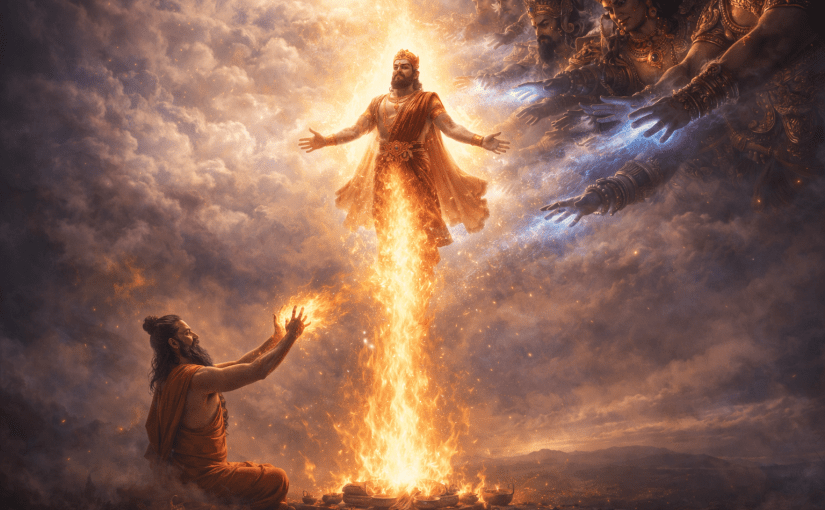
In the ancient tradition, King Trishanku of the Ikshvāku lineage desired to ascend to heaven in his physical body. When the royal priests refused to perform the rite, he approached the sage Viśvāmitra, whose tapas was unmatched. Through his austere power, Viśvāmitra attempted to send Trishanku to the celestial realms, provoking resistance from the gods. When the ascent was obstructed, Trishanku was left suspended between heaven and earth, neither accepted by the devas nor returned to the mortal world. Refusing to let him fall, Viśvāmitra established him in a unique state—neither fully liberated nor condemned—where he remained held by the force of the sage’s tapas.
Rethinking the Trishanku Story: Blessing, Not Punishment
I have often felt that the story of Vishvamitra and King Trishanku is misunderstood. Most readings stop at ego, rivalry, or defiance of the gods. But to me, it feels very different. It feels like a blessing, not a punishment. Vishvamitra did not abandon Trishanku halfway. He held him.
I feel Vishvamitra created an abode for Trishanku not out of anger, but out of compassion. However, it may be understood as a spiritual anger directed toward the devas for denying liberation to Trishanku. It was pure and positive—aimed at growth, and getting inspiration to do a great job, not rivalry. Trishanku was not ready for full liberation, yet he should not have fallen back. So Vishvamitra, through tapas, prayer, and sheer inner power, held him in between—high enough to be safe, steady enough to ripen. This suspension itself feels like grace. Liberation is not always immediate. Sometimes it is protection from regression.
Rituals for the Departed: Collective Tapas in Everyday Life
When I look at society today, I see the same intention expressed differently. People perform Bhagavatam kathas, shraddhas, yagyas, pindas, and tarpanas, prayers, rest in peace or RIP for their departed loved ones. These are not empty rituals. They are collective efforts to hold consciousness high enough so that it does not collapse back into unconscious karmic drift. Vishvamitra did this alone. Ordinary people do it together, repeatedly, across time.
Seen this way, Trishanku becomes an archetype. Not damned. Not liberated. But protected. Suspended with care.
When the Myth Became Personal: My Own Experience
This is not just philosophy for me. It touched my life directly.
Dream Visitations and the Call for Assistance
After the death of a close acquaintance, I experienced her presence repeatedly in dream visitations. These were not frightening. They were not dramatic. They felt like a seeking—an unspoken request for assistance in liberation. I did not try to command anything. I did not panic. I prayed.
Prayer, Kundalini, and the Meaning of Urging God
I prayed strongly. I urged kundalini for her peace, for her liberation, for forgiveness of acts that might be preventing liberation, for release from unresolved weight. For me, kundalini is representative of God—not as a personality, but as the deepest intelligence of integration. Urging kundalini is urging God. It is aligning intention with the highest coherence of consciousness. We may even call it a personified dhyāna-supporting chitra that often lingers during savikalpa dhyāna and, as it converges toward nirvikalpa dhyāna, enables a smooth and rapid transition.
I also urge liberation for all beings, twice daily, in my dhyana. I do this because liberation is not a limited resource. It is not like physical matter that gets exhausted by giving. It is like light. It can be wished for all, together, without loss. This understanding feels very clear to me.
Signs of Resolution: Clarity, Softening, and Residual Sadness
Over time, I noticed something important. The appearances in dreams became clearer. Calmer. More refined. Each interaction carried less confusion. There was a subtle sadness present—not fear, not agitation—but a gentle sorrow. It felt connected to not being perfectly cared for during illness and the dying phase. I did not try to fix this sadness. I simply allowed it. I know it will resolve one day on its own.
This clarity felt like confirmation—not in a grand mystical sense, but in a quiet, settling way. Something was integrating. Something was being completed.
Kundalini as Dhyana Chitra: The Inner Guru Clarified
I want to be clear about one thing. When I speak of kundalini here, I mean dhyana chitra. The inner meditative image. The inner guru. Not a voice. Not an external command. Not an authority that tells me what to do. It is orientation, not instruction. It does not demand action. It dissolves naturally in meditation.
Where Resolution Truly Happens
On careful observation, I see that nothing was resolved outside me. The resolution happened within. A tense relational field completed itself, which is why clarity increased and interactions became softer instead of more intense.
This reflects the true purpose of ancient rituals. They were meant as acts of love, not fear—support rather than rescue, holding rather than pulling. Their role was to stabilize awareness, reduce downward pull, and allow natural ripening to occur. It means these practices certainly work in this world, and they may also have effects beyond it, in the afterworld as well.
Yogic Understanding: Death as Pratyahara and Suspension
From a yogic perspective, death itself is forced pratyahara. The danger is regression into old samskaras. Holding practices—whether tapas, prayer, ritual, or remembrance—keep awareness above that collapse point or above throat chakra. Trishanku’s suspension mirrors this exactly.
Psychological Grounding: Grief, Holding, and Completion
From a psychological perspective, this is also healthy grief. Remembering without clinging. Caring without binding. Letting go without denial. Societies that abandon ritual often carry unresolved trauma because transitions are left unheld.
Responsibility Without Burden
One crucial truth remains central to me. I am not responsible for liberating anyone. I am responsible for not obstructing liberation with fear, guilt, or attachment. My prayers are permission, not intervention. Opening, not pushing.
Why Experiences Fade When Resolution Occurs
That is why these experiences naturally fade. Fewer visitations. Less emotional charge. More neutrality. Eventual quiet disappearance. Resolution softens. It does not escalate.
This is the role of the inner guru. Not to act. Not to control. But to allow completion to happen without force.
Returning to Trishanku: The Archetype of Compassionate Suspension
When I look back at Vishvamitra and Trishanku now, the story feels intimate, not mythic. One consciousness holding another until gravity loosens. One being refusing to let another fall, without pretending readiness that is not yet there.
Different methods. Same compassion.
Not a Conclusion, But a Resting Place
This blog is not a conclusion. It is a resting place. A suspension that does not need to hurry. Just as liberation itself does not hurry.

 Demystifying Kundalini