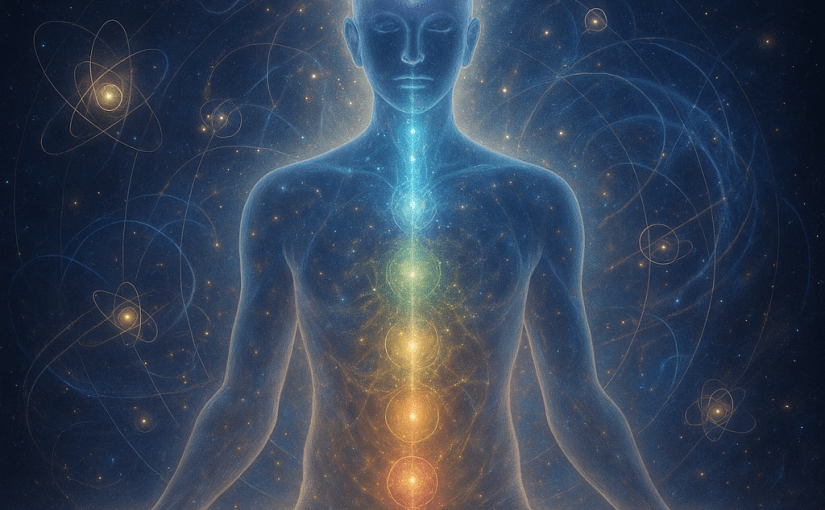
The exploration that began with matter and moved towards the self now reaches another doorway. Matter has been seen not as something separate but as a reflection of the self. The body has been observed not as a lifeless machine but as a field of consciousness woven through atoms, molecules, tissues, and energies. Now comes the most delicate and mysterious turn in this journey, where the very atom itself reveals the illusion of doership and quietly melts the ego away.
Every atom is endlessly active. Within it, protons and neutrons are bound in ceaseless dance, while electrons whirl around with unimaginable speed. Yet in all this activity, never does an atom declare, “I am the doer.” There is no self-assertion in its functioning. It simply acts because action is woven into its nature. The atom never claims ownership of creation, and yet without it, nothing can move. In this silent humility of the atom lies a mirror for the human being. The body, built of countless atoms, also functions in the same way. Breath rises and falls, blood circulates, thoughts appear and fade, but nowhere within does the body say, “I am the thinker.” Thoughts are not manufactured by the body; they are ripples in the vast lake of mind.
Ancient wisdom had already noticed this truth. In the Gita it is said that the gunas act upon the gunas. Forces of nature act upon forces of nature. Fire burns because it is the nature of fire to burn, wind blows because it is the nature of wind to move. Likewise, actions emerge from the body and mind because it is their nature to act. The witnessing consciousness remains untouched. The illusion of ego is nothing but the mind’s mistaken identification with this flow of actions. Ego believes, “I am doing,” whereas in truth action is happening through the gunas, just as rain falls or a flower blossoms.
Science, too, has begun to echo the same insight in its own language. Physics shows that before any particle is observed, it exists in superposition, holding many possibilities together. Only in the moment of observation does one outcome collapse into being. In the same way, before a thought arises, the mind is filled with infinite possibilities. Each thought is like a quantum collapse, a crystallization from the field of potential into the world of form. Prior to thought, there is only a vast dark stillness, a zero point where every possibility cancels itself by its opposite, leaving nothing but unexpressed energy. This state of unmanifest mind is experienced in meditation as a deep darkness, an ocean without ripples.
When one emerges from samadhi, there is often no immediate storm of thoughts. First, the still energy is felt, like a dark silence holding everything within it. Only afterwards does the chain of thoughts begin to rise, one by one, each collapse giving birth to the next. Ancient yogic language called this process vyutthana, the return of the mind from samadhi. The modern physicist calls it the movement from superposition to collapse. The meaning is the same: from pure potential arises form, from silence arises sound, from stillness arises motion.
During meditation, scattered traces of thoughts may appear like clouds on a clear sky. The seeker need not fight them. Simply allowing them to pass keeps the mind open to the vast akarnava, the boundless ocean beyond. Sometimes a gentle mental chanting of akarnava itself helps link the mind with this endlessness. And when thoughts grow heavy, the ancient method of neti neti offers a simple key. Neti means “not this.” At intervals, when a thought appears, it is quietly dissolved by remembering, “not this, not this.” The thought fades back into the void. Yet even this practice must remain subtle, for if repeated without pause, it turns mechanical and loses its power. Used occasionally, it creates sudden dips into stillness, where breath slows and relaxation deepens.
In deeper meditation, when the awareness is extended to the entire sitting body, something extraordinary is noticed. The body itself becomes a gateway to the cosmos. Every chakra within the body is a hidden archive of universal patterns. Within the heart lie echoes of cosmic emotions, within the throat the seeds of all expression, within the brow the visions of countless worlds. When the whole body is kept in gentle notice, the entire cosmos hidden within begins to open. Thoughts connected with the universe itself may arise, only to dissolve in the same silence.
Yet sometimes meditation feels blocked. Energy stuck at certain chakras creates a sensation of suffocation or heaviness. Breath automatically begins to focus on that region as if the body is trying to heal itself. This is not for oxygen but for prana, the subtle energy required by that chakra. Until these blockages are released, meditation remains shallow. Breathlessness is the sign of release. When, after working through the chakras, breath is naturally held at the end of inhalation or exhalation, a depth opens where suffocation disappears. The once-blocked chakra now feels free, or at least so subtle in its lack that it cannot stop the energy from rising. From this breathless stillness, meditation enters its deepest flow.
Actually, after mastering prāṇa through repeated yoga practice, one can hold the breath at will and focus on an energy-deficient chakra. That chakra then feels “hungry” for breath, producing a sharp, suffocating sensation. In reality, it is not hunger for air; it is hunger for prāṇa. When attention is placed on that sensation, the energy in the suṣumṇā naturally floods that chakra and satisfies it, even while the breath remains stopped or nearly absent. When all the chakras become fully nourished with prāṇa, a breathless and deeply satisfied state appears, which is wonderful and naturally leads to a mindless dhyāna-like stillness.
Seen in this light, the discoveries of Sanatan Dharma appear less as religious imagination and more as profound quantum insights in disguise. The sages saw that everything in existence is conscious in its own way, and thus they worshipped every element as divine. Stones, rivers, trees, animals, all were held as manifestations of the same conscious field. Idols and mandalas were not superstitions but symbolic mirrors to the cosmic order hidden within the atom and within the self. Today, quantum scientists too are beginning to wonder if consciousness itself plays a role in the collapse of possibilities into one outcome. The ancient and the modern are slowly meeting on the same ground.
Science shows the structure. Biology reveals the process. Matter, in its endless forms, presents the illusion of separation. But Sharirvigyan Darshan, the direct seeing of the body as a field of consciousness, dissolves ego through pure vision. In this vision, it becomes clear that the self is not an atom, not a cell, not a body. The self is the field in which all these arise and into which they dissolve. Ego may pretend to be the doer, but the atom has no such illusion. Ego may take ownership of thought, but thought itself is only a quantum ripple arising from silence.
The final freedom is nothing dramatic. It is the melting of ego, the end of false ownership. When this happens, silence itself shines forth, not as something achieved but as something that was always there. The self remains, untouched, unbroken, ever luminous. The journey through atoms, body, mind, and cosmos ends where it began, in the pure witnessing that needs no name.
Thus the story comes full circle. The human being entered the investigation thinking of himself as a separate doer and knower. He examined matter, cells, energies, and mind. He discovered that the atom does not claim doership, the body does not think, the mind does not own thoughts. The gunas act upon the gunas, and he is only the witness. In that recognition, the atom dissolved the ego. The silence behind all action became visible. That silence is the self, radiant and free.
And here ends the adventure of Sharirvigyan Darshan as Quantum Darshan, not in noise but in a quiet flowering. When the atom is seen as innocent of doership, the ego cannot survive. When the body is seen as a field of energies, the mind cannot cling. When thought is seen as a ripple in the quantum ocean, the self shines as the boundless sky. This is the final realization, simple and astonishing: the self was never hidden, only the illusion of doership covered it. With its melting, the journey finds its destination, and the seeker finds himself where he always was—free, silent, eternal.
 Demystifying Kundalini