In the last chapter, we asked: if the entire universe is a holographic projection, then who is observing this cosmic screen?
That question is not separate from science. It’s the very heart of it.
Everything we see — the planets, the people, the pain, the play — all of it might be appearing on a kind of invisible surface, just like a 3D movie on a flat cinema screen. But unless someone is watching that screen, the movie doesn’t truly exist. So the most important question isn’t about how the movie appears, but who is sitting in the audience — silently witnessing the show.
This witness is not your eyes. Not your brain. It is the soul — the spacious, aware presence behind all perception. And it is not passive. It does something magical. It translates a flat image into a living, breathing experience.
That’s why we don’t just see shapes and colours. We feel love. We feel distances. We experience space. Why? Because the soul itself is not flat. It is three-dimensional space, infinite, silent, conscious — and from it, all volume and depth arise.
The brain helps process signals, but the soul gives depth to reality. Without it, everything would be flat and meaningless. That’s the secret behind our experience of life as a deep, vast, unfolding mystery.
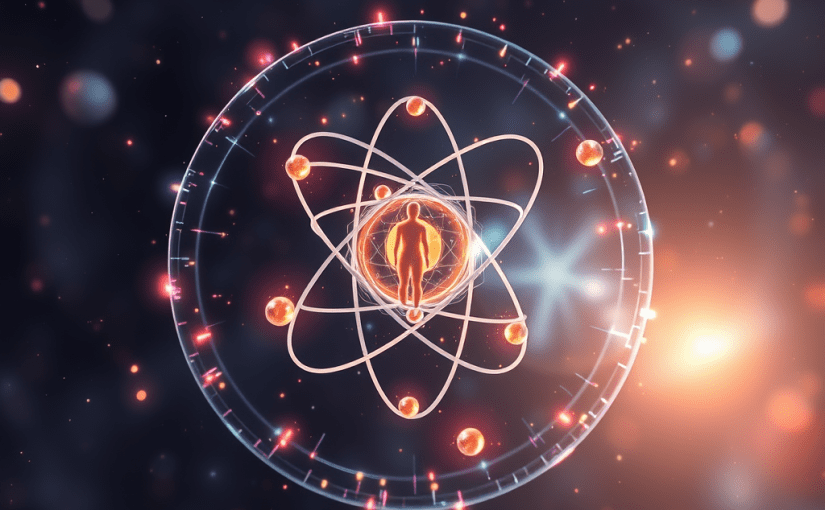
This insight also helps us approach the central question of this chapter — can a whole body fit inside an atom?
At first glance, it sounds ridiculous. Our body has bones, skin, blood, thoughts, breath — how can all of that fit inside something smaller than a speck of dust?
But if you look deeper, you’ll discover a quiet miracle. Every cell of your body carries the entire blueprint of your form — your DNA. And DNA itself is smaller than what we can imagine, yet it contains everything — your eye shape, your voice, your sleep patterns, your tendencies. And DNA is made of atoms.
So, in a simple yet astonishing truth — your entire body is already folded inside the atom. Not physically, but informationally. Like a movie is stored inside a memory chip, your whole being is encoded inside the atomic architecture of your cells.
And the more we understand information, the more we realise that information doesn’t need volume. It only needs pattern. A single holographic pixel can carry the image of the whole — and this is true not just of science, but of our very existence.
In ancient Yogic vision, this was never news. The Rishis saw that the subtle body (sukshma sharira) holds the full record of all our lifetimes — not just the current one. These records aren’t written in ink, but in subtle ripples — samskaras — which move through our soul-space like gravitational impressions.
These ripples don’t die when the body dies. They stay. They vibrate quietly in the background of consciousness, waiting for conditions to rise again. Just like ripples in space don’t disappear after a star collapses — they stretch as gravitational waves, holding memory across eternity.
This means the human soul is a personal holographic space, containing subtle ripples, vibrational patterns, and emotional waves from countless lives. It is like a microcosmic version of the cosmos. And these ripples are held by prana — the subtle life force, just as in the universe, cosmic prana may be holding all gravitational memory after the end of galaxies.
So what scientists now begin to say — that the universe stores its history as stable gravitational waves — was already intuited by ancient seers. Our individual soul-space is a smaller echo of cosmic space — each carrying memory, pattern, and subtle desire. The universe is the macro-soul. We are its holographic reflections.
And now I must tell you something that confirmed this to me beyond theory.
I once had a powerful experience — a visitation in a dream — of a freshly departed soul. But it didn’t appear merely as the person I knew in this life; it was much more than that. It came as a deeply encoded field of identity. It felt like the average of all its lifetimes, distilled into a single compact vibration — heavy and dark, but not in an evil sense. More like dense light wrapped in darkness, or a sacred knot of memory — a concentrated bundle of impressions woven from countless experiences, identities, and emotions across time. It wasn’t chaotic, but felt intentionally held together, like a spiritual DNA preserving the soul’s essence. Sacred, because it bore the silent weight of eons — yet still a knot, because it hadn’t fully unraveled into freedom.
It was alive — more alive than ever, in a strange and quiet way. Yet I could see that its soul-space was compressed. It wasn’t empty, but it was concealing its personal identity within itself, folding inward like a lotus closed at night. Its core felt heavy, as if burdened by unresolved identity — by samskaras carried across eons. Simply put, or in a nutshell, it was like a space filled with complete darkness, yet invisibly encoding an individual identity within. Because of this encoding, I could unmistakably feel it as that same individual — fully alive — even though nothing was present except sheer, expansive darkness and silence. It was an astonishing kind of encoding. Perhaps it is akin to subtle gravitational ripples in space.
It was not tortured, but it was not free. Its experiential light — its vastness, its bliss, its clarity — was present, yet covered, veiled, or diminished. It appeared lesser than the state of a living human body. Had it appeared more — more radiant, more open — it would have been recognized as liberated. Though it believed itself to be liberated, this belief was shaped by illusion and carried a subtle doubt. It even asked me to confirm its liberation, but I denied. That subtle compression of soul-space — that invisible binding — was its true suffering. It didn’t recognize it as suffering, but I did. A man who has lived in a well for eons cannot know what lies beyond, but someone outside the well can see it — and point toward the truth. It wasn’t pain in the usual sense, but rather the quiet ache of being less than what one truly is — that is, absolute.
In that moment, I understood something profound — liberation is simply the release of these samskaras. It is the melting away of these inner gravitational waves. Liberation is not the end of life, but the end of compression. One may be sitting in a cave yet still be bound and compressed by samskaras, while another, even as a king amidst the world, may be entirely free of such compressions.
Just as a black hole may one day dissolve its trapped information into open space again, the bound soul too can release its encoded ripples and return to satchitananda — being, consciousness, and bliss — in their natural, free, shining form.
So what does this say about the universe?
The scriptures say even Brahma, the cosmic creator, has a lifespan. When the cosmic play ends, even he dissolves. But just like a soul, Brahma doesn’t vanish. He merges into infinite stillness — into Brahman, the pure, ripple-free field.
This is Mahapralaya — the Great Dissolution. But it’s not destruction. It is deep sleep. And from that silent space, one day, a new Brahma emerges — and with him, a new universe, a new screen, a new holograph.
Why? Because the infinite never runs out of potential. It doesn’t need desire to create. It simply flowers.
And so it is with you. When your samskaras melt, when your inner ripples calm, when your soul becomes like clear, still space — you don’t vanish. You shine. You become the screen and the observer — at once.
So yes — a whole body can fit inside an atom. Because the body is not merely flesh and bone; it is a vibration, a subtle blueprint, a densely compressed field of infinite memory and possibility. What we perceive as the physical body is only the outermost layer. At its core, it is energy — encoded with the entire history of one’s being across lifetimes — all folded into a single point of consciousness, much like how a vast hologram can be stored in a tiny fragment of space. Just as the energies and impressions of infinite lifetimes can remain encoded in the soul, the same kind of encoding can be stored within the space bound by the boundary of an atom. In that minuscule realm, unimaginable depth and memory can reside, hidden yet alive. Just as the portion of infinite space within the human head can hold unlimited energy patterns as encoded impressions, then why can’t the part of infinite space bound within an atom also hold the same — the energy patterns of a human, or even of the entire cosmos? It is not a matter of size; it is a matter of structure — of holography. In a holographic reality, the whole is reflected in every part. So even the smallest boundary, like that of an atom, can encode the vastness of existence within it.
And inside that atom — there may be a holograph of not just your form, but of your past, your future, and the entire cosmos.
You are not a fragment — not a broken or isolated piece of existence. You are a portal: a living doorway through which the infinite expresses itself. You do not merely belong to the universe; the universe flows through you. Within you lies access to all dimensions of being — from the deepest silence to the highest awareness. You are not a small part of reality; you are the point where reality opens, unfolds, and becomes self-aware.
You are not inside space. Space is inside you.
And the one watching all this — the one reading these words now — is not a character on the screen. It is the eternal observer, patiently waiting for you to remember:
You were never just the story.
You were the light behind it all.
 Demystifying Kundalini