From Preparing the Body to Discovering the Nature of Awareness
Over the last few meditation sessions, my understanding of yoga has changed through direct experience rather than philosophical study. Each session seemed to remove another obstacle, allowing meditation to deepen naturally. Instead of searching for extraordinary experiences, I found myself discovering how ordinary factors such as the body’s condition, posture, preparation and mental state quietly influence the depth of dhyana. Looking back, I realized that every successful session had something to teach before revealing the next stage.
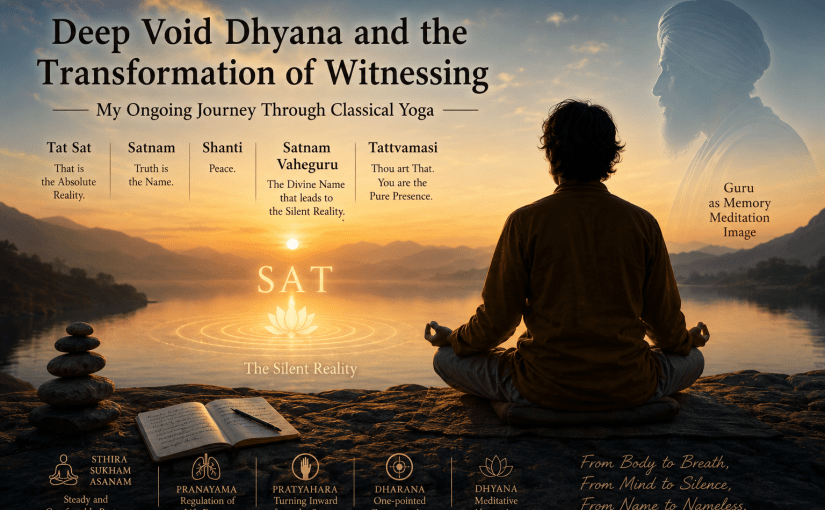
One of the earliest insights concerned the true meaning of Patanjali’s famous sutra, “Sthira Sukham Asanam.” Modern yoga often emphasizes asanas as physical exercises for flexibility or opening energetic channels. My experience suggested that this is only part of their purpose. The sutra itself simply defines an asana as one that is steady and comfortable. It does not insist that one posture should be maintained forever, nor does it encourage unnecessary movement. During meditation I realized that if one posture gradually ceased to remain both steady and comfortable, another stable posture could continue supporting meditation, provided the transition itself did not disturb awareness. The real purpose was never changing posture frequently but preserving uninterrupted meditation. Asanas therefore appeared to be less about physical performance and more about creating a body that never becomes an obstacle to prolonged awareness. This understanding also made Patanjali’s sequence meaningful. Asana naturally prepares the ground for pranayama, pratyahara, dharana and finally dhyana because the body itself becomes one of the foundations of meditation.
When Void Dhyana Changed the Nature of Witnessing
The next discovery was far more surprising. After entering what I call void dhyana, witnessing itself became completely different from ordinary witnessing. Thoughts still appeared, but they no longer possessed the brightness and convincing reality they normally have during waking consciousness. Instead, they seemed dream-like, almost transparent, arising like gentle waves within the same silent field that I experienced as the void. The void itself did not become brighter; rather, thoughts lost their apparent solidity. They no longer appeared separate from awareness. Because they were experienced as movements within the same field, they naturally settled without effort.
This led me to reflect on the difference between ordinary consciousness and meditation. During everyday life, thoughts dominate experience while awareness of the silent background remains comparatively hidden. After deep meditation, the relationship appears to reverse. Awareness becomes primary, while thoughts remain only temporary modifications arising within it. Witnessing therefore changes not because the instruction changes, but because the structure of experience itself changes.
Initially I wondered whether successful witnessing could occur only after void dhyana. On further reflection, a more careful conclusion emerged. My experience demonstrated that witnessing after deep meditation was qualitatively different from witnessing before it. Rather than claiming this must be true for everyone, it seemed more accurate to say that deep meditation transformed my own relationship with thoughts, making non-identification almost effortless.
Why Witnessing Sometimes Appears Difficult
This understanding also helped explain why many beginners report increasing mental noise when they first attempt meditation. Meditation itself may not be producing more thoughts; it may simply be making them more visible. My own experience suggested something further. When the mind remains strongly identified with worldly concerns, thoughts appear exceptionally vivid while awareness of the underlying silent field remains comparatively obscured. Under these conditions, merely attempting to witness may initially feel difficult because thoughts appear independent and convincing.
After deep dhyana, however, awareness itself becomes more evident. Thoughts continue arising, but they resemble passing dreams rather than independent realities. Because they are no longer experienced as separate, they gradually lose their binding force and dissolve naturally into the same awareness from which they arise. This insight felt far more meaningful than merely trying to suppress or control thoughts.
Comparing Yesterday’s and Today’s Meditation
As I compared consecutive meditation sessions, I noticed that each day removed another layer of obstacles. Yesterday’s meditation was performed after a bath, without preceding it with chakra meditation, and it took place on a normal working day when the background of professional responsibilities naturally remained present. Today’s practice unfolded under different conditions. It was a holiday, the mind was already more relaxed, chakra meditation preceded the main practice, and the overall atmosphere was more supportive for prolonged stillness.
Looking back, it seemed that whatever obstacles had limited yesterday’s meditation were largely absent today. Whether each factor contributed individually or together could not yet be determined, but the combined result was unmistakable. Today’s dhyana deepened significantly, and the quality of witnessing became completely transformed. This observation encouraged me not to attribute progress to any single technique but instead to continue removing one possible obstacle at a time while observing the effects honestly.
Refining the Field of Dhyana Through Mantra
Today’s meditation became sufficiently deep, although the field of void was not yet completely clear or infinitely expansive. Breathlessness was not full. Instead of struggling with thoughts, I directed my attention toward making the field of dhyana itself clearer, steadier and more transparent. Into that silent background I gently allowed the vibrations of Tat Sat, Satnam Shanti, Satnam Vaheguru and Tattvamasi to spread naturally. The chanting was not experienced as ordinary verbal repetition. It felt as though the mantras quietly diffused throughout the silent field without disturbing its stillness. As meditation deepened, the mantras themselves became subtler until silence again became primary and the sounds remained only as faint ripples within awareness.
This experience suggested that once the mind has become relatively quiet, a mantra may no longer function merely as an object of concentration. Instead, it may become a subtle resonance that gradually dissolves into silence itself. Rather than alternating between many mantras indefinitely, it may even be worthwhile to observe whether one naturally becomes subtler than the others and allows awareness to deepen further.
The Meanings of the Mantras Became Experiential
During meditation, the meanings of these ancient expressions also appeared differently than before. Tat Sat no longer seemed only a philosophical declaration but a direct indication of the silent void, the pure existence underlying all experience. Satnam Shanti suggested that the peace traditionally wished for the departed is ultimately the peace of liberation, the perfect and enduring peace of that same pure existence. During meditation, Satnam Vaheguru revealed another dimension for me. I understood Sat as the Name of Vaheguru, where “Name” did not signify a physical person but the inward remembrance through which meditation begins. A name is remembered in the mind; it is not the physical appearance itself. In this sense, the remembered name naturally becomes a meditation image or inner object of contemplation. That meditation image may arise from the memory of a physical Guru, but as meditation deepens it gradually becomes subtler, eventually dissolving into the silent reality toward which it points. Thus, my experience suggested that the purpose is not to remain attached to the form of the Guru but to allow even the remembered image to merge into Sat, the pure existence or silent presence. Whether the meditation begins with the memory of a revered Guru or with the simple remembrance of the Divine Name, both ultimately serve as pointers that dissolve into the same silent ground of awareness. Once guru dissolves in void it proves to be void itself. Tattvamasi also ceased to feel like an abstract philosophical sentence. It became almost as if a realized sage were directly addressing the disciple: “You are That.” You are not essentially the body, the mind or passing thoughts, but the silent presence that remains when all mental modifications settle.
These meanings did not arise from deliberate intellectual analysis but emerged naturally during meditation itself. Whether they continue to evolve with further practice remains an open question, yet they have already enriched my understanding of both mantra and meditation.
The Next Stage of My Exploration
Every meditation seems to reveal another condition that supports or limits depth. Rather than assuming I have reached final conclusions, I now feel encouraged to continue experimenting carefully. My next step will be to prepare the body before meditation using the traditional yogic cleansing practices of Kunjal Kriya, Jal Neti, Sutra (Rubber) Neti and Dhauti. My purpose is not simply physical cleansing but to investigate whether these classical shatkarmas remove subtler physiological obstacles that may further deepen dhyana, increase the continuity of awareness or refine the quality of witnessing. Whatever changes occur, I intend to document them honestly without forcing conclusions. This journey has increasingly shown me that yoga reveals itself step by step through direct experience. Each obstacle removed uncovers another layer of stillness, and each deeper stillness offers a clearer understanding of the relationship between body, mind, awareness and the silent reality toward which all genuine meditation ultimately points.n.
Discover more from Demystifying Kundalini
Subscribe to get the latest posts sent to your email.


