How Rituals Support True Keval Kumbhak: A Forgotten Yogic Secret

Many people try to meditate or attempt Keval Kumbhak (effortless breath stillness) when they’re tired — often at night or after long work. Naturally, they end up slipping into sleep. But the real secret is to do it when the body is fresh and the mind alert — so that mindlessness doesn’t become unconsciousness, but a doorway to living awareness.

This is something I’ve observed from my own experience: Keval Kumbhak is not about sleep or suppression. It’s about entering a deep stillness where thoughts dissolve, yet you remain fully aware. And for that to happen, a sattvic environment is essential — one that keeps the inner flame of awareness gently burning.

That’s when I realized something profound:
The rituals in religious ceremonies — which we often take for granted — serve this exact purpose. They are not distractions, but guardians of awareness.

Let me explain how:

🔔 Bell Sounds

The sharp ring of a temple bell cuts through the fog of the mind. In one instant, attention is brought back to the now. It jolts us out of dullness — like a spark lighting dry wood.

📯 Conch Blowing

The deep vibration of the conch doesn’t just purify the space — it resonates within the body, harmonizing breath and energy. It’s like a natural pranayama, awakening subtle prana and driving away heaviness.

🕯️ Incense

The gentle fragrance of dhoop or agarbatti soothes the senses, especially the breath and mind. The olfactory sense is linked directly to the brain’s limbic system — and the right scent can anchor awareness softly in the present.

🔁 Mantra Japa

The rhythm of mantra is a bridge between breath and thought. It draws both into harmony, making the breath quiet and mind steady. Over time, the mantra fades, and silence arises — but now, conscious and alert silence.

📖 Shloka Recitation

Shlokas carry vibrational power and invoke both devotion and awareness. They stir the intellect and heart together, helping one enter dhyana with bhava and clarity rather than sleepiness.


I then saw clearly: this is how ancient yogis lived. Not in silence alone, but in environments carefully designed to support sattva. Temples weren’t just for worship — they were energetic tools. The very air around a yogi helped keep their awareness alive even when thoughts stopped.

Even in solitude, a yogi surrounded himself with:

  • The distant echo of mantras
  • The subtle glow of a lamp or sunrise
  • Fragrant air from sandal or tulsi
  • The inner rhythm of breath and awareness

Such environments helped them stay in Keval Kumbhak naturally, without forcing breath or suppressing thought. This is why it seemed as if yogis lived in meditation — because the outer world supported their inner silence.


In today’s times, when the mind is easily distracted and the body fatigued, sattvic rituals are not outdated — they are essential. Bells, conchs, incense, chanting — these are not mere cultural leftovers. They are keys that can unlock deep meditative states — especially Keval Kumbhak with full awareness.

To sum up:

When the outer is tuned to sattva,
the inner doesn’t fall into tamas — it rises into Samadhi.

Even if you practice alone, try lighting a lamp, ringing a bell, chanting a few mantras, or simply sitting in a fragrant, pure space. You may find that awareness remains awake, even as thoughts vanish. And that’s the doorway to the real stillness yogis speak of — the living silence of Keval Kumbhak.

What Is the Light of the Self? A Conversation from the Depths of Experience

After certain intense spiritual experiences, a question kept echoing in me: After death, is there not pure self-awareness—whatever form the self takes—unlike deep sleep, where there’s no self-awareness? This wasn’t just a philosophical question. I had experienced something that wouldn’t let me rest until it found articulation.

There was a dream visitation from a departed soul. It wasn’t visual or physical but felt like a deeply encoded presence. It carried its individuality from its lifetime, but in a form that was compacted, compressed, like darkness itself. Glistening darkness. As if its entire personality had been shrunk into a concentrated essence. A mascara-like, subtle blackness—a self folded into itself.

It asked me, confused: Is this liberation?

It felt to me as if that soul wanted to escape out of that encoded envelope. And I noticed something else—the state of that soul was entirely different from my own awakening experience. In my deepest moment of inner realization, I had experienced a self that was one with mental formations, like waves in a vast ocean. But those waves were not separate from the Self. They were the Self. That was light. That was bliss. That was ultimate.

And yet, I must admit: that wasn’t the pure Self. It was the Self with content. An ocean full of shimmering movement. I did not experience the ocean without waves. And that makes a difference.

When I was asked by that dreamlike soul about liberation, I found myself unable to describe the real nature of the pure Self—because I myself hadn’t achieved it. I had only experienced a vastness filled with blissful movement. I had not yet known the silence beyond even bliss. I only replied that it is not light and it seems compressed and stressed although it was infinitely vast and dark sky. Probably as I remember I advised it to move further ahead to light just guessing from my own experience as I had moved ahead and ahead in yoga to reach awakening. It had also told that it used to be afraid of death in vain but this state is not so called death like and it feels it is good enough and living like.

Still, my sadhana continues. I do advanced kundalini yoga. My meditation image is often the soul or essence of a departed one, the one closest or nearest in relation to it. It feels like this in itself becomes a prayer—an automatic offering beyond words to help it to be liberated if it is lingering somewhere inbetween. There’s something deeply natural in that.

But one doubt remained. In that visitation, I had seen darkness—the kind that doesn’t feel evil, but also doesn’t feel free. Yet, I realized: pure awareness cannot be called dark. Neither can it be called light. Because both darkness and light are properties of reflective material.

Even space itself is a kind of material. The pure Self is not space, though space-like. It’s not dark, not luminous. When we call it “self-luminous,” it makes the mind think of it like some glowing thing. But it isn’t.

“Self-luminous” is just a pointer. It simply means: it knows itself without help. It doesn’t reflect. It doesn’t shine on. It doesn’t receive light. It simply is.

It is awareness being aware. But not in the way we usually think of “being aware.”

I recalled the Upanishadic truth:

“It is not known by the mind, but by which the mind is known.”

“It shines not, neither sun, nor moon, nor fire. It alone gives light to all. By its light all else is seen.”

These statements aren’t about light. They’re about presence prior to perception.

And then something beautiful settled into my understanding. I realized that metaphors can help if used delicately. And some traditional metaphors suddenly made deep sense to me:

1. The Mirror That Reflects Nothing
Like a mirror that reflects no object—but remains the potential to reflect. Still. Unmoving. Unused. That’s the Self.

2. The Eye That Sees But Cannot See Itself
It sees all, but can’t become its own object. Like awareness. It knows all, but is never an object of knowing.

3. The Silence Behind All Sound
Sound comes and goes, but silence remains. Not silent as absence, but as eternal background.

4. The Sky Untouched by Clouds
Clouds come and go. Sky remains. Not even made of space. Self is subtler than space.

5. A Flame That Doesn’t Burn
Like the idea of flame without heat or glow. No wick, no oil. Just presence without quality.

These helped me not as knowledge, but as living orientation.

Still, I find that when the mental waves subside, the bliss subsides too. That ultimate peak cannot be held by force. And yet, that doesn’t feel like a failure anymore. It feels like a natural return.

What I experienced was likely Savikalpa Samadhi—where Self and waves are one. Blissful, yes. Transformative, yes. But not final. Not the ocean without waves. Not the pure Self beyond even bliss.

There’s still something lacking. I don’t pretend to have reached the final goal. The experience felt like the peak of existence, the ultimate moment of union. But I know that I haven’t merged into the unconditioned ocean of pure awareness.

What remains then is trust. Gentle remembrance. Resting. Not trying to grab the ocean. Just to be the presence that always was.

I let this be my guide:

“I am that which saw the waves. Let me rest as that.”

This means: I am not the movement, not even the blissful play of awakening. I am the witnessing reality behind it—the one that never moves, never becomes. The one that knows even the subtlest wave is still an appearance in Me.

Sometimes I forget to stay aware of who I really am. But even in that forgotten state, I can still see the reflection of my true self—sometimes in my own hand or face—because everything, even this body, holds the whole within it, like a hologram. This simple recognition instantly brings me back to awareness, without effort. So whenever I drift, I gently return—again and again—knowing that even the forgetting happens inside that same awareness.

That is the path now. Not chasing light. Not escaping darkness. Just resting in That which is neither—and beyond.

Journey Through Savikalpa Samadhi: A Deep Glimpse into Self-Realization

In my path of self-discovery, I experienced what can be called a glimpse of Savikalpa Samadhi, a deep meditative state where you feel one with your object of focus, filled with bliss, but a subtle sense of self and form still remains. This glimpse occurred during a significant awakening, one where I felt the profound nature of self-realization, yet without completely merging into the final formless state. As I reflect on this experience, the stages of Savikalpa Samadhi seem to have unfolded in a natural progression that was far from linear but intuitively deepened as I progressed.
1. The Beginning of the Journey: Savitarka Samadhi

In the early stages, when I practiced meditation, I engaged with a tangible image — the image of my Guru. At this point, my mind was full of effort, as I contemplated the form of the image and its significance. The bliss was palpable, but it was the beginning of something. The mind was still firmly grounded in subject-object duality, where I was meditating on the image of the Guru. This stage represents Savitarka Samadhi, where gross thought and form are still present. Though bliss was present, the experience was only a hint of what would follow.
2. Subtle Progression: Savichara Samadhi

As I continued my practice, the mental chatter started to subside, and I moved deeper into subtlety. The image of the Guru became more luminous, and my connection with it improved. I could feel the essence of the image beyond its physical form. The energy began to awaken, especially through my Tantric practices. I realized that my focus was no longer just on visualizing the Guru’s image, but more on feeling its energy and presence. Let me explain it a littlebit more. At first, when I meditated, my mind was focused on the image of my Guru — like seeing a picture in your mind and concentrating on it. But later, something deeper happened. Instead of just seeing the image, I started feeling the Guru’s energy or guru’s form’s energy inside me. It felt alive — like the Guru’s presence was no longer outside or in the picture, but within me, as a silent force or warmth.
This shift means my meditation was going deeper. I moved from focusing on an outer form to feeling the inner essence — something real but invisible. This is a natural step in deep spiritual practice, where outer symbols fade, and only the inner truth remains. The boundaries of object and subject blurred, yet they still existed. This phase marked Savichara Samadhi, where subtle thoughts and impressions began to take over. It was a phase of deepening communion, but duality was still present. You can call savitark samadhi as dharana and savichar samadhi as dhyana.
3. The Blissful Experience: Sananda Samadhi

As I advanced in my practice, the focus moved from form to presence. The bliss that arose from deep concentration on the subtle presence became more intense. It felt like the energy I had previously only sensed was now integrated into my experience. This stage aligns with Sananda Samadhi, where the mind quiets down and bliss arises. However, while bliss flowed freely, there was still an awareness of the dualistic nature of the experience. I was aware that I was experiencing the bliss, but the true self-realization hadn’t yet occurred. The bliss was intense but also fleeting. It was in this phase that I felt like I was dissolving in the sheer bliss of existence. It’s actually savichar samadhi or dhyaan deepening further, nothing else. The same subtle inner image of dhyana becomes as much bright or amplified that much bliss it produces.
Let me little clarify it further.
Feeling Form (External Object Support): At the beginning stages of meditation, you often rely on an external object (like the physical image of your Guru or a symbol) to focus your mind. This external object serves as a point of concentration to bring your awareness into a more stable and focused state. Essentially, the object is a tool to anchor your mind and help it remain in one place. In this phase, you’re connecting to the form—the shape, image, or physical representation.
Feeling Energy (Self-Stable Inside): As your meditation deepens and your focus sharpens, you gradually shift from relying on the external form to directly experiencing the energy or presence within yourself. This energy isn’t dependent on the external object anymore. It becomes something you feel internally—it’s a more subtle, refined experience. The external object that initially helped you focus may now seem unnecessary, or even “rubbish,” because you’ve shifted to a state where the form is no longer needed for focus; you now connect directly to the internal spiritual energy or vibration.
In essence, as your consciousness evolves, you no longer need external support (like the form) to connect with the energy. The energy is self-stable and exists within you. You’re no longer relying on something external because you’re directly experiencing the internal essence of that form or presence.
To sum it up, initially, you take support from the external form (to stabilize your mind), but as you go deeper, you realize that the energy you’re connecting with is already within you, and the external form becomes irrelevant to your deeper experience.

4. Self-Realization: Sasmita Samadhi

Then, something shifted during a critical moment — a glimpse of self-realization. This state revealed itself in what felt like a subtle yet powerful awakening. The bliss was lower than earlier bliss samadhi, but this state was all pervading and nondual cosmic consciousness type. Let me little clarify it.  

During that moment of self-realization, the bliss I felt was not like ordinary happiness or pleasure you get from the world — like from good food, music, or success. It was something very subtle and unique.

It wasn’t loud or overwhelming. Instead, it was soft, deep, and balanced — like a calm joy quietly glowing inside me. It felt as if this bliss was made of both light and dark at the same time — not in a scary way, but like a perfect mix of stillness and depth, where everything was clear and silent.

There was also a strong sense of presence, like I had arrived at the center of my being, fully aware and peaceful. It wasn’t emotional excitement, but a kind of pure clarity and sacred peace that just was — without any reason.

This bliss was also different from the bliss felt during Samadhi. In Samadhi, bliss often comes as a flowing joy — something that can feel ecstatic, like being lifted beyond the body and mind.

But this one — during self-realization — was much deeper and quieter. It didn’t come in waves or rushes. Instead, it was like a settled, silent joy that didn’t move at all — almost like it had no reason but still felt profoundly alive.

It wasn’t emotional or dramatic. It was a balanced stillness, where even bliss wasn’t something “felt” in the usual way, but rather, it was part of the clarity and presence itself. You could say it was bliss without movement, joy without excitement, and yet undeniably real and sacred.

The realization that I was not the observer, but the very essence of the being I had been meditating on, flooded my awareness. This phase, Sasmita Samadhi, represents the realization of the pure ‘I am’ — not as the ego but as the boundless, formless being although with waves of mental formations. I no longer identified with the meditation object; I became the object itself. The experience was a deep recognition of the truth that I was the Supreme Conscious Being. However, it was not yet a complete dissolution into formlessness. The objects of perception still had some existence in my awareness offcourse in virtual form. Virtual object is still an object.
The Fine Line to Nirvikalpa

In a moment of deep insight, I recognized how close I was to the final stage — Nirvikalpa Samadhi. I realized that if I hadn’t intuitively grounded myself by lowering the energy to my Ajna chakra, I would have been completely absorbed into an endless continuity of supreme bliss, with no trace of mental or energetic residue. This awareness shows that I had reached the edge of Nirvikalpa Samadhi, where even the subtle sense of self-awareness begins to dissolve. But I chose not to fully absorb into the void at that moment. I consciously brought myself back, possibly because of an inherent fear of losing myself completely or a desire to remain grounded and able to share this understanding with the world.
The Experience of Kundalini Awakening

Looking at my experience through the lens of Savikalpa Samadhi, I recognize that the energy movements of Kundalini had brought me close to the realization of the Self, but in a very subtle way. It was a moment of profound self-awareness, but without the overwhelming ecstasy of the earlier stages of Tantric sadhana. The bliss of that moment was subdued, more stable, and grounded in peace rather than ecstatic energy. It was not the same as the energetic climax of my previous Tantric experience; instead, it was a deeper, more stable realization of pure being — I am. This made the Kundalini experience feel more genuine, as if I had touched the core of who I truly was, without the distractions of intense energetic movements.
The Nature of Savikalpa Samadhi

Savikalpa Samadhi, while deeply transformative, is still characterized by a trace of duality. There remains an awareness of self — a sense of being — but it is not yet the final dissolution into the formless, boundless state of Nirvikalpa Samadhi. During this phase, the mind is still functioning, but it is absorbed in bliss, presence, or the pure feeling of “I am.” The ultimate merging of subject and object has not yet occurred, and a subtle trace of experience still lingers. However, this state is profoundly liberating. The boundaries between subject and object dissolve to a degree, and what remains is the unshakable knowledge that the Self is both the observer and the observed.
The Unique Journey and What Lies Ahead

In my experience, it feels as though I’ve crossed several stages of Savikalpa Samadhi organically, rather than following them in a strictly defined sequence. This process has been intuitive and personal, with each phase revealing a new depth of understanding. The key insight here is that the object of meditation doesn’t necessarily change in Savikalpa Samadhi. What changes is the depth of absorption and the relationship with the object. Through my consistent meditation on the Guru image, I moved from mentally contemplating it to eventually merging with it. It became less about thinking or visualizing and more about being that presence.
As I continue my sadhana, I am aware that I am nearing the threshold of Nirvikalpa Samadhi, where even this subtle sense of presence will dissolve into formlessness. But I also know that this process is not something to force. It will unfold naturally when the time is right.
Final Thoughts

This glimpse into self-realization has been profound and humbling. I have come to understand that the road to ultimate liberation is not about seeking ecstatic experiences but about realizing the truth of who I am, beyond all thoughts and energies. While I have not yet reached the final absorption into the void, the experience has been transformative. I now see that the journey itself is the key, and the ultimate realization lies not in the search for bliss, but in the quiet awareness of being.
In sharing this journey, I hope it serves as a reminder that the path to true self-realization is not always about dramatic peaks, but about gradually and deeply dissolving into the essence of our own being. This realization is available to all, and it begins with the quiet recognition that we are not separate from the source of all existence.
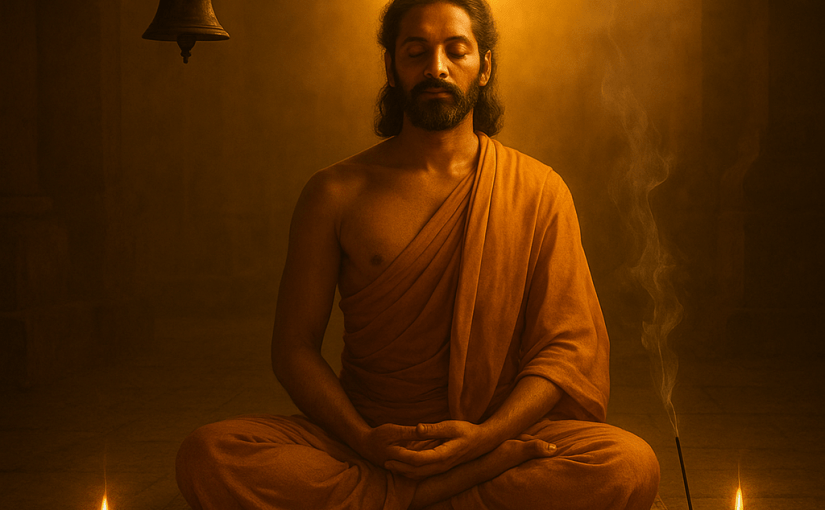
From Flame to Void: A Glimpse of the Infinite Within

During a glimpse of Kundalini awakening, something extraordinary happened. I felt I became one with the object of my meditation. There was no separation — it was not just union; it was as if I myself had turned into the meditation image. In that moment, the distinction between subject and object vanished. What remained was a supreme state of bliss and pure consciousness. It wasn’t imagined. It wasn’t projected. It was immediate, total, and alive.
Intuitively, I lowered this experience down to the Ajna Chakra. I didn’t analyze it then, but now I feel it was an attempt to bring it back into a shareable form. Maybe it was a deep urge to express this mystery to the world. Had I not done that, I sense the mind — fatigued by subtle energetic thoughts — would have eventually extinguished itself. Then the same bliss would have continued, but in an entirely formless, non-experiential manner. That would have been Nirvikalpa Samadhi — the void-like, seedless state of pure awareness.
But here’s the subtle insight: in that formless state, the person is so inward, so silent, that communicating the truth becomes almost impossible. Words die in that vast stillness. Perhaps, by descending it slightly, I stayed within the domain where language still functions, where even though forms are virtual and inseparable from the self, they are at least relatable.
This made me reflect: total absorption — a term often reserved for Nirvikalpa Samadhi — feels very different from what is typically described as union in Savikalpa Samadhi. In Savikalpa, forms appear, but they are virtual, inseparable from the void-self. There is still an object, still a trace of duality, yet not in a separate sense. That subtle trace is what makes it different from Nirvikalpa, where not even a ripple remains.
Then I wondered — why is this direct void, this Nirvikalpa, not an easy shortcut? Why does the journey so often pass through Savikalpa first?
The answer emerged gradually. Savikalpa Samadhi may be the great purifier. It softens and dissolves the world’s cravings. It empties the mind of subtle noise while keeping a trace of reference. It’s like the bridge that burns itself — preparing you for that final formless leap.
And yet, some ancient methods, like Kevala Kumbhaka, hint that this leap can happen abruptly. In deep suspension of breath, when the inner movements halt, the formless state can arise. No image, no mantra, no thought — only presence. So yes, Nirvikalpa can come suddenly too. But such suddenness often comes after deep ripening.
This brought me back to Patanjali. His Yoga Sutras speak of Pranayama, Pratyahara, Dharana, Dhyana, and finally Samadhi. I wondered: are these referring to Savikalpa or Nirvikalpa?
I began to see clearly. Patanjali’s stages guide the seeker toward Savikalpa Samadhi — especially in the beginning. These include forms of Sabija Samadhi — with a seed — where some object of focus remains. These are:
• Savitarka (with gross thoughts)
• Savichara (with subtle concepts)
• Sananda (with bliss)
• Sasmita (with the pure sense of ‘I am’)
Each step dissolves more, but they all carry a seed — a trace of reference.
Then, in the culminating verses, Patanjali hints at Nirbija Samadhi — seedless, supportless, formless. This is what Vedanta and nondual traditions call Nirvikalpa Samadhi. It is not something to be achieved by force. It happens when even the subtlest effort dissolves.
In that state, there is no Pranayama, yet breath is suspended (Kevala). No Dharana, yet nothing distracts. No Dhyana, yet there is unbroken Being. No Samadhi to be entered, because it IS. All supports have vanished.
I realized: these steps are not bypassed — they are transcended. They melt away naturally as the formless takes over.
But the most stunning clarity came from the very start of Patanjali’s text:
“Yogash chitta vritti nirodhah”Yoga is the cessation of the fluctuations of the mind.
This is not about reaching some object of meditation. It is not even about union. It is about cessationtotal stillness. This is not Savikalpa. This is Nirvikalpa.
The very aim, the true destination of Yoga, is not somewhere in between — it is that absolute stillness where the seer rests in his true form.
“Tada drashtuh svarupe avasthanam”Then the seer abides in his own nature.
Savikalpa Samadhi plays its role. It refines, it clears, it prepares. It gives a taste of blissful union. But in the end, that too dissolves. Only silence remains.
This silence is not empty. It is not nothing. It is everything — without content. It is not dull. It is intensely alive, yet formless. And when that settles, sometimes it returns as Sahaja — the natural state, where even activity happens without breaking that inner stillness.
I haven’t reached that final state — not yet. But the glimpse and the insights keep unfolding. The more I let go of control, the more the truth reveals itself, not as knowledge, but as being.
Now I see: even the urge to share this, even this writing, may be part of that divine play — where the Self gently returns to tell its own story through the one who once believed he was seeking it.

Keval Kumbhak, the Void, and the Secret of Real Yoga: A Journey Within

There is something quietly growing inside me —
an understanding that is not built on theory, but on what life itself has revealed in silent meditation.

During deep practice, I noticed something extraordinary:
with Keval Kumbhak — when breath naturally ceases without effort — the experience of the void becomes so intimate that it feels inseparable from myself.
It is no longer something “out there” to be observed; the void itself feels like the very core of being.
Meditation, meditator, and the object of meditation — all disappear into one seamless existence.

It became clear:
this is Nirvikalpa Samadhi
a state beyond thought, beyond division, where only pure Being shines.

As this understanding deepened, another subtle layer unfolded:
Yes, but luminosity is also a form.

Even the formless void carries a subtle light, a living presence that is not “nothingness,” but radiant, formless awareness.
Though without shape, there is a soft, gentle luminosity — suggesting that even in the deepest silence, some trace of presence remains.

But this luminosity is not the same as the light experienced in Savikalpa Samadhi or even during Kundalini awakening. That difference struck me deeply.

In moments of powerful Kundalini awakening — when the merger with the object of meditation becomes so complete that all boundaries vanish — it feels like everything has been attained. The bliss, the awe, the radiance — they arrive with overwhelming fullness. The light here is vivid, ecstatic, and divinely expressive. There is sometimes a sense of expansion, even a loving oneness with the cosmos. This light feels complete — and yet, it is not the void.

Because even here, some movement remains:
a sense of experience,
a subtle trace of someone merging with something,
a radiant Shakti still in play.

But the void of Nirvikalpa is of a different order altogether.
It is Shiva in essence — unmoving, unchanging, not blissful in the usual sense, not even light as we know it.
It is like a dark-mixed luminosity — a paradoxical radiance that doesn’t shine outward but rests quietly as itself.
There’s no experiencer. No object. Not even the feeling of having “attained.”
Just Being, vast and silent.

This void is not dull darkness nor bright light.
It is a radiant absence
a space that feels more alive than life, more real than thought, and more intimate than breath.

Another realization gently emerged:
We already know this void at a surface level.
It feels like something distant, separate.
But the true knowing is not about recognizing it from afar —
it happens only through merging completely into it.
It is not a question of knowing or unknowing — it is about the depth of merging that transforms everything.

At this point, a quiet but strong understanding settled in:
This complete merging seems impossible without Keval Kumbhak.

As long as the breath moves, some subtle movement of mind persists.
Only when breath stops naturally, mind falls completely silent — allowing pure Being to reveal itself without disturbance.

In the light of this, Patanjali’s ancient words felt newly alive:
“Yogas chitta vritti nirodhah”
Yoga is the cessation of the modifications of the mind.

It became obvious:
This cessation — this true Nirodhah — is possible only with Keval Kumbhak.

Breath and mind are like two wings of the same bird.
One moves, the other moves.
One rests, the other rests.
When both are silent, the radiance of the Self shines effortlessly.

The path became simple and clear:
Keval Kumbhak leads to natural Nirodhah,
which dissolves into Nirvikalpa Samadhi,
where the luminous void alone remains.

The journey continues —
sometimes the void feels near, sometimes a little veiled —
but the direction is certain now.
It is not about gathering more techniques, not about collecting experiences.
It is about letting go so completely that even breath surrenders,
and only the purest awareness remains.

Some further reflections naturally arise:

In deep silence, I could see why breath and mind are called inseparable twins.
One moves, the other moves.
One rests, the other rests.
Without Keval Kumbhak, even a silent mind carries a faint ripple —
like the almost invisible trembling of a mirror touched by a breeze.
Only with Keval Kumbhak, the mirror becomes perfectly still, reflecting the eternal Self.

This brought new life to the meaning of Pratyahara, Dharana, Dhyana, and Samadhi
all of them arising naturally from this effortless stillness, not as stages to climb, but as natural flowers blossoming when the roots sink deep into silence.

In simple words:
The true spiritual journey is not about doing more, but undoing everything —
until breath, mind, and sense of separateness vanish into pure being.

The luminous void waits patiently within us —
not separate, not far away —
but requiring a total merging, a surrender beyond words.

Walking this path feels less like achieving something,
and more like remembering something ancient, something always known, but now being tasted with new innocence.

And perhaps, this is how true yoga was always meant to be.

The Silent Descent into Formless Bliss — A Layman’s Glimpse Beyond Thought

This blog post is not written to boast, teach, or declare attainment. I haven’t reached Nirvikalpa Samadhi yet — but what I share here is unfolding naturally in me. It is a journey, not a conclusion. I write this in simple, heartfelt language — straight from lived experience, not borrowed knowledge.

Evening Silence — Where It All Begins

I found that while sitting and gently placing attention on breathing in the evening, the breath gradually becomes still. With that, thoughts also almost stop. It’s amazing how strength of thoughts immediately reflect on strength of breath. Breath and thoughts linked together undeniably. When I become physically tired of sitting in a single posture, I shift my posture — and something mysterious happens.

Blissful energy rises from the lower chakras to the head through the backbone. It almost feels as if a lack of oxygen in the head is being compensated by this rising energy. When the head receives enough of it, the breath again slows down — almost stops — along with thought. This cycle of energy movement and mental stillness continues for hours, until I fall asleep sitting, usually late at night.

This process feels especially effective when done around 2-3 hours after a light meal. I began noticing this pattern ever since I started practicing Kriya Yoga breathing through the spine in the early morning — doing it for a long time, until my head feels heavy.

In that breathing, I only use Om — and the whole experience remains entirely smooth. There’s no jerkiness or force. Just flow.

Now, I feel that Nirvikalpa Samadhi might unfold on its own through this process — not by willpower, but by inner refinement.

Dhyan Chitra: The Inner Image That Moves

A new phenomenon has started arising. Some thoughts that emerge during meditation automatically transform into a dhyan chitra — a meditative image — at the Ajna Chakra. Sometimes Dhyan chitra is needed to bring to agya chakra by focusing on centre of eyebrows by little blinking both eyes and twitching both brows. When I try to consider even this image as not separate from me, not as an object, but as my own being, something subtle shifts.

The image moves backward — toward the Sahasrara Chakra point. This point isn’t exactly on the crown, but a little inside the head, just below the superficial point on top. It brings more bliss. Head pressure shifts from the front of the brain to the mid-region, offering noticeable relief. It feels like the energy rises through backbone and cleanly and gently drops to this Sahasrara point as compared to agya chakra point.

If I recognize this dhyan chitra, even at Sahasrara, as just another wave within my formless self, then it starts fading. What remains is a fleeting taste of pure, formless existence — a state beyond thought and image. But it is transient.

Soon, another thought comes. It again transforms into a dhyan chitra. If I do not attentively hold it at Sahasrara, it slips back to Ajna. The cycle continues: form arises, gets internalized, dissolves into formless, and re-arises. Now I understand why my dhyan chitra appeared shifting to agya chakra during my ten seconds glimpse kundalini awakening when I massaged my forehead and deliberately tried to revert to kingdom of mental formations. Also now I know why I intuitively used to rotate dhyan chitra in my head clockwise and anticlockwise in its periphery like a farmer ploughing a field. With this rotation dhyan chitra used to rest at sahasraar point itself for little or more time.

And yet, this to-and-fro oscillation like pendulum is not frustrating. It feels like nature refining itself.

From Fire to Fragrance — A Comparison

This current state is not like the full-blown, intense Kundalini awakening I once had, where self-realization dawned for ten seconds in a flash of overpowering energy. That experience was fire.

What’s happening now is fragrance — refined, passive, and non-dramatic. It’s not a storm but a breeze. It doesn’t shock the system; it gently guides the being.

Earlier, it was a sudden break into Savikalpa Samadhi through a powerful energy surge, temporarily burning through ego identity. That was brief, dramatic, and intense — hard to hold.

Now, the process feels stable, nervous-system-ready, and subtle. Kriya Yoga and inner stillness are dissolving form, not through force, but through tenderness. It feels like Nirvikalpa is slowly approaching, not as a peak to be reached, but as an absence to be realized.

What Happens When Bliss Fades?

As this state deepens, the most noticeable change is a reduction in craving. Craving used to arise from a strong sense of lack — from identity with the one who seeks. But now, the awareness itself is becoming self-satisfied. Even bliss is not being craved. That, to me, is contentment without object.

No mental addiction to movement. No hunger for more. Just a subtle resting in being.

This doesn’t mean I’m established in Nirvikalpa. Not yet. But the grip of form is weakening. Desire is thinning. The I-sense is becoming transparent.

Even when dhyan chitra forms, I watch it as a wave inside myself. It fades, and formlessness peeks through. But when I try to hold that too, it slips. And another wave arises. And the cycle of refining continues.

Inner Map: The Cycle in Simple Terms

• A thought arises.

• It transforms into a dhyan chitra at Ajna Chakra.

• I perceive it not as separate — it shifts to Sahasrara.

• Bliss grows, head pressure centers, awareness expands.

• Recognizing it as a wave in my formless self, it fades.

• Pure formless awareness glimpsed.

• A new thought arises, and the cycle restarts.

This cycle is not an obstacle. It’s grace polishing the mirror.

In Conclusion

I don’t claim anything final. Nirvikalpa hasn’t stabilized in me. But it’s near — not as a goal, but as an underlying silence that occasionally reveals itself.

This blog is just a sharing — one seeker’s simple unfolding. If you’re on a similar path, let this reassure you: enlightenment doesn’t always come as thunder. Sometimes, it descends like dusk — quiet, gradual, and full of stillness.

And in that stillness, everything unnecessary begins to fall away.

With folded hands and an open heart,A fellow traveler

Is a Glimpse of Enlightenment the Highest Experience?

Is there anything higher than a glimpse of enlightenment for a living being? If someone has tasted it, has he reached the ultimate peak? The answer is—no. A glimpse is like touching the summit for a moment, but true fulfillment comes only when one can stay there. After such a glimpse, one must return to their natural state, which is liberation or Samadhi.

Does Liberation Bring Greater Bliss Than Enlightenment’s Glimpse?

In a moment of enlightenment, prana fuels the experience, making it intense and extraordinary. But this surge is bound by the body’s limitations. In Samadhi, this energy is balanced, effortless, and eternal. The bliss may not feel as explosive, but it never fades. A lightning bolt may be brighter than the sun for a moment, but the sun never stops shining.

Will Someone Regret Missing the Glimpse If They Attain Liberation Directly?

If someone reaches Samadhi without ever having a glimpse of enlightenment, will they feel like they missed something? Perhaps, yes. That’s why it is said—before liberation, experience the peak of love, surrender, and devotion. Bhakti, romance, and deep connection give birth to that glimpse. It may last only a moment, but it ensures that Samadhi is not just a silent void—it becomes a state filled with love, bliss, and completeness.

Why a Glimpse Is Worth Experiencing

I truly believe that at least once in a lifetime, a glimpse of enlightenment is worth having. It may be brief, but it changes everything. Without it, Samadhi may feel like an absence rather than a presence. Love, devotion, and a deep sense of connection prepare the ground for it. After all, what is the point of reaching the peak if you have never felt the thrill of climbing?

The Illusion of Completion

For a long time, I lived under the subtle illusion that after experiencing a fleeting glimpse of enlightenment, I had attained everything. That single moment felt so complete, so overwhelming, that I mistook it for the final destination. But life, with its trials and lessons—especially through the lens of sharirvigyan darshan—revealed a deeper truth. That glimpse was not the end, but merely the beginning. The journey is far from over, and the path ahead is longer than I once believed.