My post

Chapter 5: A Spark Without Words

The final school bell had rung, and like a flock set free, the students poured out into the corridor, the air filling with laughter, chatter, and footsteps shuffling against the dusty tiles.

But Ishaan Sharma didn’t rush. He never did.

He stood at the corner of the verandah, half hidden behind a pillar weathered by years of monsoons and sun, watching the world with that same quiet, curious stillness that had started to draw attention — especially Myra’s.

Her friends were giggling as usual — Anjali in particular was animated, narrating something with wild hand gestures — but Myra was quieter today. Her glance, as fleeting as a breeze in spring, drifted to where Ishaan stood, head tilted slightly, eyes cast downward in thought.

They had never talked alone. Never walked together. Not even by accident.

And they never would.

Not here.

Not in this time.

Not in this place.

—

It was a different era in their little town — one where even walking in a pair of opposite genders was enough to become the centre of murmurs and raised eyebrows. A single touch — even an accidental brush of the hand — was enough to stir storms in conservative corners. Usually, the dress used to be decent and classical, with a traditional style of tying the hair. Although the subjects of study were purely science-oriented and modern, it was a good blend of tradition and modernity.

Myra, graceful and thoughtful, followed those boundaries as naturally as a river flowing within its banks. Not out of fear. But out of deep respect — for her family, her culture, her own sense of purity.

And Ishaan… Ishaan would never even imagine crossing those lines.

He barely spoke as it was.

If he ever did, it was only when asked something directly. His answers were short, sometimes just a nod, sometimes a quiet, “Hmm.” He had no idea what love meant — not in the way others his age teased or whispered about it. But when Myra was near, something happened. Not to his body, but to his breath. To his soul.

—

One afternoon, while the students waited for their class teacher, Anjali joked loudly, nudging Myra, “Look at Ishaan — again! That stillness! Myra, I think he’s about to open his Shiva’s third eye!”

Everyone burst into laughter.

Myra laughed too, her tone light, but there was a twinkle in her eye that didn’t match her laughter.

“Ishaan Sharma,” she teased across the room, “Tell us — are you meditating or planning world salvation?”

He looked up, surprised by the attention. Then — as usual — looked away, the faintest blush warming his face.

He didn’t answer. He didn’t need to.

That silence of his had its own gravity.

The kind that made even jokes fall quiet after echoing too far.

—

Many boys stayed in the small hostel attached to the school — a faded, timeworn building behind the playground. It was noisy, cramped, and full of the usual pranks, midnight whispering, and the chaotic joys of teenage boys.

But Ishaan almost never stayed back.

Each day, after the last class, while most boys ran off to games or to the hostel mess, Ishaan would begin a long journey home — several kilometers on foot just to catch a rattling state bus, which took him further into the outskirts of town. And then again, he walked.

No one understood why he put himself through that daily ritual.

But for Ishaan, there was something waiting at home that no hostel comfort could match.

—

As the sun softened and shadows stretched long on the mud path, Ishaan would arrive at his modest home — a place that smelled of earth, incense, and old wisdom. Inside, seated cross-legged near the window that opened to the backyard peepal tree, his grandfather chanted from the *Puranas* — the *Shrimad Bhagavat*, the *Shiva Purana*, or sometimes, from the *Devi Bhagavatam*.

The words floated through the evening air like gentle fireflies.

“…And when Radha saw Krishna walking away with others, she smiled, not out of jealousy, but from love that knows freedom…”

Ishaan would stand silently at the door, schoolbag still on his shoulders, listening. His great-grandmother, old and blind, sat on a woven cot nearby, swaying gently, muttering the name of Hari under her breath with every bead of her rudraksha mala.

Those stories — soaked in devotion, layered with longing and surrender — were not fiction to him.

They were mirrors.

He could feel them echoing somewhere inside, in a space still unnamed.

—

It was on one such evening, while his grandfather spoke of Radha’s love, that Ishaan found himself thinking of Myra.

*Could that kind of love still exist?*
*The kind that waits, that watches, that never asks or takes or even speaks, but simply… is?*

She had never once walked beside him. Never sat alone with him. Never touched his hand. And yet, somehow, he felt as if she lived in his breath now. Not as an obsession, but as a presence — gentle, sacred, untouchable.

Like the flute music only Radha could hear.

—

One day, during a group assignment, Myra turned to him suddenly and said, “You always listen like you’re not just hearing me, but… remembering me.”

Her voice was half-teasing, half-vulnerable.

Ishaan blinked. “Maybe I am,” he replied without thinking.

The group laughed.

Myra paused. Her smile faded just a little — replaced by something softer.

They returned to their books, but the air between them had changed.

A string had been plucked.

—

The school had announced a visit to a nearby heritage temple — an old Shiva shrine atop a small hill, as part of an educational outing. The excitement was palpable. But Myra, even here, chose to remain in the company of her close-knit circle of girls. Even during the bus ride, she sat with Anjali, keeping the invisible lines of decorum intact.

Ishaan sat near the back, watching the green hills pass by, the wind tousling his hair.

At the temple, students scattered in groups, climbing the stone steps, marvelling at the ancient architecture, clicking pictures with shaky school cameras.

Ishaan drifted towards the rear courtyard of the temple — drawn to the silent banyan tree whose roots kissed the stones below.

A breeze blew. A cowbell chimed. And from the temple’s sanctum, a faint *Om Namah Shivaya* floated outward.

He sat beneath the banyan, closing his eyes. Not to meditate. Just to *be*.

—

A few minutes later, soft footsteps approached.

It was Myra.

She didn’t sit beside him. But she stood nearby, her hands folded, eyes on the leaves swaying above.

“You feel different,” she said suddenly.

He opened his eyes.

“In what way?” he asked.

“Like someone who doesn’t belong entirely to this age.”

Ishaan gave a faint smile. “Maybe I read too many stories.”

She shook her head. “Or maybe you *remember* too many.”

There was silence again.

Then she whispered, “Tell me… what is love, really?”

He looked at her for a long moment, then answered, “I think love is what remains when all desire has fallen asleep.”

—

The bus ride back was quiet.

Nobody said much. Not even Anjali.

Ishaan sat by the window, watching the trees sway under the dimming sky. Myra was two rows ahead. But their reflections, caught briefly in the glass — her gaze looking forward, his slightly turned — touched each other.

Not a word.

Not a touch.

Just a spark.

Without words.

—

That night, at home, as his grandfather read the same verse once more — “…Radha’s love knew no possession. Only presence…” — Ishaan closed his eyes and let the story carry him.

Not into fantasy.

But into something very, very real.
Chapter 4: Pages and Perceptions

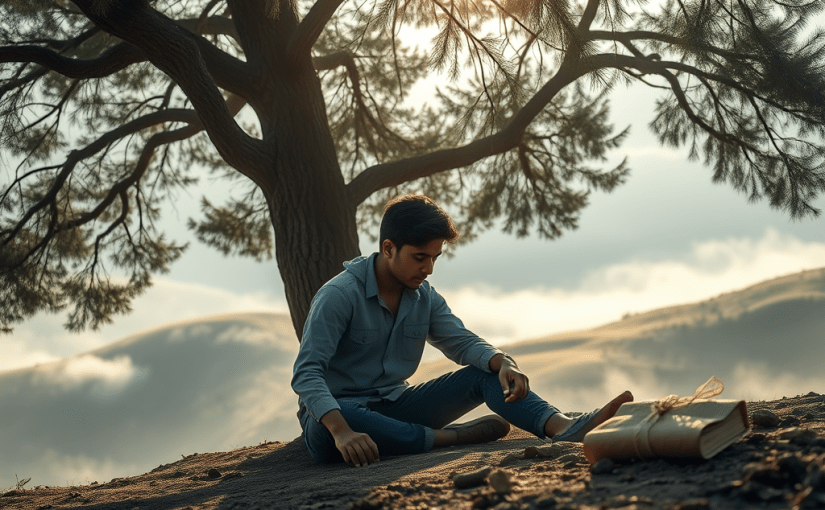
The mist lingered low over the hills that morning, weaving like a soft shawl draped across the slopes. Ishaan sat beneath the deodar tree, his fingers tracing idle patterns into the moist earth, while thoughts of Myra shimmered through his mind like sunlight dancing on still water. Something had changed after the quiz—their quiet camaraderie now hummed with a subtle intensity neither of them fully understood, but both deeply felt.

It was not in grand gestures or spoken promises. It was in the way her name lingered on his lips even when unspoken. In the way his heart beat just a touch faster when he spotted her from across the corridor. Myra had stepped into his life not like a storm, but like a soft poem read under candlelight—each line revealing more than the last.

He recalled clearly the day she first approached him for help. It wasn’t just the request for a book; it was the way she’d asked. Direct, but with a hint of curiosity that seemed to reach beyond the surface. The quiz topic had surprised many—Child Care and Family Planning—a mature subject, loaded with societal perceptions and silent hesitations. But Myra had asked for reading material without the slightest giggle or awkwardness. Ishaan had admired that.

What he didn’t admit to anyone, not even himself at the time, was how heavily he’d hesitated before deciding to lend her the book. It wasn’t a textbook from their syllabus—it was from his uncle’s private collection, a well-thumbed medical volume, factual but unflinching. It spoke candidly of biology, reproduction, contraception—terms that still made classmates squirm in discomfort.

But she had asked. And he could not deny her.

When he had handed it to her the next day, carefully wrapped in newspaper to preserve both dignity and discretion, he noticed how her eyes searched his face—not for approval or attraction, but perhaps for understanding. He offered none. Just a nod, and a simple sentence: “It’s straightforward. But helpful.”

She had taken it, her fingers brushing his, the touch brief but electrifying. For the next two days, Ishaan avoided thinking too deeply about it. Until she returned the book.

There was a hesitation in her movement, the way she held it between both hands like it was something sacred yet fragile. A flicker of embarrassment danced across her face, but her smile outshone it.

“Very helpful,” she had said softly, eyes not quite meeting his. “Thank you… and for being so… open.”

It wasn’t just the gratitude that touched him, but the honesty behind it. That simple exchange had stripped away the superficial awkwardness often surrounding such subjects. Myra hadn’t laughed. She hadn’t mocked. Instead, she had returned it with respect, appreciation, and something unspoken.

From that point on, the air between them shimmered with unsaid things.

The day of the quiz had been one of nervous anticipation. And this time, it wasn’t fate or faculty that paired them together—Myra had asked Ishaan to participate with her. It was a quiet invitation, shared under the tree between classes.

“I want you with me,” she’d said, almost casually, but her eyes revealed the sincerity behind the offer.

There were only two boys among five girls in the medical session, so the competition for a female partner was not intense. In fact, Myra’s friends had taken note of her growing closeness with Ishaan—and not all of them were pleased. A few tried to dissuade her subtly, drawing her attention away, placing gentle wedges between their growing bond. Even Anjali, one of her friends pretended to show love and care for Ishaan, just to draw him away from her and closer to herself by pointing out how much more affection he was showing. Envy has its own ways of dressing in friendly concern.

But Ishaan had sensed the truth. Beneath the smiles, the shared laughter, he could hear the deeper call. Myra wasn’t just choosing him for his academic grasp—she was choosing him for something more instinctual, more spiritual. And that was all he needed to know.

Ishaan’s calm presence and sharp knowledge complemented Myra’s eloquence and poise. Together, they were a force of quiet brilliance.

During the segment on child development, when Myra spoke about the psychological importance of early parental bonding, Ishaan couldn’t help but notice the way a hush fell over the room. Her voice carried both intelligence and care. She wasn’t reciting answers—she was speaking truth.

Later, one of their classmates whispered to Ishaan, “Bro, you looked like you were going to cry when she answered that question. You okay?”

He had laughed it off, but in truth, something had stirred within him. Not just admiration—but reverence.

Now, sitting beneath that deodar, those moments replayed in his mind. The quiz was over. Their names had been announced among the top scorers. But the event had done something more than just bring accolades. It had opened a new page in the quiet book of their shared story.

They still hadn’t spoken alone since. Conversations remained nestled within the comfort of the group—safe, public, undefined. Yet, each shared glance felt like a verse in an ancient poem only they could read.

Sometimes, Ishaan would catch her watching him when she thought he wasn’t looking. And sometimes, their eyes would meet across the classroom, and something ancient would stir—something older than their lives, something deeper than teenage affection.

One afternoon, as they sat with friends discussing the quiz, the topic drifted to the book.

“Ishaan gave me the weirdest book,” Myra said casually, but there was a twinkle in her eyes.

“Weird?” he asked.

“Weirdly… honest.”

A chuckle went around. Someone added, “Bro, bold move giving that to a girl.”

Ishaan shrugged. “She asked.”

Myra smiled. “And I respect that he didn’t sugarcoat knowledge. Truth shouldn’t be hidden in silence.”

That moment etched itself into Ishaan’s soul. In her, he saw the fearlessness of a seeker. Someone who valued truth over comfort. Someone who could laugh at herself but never at the sacred.

That night, Ishaan lay on his cot, eyes open to the ceiling. The quiet murmur of pine needles brushing against his window felt like whispers from a wiser world.

He thought of Myra—not as a girl, not as a crush, but as a reflection. She hadn’t just stepped into his world—she had cracked it open.

He remembered something his grandfather once told him during a village evening under the stars: “When your soul’s longing takes form, she may appear not as a goddess, but as a friend. Or a stranger. Or even a classmate. But you’ll know her—not by her words, but by what her silence awakens in you.”

That’s what Myra had become.

Not merely a girl with curious eyes and a confident smile. But a mirror that reflected his truest yearning—to learn, to grow, to awaken.

Perhaps that was why the subject of family planning, so taboo for many, had not felt inappropriate between them. It had felt… natural. Because they were seekers. Not of romance, not even of companionship—but of understanding. Of truth, no matter where it lay.

And Ishaan began to sense it—Myra was not here by chance.

She was not just a classmate.

She was his catalyst.

She would become his Guru.

And though their journey had barely begun, the first pages of perception had already turned.

Like ancient scriptures hidden in plain sight, waiting to be read.

As he drifted into sleep, he whispered a thought to the night wind:

“She who became my Guru… doesn’t even know it yet.”

The pines rustled softly.

Perhaps they did.

Chapter 3: Her Entrance: Myra

The pines stood still, like ancient witnesses, swaying gently in the cold morning breeze, as if whispering secrets only the mountains knew. Ishaan Sharma, with his satchel slung over one shoulder, walked silently towards the classroom, his shoes crunching faintly over fallen needles and pebbles. The calm rhythm of his new life in the cantonment-flavored school in Himachal Pradesh had begun to settle in like snow on a quiet ledge. It was peaceful—almost too peaceful. But somewhere in his heart, a strange anticipation pulsed. Something—or someone—was about to change everything.

The school, though civilian in name, bore the discipline of the army around it. A blend of civilian institutions nestled in an area that otherwise echoed with the boots of patrolling soldiers. Yet, even amidst such order, Ishaan had started finding his rhythm. The mess food had become more edible, the library more welcoming, and his bunked evenings beneath pine trees had started feeling like silent conversations with the cosmos. After the chaos of a city school he’d briefly tried—loud, impersonal, and utterly devoid of true learning—this haven amidst Himachal’s misted slopes felt like a calling answered.

That morning, he was early. His usual spot on the third bench near the window offered a perfect view of the hills beyond—hills that reminded him of his village, his parents, and the way the wind used to carry the scent of rain before it fell. He took a deep breath, as if drawing strength from that distant memory.

And then, like a quiet thunderclap in the midst of his silent sanctuary, **she walked in**.

Myra.

Her entrance wasn’t grand. There was no gust of wind, no celestial spotlight, no dramatic background music. Just a girl with curious eyes, hair tied in a lazy braid, and a smile that wasn’t trying to impress anyone. She walked into the room as if she belonged there—not in the arrogant way some do, but like a song finding its chorus.

She glanced around the room and, strangely, her eyes landed on Ishaan—as if drawn not by accident, but by some quiet gravity. He looked away instinctively, but the moment lingered, suspended like dew on a leaf just before it falls.

They didn’t speak that day.

The next day, she was back, this time seated two rows behind him. Ishaan, out of habit, listened more than he spoke. But Myra had a different rhythm altogether. During the short breaks between lectures, she would hum to herself or scribble in a notebook filled with doodles and notes. There was something oddly comforting in her presence, like the way certain dreams stay with you long after you’ve woken up.

Then came the announcement.

A regional quiz competition. The topic: Child Care and Family Planning.

That afternoon, Myra approached Ishaan as the class was dispersing.

“Hey… Ishaan, right?”

He turned. “Yes?”

“Would you have any good material to prepare for the quiz? I mean, I don’t want to go in blind.”

He paused, then nodded slowly. “Actually… I have a book. It’s from my uncle’s collection—he’s a medical practitioner. It covers family planning and child care quite thoroughly. Some diagrams too. I can bring it tomorrow.”

Her face lit up. “That would be perfect! Thanks!”

He gave it to her the next day, neatly wrapped in an old newspaper. Myra took it with a quiet smile, her fingers brushing against his. Something passed between them—silent, unformed.

The book was slightly clinical, rich with factual knowledge, diagrams, and medical insights. Ishaan had hesitated for a moment before deciding to hand it over. But since Myra had asked for it herself, a part of him felt unburdened—free from the guilt of handing a girl something so… straightforward. Perhaps even too straightforward.

She returned the book two or three days later. There was a lightness in her step, and yet, a shade of bashfulness touched her cheeks. She looked away while handing it back, but a faint happiness shimmered in her eyes.

“Very helpful,” she mumbled. “Thank you… and for being so… open.”

Ishaan simply nodded, heart quietly racing. A strange comfort had grown between them—born not of sweet nothings but of shared learning and silent honesty.

—

On the day of the quiz, rain clouds loomed like curious spectators. As they stood outside the assembly hall waiting for their turn, Myra turned to him and whispered, “Nervous?”

He shook his head. “No. With you, I’m calm.”

She laughed gently. “Good. Because I’m a nervous wreck. If I mess up, just smile at the judges. You have that mountain-boy innocence. It works.”

He smiled. “And if I mess up?”

She thought for a second. “Then I’ll cover up with my city-girl overconfidence. We’re balanced.”

The quiz was intense, yet their preparation showed. Ishaan’s factual clarity blended with Myra’s confident articulation. They handled complex questions on contraception methods, child nutrition, family welfare schemes, and infant care. A few spectator students later commented that Ishaan seemed emotionally stirred when Myra spoke—as if her voice awakened something deeper in him.

After that day, the invisible current between them deepened. They never talked directly and separately—only among classmates—but something had already begun taking root.

In shared glances, in accidental smiles, in the casual way Myra mentioned his name during group discussions, something beautiful stirred. Neither confessed, neither chased.

But the mountain breeze knew. So did the pines.

And perhaps, so did their souls.

—

She had unknowingly become his mirror, his muse, and perhaps even the flicker of something sacred. There was a mystic current beneath their connection, as though their souls had once circled each other in a different lifetime, now reunited in these hills.

And Ishaan, who once spoke only to mountains, had begun to speak with his heart.

What he didn’t know then was that Myra’s presence in his life wasn’t just to offer companionship or inspiration. She had come to awaken something far more profound. She would become the very spark that lit his path—not just through exams or classrooms, but through the winding, sacred journey of the self.

He didn’t know it yet.

But she would become his Guru.

And this—this was just the beginning.

Chapter 2: A School in the Arms of Discipline

The scent of resinous pine hung softly in the air, like the memory of something sacred.

As Ishaan stepped down from the last rickety bus that had brought him up the winding roads from the comfort of home, a silence greeted him—one that wasn’t empty, but full. It was as if the mountains themselves were holding their breath. The sunlight filtered through tall deodars, dappling the gravel path like blessings from the sky. His city-worn shoes crunched over dry needles and hidden pebbles, but even that sound felt respectful here, hushed by nature’s quiet grandeur.

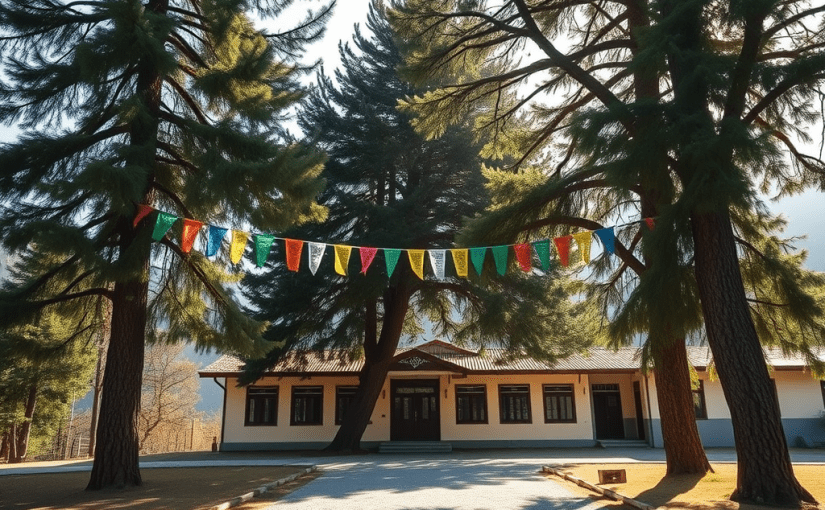
He paused. His gaze wandered to the fluttering prayer flags strung between two oaks—tired from the wind, but still dancing. Somewhere nearby, a bird sang just once, then flew off, its wings slicing the silence like a whisper.

This was not the city. Not even close.

Not the crowded school he had tried earlier in Chandigarh even though for a very brief period—a place full of vehicles, vending machines, and voices louder than thoughts. That city school had promised everything—facilities, computers, science labs, even a swimming pool—but the noise! The endless, soul-numbing hum of engines, gossip, mobile phones, and ambition. There, no one really studied. They competed. No one really listened. They just waited for their turn to speak. Ishaan’s heart, already too soft for that world, had shrunk into itself like a turtle under threat.

This, however, was different. That’s why the mountains, his inborn mates, were calling him back once again—away from the hustle of the city.

Here, amidst the thick woods of Himachal Pradesh, was a modest civilian school nestled within a cantonment area—a strange blend of order and calm. Though the buildings wore no army badge, the air carried discipline, a certain stillness of routines long practiced. The cantonment itself was mostly civilian now, with shops and households run by locals, but the army’s subtle influence hung in the backdrop like a prayer woven into the air—never loud, never pushy, just present.

Even the wind seemed to move with purpose.

He approached the school gate, where two children—perhaps from the senior classes—stood chatting softly, their uniforms neat and their postures straight. One of them looked at Ishaan and gave a small, sincere smile. Not the polished, indifferent half-smile of city kids, but something more human.

“Ishaan Sharma?” a voice called from the porch.

He turned. A teacher, tall and lean, with streaks of silver in his hair and eyes that had clearly seen more than textbooks, stepped down the stairs and offered a hand. “Welcome to Pine Crest School.”

Pine Crest.

Even the name carried dew.

As Ishaan walked beside him toward the main building, he noticed everything—the prayer flags near the flagpole, the scent of turmeric wafting from the kitchen, the rhythmic chirping of crickets from somewhere behind the library. No noise. No rush.

For the first time in many weeks, his heartbeat matched the rhythm of his steps

A Different Kind of Routine

The days that followed were unlike anything he had imagined. Here, students stood up when teachers entered not out of fear, but habit. The morning assembly wasn’t a chore—it was an invocation. Each student spoke something—a quote, a poem, a prayer—not to impress, but to share. And the teachers, though firm, seemed like mountain guides—always watching, but never pushing too hard.

The classrooms were modest—no smartboards, no plush seating—but what they had was attention. Focus. A kind of warmth that even broken desks couldn’t hide. Ishaan would often catch himself staring at the window during lectures, only to realise that the lessons were somehow seeping in even as he drifted. It was as though the very air here whispered equations and metaphors.

One day, during recess, a curious boy named Gagan plopped down next to him with a lunchbox full of pickled lingdu and chapatis.

“You’re the city guy?” he asked, mouth already full.

“I was,” Ishaan smiled. “Now I’m here.”

Gagan squinted like a monk considering a riddle. “You’ll stay. People like you always stay.”

“Why?”

“Because you look like you came searching for something.”

That line stayed with him longer than the taste of wild fern pickle.

The Silent Guru

The school had no formal guru. But in the silence between lectures, during the morning PT runs under foggy skies, or while sitting alone on the sun-warmed steps of the old temple behind the school, Ishaan found teachings more profound than words could ever deliver.

Once, during a class on moral science—a subject often laughed off elsewhere—the teacher, Mr. Dutt, placed a pebble on the table.

“What is this?” he asked.

“A stone,” someone replied.

“A weapon,” said another, giggling.

Mr. Dutt smiled. “Yes. But it is also a reminder. This came from a river nearby. Rolled, shaped, softened over decades. Like you. Life will toss you, polish you, bruise you—but if you allow it, it’ll shape you. Into what? That’s your choice.”

Something stirred in Ishaan’s heart.

He had thought transformation was loud, like lightning splitting the sky. But here, it arrived on little feet. Quiet. Patient.

That evening, he wrote in his journal—a habit he had picked up from the school’s curious emphasis on self-reflection:

> “I thought I needed a guru in saffron robes, speaking mantras. But maybe the pine trees are my gurus. Maybe the wind that wakes me up is. Maybe I am.”

Whispers in the Forest

There was a trail behind the hostel—a winding path that led to an abandoned British-era stone bungalow half-swallowed by moss. Rumor had it a saint once lived there. Some said it was haunted. Others said it was blessed. Naturally, the boys were forbidden to go.

Naturally, Ishaan went.

One misty Sunday morning, he followed the deer-trodden trail alone. With each step, the air thickened—not with fear, but with a kind of electric stillness. The kind you feel before a revelation. Or a memory.

The bungalow appeared like a forgotten temple, cradled in vines and secrets. He stepped inside. Dust motes floated like souls in sunlight. There were no ghosts, but in the silence, he heard something deeper.

His own breath.

His own heartbeat.

And then—nothing.

A strange emptiness bloomed inside, and for a fleeting second, he felt his “I” dissolve. No name, no class, no boy from the hills—just an awareness. Expansive. Eternal. Not frightening, but freeing. Like falling into the sky and finding it soft.

Then a bird chirped.

And the moment passed.

But it had happened. He couldn’t un-feel it.

The Awakening

Back at school, things seemed the same—but something inside had changed.

When he looked at classmates, he saw not competition, but stories. When teachers scolded him, he didn’t shrink—he listened. When the school’s peon, old Lalaji, limped across the corridor, Ishaan no longer ignored him. He offered a hand. And a smile.

“Something’s different about you,” Gagan remarked one evening.

“I think I’m just… beginning to notice things.”

Gagan nodded. “That’s how it starts. Before you know it, you start noticing yourself.”

Epilogue to a Beginning

Months passed.

Winter arrived with silence painted in snow. The mountains donned white robes like saints meditating in plain sight. The school felt warmer somehow. Perhaps because Ishaan had stopped looking for warmth outside.

He had come to escape the city. He had stayed because this place—this school wrapped in deodars, shadowed by army boots but sung into silence by birds—had taught him what no classroom ever could:

That discipline was not about rules, but rhythm.

That spirituality didn’t always wear beads—it sometimes wore sweaters and read geography.

And that the first guru… often waits quietly… until the student becomes silent enough to hear.

Introduction to the Series: She Who Became My Guru

Hi friends,

Love, in its deepest essence, is not merely a romantic emotion—it is a portal to transcendence. “She Who Became My Guru” is not just a story of teenage tenderness or cosmic coincidence; it is a soulful narrative of transformation, where divine love (prema) and spiritual awakening walk hand in hand through the corridors of everyday life.

This blog series is based on lived experience, contemplative memory, and mystical insight. It tells the story of an introverted student from a remote village whose life changes forever upon meeting a girl in a disciplined, army-controlled senior secondary school. What begins as a casual friendship for a quiz competition soon ripples into a deep undercurrent of emotional and spiritual evolution.

She was not a teacher. She was not a saint. Yet, her mere presence activated a current within the boy’s being that would slowly rise, oscillate, and eventually explode into a full Kundalini awakening. All without rituals, dogmas, or conscious pursuit—just the raw purity of presence, emotion, and silent grace.

Through dialogues, vivid scenes, mystical moments, and subtle humor, each chapter brings to life the boy’s inner journey. From the shy exchanges in a schoolroom to the surreal experiences on the Moon (yes, truly!), this story is both grounded in Indian mysticism and painted with the colors of futuristic imagination. Tantra, Samadhi, Puranic echoes, modern education, arranged marriage, sexual energy, and cosmic vision—all unfold as living characters in this spiritual adventure.

This is not just a novel. It is a window into what modern love can truly become when blessed with awareness. It is also a gentle challenge to outdated spiritual orthodoxy, proving that even the silent longing of a village boy can unlock the gates to Savikalpa Samadhi.

Why Read This Series?

  • To explore the mysteries of Kundalini and self-realization in a relatable, story-driven format.
  • To discover how spiritual experiences unfold in the most unexpected moments of modern life.
  • To reflect on the roles of feminine presence, ancestral wisdom, and inner control on the path of awakening.
  • To immerse yourself in a story that is simple yet profound, poetic yet real.

Each chapter is written in easy-to-understand language, deeply emotional, and filled with thought-provoking reflections—all embedded within a suspenseful, engaging narrative. The characters may be fictional in name, but their souls are rooted in real experiences—mine, and perhaps yours too.

So, dear reader, walk with me. One chapter at a time.

Let this journey begin.

Chapter 1: The Boy from the Quiet Hills

In the cradle of the lower Himalayas, where clouds brushed treetops like old friends and time slowed to the rhythm of rustling pine needles, there lived a boy named Ishaan. His village—silent, scattered, and serene—seemed etched more in spirit than in stone. It was a place where the morning mist carried the dreams of its people, and the twilight melted into tales told by flickering hearths.

Ishaan was a child of that hush. To the world, he was quiet—almost invisible—wandering through school corridors with the stillness of snowfall. Teachers marked his presence; classmates overlooked it. Yet, beneath that silence breathed a spirit wide awake.

At home, Ishaan transformed. He spoke with candor and a flicker in his eyes, revealing the poetry of a mind that saw beyond what was seen. His mother often said that his silences weren’t empty—they were full, like the sky before rain. To his siblings, he was a storyteller, a mimic, a thinker who asked why the stars trembled and where dreams went after waking. But in public, words betrayed him. They halted on his tongue, unsure, unready, often unspoken.

He had just passed his matric exams from the modest village school—a single-story building shaded by deodars and discipline. His marks, quietly earned and quietly celebrated, opened a new door. His father, a stern yet sensitive man of the soil, decided it was time Ishaan stepped out of the cradle. A senior secondary school awaited in the town across two rivers and one dusty highway—a place that promised better education and, perhaps unknowingly, solitude of a different kind.

As they packed his modest belongings—a steel trunk, a water flask, a photo of Lord Shiva, and the tight hugs of a home—something shifted. Ishaan was leaving not just geography behind, but the language of comfort and known patterns. His village was more than a place; it was a rhythm he had memorized. Now, it would become memory.

The morning of his departure, the hills stood still, as if listening. His mother’s silence was heavier than her tears. His younger brother clung to his kurta. His father said little—just a firm nod, a pat on the back, and a gaze that meant everything. Ishaan sat on the rickety bus, watching the pines retreat like waving elders.

That bus ride was the first chapter of an inward journey—one that wouldn’t just carry him to a school, but toward a self still forming, still hiding. He felt a strange loss—not of people or places—but of something nameless, a quiet certainty that used to live within him. The fields grew flatter, the air warmer, and the silence inside him louder.

There’s a peculiar loneliness in growing. Not the loneliness of absence, but of shedding. As the bus wound down the mountains, Ishaan felt he was not simply going somewhere—he was being unmade, so he could be made again.

That was the first lesson the hills taught him:
You don’t grow by adding; you grow by leaving.

And so began his life beyond the quiet hills. He didn’t yet know that the roads he took would soon bend into strange meetings, that the stillness in him would find an echo in someone unexpected—a presence that would awaken, guide, and undo him in ways no school ever could.

But that is for another time. For now, Ishaan sat in silence, a boy uprooted, gazing at a world he didn’t yet belong to, unaware that he was already on the path—not just to knowledge, but to a silent revolution within.

Chapter 30: The Ultimate Realization – The Universe Within

Hi friends,

I’m thrilled to share with you the final and concluding chapter of my series—now compiled and released as a brand-new book titled “Journey Beyond Earth: A Veterinarian’s Life on the Moon.”

This book has been a labor of love, imagination, and curiosity, blending the science of veterinary care with the wonder of lunar exploration. Through the eyes of a dedicated veterinarian stationed on the moon, the narrative takes you beyond the boundaries of Earth—into a world where healing, survival, and emotional resilience are just as vital in space as they are here at home.

In this concluding chapter, I’ve wrapped up the experiences, emotions, and lessons of life beyond Earth. It’s more than just a story—it’s a reflection on adaptation, empathy, and what it truly means to care for life, no matter the planet.

If you’ve followed this journey from the start, thank you for being part of it. And if you’re new here, you’re warmly invited to explore this imaginative tale from the beginning. The full book is now available, and you’ll find the official introduction at the end of this post to give you a feel for what lies ahead.

Your support, comments, and shares mean the universe to me.

Stay curious, and keep reaching for the stars!

The Ultimate Realization – The Universe Within

The vast, silent abyss stretched infinitely around them as the ship drifted through the cosmic void. The crew lay in their cryogenic pods, their bodies suspended between life and oblivion. Yet, even in this profound stillness, something stirred within Aryan Verma’s consciousness. It was not a dream, nor was it mere thought—it was awareness itself, floating free of form, untethered from the body yet deeply present.

As time lost meaning, an understanding dawned upon him: this was not death, nor was it the ultimate yogic samadhi. Cryogenic suspension was a state of subconscious dormancy, an artificial sleep that neither liberated the mind completely nor bound it to earthly chaos. It was like the twilight between waking and deep sleep—a space where the soul rested but did not dissolve.

“Had it been the final state,” his thoughts echoed in the infinite blackness, “then why would there still be a journey ahead?”

When he finally emerged from his frozen slumber, the first thing Aryan felt was an overwhelming sense of vastness—not of outer space, but within himself. His body awakened slowly, but his mind had already traversed distances that no spacecraft ever could. As he adjusted to the dim glow of the ship’s control panel, he saw Meera, Avni, and Ansh stirring in their pods.

Meera’s voice was the first to break the silence. “That felt like…dying. But not really.”

Aryan looked at her, his eyes carrying an inexplicable serenity. “Yes, stepping into cryostasis was like willfully surrendering to the unknown, much like the sages of old—Rishi Dadhichi, who gave up his bones for the gods, or King Shibi, who sacrificed his own flesh. It was a death of the known self, but not the end.”

Ansh, still groggy, yawned and stretched. “So…we’re still alive. But where are we now?”

Aryan turned to the ship’s navigation console. “Approaching the exoplanet,” he murmured, eyes scanning the displays. “But I feel as though I have already traveled further than any ship could take me.”

As the planet loomed ahead, its atmosphere shimmering like a mirage, Aryan’s thoughts drifted inward. Was this truly the final destination? Or was it only another mirage in the endless desert of existence?

Man had always sought new lands, new worlds, believing that space was his ultimate frontier. But space was not outside—it was within. The reason humans yearned for it was simple: the soul itself was space. It was infinite, boundless, and ever-expanding. To seek space outside was, in truth, an attempt to reunite with one’s own essence.

“Do you realize something?” Aryan said, turning toward his family, his voice carrying a quiet revelation. “Everywhere we have traveled, from Earth to the Moon, from the Moon to this distant world—what were we truly searching for? Space? We already have it within us.”

Meera nodded slowly, understanding dawning in her eyes. “Yet, where there is pure space, the body cannot survive. And where there are the resources for life, space feels distant because of the chaos of existence. It’s a paradox.”

“Exactly,” Aryan agreed. “But if we put in the right effort, we can create a space within ourselves that is untouched by chaos—a stillness that remains, no matter where we are. That is the true journey. Not outward, but inward.”

Avni, always the most skeptical, smirked. “So are you saying all of this was unnecessary? That we could have just stayed on Earth and meditated instead?”

Aryan laughed. “In a way, yes. But experience is the best teacher. Without this journey, would we have truly understood? Sometimes, one must travel outward to realize that the destination was within all along.”

The ship descended into the exoplanet’s atmosphere, golden clouds swirling beneath them. But even as they prepared to set foot on a new world, Aryan knew the greatest journey had already been taken.

Everything, everywhere, was only space. The illusion of matter was but a fleeting ripple in the ocean of the infinite. And the ultimate realization? That the universe they had sought was within them all along.

As the ship touched down, Aryan closed his eyes for a moment. Not to rest, but to witness the cosmos unfolding within.

A thought lingered in his mind—where there is only space, survival is impossible; where there is life, space is hidden behind the veil of activity. But those who master the balance between both worlds attain true freedom.

The journey had ended.

And yet, it had only just begun.

Illustrator’s Note

As someone who has visually walked alongside the themes of this book, I couldn’t help but reflect on the paradox of renunciation. People who mock or resist it often don’t do so out of conscious defiance. Rather, they seem driven by a subconscious belief: that one must first accomplish something tangible—perhaps even awaken the Kundalini and attain self-realization—before taking the next step of renunciation. Otherwise, it feels hollow, like a shortcut taken too soon. In a way, they expect you to prove yourself in the physical world before choosing to transcend it.

Ironically, it’s often during that very pursuit—while striving and struggling in the material world—that energetic awakening begins to unfold on its own. Yet, most people can’t recognize a purely mental or inner awakening unless it’s accompanied by visible, physical achievement. Physical success is what the world readily acknowledges. Only a rare few see deeper—valuing an awakening that’s subtly blended with outer accomplishment more than mere worldly success alone. That’s where many misconceptions arise: we’re wired to believe only what we can see, touch, and measure.

As I illustrated these concepts, I found myself contemplating this quiet mystery—the way the spiritual and the worldly intertwine, often when we least expect it.

Book introduction

Life has a way of turning ordinary journeys into extraordinary adventures. Our family’s story is woven with countless road trips—long drives between home and work, where the car became more than just a vehicle; it was a space of bonding, laughter, and shared dreams. As our children grew, so did our conversations, shaped by the endless roads stretching ahead of us.

One day, during one such journey, a thought struck me—”Why not see everything as connected to space?” It was a simple idea, yet it sparked a wave of imagination in our travels, turning even the most routine landscapes into cosmic wonders. The sheer joy and satisfaction we felt in these discussions made the universe seem closer than ever. I think it was the open mind of the child journeying with us that inspired me to think beyond the ordinary and imagine all this.

And then, the idea of this book-cum-novel was born. It wasn’t something I planned or struggled with—it simply flowed, as if it had always been waiting to be written. This short novel is a unique combination of science fiction and autobiographical reality. Just like the dual nature of matter—both wave and particle—this story, too, holds two truths at once. It is as real as it is fictional. What one perceives, it becomes. It dances between fact and imagination, shaped by the reader’s own lens.

Interestingly, I had always written under a pen name, choosing to keep my identity undisclosed for various reasons. My son, though, was never really a fan. He’d tease me all the time, saying stuff like, “Papa, your pen name is totally lame!” All I could do was laugh and shake my head. So, for the first time, I made a different choice—I wrote this book in his name instead of mine. It felt like the perfect tribute to the youngest member of our family, who was just a little child—still in nursery and kindergarten—when we first stepped beyond the comfort of home and into a world of endless possibilities.

This book is more than just a story; it’s a reflection of our journey, a blend of love, curiosity, science, and dreams—and the belief that no destination is too far—not even the moon.

🚀 Just Launched!
My new eBook is now available worldwide on Amazon Kindle!
No matter where you are, you can grab your copy using this universal link:
👉 https://www.amazon.com/dp/B0F3PYFJ6Z

Or

https://mybook.to/uY0kt

📖 Dive in, enjoy the journey, and don’t forget to leave a review if you like it.
Your support means the world! 🌍✨

Chapter 29- The Last Message to Earth

Dr. Aryan Verma’s consciousness flickered like a distant flame, caught between the abyss of time and the pull of an unseen future. The deep silence of cryogenic sleep had no dreams, no sensations—only an eternal pause, a breath held by the universe itself. But something stirred in the depths of his being, a whisper that was neither memory nor vision, but something beyond.

He was weightless, yet he felt motion. A slow, gentle pull, like being carried by an invisible river. And then—a sudden awareness. Not of his body, but of his mind, awakening like the first rays of dawn breaking over an untouched world.

A soft chime echoed through his pod. Systems were engaging. Cryogenic stasis was ending.

His eyelids felt heavy, but he forced them open, blinking against the dim light of the spacecraft’s interior. The cold sensation faded as warmth coursed through his limbs, his body reanimated from its deep slumber. He inhaled sharply, a sudden rush of air filling his lungs. The process was seamless, yet unsettling—like waking from death itself.

One by one, the pods around him began to hum with life. Meera, Avni, and Ansh emerged slowly, their eyes fluttering open, confusion and wonder battling in their gazes.

“Dad?” Avni’s voice was hoarse. “We made it?”

Aryan swallowed, his throat dry. “We’re awake.”

Meera sat up, pressing her fingers against her temple. “How long…?”

A holographic interface flickered before them. The system’s voice, smooth and artificial, provided the answer: ‘Time elapsed: 27 years, 4 months, 13 days.’

A silence thicker than space itself settled among them.

Ansh was the first to speak, his voice barely above a whisper. “Twenty-seven years?”

Avni gasped. “That means… everyone we knew on Earth… they’ve aged. Some might not even be alive.”

The weight of time bore down on them. The world they had left behind had moved on without them, reshaped by years they had never lived.

Meera exhaled sharply, composing herself. “We knew this would happen. We prepared for it.”

“Yes,” Aryan said, though the words felt hollow. The mind could accept, but the heart resisted.

A sudden beep interrupted his thoughts. The interface projected a flashing message—one marked with a priority code from the Lunar Space Station. A relic from the past, waiting for them in the present.

“An old transmission?” Aryan muttered, accessing the file.

The screen flickered, and a familiar face emerged—a much older Dr. Raman, the director of the Lunar Colony. His hair had grayed, his eyes lined with time, but his gaze held the same intensity Aryan remembered.

“Dr. Verma,” Raman’s voice was calm, yet heavy with emotion. “If you are receiving this, then you have awoken. I do not know what awaits you, but I trust you have reached the edge of a new world.” He paused, his expression darkening. “Much has changed since you left.”

Aryan’s heart pounded. Something was wrong.

“The Earth…” Raman hesitated, as if struggling to find the right words. “It is not the world you remember.”

A chill ran through Aryan’s spine.

“In the decades after your departure, the planet faced trials beyond our worst fears. Climate shifts accelerated. Nations fought over dwindling resources. Technology advanced, but at a cost. The balance was lost. And now… the Earth you left behind is—”

The message cut off abruptly. Static filled the screen.

“Wait, what?” Avni leaned forward, panic flashing in her eyes. “That can’t be it!”

Aryan frantically scrolled through the data. The transmission had been interrupted. Whether by technical failure or deliberate action, they would never know.

Ansh’s voice wavered. “Is Earth… still there?”

A heavy silence stretched between them.

Meera closed her eyes, inhaling deeply. “Whatever happened, we cannot change it now.”

Aryan ran a hand through his hair, his mind racing. The Earth they had once known was now a mystery. Perhaps lost. Perhaps changed beyond recognition. But one thing was certain—if they had ever considered turning back, that door was now closed.

Avni looked at her father, eyes wide with a mixture of fear and determination. “What do we do now?”

Aryan met her gaze, steadying himself. “We move forward.”

As they prepared to leave behind their past forever, Aryan reflected on the nature of cryogenic sleep. It was not an experience of space, nor could it be compared to the ultimate yogic samadhi of mindlessness. If it were, there would be no urgency to race towards the unseen future. Instead, it was a suspension—a state of the subconscious mind lingering between existence and absence, neither here nor there. True stillness, as the great sages had taught, was not merely the absence of movement but the cessation of all longing, all seeking. And yet, here they were, still searching, still yearning for a new home.

And so, with the weight of the unknown pressing upon them, they turned their eyes toward the distant exoplanet—their new home. Whatever awaited them there, it was no longer just an exploration. It was a destiny they had no choice but to embrace.

The past was behind them. The future was uncharted. And the last message from Earth remained a whisper lost in the void, an unanswered question lingering in the vastness of space.

Chapter 28- The Final Journey to a New Home

Dr. Aryan Verma took a deep breath, his fingers tightening around the edge of his desk as he stared at the departure schedule glowing on the large screen before him. The moment had arrived—the final steps of their lunar existence before embarking on a journey unlike any other in human history. A distant exoplanet, carefully chosen for its habitability, was about to become their new home.

The air in their lunar habitat was thick with anticipation. Meera, his wife, paced slowly, her arms folded across her chest, lost in thought. Avni sat on the couch, her brows furrowed as she tapped absentmindedly on her tablet. Ansh, on the other hand, bounced excitedly on the balls of his feet, utterly fascinated by the idea of traveling beyond the Moon.

“You’re still sure about this, aren’t you?” Meera finally broke the silence, her voice softer than usual.

Aryan turned toward her, catching the unspoken emotions in her eyes—excitement, nervousness, a flicker of doubt.

He walked over, placing his hands gently on her shoulders. “We’ve made it this far, Meera. There’s no turning back now. But if you’re having second thoughts—”

She shook her head. “No… it’s just… leaving the Moon, our first step beyond Earth, everything we’ve ever known. It feels like a dream. Or maybe a dream within a dream.”

Avni looked up. “You mean like how the yogis say reality is just layers of perception?”

Aryan smiled. His daughter had a way of bringing philosophy into even the most scientific discussions. “Exactly,” he said. “And perhaps, we’re just peeling away another layer of reality as we step into the unknown.”

The room fell into a contemplative silence, broken only by Ansh’s enthusiastic interjection. “But we’ll still have Wi-Fi, right?”

A burst of laughter rippled through the family, dispelling the tension like sunlight breaking through a storm.

The final preparations had been meticulous. Their belongings had been reduced to the essentials—clothing designed for the new planet’s conditions, medical supplies, Aryan’s veterinary equipment, and a few personal mementos. The children had carefully selected items that reminded them of their lunar home: Avni had packed her sketchbook, while Ansh had insisted on bringing his stuffed dinosaur, Rexy, despite the teasing from his sister.

The departure schedule was precise. Aboard the Stellar Voyager, they would leave the Moon’s surface, dock with the interstellar ark stationed nearby, and then embark on the long journey to the exoplanet. The voyage itself would span years in cryogenic sleep, a reality both thrilling and unnerving.

As they stood at the embarkation bay, a sea of emotions swirled in Aryan’s chest. This was not just another relocation—it was a leap into the great cosmic unknown. His mind drifted to the spiritual texts he had read, the ancient sages who spoke of leaving behind the transient for the eternal. Was this journey a mere physical transition, or was it symbolic of something far greater?

A low hum filled the air as the ark’s engines powered up. The final boarding call echoed through the lunar station. With one last glance at the silent, grey expanse through the massive observation windows, Aryan took Meera’s hand. She squeezed back, her silent affirmation giving him strength.

As the family settled into their stasis pods aboard the ark, a thought struck Aryan with profound clarity. To step into cryogenic sleep was to willfully embrace a kind of death—a concept unheard of except among the greatest of sages. He recalled the tale of Rishi Dadhichi, who surrendered his bones for the benefit of the gods, and the ancient king (Raja Shibi) who gave his own flesh to compensate for the loss of meat. Here they were, surrendering their waking existence, trusting that they would rise again in a new world. This was not just science; it was a sacrifice, a test of faith in the unseen future.

Avni gazed at the starry void outside. “It’s beautiful,” she whispered, watching the Moon shrink in the distance.

Ansh leaned over. “I still think the new planet will be cooler.”

Aryan chuckled. “I hope you’ll say the same when we wake up there.”

The transition into cryogenic sleep was both fascinating and unnerving. Aryan felt his consciousness slip away, his last waking thoughts filled with wonder and anticipation. Would they wake up to a paradise or a challenge beyond comprehension?

The journey had begun, and the universe awaited.

Chapter 26- The Search for the Next Destination 

Part 6: A New Beginning and the Universal Truth

The Search for the Next Destination

Dr. Aryan Verma sat in the main research hub of the Moonbase, his fingers gliding across the holographic console. The decision had been made—humanity’s journey was far from over. Now came the next challenge: finding the right destination.

Meera entered the room, her eyes scanning the array of star maps and planetary data floating in midair. “So, where do we begin?”

Aryan smiled, his excitement barely contained. “We’ve been looking outward for years, Meera. But now, we truly have to think beyond the Moon, beyond Mars. Somewhere sustainable, somewhere we can call home for generations.”

Ansh, who had been silently observing from the corner, suddenly perked up. “Dad, have you checked Kepler-442b? It’s been on the list of potentially habitable planets for years! Its star is stable, it’s within the habitable zone, and—” He paused, flipping through data projections. “Look at this! It has a 97% probability of Earth-like conditions!”

Avni leaned over his shoulder, impressed. “So, we’re talking oceans, an atmosphere, and maybe even plant life?”

“That’s the hope,” Aryan confirmed. “But there’s more to consider. Distance. Resources. Feasibility of travel. The farther we go, the harder it gets.”

Meera folded her arms, ever the practical one. “And what about the unknown variables? We might be walking into an ecosystem that isn’t as friendly as we assume. What if we’re not alone there?”

A hush settled over them. The thought had always lingered in the background. Space was vast, and they had no illusions of being the only intelligent species in the cosmos.

Ansh, still glued to his screen, broke the silence. “We could send a probe first. AI scouts can map the planet, analyze its atmosphere, and even detect signs of advanced life.”

Aryan nodded. “That’s a logical step. But we must act fast. The Interstellar Expansion Initiative has other teams researching destinations, and we can’t afford to lag.”

Avni smirked. “So, it’s a space race? Good. I always wanted to be part of one.”

The next few weeks were a whirlwind of calculations, projections, and simulations. Aryan worked alongside some of the best minds on the Moonbase, analyzing planetary candidates one by one. Kepler-442b remained a strong contender, but there were other possibilities—Proxima Centauri b, a planet orbiting the closest known exoplanetary system, and Luyten b, which had conditions remarkably similar to Earth’s prehistoric climate.

During one of their late-night discussions, Meera noticed Aryan staring at the screen with an almost trance-like focus. She placed a warm hand on his shoulder. “You look like a man searching for something more than just a new planet.”

He exhaled deeply. “Maybe I am. You ever get the feeling that we’re being guided? That we’re not just choosing this path, but it’s choosing us?”

Meera considered his words. “You’ve always been drawn to the unknown, Aryan. But I think it’s more than that. You don’t just want to find a new home. You want to find meaning.”

He chuckled softly. “And maybe that meaning isn’t in a place, but in the journey itself.”

The first probe was launched toward Kepler-442b, carrying an array of instruments designed to analyze every aspect of the distant world. The transmission delay meant it would take time to receive detailed reports, but the first images sent back left them in awe.

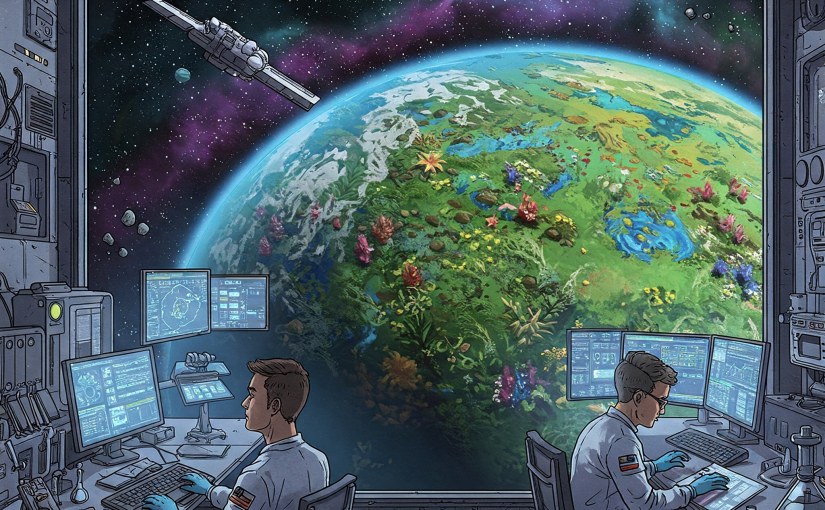
A breathtaking landscape unfolded before them—a vast expanse of cerulean oceans, emerald forests stretching beyond the horizon, and towering mountain peaks glistening under an alien sun.

Ansh gasped. “It looks like Earth before civilization! This is incredible!”

Avni’s eyes gleamed. “No dust storms, no barren wastelands. Just pure, untouched nature.”

Meera, despite her initial hesitation, couldn’t help but smile. “It’s beautiful.”

Aryan, however, remained silent, staring intently at the data stream. The atmosphere was stable, oxygen levels were compatible, and there were clear signs of an active biosphere. But something felt… off. A presence. An unshakable sense that they weren’t just discovering this planet—it was watching them back.

“What is it?” Meera asked, noticing his change in expression.

“I don’t know,” he admitted. “But I feel like… we just stepped into something far bigger than we understand.”

As the final reports trickled in, a decision loomed. Kepler-442b was viable. It was everything they had hoped for and more. But something inside Aryan whispered caution. He had spent years learning to trust his instincts, and now they urged him to dig deeper.

One evening, as he wandered the lunar surface alone, the stillness of space pressing in around him, a realization struck him. The universe was not just a collection of rocks and gases—it was alive. And every step they took deeper into it was a step into a greater, unfolding mystery.

The question was no longer whether they could go. The question was whether they were truly ready for what they might find.

As Aryan turned back toward the base, he knew that the next chapter of humanity’s journey was about to begin. But this time, it was not just about survival or exploration.

It was about awakening.

Chapter 27- Convincing the Family & Making Preparations

Dr. Aryan Verma stood at the observation deck of the lunar colony, gazing at the vast, endless stretch of stars beyond the Moon’s horizon. The search for the next destination had opened doors he had never thought possible. The mysteries of the cosmos whispered through the silence, inviting him to step further into the unknown. But before he could embark on this new journey, there was one significant challenge—convincing his extended family back on Earth.

His desire for awakening was pushing him further and further away from earthly entanglements. The energy being dissipated in the chaos of worldly affairs could instead be channeled into dedicated efforts for spiritual realization. This was not unique to him—when one’s worldly pursuits ripen, a natural drift towards solitude begins, often disguised under various excuses. And when a deep spiritual longing is interwoven with these efforts, the pull becomes even stronger. Now, standing at the threshold of a cosmic journey, Aryan felt the inevitable call of both destiny and awakening.

His nuclear family—Meera, Avni, and Ansh—had already embraced the idea with excitement, eager to explore what lay beyond. But now, it was time to inform their loved ones on Earth, to seek their blessings, and to address their inevitable concerns.

He connected to the Earth communication link, and soon, the holographic images of his parents, Meera’s parents, and their closest relatives materialized in front of him. The warm familiarity of their faces made the moment even more poignant.

“Aryan, what’s this urgent family meeting about?” his father asked, his voice tinged with curiosity.

Aryan took a deep breath. “We’re leaving the Moon. We’re traveling further into space—to explore an exoplanet that might hold signs of life.”

Gasps echoed through the connection. His mother’s face turned pale. “Beta, you already left Earth, and now you want to go even further?”

Meera’s mother shook her head in disbelief. “Meera, do you really think this is safe?”

Meera reached for Aryan’s hand, steady and firm. “Yes, Maa. We have thought this through. We are prepared.”

Aryan’s father sighed. “But why? Haven’t you achieved enough? Isn’t the Moon far enough?”

Aryan smiled gently. “Baba, every great journey in history has always had people asking, ‘Why go further?’ But if no one had dared, humanity would still be confined to a single continent, let alone a single planet.”

His mother wiped a tear. “But what if something happens to you? What if you never return?”

Ansh, who had been listening silently, spoke up. “Dadi, we’re not running away. We’re moving forward, discovering new things, making history. And we’ll always be connected.”

Avni added, “And just imagine… one day, you might visit us on a whole new world!”

The elders exchanged uncertain glances. Aryan’s father finally sighed. “I won’t pretend to be happy about this. But I trust you. If this is what you must do, then go with our blessings.”

Meera’s mother, still hesitant, nodded. “Just promise us you’ll stay safe.”

Aryan smiled. “We promise.”

The Challenges for Avni and Ansh

After the initial shock settled, Aryan’s father raised another concern. “Aryan, what about the children? Their education, their social life? They’ve already changed schools, curriculums, and friends so many times. They’re like rolling stones, never settling anywhere.”

Aryan nodded, expecting this concern. “Baba, I understand. It hasn’t been easy. But do you realize how much they’ve learned? More than they ever could have back on Earth.”

Meera’s mother sighed. “But stability is important for children. They need roots, traditions, a familiar environment.”

Avni smiled. “Dadi, I used to think that too. But moving and adapting has made me stronger. I’ve learned how to make friends anywhere, how to handle change without fear.”

Ansh grinned. “And I’ve studied things most kids on Earth never even dream about! I’ve seen Earthrise from the Moon, learned how space agriculture works, and even studied planetary geology firsthand.”

Aryan added, “They aren’t just memorizing textbooks; they’re experiencing knowledge. Every new place, every challenge has taught them resilience, curiosity, and adaptability. These are lessons no school can provide.”

Aryan’s father was silent for a moment before he sighed. “I see your point. Still, I just want to be sure they’re happy.”

Meera reached out, touching the screen. “They are, Baba. They’re thriving.”

The Preparations Begin

Once the decision was solidified, preparations began in full force. Aryan and his family were fitted for advanced exo-suits that could adapt to fluctuating temperatures and atmospheric conditions. Their spacecraft, named Vyomnaut, was undergoing final testing. Supplies were being curated—everything from genetic seeds to emergency medical kits.

As they packed, Aryan found himself sitting with Avni and Ansh in the habitat’s observation dome, watching Earth as a distant, glowing orb.

Avni broke the silence. “Do you ever miss it? Earth, I mean.”

Aryan smiled. “Every day. But missing something doesn’t mean regretting leaving it.”

Ansh tilted his head. “Do you think we’ll ever go back?”

Aryan’s gaze softened. “Maybe one day. But for now, forward is the only direction.”

A Farewell to the Moon

As the launch date approached, the lunar colony gathered for a farewell ceremony. Their fellow scientists, researchers, and astronauts wished them luck, some envious, some relieved they weren’t the ones venturing into the deep unknown.

One of Aryan’s closest colleagues, Dr. Wei, pulled him aside. “Are you ready for this, Aryan? Really ready?”

Aryan nodded. “As ready as anyone can be when staring into infinity.”

Wei chuckled. “You always did have a way with words. Just… be careful. The universe is vast, and not everything out there will be welcoming.”

Aryan placed a hand on his friend’s shoulder. “Neither was the Moon at first. But we adapted. That’s what we do.”

The final night before departure, Aryan and Meera sat together, gazing at the stars through their dome window. She leaned against him, her voice barely above a whisper. “Promise me we’ll stay together, no matter what happens.”

He kissed the top of her head. “Always.”

As dawn—artificial as it was—rose over the lunar horizon, they boarded Vyomnaut. The engines hummed, systems activated, and the countdown began.

“Three… Two… One… Liftoff.”

As the lunar surface shrank beneath them and the vast unknown stretched before them, Dr. Aryan Verma knew one thing for certain.

Their journey beyond Earth had only just begun.