The Early Phase: When Bliss Moved with Prana
Every spiritual journey has its own rhythm, and looking back at mine, I can clearly see that different stages unfolded naturally without any conscious planning. One of the most fascinating phases was the period of intense tantric practice. During those days, I frequently experienced a complete fullness in the head accompanied by powerful upward movement of prana. It was strange that there used to be no feeling of pressure or strain in head. Surprisingly, although I received my first glimpse of awakening during this phase, I did not immediately settle into deep breathless meditation or effortless dhyana. For a long time I wondered why this happened.
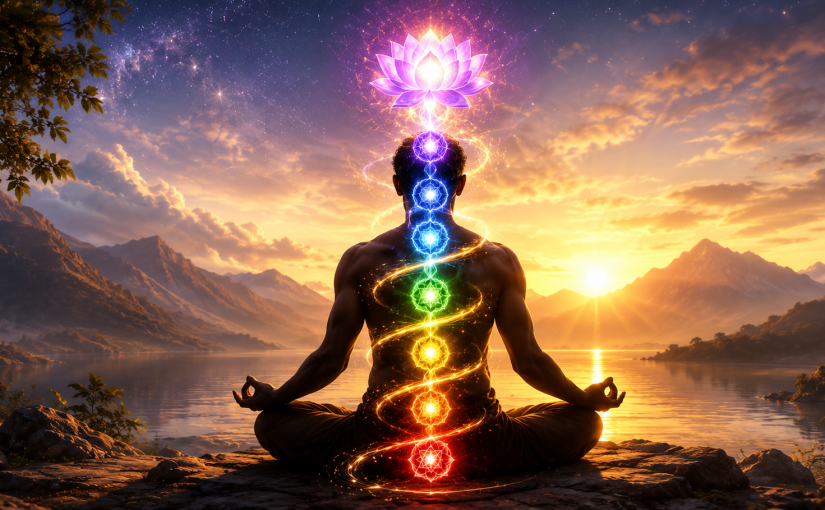
Gradually, an understanding began to emerge. It seemed that I was deeply enjoying the subtle energetic play itself. Prana continuously revolved in a loop between the muladhara and the sahasrara chakra. The movement never remained static. Instead, it flowed continuously, producing an extraordinary state of bliss. Although an ordinary observer might compare it with sexual pleasure because its energetic origin appeared to be near the muladhara, the actual experience was far more refined, subtle and spiritual. It was not ordinary sensual enjoyment but a deeply transformed form of bliss. The bliss appeared to originate in the muladhara while being experienced most profoundly in the sahasrara.
Because this circulation of prana remained continuous, the energy never completely settled. The mind remained associated with this subtle movement. Looking back, it appears that this constant motion itself prevented meditation from naturally settling into prolonged breathless absorption. Dynamic bliss and complete stillness were existing together, but the dynamic aspect remained dominant.
How the Meditation Image Changed the Nature of Bliss
Another important transformation gradually became evident. Throughout this period, the bliss became increasingly associated with my meditation image. This association slowly changed the quality of the experience itself. The meditation image was not merely an object of concentration. For me, it represented the nearest approach to pure self-awareness. As the connection between the meditation image and the bliss deepened through continuous practice, the bliss itself became more satisfying, more refined and more persistent.
It no longer appeared dependent solely upon the energetic circulation of prana. Instead, it seemed to mature into a subtler experience. However energetic circulation was responsible to make momentum that used to keep subtle bliss channels open for a day or two and thereafter needing further tantric pranic push. Since the meditation image pointed toward pure awareness, the bliss also felt progressively closer to what I perceived as the bliss of the Self. Whether one describes it as the bliss of self-awareness or simply a bliss associated with increasingly silent consciousness, the practical observation remained the same. The repeated connection made between meditation image and bliss or energy through specific advanced yoga practice transformed the character of the bliss itself.
Many contemplative traditions suggest that repeated association of attention with stillness gradually changes consciousness. Looking back, my own experience appears consistent with this understanding. The bliss became increasingly peaceful rather than merely ecstatic, increasingly satisfying rather than merely intense, and increasingly stable rather than dependent upon energetic excitement.
The Feeling of Invisible Guidance
One feature of this journey remains deeply meaningful to me. During those intense periods of practice, I repeatedly felt as though some invisible presence was inspiring me to continue allowing prana and bliss to revolve. I never consciously forced this process. Rather, it felt as if I was gently encouraged from within to continue until the energetic process naturally reached its highest point.
Eventually this period culminated in what I experienced as an awakening accompanied by a glimpse of self-realization. Whether this invisible inspiration represented divine grace, the inner Guru, the awakening of deeper intuition or simply the wisdom of the unconscious mind cannot be established objectively. Different traditions would explain it differently. What remains undeniable is the subjective experience itself—the strong feeling of being guided through an unfolding process that eventually coincided with a profound awakening glimpse.
Was My First Awakening in the Dream State Incomplete?
Looking back over the entire sequence, another possibility occasionally comes to mind. My very first awakening glimpse occurred during the dream state. Sometimes I wonder whether that experience represented only an initial opening rather than the completion of the entire process.
Perhaps the subsequent months of intense pranic circulation, refined bliss and continuous tantric practice were not separate events but a natural continuation of that original glimpse. It often feels as though the earlier awakening was gradually maturing until it became clearer and more integrated. Of course, this remains only my own interpretation. It is impossible to establish objectively whether the later experiences literally completed the earlier one. Nevertheless, the continuity between the two feels remarkably natural when viewed as one uninterrupted journey.
Why I Continued Tantric Practice Even After Awakening
An interesting aspect of my journey is that awakening itself did not bring my tantric practices to an immediate end. I simply continued because the process itself seemed unfinished. The energetic movement continued naturally, and I felt no reason to abandon it merely because an awakening glimpse had already occurred.
Only later did circumstances begin to change. Physiological difficulties gradually made it harder to continue the same intensity of tantric practice. Around the same period, another change appeared simultaneously. There arose a strong inner urgency to engage more actively with practical worldly responsibilities. It seemed that the same inner energy which had earlier expressed itself primarily through tantric practice gradually redirected itself toward ordinary work and worldly action.
Looking back, this did not feel like a loss of spirituality. Instead, it appeared as though the same energy had simply found another mode of expression. Rather than revolving continuously within the subtle body, it increasingly became available for practical activity, responsibility and service.
The Door to Kevala Kumbhaka Opened
This transition produced another remarkable change. As tantric energetic activity naturally reduced, the continuous turmoil and movement of prana also began to slow. With less energetic circulation occupying the system, a completely different quality of meditation started appearing.
For the first time, effortless breathless meditation, traditionally called kevala kumbhaka, began to establish itself naturally. Nothing was forced. Breathing simply became extraordinarily subtle and, at times, seemed to suspend by itself as meditation settled into profound stillness.
Looking back, it appears that the reduction of continuous pranic movement opened the doorway to this new phase. During the earlier tantric period, movement itself dominated the experience. During the later phase, stillness gradually became the dominant characteristic. Dynamic bliss slowly matured into silent absorption.
Although it cannot be objectively stated that the slowing of pranic movement directly caused kevala kumbhaka, the two repeatedly appeared together in my own experience. The practical relationship became increasingly obvious through repeated observation.
What I Observe Even Today
Even today I continue noticing the same relationship. Whenever worldly responsibilities increase, emotional involvement becomes stronger or pranic movement becomes highly active, effortless kevala kumbhaka becomes comparatively difficult to establish. It is as though the increased movement of energy keeps both mind and prana dynamically engaged, making complete stillness less accessible.
On the other hand, during peaceful days when emotional disturbances are minimal and worldly activity is comparatively lighter, the entire system settles much more easily. Prana naturally becomes quieter, meditation deepens effortlessly and kevala kumbhaka establishes itself without any deliberate attempt.
This repeated observation has become one of the clearest practical lessons of my own spiritual journey. Dynamic prana appears well suited for action, creativity and energetic transformation, whereas quieter prana seems to favour deep meditation, effortless stillness and spontaneous breath suspension. Rather than opposing each other, these two phases appear complementary. One represents movement; the other represents rest. One expresses energy; the other reveals silence. Both have their own place in the unfolding of practice.
A Personal Reflection on the Journey
Looking back over the entire journey, I no longer see these phases as separate events. The intense tantric circulation of prana, the refined bliss centred between muladhara and sahasrara, the gradual association of bliss with the meditation image, the mysterious feeling of inner guidance, the awakening glimpses, the possible continuation of an earlier dream-state awakening, the natural reduction of tantric practice, the redirection of energy toward worldly responsibilities and the effortless emergence of kevala kumbhaka now appear as different chapters of one continuous process.
Each phase seemed necessary for the next. The dynamic movement of prana refined the system. The meditation image transformed the quality of bliss. Worldly life unexpectedly helped reduce excessive energetic movement. That reduction allowed deeper stillness to emerge. Finally, breathless meditation became not something to be achieved but something that arose naturally when conditions became favourable.
This remains only the story of my own experience rather than a universal map for every practitioner. Yet it has taught me that spiritual development need not always proceed in a straight line. Sometimes intense movement prepares one for profound stillness. Sometimes bliss matures into peace. Sometimes the same inner energy that once expressed itself through powerful tantric experiences later expresses itself through ordinary work, quieter meditation and effortless awareness. For me, these have not been contradictory paths but successive expressions of the same unfolding spiritual journey.

