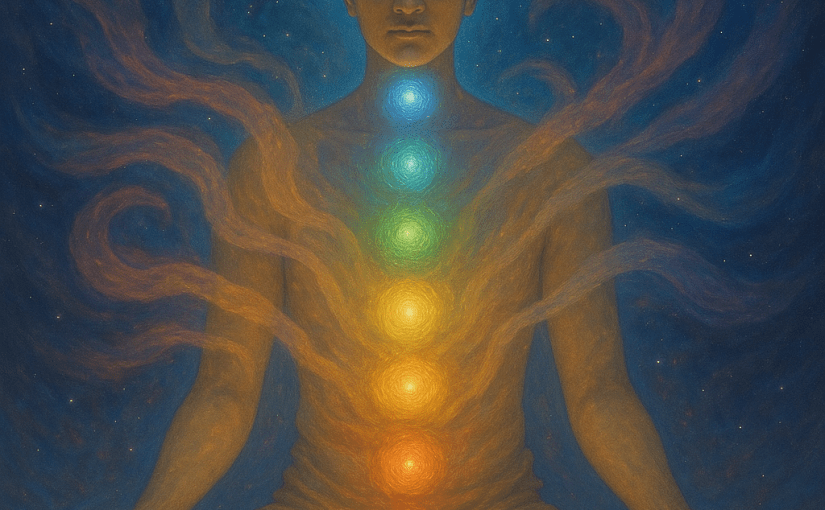
Modern physics and Vedanta both tell us that the world we experience is not exactly the world that exists outside. Quantum physics says things exist in many possible states until interaction selects one. Vedanta says the universe created by Ishvara is one, but the world each person lives in is different. This difference comes from how our own mind and energy process the same situation.
Every moment, our mind goes through three steps. First, the subconscious picks one emotional possibility out of many. A single scene can hold fear, love, disgust, calmness, or joy. Which one we feel depends on our past experiences, tendencies, guna balance, energy flow, and the dominant chakra. This selection happens instantly and quietly. Next, the mind turns that selected possibility into an actual emotion—fear becomes anxiety, anger becomes heat, love becomes warmth, and peace becomes stillness. Finally, our intellect interprets that emotion and forms meaning, stories, and opinions. This is how our personal world is created.
Chakras play a big role in this process. Lower chakras make us collapse experiences into fear, desire, or anger. Middle chakras make us collapse experiences into love, empathy, and understanding. Higher chakras make the collapse lighter, calmer, and more detached. When the energy reaches Ajna or Sahasrara, emotional reactions become very subtle, and the person begins to witness thoughts and feelings without getting pulled into them.
Kundalini movement changes the collapse even more. When energy is low, the collapse is emotional and reactive. When energy rises to the heart and throat, collapse becomes meaningful and refined. When energy reaches the higher centers, collapse becomes quiet and almost neutral. In deep meditation or samadhi, collapse becomes extremely weak or stops completely. There is no emotional or mental coloring—only pure awareness remains.
Quantum physics supports this kind of idea at a physical level. A particle stays in many possible forms until interaction fixes it. But this does not mean we create the entire universe by observing it. Ishvara creates the physical universe. We only create our personal experience of it. Things happen outside, but our inner world forms through emotional and mental collapse inside us.
As we grow spiritually or through meditation, this collapse becomes less noisy and more peaceful. The mind reacts less. Interpretation becomes minimal. Awareness becomes clearer. In the highest state, there is no collapse at all—no emotion, no story, no reaction—only pure consciousness aware of itself.
In simple words:
We do not create the outer universe, but we continuously create the inner universe we live in.
The more balanced our energy and mind become, the more peaceful and clear this inner universe becomes, until finally it dissolves into pure awareness in samadhi.
How Balanced Chakra Energy Stops Emotional Overreaction and Leads Toward Samadhi
In everyday life, we react emotionally because one part of our inner system becomes stronger than the others. If lower chakras become active, we react with fear, anger, or hurt. If middle chakras dominate, we respond with empathy or emotional softness. If upper chakras dominate, we remain calm, clear, and unaffected. But through practices like chakra meditation, pranayama, and other yogic methods, our energy gradually spreads evenly across all chakras. When this balance happens, something very interesting occurs: no single emotional pattern becomes dominant. All emotional possibilities arise together, and because they appear at the same time, they naturally cancel each other out.
When chakra energy becomes balanced, cancellation does not mean we stop feeling emotions. In fact, we feel all emotional responses more clearly, but none of them overpower us. The emotions rise naturally, but because opposite tendencies appear together, they quickly neutralize each other. This creates a healthy inner balance where we remain aware of every emotion without getting trapped in any one of them. Yoga does not make us dull or detached from life; instead, it expands our capacity to experience. We sense fear, love, anger, compassion, clarity, and calmness all at once, but they do not disturb our inner state. This expanded emotional umbrella allows us to enjoy the world more deeply while staying free from entanglement. In this sense, yoga helps us live fully, feel everything, respond intelligently, and yet remain centered and unaffected. This natural neutrality is what gradually leads toward inner peace and eventually toward samadhi.
This means the mind does not fall into one fixed reaction. It doesn’t collapse into only fear, only anger, only love, or only logic. Instead, all these tendencies stay balanced. This creates an inner state where emotional reactions lose their force, and the mind remains steady and neutral. In this balanced condition, awareness becomes spacious and calm because nothing inside pulls the mind strongly in any direction. This is why the experience begins to feel like samadhi—quiet, open, and free from emotional disturbance.
For example, if someone insults us, an unbalanced system reacts from whichever chakra is strongest at that moment. Lower chakras produce hurt or anger. Middle chakras produce understanding or softness. Upper chakras produce calm detachment. But if all chakras are balanced, the lower and middle reactions rise together and neutralize each other. What remains is the clarity and calmness of the higher centers. The result is that the person does not feel shaken, and the mind stays peaceful.
In simple terms, balanced chakra energy prevents the mind from collapsing into one emotional pattern, and when no single collapse is favored, the mind naturally becomes still. This stillness is the doorway to samadhi. When the mind does not cling to any specific reaction or outcome, inner freedom appears on its own. This is the essence of why balanced energy leads to calmness, clarity, and eventually glimpses of real samadhi.
 Demystifying Kundalini