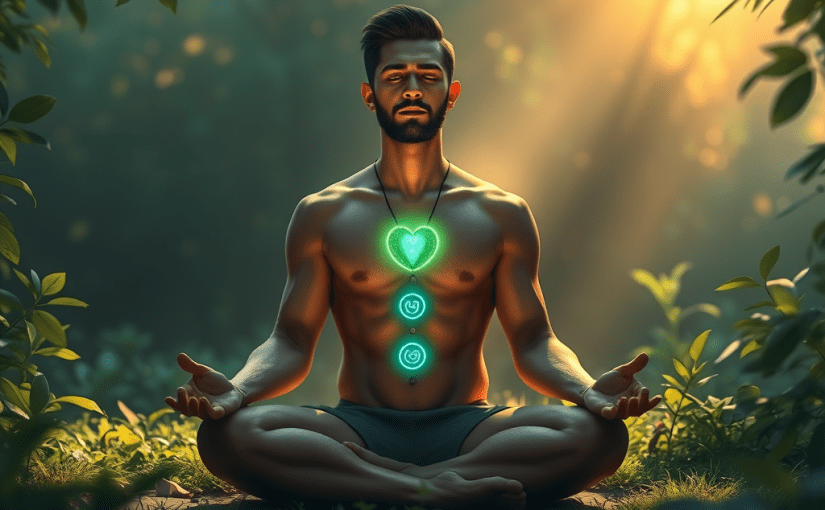
A few days ago, I experienced a strong emotional blow due to social reasons. I had high expectations from highly paid laborers, expecting some great work, but they delivered nothing more than child’s play. I was deeply disturbed. That evening, when I sat for dhyana, I noticed my breathing naturally suspended at my Anahata chakra. Instantly, I felt immense relief, and my heart was healed surprisingly and immediately.
The very next day, I faced a heated debate with a few fellows, which tensed and disturbed me. Being more tired that evening, I skipped my dhyana practice. However, I did receive some relief through sympathetic family interactions. On the following morning, I noticed my breathing naturally settled at my Vishuddhi chakra, and during dhyana, I experienced a smooth breath suspension and healing at the throat. This taught me that worldly conflicts are not necessarily opposing dhyana. In fact, when tactfully handled, they can sometimes favor it rather than hinder it.
This experience led me to reflect on the deeper mechanisms of chakra energy, breath, and meditation. The emotional blow activated my Anahata chakra, which is the center of love, trust, and emotional processing. Breath suspension during dhyana allowed prana, or life energy, to flow precisely where it was needed, releasing tension and producing immediate healing. This shows how meditation can catalyze self-healing by aligning breath and awareness with the chakra that has been activated by specific emotional events.
Even when I skipped dhyana during the heated debate, some relief still came through external emotional resonance, like the support and sympathy of family members. While this relief was partial and slower than meditation, it shows that external support can act as a mild substitute for dhyana in harmonizing chakras.
The shift to Vishuddhi chakra the next morning was directly related to the intellectual and verbal stress from the debate. The throat chakra governs communication, expression, clarity, and mental processing. After tension in Anahata, the energy naturally rose to Vishuddhi, allowing breath suspension there and smooth, instant energetic recalibration through dhyana. This shows that chakras respond to context-specific triggers: the heart for emotional stress, the throat for intellectual or verbal challenges.
One of the key insights from these experiences is that worldly conflicts can actually favor dhyana. When handled tactfully without being drowned in the drama, meditation can utilize activated chakras for healing and alignment. Life stress can thus become a guide, highlighting where energy is stuck or needs refinement, rather than an obstacle.
The general mechanism appears as follows:
- Trigger → Chakra activation → Breath aligns → Awareness directs prana → Healing.
- External stress does not block dhyana; instead, it creates a map of where energy is stuck, which meditation can resolve.
- Each chakra responds to a preferred type of stress:
- Muladhara → survival, security
- Svadhisthana → relationships, pleasure
- Manipura → power, confidence
- Anahata → love, trust, emotional hurts
- Vishuddhi → speech, clarity, mental tension
- Ajna → intuition, decision-making
- Sahasrara → transcendence, cosmic awareness
Through these insights, I realized the intelligent interplay between emotional triggers, energetic responses, and meditation. Dhyana does more than quiet the mind—it serves as a precise tool for emotional and energetic recalibration. Conflicts, when approached with awareness, can become openings for inner work, and each chakra reacts to the stress that naturally pertains to it.
In essence, meditation works in harmony with life’s challenges. Emotional pain or tension doesn’t block growth—it illuminates the path for healing, showing exactly where awareness and prana should be directed. My personal journey through Anahata and Vishuddhi chakras illustrates this beautifully.
For anyone practicing meditation, this experience emphasizes that being tactful in worldly interactions and observing where stress manifests in the body can guide dhyana to the most needed areas. Emotional, intellectual, and verbal challenges can activate corresponding chakras, and dhyana can then harmonize them, turning ordinary life events into precise tools for self-healing and awakening.
 Demystifying Kundalini