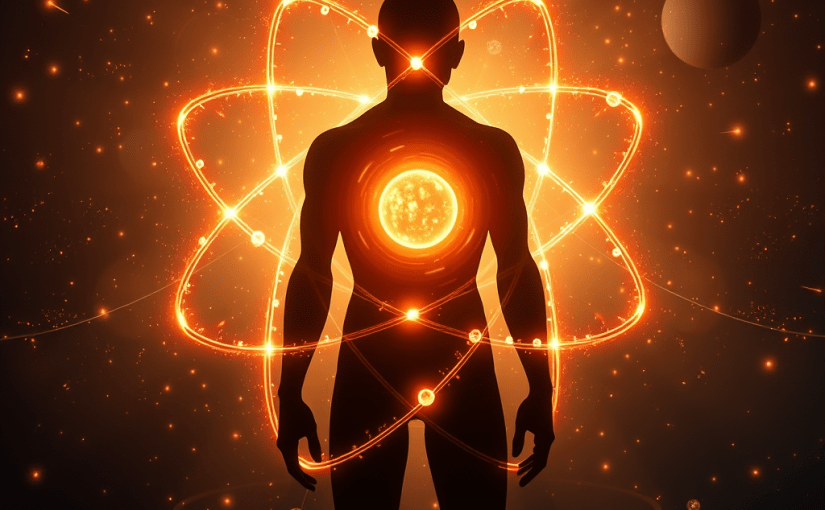
Chapter 10: Death, Memory, and the Holographic Field

Life has a mysterious way of continuing itself. What looks like an end is often only a rearrangement. The tree that falls becomes soil, the flame that dies leaves behind smoke and warmth, and the body that breathes its last turns into earth again. Nothing in existence truly disappears. Matter never dies, atoms never lose their being; they simply change places, alter their bonds, and take on new forms. Death, therefore, is not the destruction of reality but the reshuffling of patterns. The body that is cremated is only a temporary arrangement of atoms and molecules. Fire loosens those arrangements and hands them back to air, earth, and water. The wave collapses from one expression only to rise again in another.

From this understanding, memory itself begins to look different. It no longer seems locked inside the gray folds of the brain alone. There are countless mysterious events where heart transplant recipients reported memories, tastes, or fears belonging to the donors. Science finds it hard to explain how such impressions travel with organs, but the idea of memory being held in fields makes it less strange. It is the electromagnetic field of the heart. The heart creates the strongest field in the body, even more powerful than the brain’s, and it carries patterns that can hold impressions of memory and emotion. When a heart is transplanted, this field may transfer subtle imprints from the donor to the recipient, which explains why some people suddenly feel the donor’s tastes, fears, or memories as their own. Water itself is known to hold patterns, rearranging its structure according to subtle vibrations. If even water, a simple arrangement of hydrogen and oxygen, can keep impressions, then what of the human heart that pulses with electrical rhythm every moment of life? Scientific studies suggest water’s structural “memory” lasts only for seconds to minutes under normal conditions, though some experiments in homeopathy and quantum coherence claim it can persist hours to days if stabilized by external fields or freezing. In simple terms: without preservation, water’s impressions are short-lived, not permanent as those patterns are dynamic and can dissolve or change with new influences. The possibility that memory is a field, not just a circuit in neurons, opens a vast new horizon.

One morning, during a nirvikalp-like dhyana immediately after rising from bed, my attention first concentrated on the Ajna and Sahasrar chakras. Subtle breathing seemed to arise from these centers as the mind waves dissolved into the background of space, leaving a still, expansive awareness. After about an hour, the meditation naturally shifted downward to the heart area. There, a dense darkness was felt, as if heavy emotions had been deeply encoded in that space. Gradually, as these emotions and the associated thoughts emerged into awareness, the dark weight began to ease, and the space in the heart felt lighter. This revealed how even subtle residues of memory and feeling can exist as energetic imprints in the body, quietly influencing awareness until brought gently into consciousness.

Death, in this light, is not erasure but continuity. The ancient thought of rebirth carries the same intuition. The traces of one life do not vanish but remain as subtle vibrational residues. Just as a fragrance lingers in an empty room long after the flower is removed, karmic impressions linger in the field even after the body dissolves. When circumstances ripen, when conditions align, those vibrations may find new soil to sprout again as another life. What is called “self” may not be a solid entity at all but a recurring pattern, rising whenever the field resonates with the right conditions. Means the self is not a fixed solid thing but a shifting pattern that reappears according to thoughts, karmas, and conditions—like a wave that takes different shapes yet belongs to the same field—and that field itself is the Supreme Soul, the unchanging reality from which all selves arise and into which they return. A candle flame passed from one wick to another does not carry the same molecules, but the pattern of fire continues. The one who says “I” may be only a wave-form that can appear again and again.

In a dream visitation, I once met a freshly departed close acquaintance. What appeared was not a body but a presence—waveless darkness, infinite like space yet strangely compressed and localized. It carried a sense that all its lives were recorded there, not as visible waves but as the finest ripples in conscious space, too subtle to be recognized as movement. This gave me the unmistakable feeling that what I encountered was more real and complete than even its time in the living body. Such an encounter reflects how memory and experience may exist as subtle encodings in the very fabric of consciousness itself.

To the ordinary eye, this cycle of arising and vanishing feels dark, frightening, ghostly. Yet in the mystic vision, it is none other than Shiva, the great witness of the cremation ground. The Shmshana Shiva is not merely a deity surrounded by deathly silence; it is the Shiva of Nirvikalpa Samadhi, appearing terrifying only because the ego cannot imagine its own absence. What the layman sees as a fearful god of the funeral pyre is, for the awakened, the supreme stillness beyond form. The cremation ground is nothing but the mind’s final surrender, where the false self is burnt away and only pure awareness remains.

This play of rising and falling is mirrored even in the breath. In the morning, with an empty stomach, prana naturally moves upward, light and clear, ready for meditation. In the evening, after meals, apana dominates, pulling downward in its grounding movement. Breath is not a simple inhaling and exhaling of oxygen but a wave that reflects the entire rhythm of existence. Particles themselves run in a wave-like fashion of probability because they emerged from energy that is wave in nature. God is wave, Om is wave, breath is wave. Rising to a peak, falling to the base, sinking into a negative trough of destruction, then again creation beginning, the cycle of nature follows the same undulation. To contemplate the breath is to contemplate Om, the eternal vibration of God.

Even the human attempt to understand the body at the deepest level follows this wave-like adventure. In early stages, my awakening came through body-based Sharirvigyan Darshan, through direct physical and spiritual experimentation. Yet the same awakening can also be glimpsed through the lens of quantum science. For if whatever is in awareness at any moment is reflected in every cell of the body as per Sharirvigyan Darshan, then naturally the same principle extends to every atom in the cosmos as per Quantum science philosophy, since each atom too carries the imprint of the whole. Every atom of the body is not just matter but a miniature cosmos, thinking as probability distributions and deciding reality as collapses. If every atom carries this mystery, then the human itself is a walking quantum experiment, unfolding wave into particle at each decision, each thought, each action.

Atoms, though appearing silent, perform their roles with precision. In the air, atoms remain mobile, constantly moving, their wave-nature decohering into the simple expression of free motion. Yet hidden within that motion is the entire spectrum of possibilities their quantum nature holds. A stone, on the other hand, seems fixed and unmoving, its atoms bound tightly in a lattice. But even here, at the heart of stillness, the atoms vibrate, whispering with suppressed possibilities. Physics confirms that every atom, whether roaming in air or locked in stone, carries a wave-function of countless options—though only one expression is allowed to shine forth in the visible world, while the rest remain folded in silence. Inside an atom, the probabilities of many quantum particles overlap and interfere, weaving into a far more intricate pattern than any single particle alone. This combined wavefunction is what gives atoms their unique shapes, shells, and behaviors. Humans are no different. Within lies the field of all possibilities, but only one expression appears as practical reality at a given moment, shaped by circumstances and conditions.

Just as a quantum particle has fixed traits like mass or charge that do not change, so a human being carries fixed aspects like the body and general personality. Yet there are also shifting properties—energy, mood, thought, momentum—that remain in a kind of superposition, open to change until collapsed into one choice by the movement of life. The mind itself resembles this quantum dance, hovering in possibilities until crystallized into a single perception or decision.

The breath again reveals the secret of this dance. When the amplitude of its up-down wave merges into a central point at a chakra, the feeling arises of breath cessation—Keval Kumbhak. In that state, there is no mental formation. For a quantum particle too, the probability at zero amplitude is zero. At this still point, mind and world dissolve into nothingness. As amplitude grows again, the world reappears, just as thought and perception bloom back into being after the pause of Samadhi. This very rhythm echoes the Orch-OR theory, which holds that mind itself is the collapse of quantum particles in microtubules of the brain. Yet the collapse never lands on the zero amplitude itself; it always arises at some non-zero state. That is why in Samadhi, there is still existence but no sense of mind—because the probability rests at the silent node of the wave.

The human body is not only made of matter but also of energy, memory, and possibility. Death is not the final end but a doorway. Memories are never fully lost; they remain imprinted in the deeper field of life. The deeper field of life points to something larger: the universal field of consciousness or energy where both personal and cosmic memories are imprinted. The subconscious is like one person’s private notebook, while the deeper field of life is like the universal library where every life, memory, and pattern is recorded. Each life is like a wave that rises again from the hidden movements of earlier waves on the deeper field of life. Just as every piece of a hologram contains the whole picture, every cell in the body reflects the whole person, and every atom carries the song of the universe.

One who understands this does not see death as an ending but as a doorway. Cremation ground or graveyard, morning prana or evening apana, rising wave or falling trough—all are expressions of the same eternal pulse. Existence breathes itself in and out, collapses itself into forms, releases itself into silence, only to start again. The mystery of memory, rebirth, karma, and the holographic field is not a puzzle to be solved but a song to be heard.

Standing at the boundary of life and death, science and spirituality, matter and consciousness, the vision opens. The self is no longer a fixed identity but a pattern woven from waves, rising, collapsing, arising again. Death then becomes less frightening, for it is not erasure but return to the great wave, waiting to be expressed once more. Memory is not just ours but part of a shared field, carried forward and echoed across lives and forms.

The adventure of understanding life does not stop here. If the body holds the whole cosmos inside, then looking within is also seeing beyond. Death, memory, wave, collapse—these are not endings but doorways. And through them, the human spirit continues its journey, shimmering like a wave, never ceasing, always becoming.

Chapter 8: How Consciousness Connects the Dots

Sometimes, if you sit quietly and really pay attention, you can feel something deeper—something gentle, like a hidden music playing beneath everything. It’s not sound you hear with your ears, but a kind of rhythm that flows through life, through thoughts, through the world itself. This silent music connects things in a way we don’t usually notice. It’s always there—under your breath, behind your heartbeat, even in stillness. You don’t need to understand it. Just feel it. That quiet presence is what some call consciousness.

Previous insights pointed toward this. The quantum field danced with uncertainty until observed. Atoms floated in a haze of probabilities until measured. Waves collapsed into particles not through force or contact but through the mysterious act of being “seen.” It was tempting to imagine that human observation caused this collapse, as if consciousness touched the world and forced it to decide. But the mystery goes deeper. Your laptop looks solid and real because its particles have already collapsed from quantum waves into fixed states through endless interactions—with light, air, and even your own eyes. But the real mystery lies in how and why that collapse happens at all. In the quantum world, particles exist in many possible states at once—until something, even a soft touch or the mere chance of being observed, makes them “choose” one. No one fully understands what causes this shift from possibility to reality. It’s as if the universe responds to being watched, or simply to the potential for information to be known. That’s the strange part: reality isn’t made of things alone, but of relationships, touches, and the quiet mystery of why anything becomes definite at all.

Just like quantum particles lose their wave-like nature when touched by the environment, we humans also tend to settle into roles through the subtle influence of those around us. Science calls it decoherence—a process where interaction makes a system appear definite, even if, deep down, its possibilities still exist. In daily life, we act similarly: we appear to “become” something in response to relationships, attention, and expectations. Whether it’s a particle or a person, the presence of others seems to shape the outcome—not always by force, but by quiet connection. Yet, just as quantum physics still puzzles over what truly causes a wave to collapse into a solid fact, we too may never fully know what finally makes us become who we are.

In the quantum world, particles like photons act mysteriously — they don’t need to be physically touched to change. Just placing a detector near one slit in the famous double-slit experiment, even without directly interacting with the particle (means if detector is placed on slit A but particle crossed throgh slit B, even then collapse occures as it is assumed if particle did not crossed throgh A it surely would have crossed through B, as if whole system acts as a combined unit), can collapse its wave-like behavior into a definite path. This collapse isn’t caused by force, but by the mere possibility of observation — a kind of ghostly influence where knowing matters more than touching. Unlike regular interactions that cause temporary decoherence, true observation leads to a lasting collapse, changing the outcome completely. It’s as if reality waits to decide — until someone tries to know.

In the quantum eraser experiment, when one of a pair of entangled photons (let’s call it photon A) hits a detector screen, it may appear to behave like a particle, producing no interference pattern. But here’s the strange part: if the which-path information of its entangled partner (photon B) is later erased — even after photon A has already hit the screen — then interference reappears in the coincidence data of photon A. It is as if photon A’s behavior (wave or particle) depends not on what happened to it directly, but on whether information about its entangled partner was ultimately known or not. The outcome is not about real-time causality but about correlations. No actual signal travels backward in time — yet, the observed pattern appears to change depending on whether we “ask” nature which path photon B took. This is like two deeply connected friends. Suppose one of them is accused of stealing a gold biscuit. Even if innocent, the accusation mentally burdens him — he collapses into a narrow mindset of guilt and self-doubt. But when his close friend is later cleared of all suspicion, or when no inquiry is made into that friend at all, then the first one also feels liberated. The burden lifts, and he regains his full range of being — like a wave of infinite potential once more. In the same way, a human being — especially a child — when trapped in an environment full of assumptions, blame, or fixed expectations, collapses into a single identity. Their growth is stunted. But when they enter a free, open environment where no assumptions are made, they flourish. Like quantum particles in a superposition, they explore multiple possibilities and develop naturally in alignment with life’s evolving intelligence. The quantum eraser shows us that knowing — or merely the potential to know — collapses the wave. In human life too, assumptions — even if unspoken — reduce us to labels. This is why we must be careful with judgments. It is better to stay neutral than to impose a limiting belief on someone, especially a child. Neutrality is not indifference; it is the wisdom to allow natural growth — just as nature reveals her beauty best when left unmeasured. That is why a man shifting to new and open environment where no one knows him (so making assumption about him by anyone is not possible) feels freedom to grow his potential to top. This forces us to think, does quantum world behaves like our minds or if quantum world is conscious. I have observed this entangled state with people many times as I’m already a croocked researcher by default. Haha. At many times people being in full cooperative and comfortable environment felt suffocated for their entangled partners were feeling the same. At other times a man being in gruesome environment felt quite comfortable and growing for his entangled partner was probably feeling the same, although they both had no contact with each others.

Just like the quantum world, the gross (physical) world also runs on assumptions. People used to perform yajnas assuming that Indra, the god of rain, would bless them with rainfall — and it used to happen. People invest money in companies assuming they will generate profits, and this collective assumption drives the stock market. When an officer is given a job, it is assumed that he will fulfill his duties publicly, and he does the same.

Decoherence explains how quantum possibilities fade due to environmental noise, while collapse marks the mysterious final selection of one definite outcome when observed. Similarly, worldly interactions reduce a human’s wavering or confused nature—this is like decoherence, gently pushing one toward alignment. But when a guru or guiding force observes and nurtures that potential with clear intent, the person transforms into a definite form—an artist, a yogi, or something greater. This is collapse.

Decoherence explains how quantum possibilities fade amid environmental noise, much like how worldly influences narrow a person’s scattered potential into a specific direction — a student becoming serious, a wanderer finding purpose. But the true mystery lies in the collapse: how, out of countless outcomes, a single destiny is chosen — just as a quantum particle suddenly ‘decides’ on one path when observed, so too does a person, under the subtle influence of a guru or a defining moment, become an artist, a yogi, or something else entirely.

A quantum particle, in its wave-like state, mirrors the wandering nature of the uncontrolled human mind—full of possibilities, undefined and fluid. Decoherence, like a focused environment shaping a person’s thoughts, suppresses this wandering and narrows the mind’s fluctuations, leading it toward clarity. Just as decoherence reduces the quantum superposition into a more definite range of outcomes, a stabilized mind is no longer distracted by countless directions. But the real mystery lies in the final collapse—how a quantum particle, from a sea of probabilities, “chooses” a specific outcome, just as a focused mind settles on one life path out of hundreds. The particle might collapse into a position, momentum, spin, or energy state, depending on the kind of measurement—each equally probable until the moment of interaction. Likewise, a human mind, when undecided, holds many possible outcomes: a career path, a moral choice, an emotional response, or a creative direction. The final decision may be influenced by the laws of physics in the quantum realm and by a blend of personal values, subconscious conditioning, societal needs, and harmony with the world in the human case. This convergence of potential into a single reality remains one of the deepest mysteries shared by both consciousness and quantum nature. I personally believe, the same guiding force of infinity guides both mind and the quantum world to produce a streamlined and progressive world. Moreover, In quantum experiments, repeating the same setup doesn’t give the same outcome every time. A particle may land at different positions with each trial, even though the conditions are identical. This is because quantum mechanics is probabilistic, not predictable in the classical sense. Over many repetitions, a clear pattern forms, but each individual result remains uncertain—just like the human mind may respond differently to the same situation depending on subtle internal shifts, but pattern of these shifts can be predictable just like pattern of position of quantum particle. Though both the quantum world and the human mind appear probabilistic—producing different outcomes under the same conditions—there still seems to be a deeper, unseen intelligence or system that guides the final choice. In quantum physics, this mystery surrounds what actually causes a wavefunction (probability wave of finding the particle) to collapse into one specific result. In the mind, it’s the subtle blend of intuition, conditioning, and perhaps a deeper purpose that decides. Beneath the randomness, both seem to obey a hidden order. We speculate a deciding intelligence not because science proves it, but because randomness without reason feels incomplete. When repeated outcomes form meaningful patterns — in nature, life, or personal growth — it hints at a quiet intelligence choosing not randomly, but purposefully, whether hidden in physics or within consciousness.

It is true that collapse happens even when no conscious being is watching. If a detector is placed in the path of a particle, the wavefunction still collapses. The measuring instrument leaves a mark, and that mark remains even if no eye ever sees it. So does this mean consciousness plays no role? That the universe ticks forward on its own, without awareness?

Not quite. The key lies in understanding what “measurement” really is. In the quantum world, not every interaction counts as measurement. Particles interact all the time—with air, with heat, with stray radiation—and yet those interactions do not cause collapse. Instead, they lead to what is called decoherence. The quantum system becomes entangled with its environment. It loses its delicate superposition. The interference between different possibilities disappears. The system starts to behave as if it has become classical. But there’s a difference—collapse has still not happened. All possibilities still exist, hidden from view, tangled up with the countless details of the environment.

Measurement, in contrast, is not just interaction. It is interaction followed by amplification, stabilization, and irreversibility. A detector doesn’t merely touch the particle—it traps the event. It records it in a way that cannot be undone. A photon hits a screen, triggers electrons, produces a visible dot, or changes a number in a memory cell. From then on, the system is no longer in a state of possibility. It is in a state of fact. But that fact, though physically stored, still hovers in uncertainty until accessed—until it becomes part of some larger knowing, perhaps even conscious knowing.

This opens a strange in-between realm. Is the collapse real and physical, happening at the moment the detector records the event? Or does the final collapse, the true one, occur only when that information becomes part of someone’s conscious experience? Interpretations vary. Some say yes, some say no. But the deeper view, and perhaps the one more aligned with ancient darshan and subtle observation, is that even the detector, the machine, the experiment—all appear within a wider field of awareness.

Whether collapse happens “on its own” or “because of consciousness” is a question that may never find a final answer in equations. But the point remains—Decoherence is like a partial collapse of the quantum wave. It happens when a quantum system interacts with the environment, causing the wave-like behavior to break down. But full collapse — where a specific outcome is chosen — happens when a conscious observer tries to know it directly. This observer doesn’t always have to be a human. In some views, the background omnipresent consciousness — the pure awareness that exists everywhere — also acts as an observer. This means quantum collapse could happen even without human involvement, just by being known in the field of universal consciousness.

In other words, Knowing, or gyana, is an inherent quality of consciousness as per Hindu philosophy. Therefore, the interaction of the environment with a particle can be seen as a feature of knowing, which is inherent to consciousness itself. If that is the case, then such interaction should also lead to collapse. Decoherence can be considered a kind of partial collapse, while full collapse occurs when a conscious human being directly tries to know or observe the system. There can be some environmental interactions, that fully mimic the human observation.

The gross physical world is objectively real — solid, measurable, and consistent, forming a shared stage for all beings. But how each of us experiences it is deeply subjective, shaped by our beliefs, emotions, and level of consciousness. Reality unfolds on two levels: the external world we all see, and the inner world we each uniquely interpret. Both are real — the first supports survival and interaction, the second gives meaning and direction. True understanding lies in recognizing that while the world exists, the way we experience it is our own creation — the final collapse happens through us.

In this light, even the detectors, instruments, and screens are expressions of that same awareness. They act as intermediaries, catching and recording interactions, but their existence, their intelligibility, rests on a foundation that is not mechanical. A camera may record an image, but unless some deeper knowing holds the possibility of meaning, the image is just a flicker of matter. Without awareness, form is blind. Without awareness, even information is meaningless.

And so, the mystery is not solved by saying “measurement causes collapse.” It only deepens. For what defines measurement? Why does one interaction cause collapse and not another? Why does the universe act as if it’s waiting to be known? Is this the same saying by ancient seers that prakriti wants herself to show to purusha? Why do probabilities persist until something final happens, and what is this finality?

The ancient seers may not have used the term “wavefunction collapse,” but they pointed toward the same mystery. They spoke of chidakasha—the space of consciousness—within which all forms arise and disappear. Forms appear in the mind like particles collapsed, at varied spatial locations, with varied intensity or energy, and with contrasting qualities like up or down spin, and so on. Those forms may be rapidly fluctuating like superimposed, a little stable like decohered, or fully stationary as in dhyana, like collapsed to a permanent, fixed meditation image. Sometimes when not deeply observed or only witnessed, those forms disappear into the invisible waves of chidakasha. Seers spoke of the drashta, the witness, who is untouched by action yet whose presence allows action to be known. They observed that the world changes shape in the presence of inner silence. That clarity comes not from thinking harder, but from quieting down. And that when the “I” dissolves, reality becomes strangely luminous—clearer, yet unspeakable.

In quantum physics, it’s important to distinguish between a particle that already exists and a particle that hasn’t yet been created. A single particle, like an electron, travels as a probability wave but always appears as that same one particle when detected — never more or less. In quantum field theory, particles can also be created or destroyed when the right energy and interactions are present. In that case, the “wave” describes a field of possibility from which one, many, or no particles may emerge, much like rain forming from unseen vapor when conditions align.

In Sharirvigyan darshan, the body is not a container but a shape formed inside awareness. Atoms are not solid pieces, but small waves in a deeper field. The body is like a tool, tuned to a certain level of consciousness. It doesn’t stand apart—it comes from the same field. Every feeling, thought, cell, and breath of energy is part of one whole movement. And behind it all is not a person, but a quiet presence—just watching, not doing, yet allowing everything to happen.

In other words, an atom is like a complete human body in itself. The brain is everything in a body, and that brain seems exactly similar inside the atom. Its different electrons orbiting in different orbitals are like its different personalities. Each electron, having countless probable outcomes, is like its countless thoughts. The collapses of these countless probable outcomes into real outcomes are like its countless decisions — and much more. On contemplating — or even barely believing — this similarity, one may not become an accomplished void like the atom, but at least one would loosen the binding grip of ego and personal gratification. This is the essence of Sharirvigyan Darshan on a universal scale.

Consciousness doesn’t come from the brain. The brain comes from consciousness. It’s not outside, watching — it is the space in which everything happens. In physics, the wave becomes a particle not because someone looked at it with eyes, but because reality is already aware at its core. This awareness is not added later — it is the first thing, the source of everything.

As ancient seers said, God wished, “I am one, let me become many.” That wish itself is consciousness observing. And that observation is what creates the world by collapsing probability waves into ineracting particles.

When the mind quiets, this becomes not a theory but an experience. One feels directly that knowing does not require thought. That awareness does not flicker. That even in sleep, even in stillness, even in the space between breaths, there is something present—calm, clear, unbroken. And that this presence is not inside the body. Rather, the body is inside it.

At first glance, this may seem opposite to science. But science too is arriving at the edge of its own language. When electrons behave like waves and collapse like particles, when matter appears as energy and energy as probability, when the very act of knowing affects the known—then science too must bow to the mystery. Not to abandon reason, but to expand it. To see that reason itself arises from a deeper intuition—the intuition of being.

And this is where the paths of darshan and physics converge. Both look at the world and ask—not just what is happening, but how is it happening, and who is it happening for? Both come to the same edge, where logic dissolves into directness. Both stand in awe of a universe that is not built from objects, but from relationships. Not constructed from bricks, but from waves. Not powered by things, but by presence.

So when the measuring instrument causes collapse, it is not contradicting the role of consciousness. It is revealing it more subtly. Even the machine collapses the wave because it is part of the same dream. It is part of the same story told within awareness. And that awareness is not limited to humans, not limited to minds, not limited to any form. It is the infinite container that holds all forms, the screen on which all images move.

In the end, every collapse, every emergence, every ripple of creation points back to the same silent origin. That origin is not seen. It is the seer. Not thought. Not body. Not name. But the unbroken presence in which thought, body, and name appear and disappear like waves in the ocean. That is how consciousness connects the dots—without doing anything, yet allowing everything.

And to live from that knowing, even for a moment, is to realize that the world is not a collection of events. It is a living unity, unfolding inside its own mirror. And that mirror is consciousness—mysterious, infinite, and profoundly real.

Moreover, Scientists say it is just the probability of quantum particles collapsing to a specific outcome — nothing like an intelligent decision. But I ask: why is there a fixed pattern of higher probability in certain situations, always? Isn’t that a sign of intelligence? If it were truly arbitrary probability without any consistent pattern, we would call it non-intelligent. But quantum systems tend to express themselves more clearly in specific, fixed conditions. Collapsed quantum particles concentrate more in regions where there would be constructive interference, rather than in regions of destructive interference, assuming their wave nature. Constructive interference regions appear as bright bands, and destructive interference as dark bands. This means electrons tend to move toward the bright regions. We humans, as living beings, do the same — we are drawn to bright regions: bright futures, bright careers, bright education, and brighter living. Constructive interference regions are high amplitude areas. Human also tend to move towards regions of high position like higher post, higher social status, higher pay scale etc. Then what is the difference between us and quantum particles or atom, in terms of instinct? It’s not that the dark bands are empty — particles land there too, just less frequently. Similarly, it’s not that bad environments are devoid of humans, but the human strength there is low. This tendency of every particle toward brighter and higher situations seems to drive the world’s forward progression.

Why Do We Get Stuck? A Quantum Insight Into Depression, Happiness, and Letting Go

In life, we all experience many moods and mind states—joy, sadness, courage, fear, excitement, boredom. These are natural waves of consciousness. But somewhere along the journey, many people make a silent mistake: they get attached to one mental state and start believing it is permanent. This is one of the root causes of suffering.

People fall into depression not just because life is hard, but because they begin to think, “This sadness is final. This is how my life will always be.” Suicidal thoughts often come from this same illusion—the belief that one unbearable feeling is the whole truth of existence, with no possibility of change. People lose happiness not because joy is absent, but because they get trapped in one emotional corner of the mind and forget how naturally shifting life actually is.

This is where Sharirvigyan Darshan, the science of understanding life through the body and the atom, offers a simple but powerful insight.

Look at the quantum world, the very foundation of life. The particles inside every atom—electrons, protons, photons—never cling to one state. They exist inside what physicists call the quantum field, a state where multiple possibilities are always alive at once. The quantum field is like an open playground, where a player can do anything—jump, sit, lie down, roll, squat, walk, run, or stand still. All these actions are present in potential, but the player chooses one depending on the moment. The other actions remain available, silently waiting, not lost. Similarly, in the quantum world, when the right condition appears, one possibility crystallizes into reality, while the others gently step back into the field of maybes.

Now compare this to the human mind. Our consciousness also holds many options. We can think new thoughts, feel new emotions, and take new actions. But we get stuck when we obsessively identify with one mind state, believing, “This is me, and this is final.” This leads to stress, anxiety, depression, and sometimes even the tragic decision to give up on life. But nature itself doesn’t behave this way. Your own body is proof. Right now, trillions of atomic decisions are happening in your cells, constantly shifting, adjusting, and choosing the next best state according to the present moment. Life is not designed to be rigid—it is designed to flow.

So what is the solution? Sharirvigyan Darshan teaches you to remember your atomic roots. Like the quantum field, you too are standing in an open playground of possibilities at every moment. If sadness is present, let it pass through you like a temporary action in the field—but don’t block joy, courage, or peace from blooming next. The universe is constantly shifting between possibilities. Particles don’t get stuck—they shift when needed. Why should you be any different?

This is not just philosophy—it is how reality works. Learning to live like the quantum world means letting go of obsessive clinging to one mental state and allowing life to unfold naturally, just as it was designed to do.

The Dual Nature of the Soul: A Reflection of Matter’s Duality

In this regard, I find the dual nature of matter or particle very interesting. When we look at the finite particle nature, the infinite wave nature abolishes. It seems as if infinite space gets localized at a point space. When we observe its wave nature, the particle nature collapses. It means we cannot observe both natures together. These are completely contrasting to each other, and yet, they are two aspects of the same reality. This mysterious behavior is not just a property of physical matter but hints at something deeper, something metaphysical.

A similar phenomenon seems to happen with the soul or consciousness. When we observe the particle-like world inside the soul deeply with attachment, its infinite nature collapses into a localized experience. Our awareness shrinks down to the level of the senses, the ego, and the personal story. We get entangled in the world, and the vastness of consciousness becomes hidden.

On the other hand, when we try to see the infinite sky-like nature of the soul through yoga, meditation, or inner stillness, the localized experience collapses. The senses become secondary, the ego fades, and the experience of the infinite opens up again. It seems that we cannot observe both natures together deeply with attachment because both are completely opposite to each other. This is exactly why the seers have been saying since ages that the world and God cannot be enjoyed together. We have to leave one to get the other. It is the dual nature of the soul, just like the dual nature of matter. The way of seeing determines what reveals itself.

If we assume the particle to be the worldly experience, and the wave to be the pure soul, the analogy becomes clear. The particle is the personal story, the wave is the infinite being. If one has not dissolved all sanskaric imprints in this lifetime through yoga, meditation, or inner purification, then these impressions remain buried as encoded memories on the soul even after death. The soul continues to observe or experience these localized imprints, because the attachments and tendencies are not dissolved.

According to this understanding, it becomes natural to conclude that the soul will not experience its limitless self-nature in such a state. Its infiniteness will be veiled, although it will still be the same pure space as the soul itself. The difference is only in the covering, the veiling caused by impressions.

In this way, space or sky becomes of two types:

  1. One is the unveiled pure space, where the consciousness is free and expansive.
  2. The other is the veiled impure space, where consciousness is dimmed and clouded by sanskaric burdens.

Although both are having consciousness, the extent differs like sky and earth. That veiled space is called jada (inert or unconscious) by common people, although it is not fully jada, but having a very faint consciousness, varying according to the burden of imprints.

This understanding reveals a deep truth: the dual nature of soul is not different from the dual nature of matter. It is the same space, the same consciousness, but the way of seeing changes everything.

Chapter 4: The Body’s Mirror – Inside the Atom(Structure and Function Parallels)

When we left the last chapter, a strange but exciting possibility opened up—
Can the entire human body fit inside an atom?
And we saw, with childlike wonder and deep scientific insight, that it not only can—it already does.

Not in a solid, visible way. But in a subtle, energetic, holographic way.

Just like a tree already lives inside its seed in a hidden form, the entire human being lives inside the atom—not as a full-grown body, but as a blueprint, a design, a vibrational possibility. And just like the seed grows into a tree, the atom evolves into cells, tissues, organs, and finally into us.

But this brings us to a fascinating question:

If atoms already carry the human inside them, do they also function like the body?
Is it just a structural similarity? Or do both the atom and the body actually do the same things in their own scale?

Let’s explore. But not like a boring textbook. Let’s walk together like curious children exploring a hidden ancient cave—with wonder, joy, and awe.

The Hidden Map: Body and Atom Side by Side

The human body has many organs and systems—brain, heart, blood, skeleton, DNA…
The atom has parts too—nucleus, electrons, orbitals, energy levels, vibration…

Let’s look at them side by side.
You’ll start seeing something truly magical.

Brain and Nucleus: The Command Center

Our brain is the control tower of the body. It processes everything—thoughts, emotions, signals. It decides what to do and when to do it. It’s the most complex machine in the known universe.

Now look at the atom.
Right at its center lies the nucleus—a tiny, dense heart of energy.
It decides the identity of the atom just as our brain decides our personality. Whether it’s hydrogen, oxygen, carbon—it’s the nucleus that decides. It controls the atom’s stability, behavior, and power. The nucleus, made of protons and neutrons, is the atom’s core. The number of protons defines the element—1 for hydrogen, 6 for carbon, 8 for oxygen. If the nucleus becomes too heavy or unbalanced, the atom turns unstable or radioactive, sometimes releasing enormous energy. Similarly, the human brain is the control center of personality and function. When the brain is overloaded or imbalanced, it can lead to a crash in personality, much like how an unstable nucleus causes atomic breakdown. Both are small cores with massive influence.

So just like the brain gives order to the body, the nucleus gives structure and energy to the atom.

They are mirrors of each other—one at the macro level, one at the micro.

Heart and Nucleus Again: The Source of Power

The heart beats and pumps blood. It creates rhythm and flow, keeping every part of the body alive. Its beat is our life’s background music.

In the atom, the nucleus is also the source of immense power. In fact, nuclear energy is the strongest known force in nature—millions of times stronger than the chemical energy in bonds.

So while the heart pumps blood to sustain the body, the nucleus holds energycompressed, stable, and immensely powerful. It’s this concentrated energy at the core that gives electrons the force to move in their orbits, much like how the heart drives life through circulation. The nucleus may sit quietly at the center, but it fuels the entire atomic structure, just as the heart silently powers the entire body.

Both sit silently at the center.
Both keep everything else alive.
Both beat—one with sound, one with silence.

Blood, Nerves and Electron Flow: Movement and Messages

Our blood flows endlessly through a vast network of veins and arteries, delivering oxygen, nutrients, hormones, and waste—sustaining not just individual cells but the entire body. Alongside this, our nervous system fires rapid electrical signals between the brain and body, coordinating every movement, reflex, and thought. These two systems—circulatory and nervous—are the main lifelines of the body. They ensure that every part remains nourished, aware, and responsive.

Now shift to the atomic scale. Inside every atom, a similar dual dynamic is at play. Electrons, tiny charged particles, spin and shift through orbits and clouds, never still. They jump between energy levels, carrying not just electric charge, but also light, interaction, and the possibility of bonding. In the same way, refreshed circulation brings a glow to the face and positively modulates interactions with people in society. Electrons carry light by emitting or absorbing photons during energy jumps, and carry interaction by enabling chemical bonds and mediating electromagnetic forces. Just as blood flows through vessels, electrons flow through defined paths—and just as the body depends on blood flow for life, the atom depends on the movement of electrons. If electrons stopped or spiraled into the nucleus, the atom would collapse—its structure gone, its function lost.

Just as nerve signals generate electric fields in our body, electrons produce electric and magnetic fields around the atom. Just as nerve signals command the body on how to move, react, or feel, moving electrons guide the atom—determining which other atoms to interact with and which to ignore, by shaping the atom’s electric field and bonding behavior. Just as blood pulses rhythmically, electrons flow in patterns that drive chemical reactions and energy transfer. These patterns determine whether atoms link together, repel each other, or light up the world.

In this way, the life inside us—the flowing of blood, breath, and signals—is mirrored by the life within atoms, where electrons dance and communicate through fields and flows. Movement gives purpose. Flow creates connection. Whether in the vast body or the tiniest atom, everything is motion, everything is message.

Skeleton and Electron Shells: Structure and Stability

Just as the skeleton gives the body its shape, support, and movement, holding all parts in place and allowing them to work together, electron orbitals give the atom its structure and behavior. The skeleton decides how the body stands, moves, and stays connected; likewise, electron orbitals decide how atoms bond, fit together, and form molecules. Without the skeleton, the body would collapse—just as without orbitals, atoms wouldn’t know how to connect or create anything. Both are invisible frameworks that hold form and enable function.

If electron shells were chaotic, not rigid like skelton, no atoms would hold. No molecules, no matter, no life. Their stability allows the universe to have form.

So just as bones are invisible under the skin but hold the body,
electron shells are invisible structures that hold all creation.

DNA and Atomic Code: Memory and Design

Every living cell has DNA—a twisted spiral of information.
It tells each cell what to become—eye, skin, heart, or brain.

But what is DNA made of? Molecules.
And what are molecules? Arrangements of atoms.

Which means the real memory is stored in how atoms sit next to each other.
How they bond, vibrate, and form structures.
The vibration and pattern is the real code.

Even the spiral shape of DNA comes from atomic geometry. The spiral shape of DNA, known as the double helix, is not random—it arises from the way atoms are arranged and bonded within the molecule. The angles at which atoms bond, the electron orbitals, and the repulsion between electrons all influence the overall 3D shape. The atomic geometry—how atoms naturally prefer to sit in space—causes the DNA strands to twist into a spiral. So, the elegant spiral form of DNA is a direct result of the geometrical rules of atoms at the tiniest level.

So in a way, atoms are carrying vibrational memory. Yes, in a way, atoms do carry vibrational memory—though not like human memory, it’s a kind of energetic imprint. Atoms and molecules constantly vibrate, and these vibrations depend on their structure, bonds, and energy levels. When atoms absorb energy, they vibrate differently, and that vibration can influence how they interact with other atoms or molecules. In complex molecules like proteins or DNA, these vibrations can even affect biological behavior and information transfer. So, while atoms don’t “remember” like a brain, their vibrational patterns reflect their past interactions and current state—a kind of memory stored in motion, shaping how they behave next.
The entire body’s design is encoded in how atoms behave.

It’s not magic. It’s vibration, pattern, and harmony. Means that the complex beauty we see in nature—from the shape of a snowflake to the spiral of DNA or the rhythm of a heartbeat—is not due to something mystical, but to the natural laws of physics and chemistry. At the atomic and molecular level, everything vibrates—atoms, bonds, and particles move in tiny, rhythmic motions. These vibrations follow specific patterns, governed by energy, structure, and interaction. When these patterns align in a balanced and organized way, they create harmony—leading to stability, form, and function in everything from crystals to living organisms. So, what may appear magical is actually the elegant dance of vibrations following natural laws—a universe built on rhythm, not randomness.

Breathing, Thinking, Feeling – Is the Atom Doing It Too?

Now comes the fun part.
You may ask: Okay, atoms have structure like the body. But do they also breathe? Think? Feel?

Let’s see:

Breathing?
Atoms constantly vibrate. That vibration is like their breath.
More energy, faster vibration. Less energy, slower.
This is the rhythm of life at the tiniest level.

Circulating?
Electrons are always moving. They never sit still.
They flow, jump, tunnel, interact. This is circulation at the atomic scale.

Thinking?
Our thoughts are electrical signals in neurons.
At base, they are movements of ions—charged atoms. Our thoughts are the result of electrical signals traveling through neurons in the brain. At the most basic level, these signals are created by the movement of ions—which are atoms or molecules that carry an electric charge. For example, when you think, neurons open tiny gates in their membranes that allow charged ions like sodium (Na⁺), potassium (K⁺), and calcium (Ca²⁺) to move in and out. This flow of ions creates tiny electrical currents, which travel along the neuron and send messages to other neurons. So, beneath every emotion, memory, or idea is the simple motion of charged atoms—thoughts begin with the physics of moving particles.

And inside atoms, electrons also jump and release energy.
This quantum jump is mysterious—it happens instantly. No travel, no in-between.
It’s not “thinking” like humans do, but it behaves like flashes of choice. Just as electrons gain or lose energy by jumping between orbitals—absorbing energy to move to a higher level and releasing energy when dropping to a lower one—the human body also experiences energy shifts. When we’re uplifted—through joy, love, or positive experiences—it’s like electrons absorbing energy, rising to a higher energetic state. And when we’re grounded—through rest, nature, or emotional release—it’s like electrons releasing excess energy, returning to a more stable, balanced level.

In both cases, whether in atoms or the body, energy flows in steps, not randomly. These jumps create change, spark reactions, and maintain harmony. Energy in, energy out—it’s how both electrons and humans stay in balance.

So what is the body doing… that the atom isn’t?

Surprisingly—nothing.

Every action in the body is an advanced version of what atoms already do.

The body is the orchestra.
The atom is the original note.

The Illusion of “I Am Doing” – A Deeper Realization

Here’s where the mystery deepens.

We often say:
“I am breathing.”
“I am thinking.”
“I am walking.”

But let’s pause. Are we really doing these things?

The heart beats on its own.
The lungs breathe even when we sleep.
The brain thinks without our permission.
Even digestion, healing, and movement happen naturally.

So who is this “I” that claims to be doing?

Most of the time, the body runs on its own. Just like an atom doesn’t try to spin—it just does.
There is no manager inside the atom. No ego. No “doer.”

In the same way, the body doesn’t need an ego to function.
It already knows what to do—just like the atom.

The sense of doership is like a story we add on top of what is already happening.
The body is moving. The breath is flowing. The mind is thinking.
But “I am doing” is just a caption, not the photo itself.

When this is deeply seen, a strange peace enters.
The burden drops. Life feels lighter.
You stop trying to control everything. You start to trust the process.

The body is not your slave.
It is a part of nature, just like wind, fire, or stars.

You are not a fragment, you are a portal — a window through which the atom is looking at itself as a full-grown universe. Means that you, as a conscious being, are not just a small piece of the universe—you are a gateway of awareness through which the universe can perceive and reflect upon itself. At the core, your body and mind are made of atoms, just like everything else in the cosmos. But through consciousness, those atoms have formed something extraordinary—you, a being capable of self-awareness, wonder, and understanding.

So rather than being just a tiny, separate fragment of existence, you are like a lens or opening through which the vast universe—built from atoms—is able to experience itself as something whole, intelligent, and alive. The same particles that make up stars, galaxies, and oceans are now, through you, thinking, feeling, and observing. Before you, they were blindly making things up, unaware of the actual facts and processes.

It’s not poetic exaggeration—it’s a profound truth of existence: the universe, through you, becomes aware of itself.

The Final Glimpse: Body and Atom Are One Journey

So what have we seen?

We’ve seen that the atom and the body are not separate things.
They are reflections of the same pattern, at different scales.

The atom is the seed.
The body is the tree.
But the code is the same.

Everything you see in your body — breathing, thinking, moving, feeling — is already present in subtle form inside each atom.

The body is not made of atoms.
The body is an atom, unfolded.

This is the beauty of creation—the small and the large are not opposites but echoes of the same sound, reflections of one reality.

The atom is alive. The body is alive.
And through both, you — the awareness behind all this — are watching it all happen.

The purpose is not to control it, but to marvel at it—to witness the harmony of creation, where small and large are echoes of the same truth, flowing effortlessly from one source, the endless and self-aware space.

So next time you breathe…
remember — even the atom is breathing with you.

And that is the science of the Self.