How Physical Tiredness, Breathless Dhyana and Night Silence Changed the Depth of Meditation
Recently I observed a very interesting difference between my late-night Dhyana and early morning Dhyana. The difference was not merely about meditation timing, but about the entire condition of consciousness, sensory withdrawal, breathless awareness, environmental influence, and the subtle relationship between effort and Ekarnava-like absorption.
One day I had a long tiring journey by car to and fro my hill office. Along with that there was heavy checking work related to some recruitment forms. The body and nervous system were naturally tired. Still, all work was being done with a background feeling of quantum-darshan-like nonduality. At night I had eaten slightly undercooked broken maa-chana pulse, which created some gastric disturbance. Sleep broke around one-thirty to two o’clock at night. Instead of sleeping again, I sat for Dhyana around 2 AM.
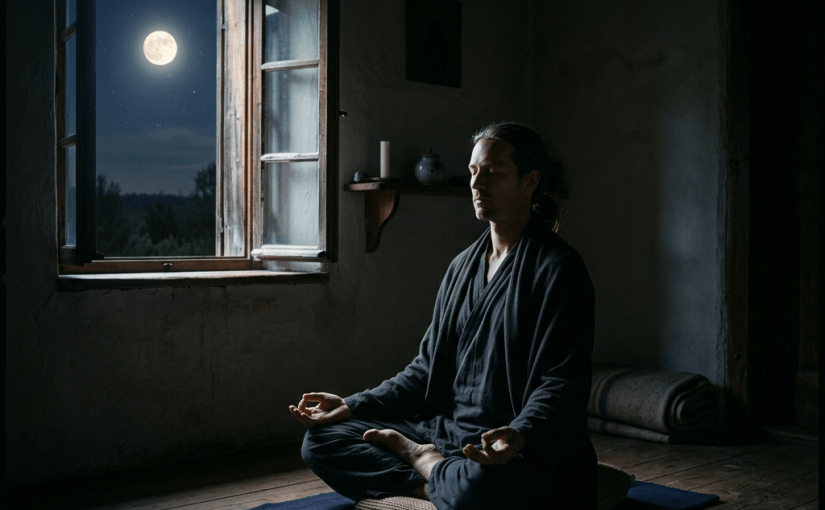
That late-night Dhyana became very deep, peaceful and Ekarnava-like. There was a natural inward merging and continuity in awareness. Breath gradually became very subtle and breathless intervals arose naturally. There was no aggressive attempt to force concentration. The awareness simply moved inward in a very complete and unified manner.
After meditation I did some book work on the laptop for around half to one hour and then slept on the ground. At that time I felt that perhaps I should not sleep because sleep might weaken the continuity of the meditative state in memory and awareness. Later I woke around five-thirty in the morning. After waking I did full yoga and pranayama practice. Then I again sat for Dhyana from around seven to eight-ten in the morning.
Why Morning Dhyana Felt Different from Night Meditation
During the morning meditation, deep breathless pauses again appeared at intervals. However, the quality of awareness was different from the night experience. At night awareness had moved naturally toward Ekarnava, but in the morning there was more complexity.
Initially I thought perhaps trying to put awareness into Ekarnava was creating dullness in the breathless awareness. But later I observed more carefully and realized the opposite was happening. The intentional movement toward Ekarnava was actually preventing dullness. Without that intentional inward merging, awareness would become somewhat dull or less vivid. The willful movement toward nondual continuity was helping preserve luminous awareness.
But there was also a side effect. Along with that intentional inward movement, thoughts and mental images also started expressing themselves. During this morning meditation, images connected to the previous day’s work environment, including boss-related impressions, started appearing. Interestingly, even small environmental sounds or sensory inputs were able to slightly interact with awareness.
At night this had not happened. During the 2 AM meditation there was no dullness, and even when awareness moved toward Ekarnava there was no strong expression of thoughts or mental imagery. The absorption was smoother, more silent and less fragmented.
This led to an important observation. The difference was not necessarily psychological stress from work itself. The real difference appeared connected to the sensory and environmental field.
The Role of Night Silence, Darkness and Sensory Withdrawal in Deep Dhyana
At 2 AM the environment was naturally silent and dark. There were no daytime activities, social interactions or sensory disturbances. Darkness itself reduced visual processing. Silence reduced orienting responses of the nervous system. The social identity connected to daytime functioning was weaker. Awareness therefore moved inward more easily and continuously.
In contrast, the morning environment contained passive sensory activity. There was light, bird chirping, subtle sounds and environmental movement. These were not emotionally disturbing sounds. They were natural and peaceful. But even peaceful sensory inputs create subtle differentiation inside awareness. They create multiple points of attention.
During the morning meditation, the disturbance was not active mental stress from work. It was the passive sensory richness of the morning atmosphere itself. Light, bird sounds and subtle environmental stimulation continuously kept some part of sensory mapping active in consciousness.
This created an important distinction. At night awareness flowed directly toward Ekarnava. In the morning awareness was simultaneously trying to maintain unified continuity while also interacting with a more active sensory field.
The interesting thing was that the intentional inward movement toward Ekarnava was not weakening awareness. It was strengthening and sharpening it. It was preventing meditation from slipping into tamasic dullness or blankness. But because the morning nervous system was already more alert and externally activated after yoga, pranayama and environmental stimulation, the same intentional force also kept subtle cognitive activity alive.
Thus two simultaneous processes were happening together. One process preserved luminous breathless awareness and prevented dullness. The second process allowed subtle thought-expression and associative imagery to remain partially active.
Breathless Awareness and the Difference Between Clear Stillness and Dull Stillness
This experience revealed a very subtle distinction between clear stillness and dull stillness. Sometimes meditation becomes quiet not because consciousness has become deeply unified, but because awareness becomes energetically dull or passive. In my experience, the intentional inward merging toward Ekarnava in the morning prevented such dullness.
However, unlike the night meditation, the morning state also allowed thoughts to express alongside the expanded awareness. Thus breathless awareness alone was not the determining factor. Deep pauses in breath appeared in both sessions. The difference lay in the structure of awareness itself.
At night there was effortless inward continuity with minimal thought expression. In the morning there was luminous inward awareness along with subtle cognitive activation.
This also showed that external sound itself is not always the real disturbance. The deeper issue is whether awareness is functioning inside a sensory-empty field or a sensory-active field. Even peaceful natural sounds like bird chirping maintain subtle duality because they continuously stimulate object-awareness and directional attention.
This explains why many meditators throughout history preferred caves, darkness, midnight meditation, or pre-dawn silence. The purpose was not hatred of nature or sound, but reduction of sensory multiplicity so that awareness could remain in a more unified state.
How Yoga, Pranayama and Morning Activation Changed the Meditation State
Another observation was related to the role of yoga and pranayama before morning meditation. Full yoga practice and pranayama increased bodily activation, sensory sharpness and alertness. While this helped create strong breathless pauses, it also increased outward orientation of the nervous system.
Therefore, even though breath became very subtle, consciousness itself was more externally distributed compared to the night meditation. The morning state balanced between absorption and wakeful cognition.
At night the system had already moved naturally toward inward withdrawal due to exhaustion, silence, darkness and partial sleep interruption. Therefore no additional effort was needed to sustain vivid awareness. The inward movement happened almost spontaneously.
In the morning, however, awareness needed intentional inward direction to remain vivid and unified. Otherwise it risked drifting into dullness. Yet because the nervous system was more awake and sensory-active, thoughts could also arise alongside that intentional merging.
My Final Understanding About Ekarnava and Dhyana
This entire experience taught me something very subtle about Dhyana. Not every deep meditation arises through force or intense control. Sometimes deep absorption emerges naturally when the external sensory field becomes quiet and the ordinary operational personality weakens.
At the same time, complete absence of intentionality can sometimes produce dullness instead of luminous awareness. A certain inward intentional movement toward Ekarnava may preserve clarity and continuity. However, under sensory-active conditions this same force may also keep subtle thought-capacity alive.
Thus the issue is not simply effort versus effortlessness. The real issue is the total condition of consciousness, environment, sensory activity, bodily state, nervous activation and the quality of awareness itself.
My late-night Dhyana revealed effortless inward continuity without much thought-expression. My morning Dhyana revealed luminous breathless awareness preserved by intentional inward movement, but accompanied by subtle sensory and cognitive activation. Both experiences revealed different dimensions of meditation, nonduality and Ekarnava.
The experience also deepened my understanding that breathlessness alone does not define the deepest state. Sometimes ordinary quiet breath inside a deeply withdrawn consciousness can produce greater continuity than aggressive breath-control inside a sensory-active environment. However, breath and state of mind are deeply interconnected. Changes in consciousness naturally influence breathing, and changes in breathing also influence consciousness. When awareness becomes inward, unified and deeply absorbed, breath often slows down, softens or temporarily pauses naturally. When the mind becomes externally active, sensory-engaged or thought-oriented, breathing usually becomes more noticeable and dynamic. In my experience, the deep night Dhyana created effortless breathless awareness because the mind had naturally moved toward inward continuity and Ekarnava. In contrast, the morning environment with light, bird sounds and subtle sensory activity kept some cognitive and sensory engagement alive, which slightly altered both the state of mind and the rhythm of breath together. Thus breath and awareness were not functioning separately, but as two interconnected expressions of the same meditative process.
I also observed that during the morning meditation, the breath stasis felt slightly forced compared to the natural breathlessness of the night Dhyana. This appeared to influence the quality of awareness itself. When breathlessness arose spontaneously during deep inward absorption at night, the void-like awareness remained clear, luminous and naturally unified. In contrast, when breath retention became even slightly effortful in the morning, the void awareness developed a mild dullness despite remaining deep and quiet. This suggested that the more spontaneous the breathless state becomes, the greater the clarity, vividness and continuity of awareness. Forced or partially controlled breath stasis may quiet the mind externally, but it can also introduce subtle heaviness or dullness into consciousness, whereas naturally arising breathlessness during genuine Dhyana preserves both stillness and clarity together.
These observations continue to refine my understanding of Dhyana, awareness and the movement between individuality and nondual continuity.


