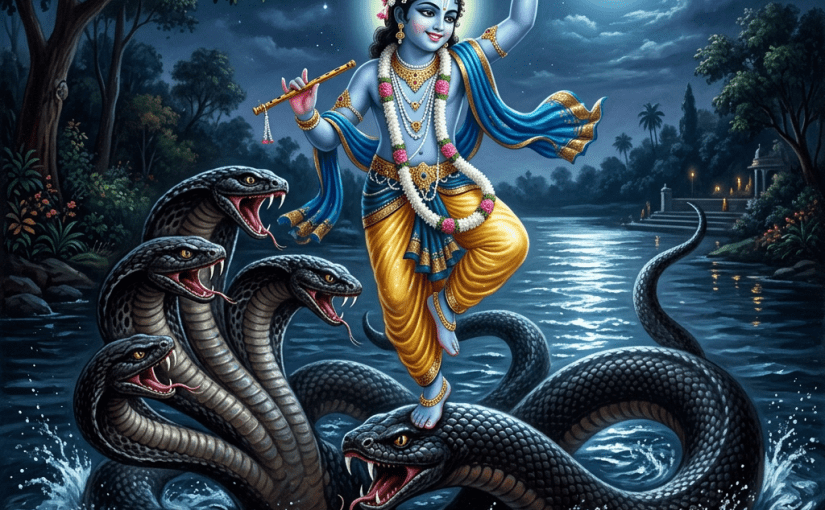
There are some Puranic stories that appear simple in childhood, devotional in adulthood, and deeply psychological only after inner experience begins to unfold. The story of Kaliya Naag from the life of Krishna is one such mysterious episode. Traditionally it is narrated as the story of a poisonous serpent living in the Yamuna river whose venom made the waters deadly for humans and animals. But when viewed through the lens of Kundalini, yoga, consciousness, vasanas, and awakening, the entire story starts appearing like a coded map of inner transformation.
The story begins with Kaliya Naag living inside Kaliya Hrada, a deep pit-like region of the Yamuna river. The serpent constantly spit poison into the waters. People, cows, birds, and animals who drank the water either became unconscious or died. One day the ball of the gwalas or cowheards fell into the poisonous waters. Krishna jumped into the river to retrieve it. Kaliya attacked him violently. Krishna subdued the serpent by dancing upon its thousand heads and crushing them beneath his feet. The wives of Kaliya then prayed to Krishna for mercy. Krishna spared the serpent on one condition: Kaliya must leave Yamuna and go to Ramanaka Island, where it would no longer remain hidden from Garuda.
When this story is viewed symbolically, the serpent immediately starts resembling Kundalini energy. A serpent naturally symbolizes coiled life-force. Kaliya living in dark poisonous waters resembles dormant life-energy trapped in unconscious lower tendencies. The serpent living in fluid is also important because the lower chakras are connected with bodily fluids, instincts, desires, and reproductive energies. The poison entering the Yamuna resembles life-force flowing downward and outward into ignorance instead of upward toward awakening.
In this interpretation, Yamuna is not merely a river. It resembles the subtle channel through which energy flows. The downward poisoned flow represents energy wasted through uncontrolled desires, compulsions, emotional intoxication, scattered thoughts, and outward attachment. The people and animals becoming unconscious after drinking the water symbolize ordinary worldly consciousness becoming trapped in illusion, ignorance, sleep-like existence, and mortality. The poison here is not merely physical death but spiritual unconsciousness.
The thousand heads of Kaliya are especially meaningful. A serpent with one head would represent a single instinct. But a serpent with a thousand heads resembles countless vasanas, desires, cravings, emotional impulses, and thought-streams constantly arising in the human mind. These heads continuously spit poison into consciousness. The poison is not only lust or attachment but every scattered tendency that pulls awareness outward and downward. These many heads also symbolize immense potential power. Kundalini energy, if mastered, can transform consciousness completely. Left uncontrolled, the same force becomes toxic.
The ball of the gwalas falling into the Yamuna also becomes deeply symbolic. The ball can be understood as desire itself, or the lost center of consciousness. Ordinary beings cannot retrieve it because once consciousness falls into unconscious instinctive depths, it becomes difficult to recover through ordinary effort. Only Krishna enters the poisonous waters fearlessly. In yogic symbolism, Krishna represents divine consciousness, awakened intelligence, or the yogi capable of entering the unconscious depths without becoming consumed by them.
Kaliya first attacks Krishna because the egoic life-force resists transformation. The serpent does not want its poisonous dominance to end. Krishna dancing upon the thousand heads symbolizes mastery over mental modifications and vasanas. It is important that Krishna does not kill the serpent immediately. Instead he subdues it. This reflects an important yogic principle. Kundalini itself is not evil. Life-energy is not destroyed in yoga. It is purified, redirected, elevated, and transformed.
One of the deepest insights in this symbolism is the role of Garuda. In the story Kaliya hides in Yamuna because there it remains safe from Garuda. Symbolically, Garuda resembles transcendence, divine ascent, higher intelligence, or the force that carries consciousness toward the infinite cosmos. The serpent fears Garuda because egoic energy fears dissolution into infinity. As long as Kundalini remains trapped in lower unconscious regions, awakening cannot fully occur. The energy remains safe from transcendence there.
Ramanaka Island then becomes symbolic of Sahasrara or higher awakened consciousness. Krishna does not destroy Kaliya but orders it to relocate there. This is profound. The same energy that was poisonous below becomes harmless and spiritually transformed above. Kundalini rises through the inner channel like a serpent swimming through the Yamuna toward higher consciousness. In Sahasrara awakening no longer appears dangerous. There transcendence feels natural, effortless, and divine.
Another subtle but meaningful part of the story is the role of Kaliya’s wives. They beg Krishna to spare their husband. Symbolically these wives can be understood as subsidiary energies, thoughts, emotional currents, and expressions dependent upon the main life-force. If the root energy were completely annihilated, all associated movements would also collapse. Therefore Krishna chooses transformation instead of destruction. The energies are not killed but spiritualized. The thoughts that were previously chaotic, instinctive, and worldly become refined into spiritual tendencies once the serpent ascends to higher consciousness.
This interpretation also reveals why many yogic traditions do not advocate suppression of life-energy. Suppression alone creates inner conflict. Transformation creates awakening. The same energy that creates bondage can create liberation when redirected upward. This is why serpents appear throughout yogic and tantric symbolism. Sheshnag, Kundalini, Vasuki, and many serpent forms represent hidden cosmic power.
In this framework, Krishna’s dance on Kaliya’s heads becomes an image of consciousness gaining mastery over fragmented mental impulses. The crushing of the heads does not mean violent destruction of life but the ending of poisonous dominance. The poison-spitting tendencies lose their control. The energy becomes available for awakening rather than outward dissipation.
There is also psychological depth in the symbolism of unconsciousness and death caused by the poisoned waters. Ignorance itself is a form of unconscious living. Most human beings live mechanically through habit, desire, fear, attraction, and emotional conditioning. In yogic language this is spiritual sleep. The poisoned Yamuna therefore symbolizes a consciousness polluted by lower tendencies where true awareness cannot easily survive.
The interpretation further aligns with many esoteric methods of reading the Puranas. In several yogic and tantric traditions rivers symbolize nadis, mountains symbolize states of consciousness, demons symbolize egoic forces, gods symbolize awakened principles, and cosmic battles symbolize inner transformation. Stories that appear mythological outwardly become maps of consciousness inwardly.
Krishna lifting Govardhan, Shiva drinking poison, Samudra Manthan, Devi slaying Mahishasura, Vishnu resting on Sheshnag — all these stories can be understood not only historically or devotionally but psychologically and spiritually. The ancient sages often encoded subtle truths in symbolic narratives so that different levels of people could derive different meanings from the same story.
The Kaliya episode especially captures the yogic truth that the greatest danger is not energy itself but unconscious direction of energy. Downward-moving life-force becomes poison. Upward-moving life-force becomes awakening. The serpent remains the same. Only its direction changes.
This is why Krishna does not destroy Kaliya. He transforms its destiny.
The story therefore becomes not merely a childhood miracle tale but a profound inner map of Kundalini, vasanas, consciousness, egoic resistance, spiritual ascent, and the transformation of poison into awakening. When read this way, the ancient Puranic world suddenly feels less like mythology and more like encoded inner science preserved in symbolic language for generations of seekers.


