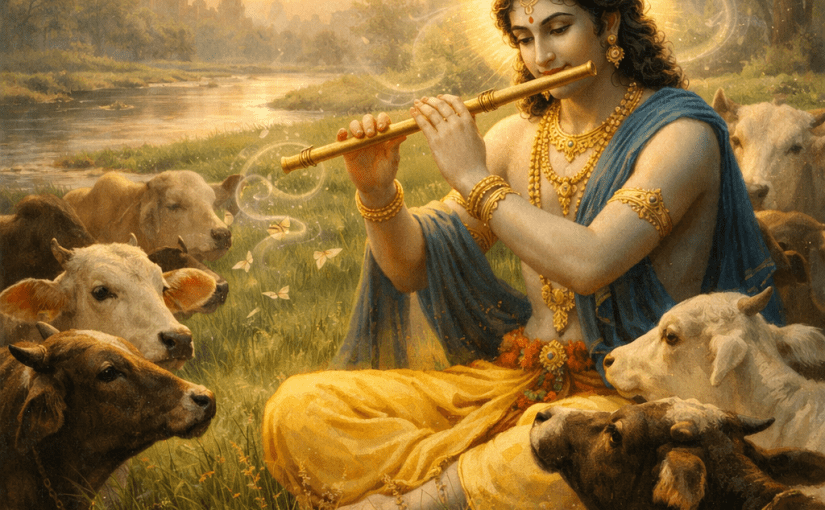
Vrindavan Not as a Place but as an Inner Field of Self-Awareness
The understanding began very simply and very directly, not as philosophy but as lived seeing. Vrindavan appeared to me not merely as a sacred town associated with stories and devotion, but as a field of self-awareness inside. This inner Vrindavan is not created by imagination; it is discovered when awareness becomes calm, spacious, and naturally present. In this field, nothing is forced and nothing is rejected. It is a place of inner softness, where awareness rests in itself without struggle. The idea that Vrindavan exists within is not symbolic poetry alone; it reflects an actual experiential landscape that becomes available when attention settles into its own source.
Cows as the Senses and Grass as Subtle Bliss
Within this inner Vrindavan, cows reveal themselves as the senses. Senses are often treated as enemies or distractions, but here they appear gentle, habitual, and innocent, just like cows. They move toward nourishment naturally. The nourishment they seek, in a meditative inner state, is not gross pleasure but subtle, blissful, calm, and peaceful thoughts. These thoughts feel like grass—soft, tender, refined, and non-violent. Grass is nourishment that does not agitate; it sustains without intoxicating. When blissful and sattvic thoughts arise in meditation, they are like this grass, feeding the senses without disturbing awareness.
From Inner Grass to Outer Grain and Worldly Activity
Grass, however, does not remain grass forever. When it grows outward, when it matures and hardens, it becomes grain. Grain is useful, productive, and necessary, but it is denser and harder. In the same way, subtle inner bliss, when expressed outwardly, becomes worldly activity. The outer world is not wrong or inferior; it is simply condensed sensory awareness. What is soft and fluid inside becomes structured and solid outside. The gross world is like hard grain, while the inner field remains like living grass. This distinction is crucial: it shows that worldly life is not separate from inner awareness, only a different density of the same reality.
Cow Grazing as Calm Sensing Without Disturbance
When cows graze peacefully, they do not fight the grass nor cling to it anxiously. They simply eat. Similarly, when the senses function calmly, without craving or resistance, sensing continues but does not bind. This is the meaning of cows grazing in the inner Vrindavan. Sensing happens, but awareness remains untroubled. There is no suppression of the senses and no indulgence. There is only relaxed participation. In this state, life flows smoothly, and awareness remains intact.
When grain is shown and fed to cows, they struggle to get it, fight with each other, and eat it with craving and attachment. They appear disturbed and restless. This disturbance also affects the cowherd, because he now has to actively control them.
Similarly, in the outer world, the senses behave like furious animals rather than grazing cows. They no longer move calmly but rush toward objects with craving and competition. This agitates self-awareness as well, because it must struggle to restrain and manage the senses instead of resting naturally in witnessing
The Cowherd as Witnessing Self-Awareness
The most important presence in this inner scene is the cowherd. The cowherd does not graze, does not become the cows, and does not consume the grass. He watches, guides lightly, and remains free. This cowherd is witnessing self-awareness itself. It is not effortful observation and not mental vigilance. It is simple presence. When witnessing becomes strained or intentional, the inner Vrindavan turns into a field of discipline. When witnessing is natural, it becomes play, or līlā. Awareness simply remains aware.
Krishna as Self-Awareness Itself
At this point, Krishna appears not as a mythological figure. He may have been incarnated in the Dvāpara Yuga, as scriptural stories always carry double meanings—both internal and external. Yet here, Krishna is revealed as the very essence of self-awareness. He is not the mind, not a personality, and not an individual doer. He is the effortless center of attraction that awareness naturally has when it rests in itself. That is why Krishna never forces anything. He does not command the cows; they come on their own. Self-awareness does not push the senses inward; alignment happens naturally when conditions are right.
The Flute as the Subtle Body and the Seven Chakras
Krishna’s flute reveals another layer of lived understanding. The flute is empty inside, just like the subtle body must be empty of egoic tension to function as an instrument. It is helped by nonduality. Its seven holes correspond to the seven chakras of the body. Without holes, there is no sound; without chakras, there is no expression. The body itself does nothing. It becomes music only when prana flows through it under the presence of awareness. This emptiness is not absence but readiness. Prana flows through different chakras, invoking different expressions and emotions. It is as if different sounds are emerging from the flute.
Playing the Flute as Natural Prana Flow
Krishna playing the flute is awareness breathing prana through the subtle body. This is not forceful pranayama and not controlled breathing. It is natural breath, unstrained and effortless. Awareness does not blow hard; it simply allows prana to pass. Because of this alignment, the sound produced is irresistibly harmonious. In yogic terms, when awareness and prana align, the entire system becomes coherent. When awareness and prana align means prana becomes so subtle that it is equal to void-like awareness. Its subtle music is so refined and harmonious that the senses, which are feeding on grain in the gross outer world, leave it and move toward inner Krishna playing the flute in inner Vrindavan, to graze again on grass. As the breath passes through the flute and becomes almost zero-like, even the grazing senses calm down so deeply that they themselves dissolve into void.
Cows Leaving Grass as Entry into Nirvikalpa
When the flute sounds with feeling of breathlessness, the cows leave even the grass and move toward Krishna. This moment carries the deepest yogic meaning. Grass itself represents subtle bliss and sattvic pleasure. When cows leave the grass, it means the senses abandon even refined enjoyment. They are not suppressed; they forget themselves. This forgetting is nirvikalpa. There is no object, no experiencer, no claim of bliss. Even the thought “I am experiencing bliss” disappears. There is only absorption.
Why Nirvikalpa Cannot Be Held
This state cannot be maintained by will. The moment a thought arises—“I am in nirvikalpa”—the absorption breaks, and the senses return to grazing. Awareness does not mind. Krishna keeps playing. Self-awareness does not cling to states. It allows coming and going. That is why nirvikalpa often lasts only moments, yet leaves deep understanding behind.
Direct Experience in Riverbeds and Flood Plains
These insights are not theoretical. Repeatedly, I sit near a riverbed spread across vast flood plains. The ground is covered with stones of varied sizes and shapes, naturally polished and layered like a welcoming carpet. The openness of the land, the silence of the space, and the slow rhythm of nature create a natural inner stillness. In these places, stray cattle often roam and graze freely.
The Presence of Cows and Effortless Nirvikalpa Dhyana
In these environments, nirvikalpa dhyana arises easily, without effort. This repeated experience reveals something important: cows grazing are not only symbolic representations of yogic processes; cows themselves have a direct effect on the mind. Their presence calms the nervous system. Their grounded, non-aggressive energy supports inner silence. The mind mirrors what it perceives. When awareness rests among beings who live without inner conflict, awareness recognizes itself more easily.
Sages composed scriptural stories in such a way that they carry both physical and symbolic meanings, though the symbolic meaning is primary. The physical layer is not accidental; it supports and strengthens the inner teaching. For example, if grazing alone were the message, other grazing animals could have been chosen. The cow was chosen specifically because of her physical qualities as well—her calmness, non-violence, nourishing nature, and her ability to transform rough grass into sustaining milk. These physical characteristics make the symbolic teaching visible and experiential, ensuring that the metaphor is not abstract but lived and understood through everyday life.
Nature, Animals, and the Support of Awareness
The river, the stones, the open plains, and the grazing cattle together create an environment where prana flows smoothly and awareness remains uncontracted. This shows that yogic realization is not only an inward practice but also a resonance with living nature. The outer landscape reflects and supports the inner landscape.
Vrindavan as Awareness at Play
Ultimately, Vrindavan reveals itself as awareness at play. Senses graze on subtle bliss without agitation. Worldly action emerges naturally from inner calm, just as grain emerges from grass. Prana flows like flute music through an empty body. The senses abandon even bliss when alignment deepens. Awareness remains the silent cowherd, untouched and free. When awareness breathes through emptiness, the senses dissolve into silence, and nirvikalpa appears effortlessly. This is not mythology, not imagination, and not borrowed doctrine. It is direct yogic physiology lived, seen, and expressed through the timeless language of Vrindavan.

 Demystifying Kundalini