
Imagine a universe where nothing is separate—not even for a moment. A universe where every particle, every star, and every human heart is silently connected through an invisible thread. This hidden thread is quantum entanglement, and it may be the most profound clue we have to understanding the unity of existence. What begins in physics soon expands into life, society, consciousness—and even spirituality.
If spin is the rhythm of creation, position is its stage, energy is its fuel, charge is its attraction and repulsion, and mass is its weight, then entanglement is the invisible thread that binds everything together.
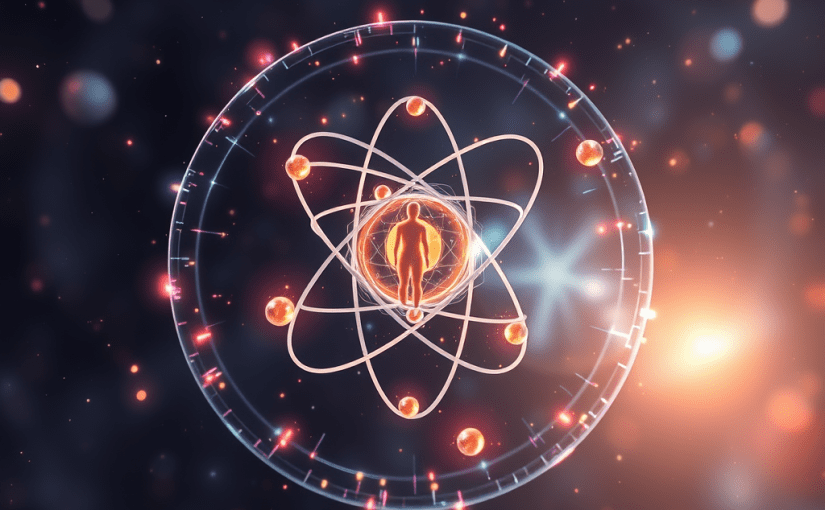
Entanglement is one of the most mysterious qualities of quantum particles. It means that two or more particles, once connected, remain linked even if they fly apart across the universe. What happens to one immediately affects the other, as though an unseen string ties their destinies together.
To understand it in simple terms, imagine two lamps that were once lit from the same spark. No matter how far you take them—one on a mountain, another deep in a valley—their glow flickers in harmony. When one shifts, the other responds. This is how entanglement works. It defies distance and time, whispering that unity never truly breaks, even when diversity blooms everywhere.
Unity Beneath Diversity
Creation looks like diversity to our eyes: stars, rivers, animals, trees, and people. Everything seems separate. Yet entanglement suggests there is a deep oneness running beneath this seeming separation. Like a spider’s web, invisible yet holding all its strands, entanglement ensures that the cosmos is not a scattered puzzle but a woven tapestry.
Why not call entanglement an analogy to human society, where each member interacts with all the members to live and earn livelihood together? With this cooperation both manufacture various structures and machineries in a similar way. One insight emerges from here. Take an example: quantum particles make human eyes; humans make cameras. Both are similar, so the maker of both also proves similar. It also means both work in a cooperative society through similar 5 work senses, feel through 5 feeling senses, think with mind, decide with intellect, and have all bhavas, emotions, rasas, and arishadvargas. Simply, the qualities we see in humans are reflections of deeper cosmic principles already present at the fundamental level.
When the first quantum particles emerged, they did not float around in isolation. They carried within themselves silent connections with others. Because all are the children of single mother space. Each collapse of entangled particles did not just decide the fate of one—it shaped the destiny of both and probably even all to more or less extent, simultaneously, no matter how far apart they were. This synchronicity became the secret glue of creation.
Human’s married and family life can be understood through an analogy with quantum entanglement: just as one particle can be maximally entangled with only one partner and only partially with others, a husband is maximally entangled with his wife and indirectly with their children through her, while maintaining partial entanglements with society. Multipartite quantum entanglement fully resembles the family unit, where husband, wife, and children form a shared web of connections. If a person had a deep love affair before marriage, he became maximally entangled with that lover, and therefore cannot form maximal entanglement with his wife but only a partial one, exactly reflecting the monogamy and distribution rules of quantum entanglement. That is why purity is preferred for marriage, and society considers this a valid reason. If someone is accused of loving another partner, he or she is maligned and dishonoured. Similarly, In school and college life, students who get into romantic or sexual relationships with someone of the opposite sex tend to show less bonding with other classmates. This simply means that quantum particles behave very similarly to human beings in terms of family and social relationships, symbolically proving non-duality at all levels.
In Indian Darshana, this resonates with the idea of Advaita—the non-duality of existence. Just as the children of a mother are indirectly entangled with each other through their one shared mother, in the same way all quantum particles — or everything in existence — is entangled to some degree through the one shared mother: space itself. It is a reverse analogy, but it explains the idea clearly.
The Choosy Collapses of Entanglement
So how does entanglement guide creation? It does so through its choosy collapses.
When two entangled particles exist in superposition, each remains a cloud of possibilities until one collapses into a definite state, instantly shaping the state of the other. This is not merely a passive reaction but a creative choice of nature. In a deeper sense, all particles arise from the same shared space — the single ‘mother’ of creation — and therefore carry faint traces of connection with all others, just as children remain indirectly linked through their mother. Although modern physics shows that strong entanglement fades through decoherence, the underlying unity of space and quantum fields suggests a subtle background interconnectedness. Every collapse, every quantum decision, participates in shaping the unfolding cosmos, reflecting the profound non-duality behind the dance of forms.
This is also evident from the fact that every event in the body and even cosmos is connected to the past, future, and even processes occurring elsewhere in nature. For example, when strong stomach acid enters the mouth during vomiting, there is an immediate profuse flow of saliva to neutralize it; otherwise, the acid would dissolve the teeth. This hints at entanglement occurring even at the macroscopic level.
If two entangled particles must always be opposite in spin, when one chooses “up,” the other instantly becomes “down.” If one locks into a position, the other aligns correspondingly. It is similar to the case of two people arguing: when one becomes angry, the other calms down to maintain harmony. In the same way, married life works better when one partner embodies a more masculine energy and the other a more feminine energy. This coordination echoes everywhere in creation. It is as though nature whispers, “Even in difference, remain one.”
Through countless such coordinated and harmonical collapses, the universe maintains order — galaxies stay together instead of flying into chaos, atoms form stable molecules, and even human hearts feel subtle connections across distances. Entanglement is not just a physical phenomenon; it is the universe’s way of reminding us that, beneath everything, we are all connected.
Entanglement and Living Beings
Look at how life mirrors this principle. A mother feels the cry of her child even from miles away. Twins often sense each other’s moods without speaking. Friends think of calling each other at the same moment. Science may call this coincidence, but at its root lies the same mysterious entanglement that connects all existence.
Just as quantum particles collapse together, our lives, too, are woven in collapses of destiny. The choices of one being ripple through the web, shaping the path of another. Entanglement makes the cosmos less like a machine of cold parts and more like a living organism, breathing in unity.
In simple forest tribes or small rural communities, people often feel more emotionally connected, because their lives are quieter, slower, and less filled with distractions. In crowded metro societies, this emotional ‘coherence’ breaks down due to noise, stress, and constant mental clutter — very similar to how quantum entanglement disappears in particles when they interact too much with their environment. This is the social equivalent of decoherence. Yet even in big cities, a faint sense of connection still persists — between family members, close friends, or even strangers who suddenly understand each other without words. This lingering human coherence suggests that, just as some emotional entanglement survives in complex societies, a very tiny trace of quantum entanglement might also persist in complex and noisy natural objects. It would not be strong or useful like laboratory entanglement, but the fact that coherence never becomes zero hints at an underlying unity that never fully breaks.
Entanglement as the Harmony of Creation
Imagine a grand orchestra. Each instrument is unique, playing its own notes, yet all are tuned to a single rhythm, otherwise the music would be noise. Entanglement is that hidden rhythm. It ensures that even when the violin sings differently from the drum, both remain part of the same symphony.
Without entanglement, the world would splinter into lifeless fragments, like scattered beads without a thread. But because of it, the beads form a necklace—diverse in form, united in purpose.
Quantum Collapse: The Engine of Creation
At the heart of it all is quantum collapse. Creation is not a pre-written script. It is a live performance, each moment born afresh when a particle chooses one possibility out of many. Collapse is the great chooser, the silent decision-maker.
Entanglement adds depth to this act. One collapse does not happen alone—it carries others along, weaving a larger order. It is like dominoes falling in patterns, not randomly, but in carefully chosen designs that give rise to galaxies, stars, life, and consciousness.
Collapse is the engine that keeps creation moving, while entanglement ensures that the engine’s many parts remain in harmony. Together, they make sure the universe is not just a collection of accidents, but a living, breathing dance of unity and diversity.
Closing Thought
Entanglement teaches us that separation is only skin-deep. Beneath the surface, all existence remains connected. Every particle, every being, every star is part of a silent unity. When quantum particles collapse, they do not just create diversity—they reveal that this diversity never left its unity.
In this light, entanglement is not only a scientific puzzle but also a spiritual reminder: we are many, yet one; different, yet inseparably bound. Creation thrives on this truth, and collapse is the way it continuously paints the picture of unity within diversity.
 Demystifying Kundalini