When we left the last chapter, a strange but exciting possibility opened up—
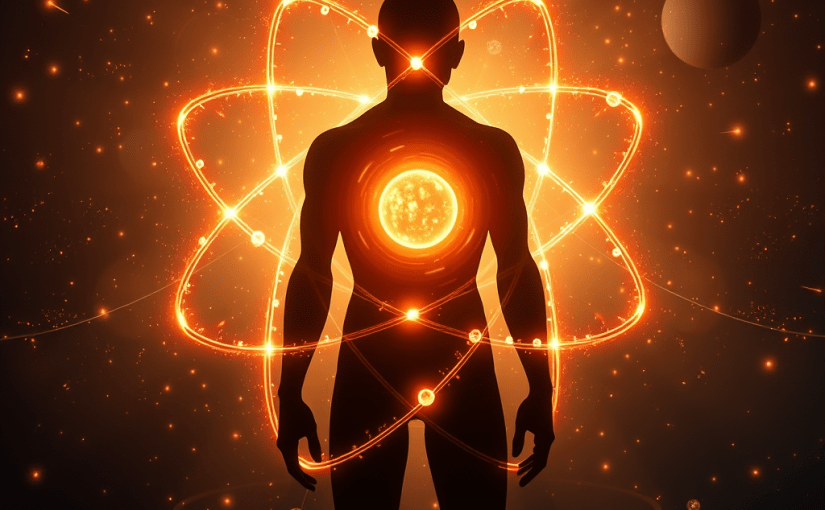
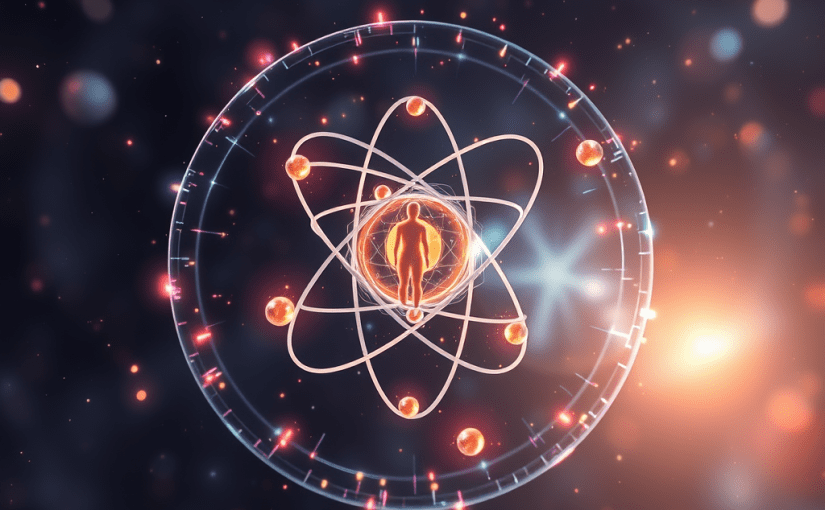
Can the entire human body fit inside an atom?
And we saw, with childlike wonder and deep scientific insight, that it not only can—it already does.
Not in a solid, visible way. But in a subtle, energetic, holographic way.
Just like a tree already lives inside its seed in a hidden form, the entire human being lives inside the atom—not as a full-grown body, but as a blueprint, a design, a vibrational possibility. And just like the seed grows into a tree, the atom evolves into cells, tissues, organs, and finally into us.
But this brings us to a fascinating question:
If atoms already carry the human inside them, do they also function like the body?
Is it just a structural similarity? Or do both the atom and the body actually do the same things in their own scale?
Let’s explore. But not like a boring textbook. Let’s walk together like curious children exploring a hidden ancient cave—with wonder, joy, and awe.
The Hidden Map: Body and Atom Side by Side
The human body has many organs and systems—brain, heart, blood, skeleton, DNA…
The atom has parts too—nucleus, electrons, orbitals, energy levels, vibration…
Let’s look at them side by side.
You’ll start seeing something truly magical.
Brain and Nucleus: The Command Center
Our brain is the control tower of the body. It processes everything—thoughts, emotions, signals. It decides what to do and when to do it. It’s the most complex machine in the known universe.
Now look at the atom.
Right at its center lies the nucleus—a tiny, dense heart of energy.
It decides the identity of the atom just as our brain decides our personality. Whether it’s hydrogen, oxygen, carbon—it’s the nucleus that decides. It controls the atom’s stability, behavior, and power. The nucleus, made of protons and neutrons, is the atom’s core. The number of protons defines the element—1 for hydrogen, 6 for carbon, 8 for oxygen. If the nucleus becomes too heavy or unbalanced, the atom turns unstable or radioactive, sometimes releasing enormous energy. Similarly, the human brain is the control center of personality and function. When the brain is overloaded or imbalanced, it can lead to a crash in personality, much like how an unstable nucleus causes atomic breakdown. Both are small cores with massive influence.
So just like the brain gives order to the body, the nucleus gives structure and energy to the atom.
They are mirrors of each other—one at the macro level, one at the micro.
Heart and Nucleus Again: The Source of Power
The heart beats and pumps blood. It creates rhythm and flow, keeping every part of the body alive. Its beat is our life’s background music.
In the atom, the nucleus is also the source of immense power. In fact, nuclear energy is the strongest known force in nature—millions of times stronger than the chemical energy in bonds.
So while the heart pumps blood to sustain the body, the nucleus holds energy—compressed, stable, and immensely powerful. It’s this concentrated energy at the core that gives electrons the force to move in their orbits, much like how the heart drives life through circulation. The nucleus may sit quietly at the center, but it fuels the entire atomic structure, just as the heart silently powers the entire body.
Both sit silently at the center.
Both keep everything else alive.
Both beat—one with sound, one with silence.
Blood, Nerves and Electron Flow: Movement and Messages
Our blood flows endlessly through a vast network of veins and arteries, delivering oxygen, nutrients, hormones, and waste—sustaining not just individual cells but the entire body. Alongside this, our nervous system fires rapid electrical signals between the brain and body, coordinating every movement, reflex, and thought. These two systems—circulatory and nervous—are the main lifelines of the body. They ensure that every part remains nourished, aware, and responsive.
Now shift to the atomic scale. Inside every atom, a similar dual dynamic is at play. Electrons, tiny charged particles, spin and shift through orbits and clouds, never still. They jump between energy levels, carrying not just electric charge, but also light, interaction, and the possibility of bonding. In the same way, refreshed circulation brings a glow to the face and positively modulates interactions with people in society. Electrons carry light by emitting or absorbing photons during energy jumps, and carry interaction by enabling chemical bonds and mediating electromagnetic forces. Just as blood flows through vessels, electrons flow through defined paths—and just as the body depends on blood flow for life, the atom depends on the movement of electrons. If electrons stopped or spiraled into the nucleus, the atom would collapse—its structure gone, its function lost.
Just as nerve signals generate electric fields in our body, electrons produce electric and magnetic fields around the atom. Just as nerve signals command the body on how to move, react, or feel, moving electrons guide the atom—determining which other atoms to interact with and which to ignore, by shaping the atom’s electric field and bonding behavior. Just as blood pulses rhythmically, electrons flow in patterns that drive chemical reactions and energy transfer. These patterns determine whether atoms link together, repel each other, or light up the world.
In this way, the life inside us—the flowing of blood, breath, and signals—is mirrored by the life within atoms, where electrons dance and communicate through fields and flows. Movement gives purpose. Flow creates connection. Whether in the vast body or the tiniest atom, everything is motion, everything is message.
Skeleton and Electron Shells: Structure and Stability
Just as the skeleton gives the body its shape, support, and movement, holding all parts in place and allowing them to work together, electron orbitals give the atom its structure and behavior. The skeleton decides how the body stands, moves, and stays connected; likewise, electron orbitals decide how atoms bond, fit together, and form molecules. Without the skeleton, the body would collapse—just as without orbitals, atoms wouldn’t know how to connect or create anything. Both are invisible frameworks that hold form and enable function.
If electron shells were chaotic, not rigid like skelton, no atoms would hold. No molecules, no matter, no life. Their stability allows the universe to have form.
So just as bones are invisible under the skin but hold the body,
electron shells are invisible structures that hold all creation.
DNA and Atomic Code: Memory and Design
Every living cell has DNA—a twisted spiral of information.
It tells each cell what to become—eye, skin, heart, or brain.
But what is DNA made of? Molecules.
And what are molecules? Arrangements of atoms.
Which means the real memory is stored in how atoms sit next to each other.
How they bond, vibrate, and form structures.
The vibration and pattern is the real code.
Even the spiral shape of DNA comes from atomic geometry. The spiral shape of DNA, known as the double helix, is not random—it arises from the way atoms are arranged and bonded within the molecule. The angles at which atoms bond, the electron orbitals, and the repulsion between electrons all influence the overall 3D shape. The atomic geometry—how atoms naturally prefer to sit in space—causes the DNA strands to twist into a spiral. So, the elegant spiral form of DNA is a direct result of the geometrical rules of atoms at the tiniest level.
So in a way, atoms are carrying vibrational memory. Yes, in a way, atoms do carry vibrational memory—though not like human memory, it’s a kind of energetic imprint. Atoms and molecules constantly vibrate, and these vibrations depend on their structure, bonds, and energy levels. When atoms absorb energy, they vibrate differently, and that vibration can influence how they interact with other atoms or molecules. In complex molecules like proteins or DNA, these vibrations can even affect biological behavior and information transfer. So, while atoms don’t “remember” like a brain, their vibrational patterns reflect their past interactions and current state—a kind of memory stored in motion, shaping how they behave next.
The entire body’s design is encoded in how atoms behave.
It’s not magic. It’s vibration, pattern, and harmony. Means that the complex beauty we see in nature—from the shape of a snowflake to the spiral of DNA or the rhythm of a heartbeat—is not due to something mystical, but to the natural laws of physics and chemistry. At the atomic and molecular level, everything vibrates—atoms, bonds, and particles move in tiny, rhythmic motions. These vibrations follow specific patterns, governed by energy, structure, and interaction. When these patterns align in a balanced and organized way, they create harmony—leading to stability, form, and function in everything from crystals to living organisms. So, what may appear magical is actually the elegant dance of vibrations following natural laws—a universe built on rhythm, not randomness.
Breathing, Thinking, Feeling – Is the Atom Doing It Too?
Now comes the fun part.
You may ask: Okay, atoms have structure like the body. But do they also breathe? Think? Feel?
Let’s see:
Breathing?
Atoms constantly vibrate. That vibration is like their breath.
More energy, faster vibration. Less energy, slower.
This is the rhythm of life at the tiniest level.
Circulating?
Electrons are always moving. They never sit still.
They flow, jump, tunnel, interact. This is circulation at the atomic scale.
Thinking?
Our thoughts are electrical signals in neurons.
At base, they are movements of ions—charged atoms. Our thoughts are the result of electrical signals traveling through neurons in the brain. At the most basic level, these signals are created by the movement of ions—which are atoms or molecules that carry an electric charge. For example, when you think, neurons open tiny gates in their membranes that allow charged ions like sodium (Na⁺), potassium (K⁺), and calcium (Ca²⁺) to move in and out. This flow of ions creates tiny electrical currents, which travel along the neuron and send messages to other neurons. So, beneath every emotion, memory, or idea is the simple motion of charged atoms—thoughts begin with the physics of moving particles.
And inside atoms, electrons also jump and release energy.
This quantum jump is mysterious—it happens instantly. No travel, no in-between.
It’s not “thinking” like humans do, but it behaves like flashes of choice. Just as electrons gain or lose energy by jumping between orbitals—absorbing energy to move to a higher level and releasing energy when dropping to a lower one—the human body also experiences energy shifts. When we’re uplifted—through joy, love, or positive experiences—it’s like electrons absorbing energy, rising to a higher energetic state. And when we’re grounded—through rest, nature, or emotional release—it’s like electrons releasing excess energy, returning to a more stable, balanced level.
In both cases, whether in atoms or the body, energy flows in steps, not randomly. These jumps create change, spark reactions, and maintain harmony. Energy in, energy out—it’s how both electrons and humans stay in balance.
So what is the body doing… that the atom isn’t?
Surprisingly—nothing.
Every action in the body is an advanced version of what atoms already do.
The body is the orchestra.
The atom is the original note.
The Illusion of “I Am Doing” – A Deeper Realization
Here’s where the mystery deepens.
We often say:
“I am breathing.”
“I am thinking.”
“I am walking.”
But let’s pause. Are we really doing these things?
The heart beats on its own.
The lungs breathe even when we sleep.
The brain thinks without our permission.
Even digestion, healing, and movement happen naturally.
So who is this “I” that claims to be doing?
Most of the time, the body runs on its own. Just like an atom doesn’t try to spin—it just does.
There is no manager inside the atom. No ego. No “doer.”
In the same way, the body doesn’t need an ego to function.
It already knows what to do—just like the atom.
The sense of doership is like a story we add on top of what is already happening.
The body is moving. The breath is flowing. The mind is thinking.
But “I am doing” is just a caption, not the photo itself.
When this is deeply seen, a strange peace enters.
The burden drops. Life feels lighter.
You stop trying to control everything. You start to trust the process.
The body is not your slave.
It is a part of nature, just like wind, fire, or stars.
You are not a fragment, you are a portal — a window through which the atom is looking at itself as a full-grown universe. Means that you, as a conscious being, are not just a small piece of the universe—you are a gateway of awareness through which the universe can perceive and reflect upon itself. At the core, your body and mind are made of atoms, just like everything else in the cosmos. But through consciousness, those atoms have formed something extraordinary—you, a being capable of self-awareness, wonder, and understanding.
So rather than being just a tiny, separate fragment of existence, you are like a lens or opening through which the vast universe—built from atoms—is able to experience itself as something whole, intelligent, and alive. The same particles that make up stars, galaxies, and oceans are now, through you, thinking, feeling, and observing. Before you, they were blindly making things up, unaware of the actual facts and processes.
It’s not poetic exaggeration—it’s a profound truth of existence: the universe, through you, becomes aware of itself.
The Final Glimpse: Body and Atom Are One Journey
So what have we seen?
We’ve seen that the atom and the body are not separate things.
They are reflections of the same pattern, at different scales.
The atom is the seed.
The body is the tree.
But the code is the same.
Everything you see in your body — breathing, thinking, moving, feeling — is already present in subtle form inside each atom.
The body is not made of atoms.
The body is an atom, unfolded.
This is the beauty of creation—the small and the large are not opposites but echoes of the same sound, reflections of one reality.
The atom is alive. The body is alive.
And through both, you — the awareness behind all this — are watching it all happen.
The purpose is not to control it, but to marvel at it—to witness the harmony of creation, where small and large are echoes of the same truth, flowing effortlessly from one source, the endless and self-aware space.
So next time you breathe…
remember — even the atom is breathing with you.
And that is the science of the Self.



 Demystifying Kundalini