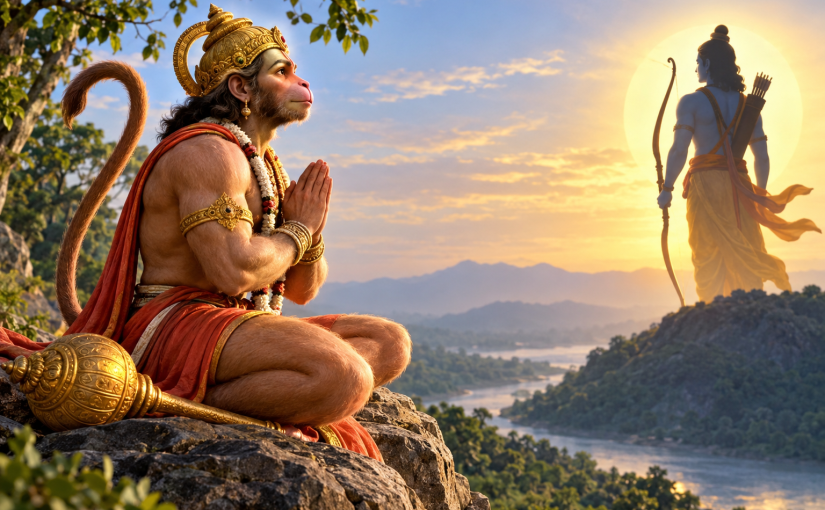
Hanuman as the Symbolic Union of Monkey and Human
The line of the Hanuman Chalisa, “Tumharo bhajan Ram ko paave,” has always appeared to me as one of its most amazing and insightful statements. Its simple meaning is that through devotion to Hanuman, one attains Ram. But when I look at Hanuman not only as a religious figure but also as a symbol, the line opens into a much deeper meaning. Hanuman is a monkey god, and I see this expression literally as a blend of the characteristics of the monkey and the human. Neither the monkey alone becomes this god nor the human alone. The combination becomes Hanuman.
The monkey side of Hanuman represents a peculiar set of characteristics. A monkey is highly active and does not seem comfortable remaining idle for long. Even when it has no obvious work, it may begin moving, climbing, shaking a branch, looking around, or changing its position. It lives high on trees and naturally moves through open space. Its food can be seen, symbolically, as simple and sattvic: fruits, leaves, sprouts and other natural things. It is also constantly moving its attention. It does not usually fix its gaze or mind on one thing for a long time. It looks here, there and everywhere, changes position, wanders from one place to another and does not remain psychologically fixed in one object. This gives an impression of great activity combined with detachment.
I am using these qualities as spiritual symbolism rather than making a scientific claim that monkeys literally have no rajas or tamas. The point is what these visible characteristics can represent when a human being consciously embodies them. A monkey appears light-bodied, mobile, active and relatively free from the heavy kind of attachment through which human beings become fixed in possessions, places and objects. It may quarrel at times, of course, but symbolically it suggests an existence based much more on movement and immediate action than on prolonged fixation.
When Monkey Characteristics Enter a Developed Human Mind
This becomes especially interesting when the same characteristics are embodied by a human being. Human consciousness has the further capacity for sustained meditation, self-observation, discrimination and inner transformation. My understanding is that constant activity, detachment and sattvic living free a large amount of mental energy that otherwise remains occupied in attachment, possession, unnecessary thought and psychological fixation. That energy becomes available for meditation.
Then something remarkable can happen: the meditation image can become continuously present in the mind. It is no longer necessary to make a great effort every time to bring it back. It begins to express itself and shine almost constantly. After awakening, that established meditation becomes the basis for resting in samadhi. In this sense, the mind that was once continuously moving can finally arrive at a state of perfect rest.
This is where I connect Hanuman with Ram. I understand Ram not merely as a historical person or external deity, but also as a state of being, a state of rest. The word itself can be associated with resting or delight, and the historical Rama can then be understood as the godly person who perfectly embodied that state. Thus the symbolism becomes very beautiful: Hanuman represents dynamic activity without attachment, while Rama represents perfect rest.
Why “Tumharo Bhajan Ram Ko Paave” Is So Deep
Seen in this way, “Tumharo bhajan Ram ko paave” means devotion to you makes get Rama, becomes much more than a simple devotional promise. Hanuman is not the final destination who keeps the devotee attached to himself. He is the bridge to Ram. The devotee begins with Hanuman, with his strength, activity, devotion, purity and freedom from attachment, and through that devotion consciousness gradually moves toward Ram, the state of inner rest.
Bhajan here also need not mean only singing devotional songs. It can mean remembrance, contemplation, love, surrender and living in the consciousness represented by Hanuman. The highest quality of the true guru is similar: he does not keep the disciple dependent upon himself; he leads the disciple beyond himself to the ultimate.
This makes the progression almost experiential: Hanuman, devotion, transformation of consciousness, and finally Ram. The servant becomes the doorway to the Master.
The Monkey Can Express the Outer Characteristics, but the Human Can Realize Their Inner Effect
There is also an important difference between an actual monkey and a human being who embodies monkey-like qualities. A monkey can naturally express movement, activity, non-fixation, simplicity and detachment through its behavior, but its brain does not have the same developed human capacity for abstract meditation and deliberate spiritual self-transformation. The monkey therefore expresses the outer characteristics, but little, if any, of their deeper inner effect.
A human being can take these same qualities and turn them inward. Activity combined with detachment can reduce psychological entanglement. Sattvic living can simplify the mind. Non-fixation can reduce possessiveness. All this can release mental energy for dhyana. When meditation becomes stable, the meditation image can become spontaneous, and that spontaneous dhyana can mature into awakening and samadhi.
This is why, for me, Hanuman is not merely a theory or philosophy. It resembles something I have directly experienced in life.
My Own Experience of Becoming Like Hanuman Through Association
These characteristics were strongly present in my Dadaguru. He was, in my experience, almost like Hanuman himself: extraordinarily active, detached, simple, meditative and inwardly free. I did not consciously decide to imitate him. I simply lived in his company and absorbed the atmosphere and way of living for years.
I found these same characteristics gradually appearing in myself. The result was awakening and dhyana. In this sense, the symbolism became a living experience. What I am describing is therefore not simply an intellectual theory about monkeys, humans and gods. It is my attempt to understand something that actually happened in my life.
Later, karma-yoga and the non-dual philosophy of Sharirvigyan Darshan became a kind of medium for amplifying tendencies that were already present in small form. The philosophy strengthened activity, detachment, non-duality, sattvikata and meditation, and these in turn strengthened spiritual development.
The Monkey as a Natural Symbol of Non-Duality and Detachment
Some very simple monkey behaviors also become meaningful in this symbolic reading. A monkey does not necessarily make the elaborate distinctions that human beings make. It can take both raw and ripe fruit as food without building a philosophy around the difference. It can use an ornament and then throw it away. The famous image of a monkey being given a golden necklace captures this beautifully: it may know how to wear an ornament and use things with its human-like hands and arms, yet it can soon drop the object as though it has no lasting interest in it.
That is why I find the monkey an unexpectedly powerful symbol of detachment and even non-duality. It can use the world without becoming permanently fixed in it. It can move constantly without needing to possess every place it visits. It can handle objects without making them the center of its identity.
When such qualities become conscious in a developed human being, however, they can do something the monkey cannot do by itself: they can produce sustained meditation, awakening and samadhi. Then the monkey-like activity reaches its opposite end in Rama-like rest.
For me, this is the deeper meaning hidden in “Tumharo bhajan Ram ko paave.” Hanuman is the embodiment of activity, purity, devotion and detachment; Ram is the state in which consciousness finally rests. The monkey gives the outer symbolism, the human gives it conscious direction, and the awakened state gives it its final meaning. In that sense, Hanuman truly becomes the bridge from restless movement to perfect rest, from worldly activity to dhyana, and from dhyana to Ram.


