Chapter 9 – Healing from the Inside Out

Human life is not just a chain of days and events. It is a flow of patterns, shaped by awareness, taking form as the body and mind we live in. In the last chapter, we saw how consciousness links experiences together and turns possibilities into reality. Now, we look deeper—into the body’s power to heal itself from the inside out.

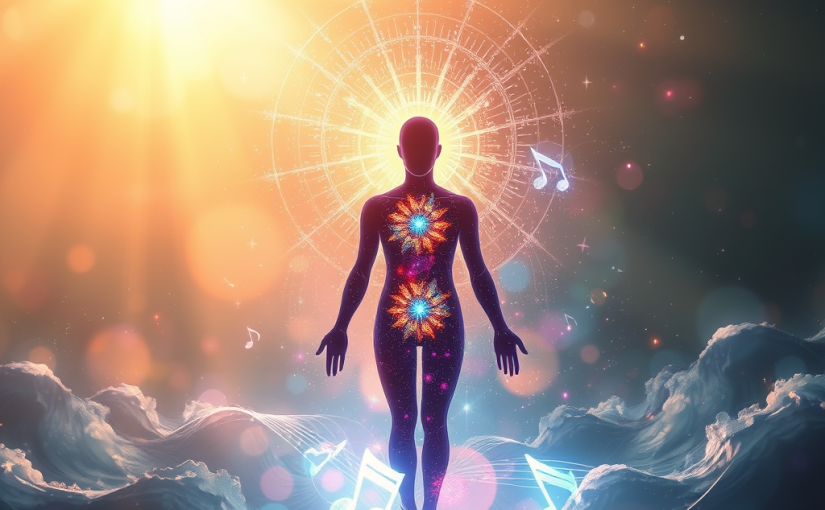
Most of us are taught to think of illness as something that “attacks” us from outside—a virus, a germ, an injury. But seen more deeply, illness is often a disturbance in the body’s natural balance. It is like a musical note going slightly out of tune. The instrument is still there; it just needs the right vibration to return to harmony.

The human body is not just flesh and bone. On a finer level, it is a field of information. Every cell and atom follows a kind of invisible blueprint. That invisible blueprint can be understood as the subconscious mind, because the subconscious stores the deep patterns, memories, and beliefs that quietly shape how the body functions, heals, and responds to life—often without our conscious awareness—acting like the hidden master plan the body follows. When this blueprint is clear, the body is healthy. When it is disturbed—by stress, shock, or unprocessed emotions—the body’s image of health becomes blurred. Real healing happens when that inner pattern is restored. Then, the body’s physical parts follow naturally. The inner pattern or blueprint means the subconscious mind’s pattern becomes clearer through meditation and spiritual practices like dana (charity), tapa (discipline), and vrata (sacred vows), which purify hidden impressions and restore the mind-body field to its natural harmony, allowing the body to heal more easily.

Modern medicine sees disease as a chemical imbalance or physical damage. That is true, but these are often the surface effects of a deeper cause—the disturbance in the body’s energy or information field. I refer to the subconscious mind as the body’s energy or information field because it silently stores and transmits the mental-emotional patterns as information and energy that influence the body’s chemistry, cell behavior, and overall balance—acting like an invisible control network that links mind, energy, and physical form. Quantum physics tells us that many possible states exist at once. In the body, this means every cell can “choose” between states of health or illness. The choice depends on the signals it receives from the surrounding field.

From this point of view, the work of a healer is not only to fight the disease, but also to guide the body back into its natural rhythm. A certain threshold of subconscious clarity is needed for the body’s natural rhythm to hold; when clarity drops below that point, distortions build up in the mind-body field, and disease begins to appear. This is why some therapies—sound, light, gentle touch, meditation—can help. They are not magic; they are ways of sending the “right song” back into the body so it remembers how to be well.

Even the so-called placebo effect is proof of this. When someone truly believes they will heal, the belief itself changes the body’s energy blueprint. “Blueprint” is just a metaphor to make the idea visual, but it directly means the body’s energy field or subconscious pattern that belief can influence and change. It is not the pill but the mind’s certainty that triggers the body to repair itself. Far from being “just imagination,” it is one of the clearest examples of the mind’s healing power.

Deep spiritual states also create a powerful healing field. For example, Nirvikalpa Samadhi is often misunderstood as withdrawing from life and sitting in emptiness. But it is really about living and acting with the understanding that the doer, the action, and the result are one. When the sense of doer, action, and result being one is realized, stress and inner conflict drop sharply, which prevents new subconscious disturbances from forming—helping the body stay in its natural state of health. Simply saying, nirvikalp samadhi clears the subconscious mind. A person in this state naturally radiates balance and calm. Just being around them can help others’ patterns return to harmony.

In yoga, practices like Yam and Niyam are not strict rules but ways to keep the body’s field clear and steady. They prevent disturbances before they appear. A karmayogi—someone who works in the world with selfless awareness—may look fully engaged in life, but inside they are in deep alignment, already healing themselves and influencing others.

Healing and self-realization meet in the quiet space between thoughts. When we pause and rest in awareness, the mind’s noise settles, and distortions fade. This is not emptiness in the dull sense, but a full and alive silence where the body remembers its original state of balance. It means that in moments of pure awareness—when thoughts pause like in keval kumbhak—the mind becomes still, the subconscious clears, and the body naturally returns to its healthy, balanced state; this silence feels vibrant and alive, not blank or lifeless.

The brain adds another mystery. Neurons send electrical signals in two-dimensional patterns, yet we experience a rich, three-dimensional world. This shows that depth and reality are not purely in the brain’s matter, but in how consciousness shapes information. In a hologram, if the source plate is clear, the image is clear. Healing works the same way—clarify the blueprint, and the whole picture changes. It means that just as a hologram’s image depends entirely on the clarity of its original recording plate, the body’s health depends on the clarity of its inner pattern or subconscious; when that inner “source” is clear, the outer physical condition naturally improves.

Life also gives us natural phases of alignment. In youth, energy flows strongly, and engaging fully with life strengthens harmony. Later, as the body slows, deeper stillness and states like Nirvikalpa come more easily, keeping the field aligned with less outward action. It means we have a better opportunity in youth to experience energy-awakening–based Savikalpa Samadhi, while in later life, silent Savikalpa Samadhi and even Nirvikalpa Samadhi can naturally arise as a result of the earlier energetic awakening.

In physics, the wavefunction holds all possible realities. What becomes real is chosen by the conditions at the moment. Healing is about tuning the conditions so the healthiest possibility becomes the natural choice. It means that, just as physics says all outcomes exist until conditions decide which one appears, the body also holds many possible health states, and by creating the right mental, emotional, and physical conditions, the body naturally “chooses” the healthiest state to manifest.

To heal from the inside out is to remember that the body is not a machine needing only external repair, but a living hologram in constant contact with infinite intelligence. At any moment, the song of the field can change—and when it does, the atoms follow. Whether through belief, sound, selfless work, or deep silence, we can invite the body back into its natural rhythm.

True healing is not about escaping the world or clinging to it. It is about walking through life as both healer and healed, knowing that the blueprint of wholeness is always present. Every mindful step strengthens the song of health. Every breath taken in awareness is a gentle return to balance. In this way, healing becomes not a struggle, but a natural expression of living in tune with who we really are—a spark of consciousness, shaping itself into the form of a healthy, living human being.

When the Breath Moved to My Ajna Chakra

🌸 Happy Janmashtami! 🌸
On this sacred day when we rejoice in the birth of Lord Krishna, a quiet celebration unfolded within me — a new birth of awareness, as the breath began to awaken in the Ajna Chakra.

Today something new happened in my meditation.
Earlier, my subtle breathing seemed to come from the Anahata Chakra — a gentle rise and fall at the heart center. But this time, my awareness settled fully in the front Ajna Chakra between my eyebrows, and something extraordinary unfolded.

It felt like the Ajna itself was “breathing.” There was a subtle constriction as prana moved downward, with awareness contracting into a fine point, and a gentle relaxation as prana moved upward, with awareness expanding like a soft glow. This rhythm was continuous — like respiration — yet my physical breathing was barely noticed. Air still flowed in and out of my lungs, but it seemed irrelevant. At times, it even felt like the breath had stopped entirely.

From a yogic perspective, this is when the chitta (mind-field) and prana (life-force) synchronize at the Ajna. The normal link between mind and chest breathing fades, replaced by a pranic tide in the head. This is a pratyahara–dharana fusion state: senses withdrawn, awareness steady, yet alive. The physical lungs continue their work in the background while awareness rides only the subtle rhythm. This can lead naturally to kevala kumbhaka — the effortless, breathless stillness.

I learned that Ajna breathing happens when the ida and pingala energy channels merge at the Ajna, creating a tiny “micro-pump” in the pranic body. The sensation is like the Ajna itself is inhaling and exhaling. It sharpens inner vision and steadies meditation, but it can also pull prana upward so much that grounding is needed to stay balanced. A simple way to do this is to keep a thin “awareness-thread” down the spine to the Muladhara Chakra while meditating.

We also explored how this can evolve:

  • Path 1: Stay in Ajna breathing and stabilize it until samadhi readiness is natural.
  • Path 2: Let Ajna’s expansion phase overflow into the Sahasrara Chakra, where the breathing becomes spherical and almost timeless.
  • Path 3: Occasionally cycle awareness through all chakras to keep the whole system alive and balanced while still rooted in the higher centers.

From this, we shaped a single practice:

  1. Start with Ajna breathing for stability.
  2. Let expansion naturally drift upward into Sahasrara breathing.
  3. Before ending, cycle down and up through all chakras a few times to ground and integrate.

Ajna breathing feels like a gateway. Sahasrara breathing feels like stepping beyond the gate into the infinite sky. Both are precious, but Ajna gives the steady flame, while Sahasrara gives the boundless space. The key is to let it happen naturally, ride the rhythm, and stay rooted enough to live fully in both worlds — the inner and the outer.

Chapter 7- The Energy Body: The Bridge of Inner Aliveness

From outside, we look like a body made of flesh, bones, blood, and nerves. But as we sit quietly and close our eyes, a deeper layer of ourselves begins to appear. This layer is not visible with the eyes, but it is very real in experience. It is felt as tingling, vibration, pressure, warmth, movement, inner space, and awareness. This layer is often called the energy body. It is not a body made of atoms or particles like the physical one. It is not something you can touch with your hand or see with a microscope, but you can feel it clearly inside you—especially during deep silence or meditation. Actually it is the pure experiential body, nothing physical.

Scientists say that when brain cells fire signals, they produce small electromagnetic fields. These are natural and part of how the brain works. These fields are not just limited to the head; they spread out in patterns. Some scientists believe that this field may be linked to our conscious sense of self. From the spiritual side, many say that this field is the very bridge between soul and body. This bridge is what we feel as the energy body.

The energy body has its own structure—not of matter, but of movement and awareness. In ancient Indian understanding, this structure is described through chakras, nadis, and prana. Prana means life-force. It is not air or oxygen, but the driving power behind breath, thoughts, and emotions. Nadis are the invisible channels through which prana flows. And chakras are the subtle centers where energy collects, rotates, and transforms. These are not located on any scan or X-ray but are known by their effects. Just as nerves carry signals in the physical body, nadis carry prana in the energy body. In a nutshell, we feel a sensation both in the organ and in the brain at the same time. That’s why we perceive the sensation as being located in the organ, even though it’s processed in the brain. Normally, we don’t notice the actual transmission of the sensation from the organ to the brain. But with meditative awareness, this flow can also be perceived. This flow is called prana, and the subtle channel through which it moves is known as a nadi.

In simple words, when your breathing changes, your energy changes. When your thoughts change, your body heat, posture, and feelings change. This shows that there is a clear link between the physical and the energy layers. One affects the other instantly.

The entire setup of the energy body mirrors the cosmos. Just as the universe has galaxies, black holes, stars, and movements of energy, our inner world has chakras (like suns), nadis (like space highways), and prana (like flowing light). The same way the sky spreads in all directions, our own awareness silently fills our inner space. The outer universe and our inner structure follow the same design. This is called the micro-macro equivalence or Sharirvigyan Darshan—the science of understanding the body as a reflection of the cosmos.

Sometimes, even in normal meditation, just by thinking about the infinite sky, we begin to feel a vast peace. This shows that the deeper layers of the mind and energy body are already connected to the larger cosmos. When this connection becomes total and not just imagined—like in Nirvikalpa Samadhi—the bliss is beyond all limits. Just as Savikalpa Dhyana gives joy by visualizing the physical world, Savikalpa Samadhi brings a flood of real, living bliss. Merging fully is more joyful than standing nearby. Thinking about sunlight gives some warmth, but becoming sunlight is another thing.

Experiencing a blissful shining rod of energy in the backbone during meditation offers a profound insight—it reveals that pure energy can indeed be directly felt by the soul, not merely as a concept, but as a vivid inner reality. Ordinarily, the soul seems to be most aware of energy within the brain, where the constant dance of neural activity creates a dynamic electromagnetic field. However, with focused meditation, this perception can extend to other regions such as the spinal axis and chakras, as if the soul’s attention shifts its sensing lens from the cerebral core to the subtle network that permeates the entire body. Even great yogi Gopi Krishna used to experience his energy body in entire body system like gastrointestinal system etc. leading to his overwhelmingly tiredness. Such experiences challenge the notion that the soul is merely entangled with the physical structure. Instead, they suggest that the soul interfaces with the field—the invisible energy patterns created by the body’s bioelectric activity—rather than directly with nerves or flesh. This realization becomes even more striking during dream visitations, where one may encounter a departed being not as a solid form but as an amazingly radiant and dark together like mascara, and waveless conscious energy presence. Since the departed body no longer exists, the soul must be perceiving an energy body—a subtle electromagnetic or pranic form that carries the essence of identity. This not only validates the ancient yogic idea of the pranamaya kosha or energy sheath, but also lends credibility to emerging scientific hypotheses that suggest consciousness interacts with or arises within the electromagnetic field generated by the brain. Shifts in physical nerve activity merely alter this field, and it is this changing field that the soul likely perceives as sensation, emotion, or thought. In this light, the energy felt along the backbone—like an experientially luminous rod of awareness—is more than symbolic. It is an experiential clue that the soul’s relationship with the body is not with its dense matter but with its living vibrational field. This aligns with ancient Sharirvigyan Darshan, where the body is not seen as an isolated physical entity but as a microcosmic reflection of universal forces. The electromagnetic field within is but a thread in the greater cosmic loom—what is within the spine mirrors the current of the stars, and the soul dances in both. In essence, the electromagnetic field outside is the same as within. Nothing truly exists apart from these fields and waves. What we experience is not material, but a wave — we simply assign it a physical name and form. The shape and form of physical matter are illusions. Space itself is the field through which every wave moves — a grand, all-encompassing field. In this sense, what is God, if not the supreme or ultimate field — the mother field upon which all waves and particles, as players, dance like children at play, giving rise to creation.

Even stories hint at these truths. Like Hanuman taking the sun in his mouth—this is like the space or darkness covering the sun, as in an eclipse. Later, he throws it out, restoring light. The story shows how space itself, when taken as living and conscious in the form of monkey god, plays with light. Hanuman represents the conscious sky, the soul. Space is not empty—it is full of awareness, and that is why it can take forms and perform such cosmic plays.

So the energy body is not imagination. It is the true experience of the living, sensing self. It is connected to the brain’s electric field, but goes beyond it. It is supported by breath, thought, feeling, and deep silence. It reflects the entire design of the cosmos within. By understanding this body, one begins to see the unity of science, soul, and the universe in the simplest and most natural way.