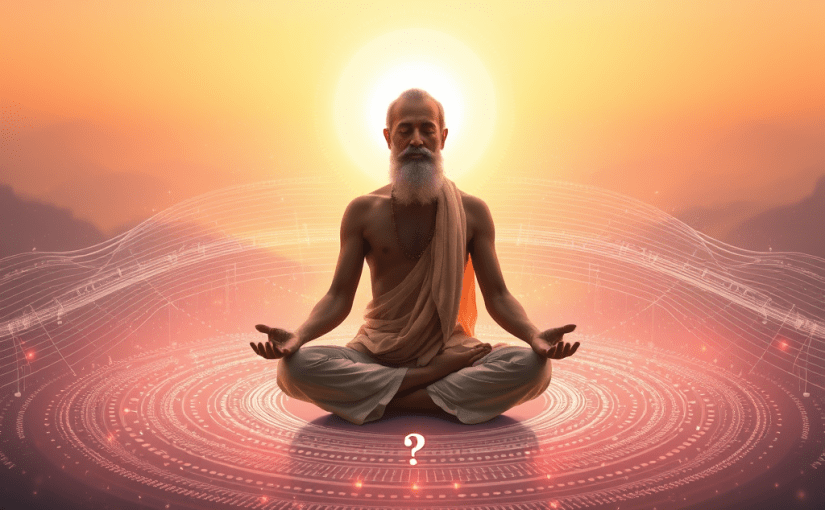
Journey of Nada, Keval Kumbhak, and Deep Dhyana

I noticed that during deep meditation, when I enter keval kumbhak — spontaneous breath suspension — even ordinary external sounds like people talking, mantras, or conch blowing affect my meditation profoundly. The stillness of the mind in keval kumbhak makes these external sounds feel amplified, not terribly but blissfully and calming down breath to enter deeper dhyana, almost like they are resonating inside me. Within these sounds, mind dissolves and these sounds even dissolve into nirvikalpa quickly. At first, I wondered if this was the same as Nada, the inner sound described in Nada Yoga.

After reflecting, I realized there’s a subtle difference. Nada is internal, independent of the outside world, and arises naturally from the flow of prana and consciousness. What I was experiencing with external sounds was similar in effect, but not true nada. The external sounds were acting as triggers or anchors, deepening dhyana, but they are not generated from within.

Interestingly, I once had a glimpse of true internal sound — an extraordinary OM-like vibration that was blissful, deep, and sober, like so called voice of God. That experience felt completely different: it was independent of external stimuli, and I could feel consciousness itself vibrating in resonance. That is what Nada truly is, and it shows the mind is capable of perceiving the subtle inner universe.

Many practitioners wonder if keval kumbhak alone, with its associated void, is enough for final liberation. I found that the void from keval kumbhak is indeed sufficient. The stillness, non-dual awareness, and temporary dissolution of the sense of “I” create a direct doorway to nirvikalp samadhi. Nada is helpful, as it deepens and stabilizes meditation, but it is not essential for liberation.

I also noticed that in my practice, my strong meditation image of Dada Guru already acts as a powerful anchor. The image generates concentration, subtle energy, and devotion, which naturally lead to deep absorption. In this case, keval kumbhak arises spontaneously, the mind enters void, and bliss is already accessible. Nada may appear, but the image alone is sufficient to stabilize meditation.

Here’s how I conceptualize the stages of my meditation experience:

  1. Meditation Image as Anchor:
    My Dada Guru image keeps the mind absorbed and generates subtle energy. External sounds or nada are optional at this stage.
  2. Keval Kumbhak:
    Spontaneous breath suspension creates extreme mental stillness. The void arises naturally, and subtle mental vibrations may appear.
  3. Void:
    The mind experiences non-dual awareness. Mental fluctuations stop, bliss arises, and the mind is ready for advanced stages.
  4. Nada:
    Internal sound may arise spontaneously, guiding deeper absorption. It enhances meditation but is not mandatory for liberation.
  5. Integration:
    Meditation image, void, keval kumbhak, and nada work in harmony. The mind achieves stable absorption, preparing for continuous nirvikalp samadhi.

Practical Insights from My Experience:

  • External sounds can deepen meditation, but true Nada is internal and independent.
  • Keval kumbhak is a powerful catalyst, but Nada does not require it to arise.
  • A strong meditation image can serve as a complete anchor, making external Nada, even internal nada optional.
  • Liberation ultimately depends on stable void and absorption, not phenomena like sound.

Daily Practice Direction:

  • Let your meditation image anchor your mind effortlessly.
  • Allow keval kumbhak to arise spontaneously; do not force it. However, in yoga, both views about keval kumbhak are valid. Patanjali-type Raja-yoga teachings emphasize that kumbhak should arise naturally as the mind becomes still, while Haṭha Yoga texts say that by learning uniting prāṇa and apāna through practice, one can also enter it willfully. In practice, a middle way works best: slight, gentle regulation of breath helps balance prāṇa and apāna, after which kumbhak may either happen spontaneously or be entered at will. Forcing is harmful, but skillful tweaks to breath, as hinted in the old texts, can make keval kumbhak accessible immediately.
  • Observe any inner sound that appears, without grasping or expectation.
  • Bliss and absorption will deepen naturally; Nada will appear when awareness is refined.

Through this journey, I learned that meditation is a play of subtle energies, awareness, and devotion. External triggers help, inner phenomena inspire, but ultimately, it is the mind’s stillness and refined awareness that open the doors to the ultimate experience — nirvikalp samadhi.

Keval Kumbhak, Prana–Apana Balance, and the Quantum Nature of Thoughts

There is a certain moment in deep meditation when the breath simply stops.
It is not forced. It is not held. It just… disappears.

This is keval kumbhak — a natural cessation of breath. For me, this happens when the up–down oscillations of pranic energy at a chakra slowly merge into a central still point. The wave’s amplitude reduces and reduces until it reaches zero.

In that zero point, I notice something striking — the mind is gone.
No thoughts, no images, no mental chatter. Just an absolute stillness.

Zero Amplitude – Zero Thoughts

While sitting in that state, it feels as if all mental activity has stopped. But thinking deeper, I realized: maybe the mind has not truly stopped existing. Maybe it is still active somewhere, just not where my awareness is looking.

When the amplitude of the pranic wave is at zero, my attention is also resting in that zero point. Thoughts may still be forming somewhere in the “mind-field”, but in this zone, they are simply not perceptible.

It’s like looking at a large movie screen but focusing on one tiny, blank center spot — all the action at the edges is still playing, but you don’t see it.

Breath Amplitude as the Thought Gateway

As I slowly come out of that deep point and start observing the breath’s movements again, I notice something:

The moment the breath-wave amplitude increases, thoughts start appearing. Small amplitude → few thoughts. Larger amplitude → more thoughts.

It’s as if the breath’s oscillation opens the gate for more of the mind-field to become visible. The breath amplitude acts like the size of a window — the bigger the opening, the more thoughts can pass into perception.

The Quantum Analogy

This reminded me of quantum wave mechanics.

In quantum theory, a particle’s probability of being found at a certain location depends on the amplitude of its wavefunction. Zero amplitude means zero probability — the particle simply won’t be found there. Means, the probability of finding a wavy quantum particle increases in direct proportion to its wave amplitude, with zero amplitude meaning zero probability.

My experience felt similar:

  • Mind = quantum particle
  • Thoughts = particle detections (collapses)
  • Breath/pranic amplitude = probability amplitude for perceiving thoughts

At zero amplitude (in keval kumbhak), the probability of detecting a thought is effectively zero in the zone of observation. When amplitude rises, the probability rises — thoughts appear.

Orch-OR Connection

Orch-OR (Orchestrated Objective Reduction), proposed by Hameroff and Penrose, suggests consciousness arises from quantum collapses in microtubules inside neurons.

In my case, I don’t think those collapses stop entirely in samadhi. Instead:

  • Collapses (thought formations) still happen in the mind-field.
  • But my awareness in deep meditation is focused on the zero-amplitude center, where no thoughts register.
  • When pranic amplitude grows, awareness spreads over a wider zone, catching more of these collapses as thoughts.

It’s a subtle but important difference:
The mind’s activity might still exist in potential form, but in samadhi, I am tuned into a region where it doesn’t show up.

The Practice-Based Side: Prana–Apana Tactics

In truth, this is not just a passive state that “happens” — it can also be reached deliberately through classical yogic techniques.
It involves balancing prana (upward-moving energy) and apana (downward-moving energy) in specific ways:

  • Making one dominant over the other
  • Reversing them — sending physical breath in one direction, mental breath (visualized energy) in the other
  • Colliding them so they meet at a chosen point in the body
  • Merging them completely into a single unified flow

The “mental breath” here is not literal air but the directed pranic flow in awareness. The “physical breath” is the actual inhalation/exhalation movement. These two can be made to work in opposite or complementary ways.

When they fully merge or balance, their oscillations cancel out, creating the still-point — the zero-amplitude zone I described earlier. That is where keval kumbhak naturally occurs, and thought perception drops to zero.

This is why it is hard to explain literally — without direct practice, the idea of “moving physical breath one way and mental breath the other way” sounds abstract. But in practice, it is as real and mechanical as adjusting two water streams so they meet perfectly.

Why This Feels Unique

I have read yoga texts, studied some Kashmir Shaivism, and explored modern quantum-consciousness theories.
Yoga speaks of chitta vritti nirodha (stilling the mind waves).
Kashmir Shaivism says vibration (spanda) never fully stops, but one can rest in the bindu (center).
Science says breath influences brain rhythms.
Orch-OR says quantum collapse underlies awareness.

But I have not come across anyone directly mapping breath/pranic amplitude to the probability of perceiving thoughts, using both lived yogic experience and quantum analogy.

This feels like my personal discovery — a bridge between keval kumbhak and quantum perception theory.

The Simple Takeaway

In keval kumbhak, the mind does not truly vanish — it simply becomes unobservable when awareness rests in the zero-amplitude point of the pranic wave.
As breath amplitude increases, the observable field expands, and thoughts return in proportion to that amplitude.

It is not about stopping the mind entirely; it is about where the lens of awareness is placed.

In the deepest stillness, the movie of the mind is still running somewhere — but I am looking at a blank spot in the center of the screen.

Why Breath Became My Teacher in Chakra Meditation: A Simple Truth Hidden in the Head Pressure

I used to notice a peculiar thing during my meditation. Whenever I felt pressure in the head — that dense fullness or tingling stillness — I found it easier to either breathe normally or hold the breath after exhaling, rather than after inhaling. Not really “holding” it in a formal sense, but more like a spontaneous pause that came gently during or after exhale.
In contrast, whenever I tried to hold the breath after inhalation, it seemed to make the pressure in the head rise. It was like a build-up I couldn’t quite integrate comfortably. And this wasn’t an isolated event. It kept happening, again and again — so naturally that it started to feel like a message from within. Something deeper than theory.
I wondered, “Is this just happening with me?” But then I came to understand that it’s not just me. What I was going through had both scientific grounding and a subtle yogic significance.
易 The Science Behind the Breath and Head Pressure
Breath retention after inhaling increases pressure inside the chest and the brain. This is known in physiology as the Valsalva effect, where blood returning to the heart slows down and cranial pressure rises. That’s why holding breath after inhalation can create a sense of heaviness or tightness in the head — exactly what I was experiencing.
But when I paused after exhaling, everything felt lighter. My system felt relaxed. The breath had left, the lungs were neutral, and there was no pressure build-up. That gave me a natural stillness, a blankness where the awareness could rest on the chakra points with ease.
And interestingly, this matched perfectly with yogic insights too.
律‍♂️ The Yogic Perspective I Grew Into
In classical yoga, the goal of breath practices is to enter a state called Kevala Kumbhaka — a moment when breath stops on its own without any force. And that’s exactly what seemed to be happening in micro-moments: short, effortless pauses that came only after exhaling, never imposed by willpower.
This natural way of breathing — interspersed with gentle pauses after exhale — started becoming my method of chakra meditation. Not because I planned it, but because my body, my mind, my prana preferred it. It felt smoother. It didn’t distract me from the chakras. In fact, it helped me stay more subtly aware of them.
In this way, I realized that chakra meditation can be done with normal breathing, as long as the breath is not mechanical or forceful. And when spontaneous short breath holds occur during or after an exhale, they actually deepen attention and quiet the mind.
 A Shift from Force to Flow
It became clear to me: forced inspiratory holds or even prolonged expiratory holds often invite tension — either in the chest or the head. They shift the focus away from inner awareness toward breath control itself.
But in my case, the non-forced, natural rhythm — breathing gently, allowing pauses to come and go — kept my attention inside, where it needed to be.
Over time, I saw this wasn’t some special ability, nor something exclusive to me. It was simply a sign that the body knows how to meditate when we stop interrupting it with effort.
杖 What This Taught Me
I’ve not yet achieved the final states like Nirvikalpa Samadhi, nor do I pretend to sit constantly in thoughtless bliss. But these small, revealing moments — like the head pressure easing through natural breath, or spontaneous stillness arising without effort — tell me I’m on a path that is unfolding in its own time.
From this experience, one clear realization arose in me:
“Yes, my natural breath with gentle pauses is better than forced breath holds during chakra meditation. It helps me go deeper without strain. Yoga is about ease, awareness, and flow — not pressure or tension.”
This understanding didn’t come from a book or guru — it came from within, supported and clarified when I asked and listened. It came from experience, from staying with what is real in the moment. And that has made all the difference.
✨ Final Insight for Fellow Practitioners
If you’re practicing chakra meditation and notice that head pressure rises during breath control, don’t be afraid to let go of control. Let the breath be normal, let it pause when it wants to, especially after an exhale. These spontaneous breath holds may feel subtle, but they carry the seed of deep inner stillness.
Your body is intelligent. It remembers how to meditate.