Chapter 24: When the Atom Dissolves the Ego

The exploration that began with matter and moved towards the self now reaches another doorway. Matter has been seen not as something separate but as a reflection of the self. The body has been observed not as a lifeless machine but as a field of consciousness woven through atoms, molecules, tissues, and energies. Now comes the most delicate and mysterious turn in this journey, where the very atom itself reveals the illusion of doership and quietly melts the ego away.

Every atom is endlessly active. Within it, protons and neutrons are bound in ceaseless dance, while electrons whirl around with unimaginable speed. Yet in all this activity, never does an atom declare, “I am the doer.” There is no self-assertion in its functioning. It simply acts because action is woven into its nature. The atom never claims ownership of creation, and yet without it, nothing can move. In this silent humility of the atom lies a mirror for the human being. The body, built of countless atoms, also functions in the same way. Breath rises and falls, blood circulates, thoughts appear and fade, but nowhere within does the body say, “I am the thinker.” Thoughts are not manufactured by the body; they are ripples in the vast lake of mind.

Ancient wisdom had already noticed this truth. In the Gita it is said that the gunas act upon the gunas. Forces of nature act upon forces of nature. Fire burns because it is the nature of fire to burn, wind blows because it is the nature of wind to move. Likewise, actions emerge from the body and mind because it is their nature to act. The witnessing consciousness remains untouched. The illusion of ego is nothing but the mind’s mistaken identification with this flow of actions. Ego believes, “I am doing,” whereas in truth action is happening through the gunas, just as rain falls or a flower blossoms.

Science, too, has begun to echo the same insight in its own language. Physics shows that before any particle is observed, it exists in superposition, holding many possibilities together. Only in the moment of observation does one outcome collapse into being. In the same way, before a thought arises, the mind is filled with infinite possibilities. Each thought is like a quantum collapse, a crystallization from the field of potential into the world of form. Prior to thought, there is only a vast dark stillness, a zero point where every possibility cancels itself by its opposite, leaving nothing but unexpressed energy. This state of unmanifest mind is experienced in meditation as a deep darkness, an ocean without ripples.

When one emerges from samadhi, there is often no immediate storm of thoughts. First, the still energy is felt, like a dark silence holding everything within it. Only afterwards does the chain of thoughts begin to rise, one by one, each collapse giving birth to the next. Ancient yogic language called this process vyutthana, the return of the mind from samadhi. The modern physicist calls it the movement from superposition to collapse. The meaning is the same: from pure potential arises form, from silence arises sound, from stillness arises motion.

During meditation, scattered traces of thoughts may appear like clouds on a clear sky. The seeker need not fight them. Simply allowing them to pass keeps the mind open to the vast akarnava, the boundless ocean beyond. Sometimes a gentle mental chanting of akarnava itself helps link the mind with this endlessness. And when thoughts grow heavy, the ancient method of neti neti offers a simple key. Neti means “not this.” At intervals, when a thought appears, it is quietly dissolved by remembering, “not this, not this.” The thought fades back into the void. Yet even this practice must remain subtle, for if repeated without pause, it turns mechanical and loses its power. Used occasionally, it creates sudden dips into stillness, where breath slows and relaxation deepens.

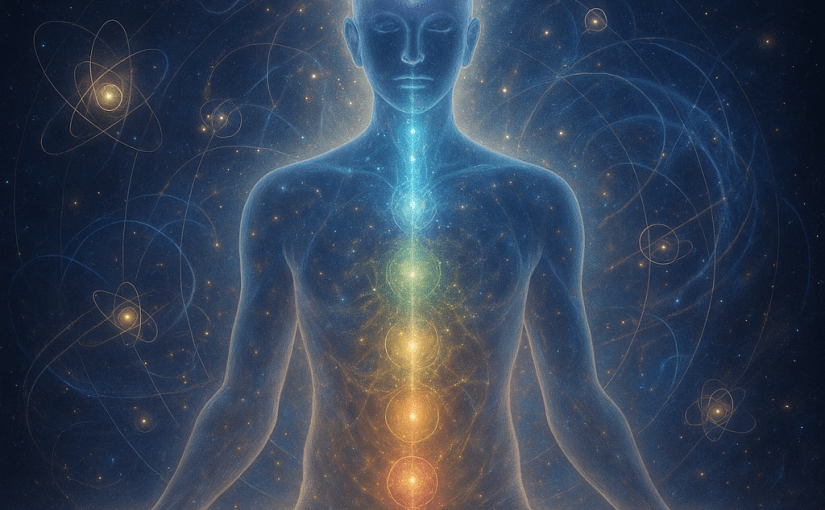
In deeper meditation, when the awareness is extended to the entire sitting body, something extraordinary is noticed. The body itself becomes a gateway to the cosmos. Every chakra within the body is a hidden archive of universal patterns. Within the heart lie echoes of cosmic emotions, within the throat the seeds of all expression, within the brow the visions of countless worlds. When the whole body is kept in gentle notice, the entire cosmos hidden within begins to open. Thoughts connected with the universe itself may arise, only to dissolve in the same silence.

Yet sometimes meditation feels blocked. Energy stuck at certain chakras creates a sensation of suffocation or heaviness. Breath automatically begins to focus on that region as if the body is trying to heal itself. This is not for oxygen but for prana, the subtle energy required by that chakra. Until these blockages are released, meditation remains shallow. Breathlessness is the sign of release. When, after working through the chakras, breath is naturally held at the end of inhalation or exhalation, a depth opens where suffocation disappears. The once-blocked chakra now feels free, or at least so subtle in its lack that it cannot stop the energy from rising. From this breathless stillness, meditation enters its deepest flow.

Actually, after mastering prāṇa through repeated yoga practice, one can hold the breath at will and focus on an energy-deficient chakra. That chakra then feels “hungry” for breath, producing a sharp, suffocating sensation. In reality, it is not hunger for air; it is hunger for prāṇa. When attention is placed on that sensation, the energy in the suṣumṇā naturally floods that chakra and satisfies it, even while the breath remains stopped or nearly absent. When all the chakras become fully nourished with prāṇa, a breathless and deeply satisfied state appears, which is wonderful and naturally leads to a mindless dhyāna-like stillness.

Seen in this light, the discoveries of Sanatan Dharma appear less as religious imagination and more as profound quantum insights in disguise. The sages saw that everything in existence is conscious in its own way, and thus they worshipped every element as divine. Stones, rivers, trees, animals, all were held as manifestations of the same conscious field. Idols and mandalas were not superstitions but symbolic mirrors to the cosmic order hidden within the atom and within the self. Today, quantum scientists too are beginning to wonder if consciousness itself plays a role in the collapse of possibilities into one outcome. The ancient and the modern are slowly meeting on the same ground.

Science shows the structure. Biology reveals the process. Matter, in its endless forms, presents the illusion of separation. But Sharirvigyan Darshan, the direct seeing of the body as a field of consciousness, dissolves ego through pure vision. In this vision, it becomes clear that the self is not an atom, not a cell, not a body. The self is the field in which all these arise and into which they dissolve. Ego may pretend to be the doer, but the atom has no such illusion. Ego may take ownership of thought, but thought itself is only a quantum ripple arising from silence.

The final freedom is nothing dramatic. It is the melting of ego, the end of false ownership. When this happens, silence itself shines forth, not as something achieved but as something that was always there. The self remains, untouched, unbroken, ever luminous. The journey through atoms, body, mind, and cosmos ends where it began, in the pure witnessing that needs no name.

Thus the story comes full circle. The human being entered the investigation thinking of himself as a separate doer and knower. He examined matter, cells, energies, and mind. He discovered that the atom does not claim doership, the body does not think, the mind does not own thoughts. The gunas act upon the gunas, and he is only the witness. In that recognition, the atom dissolved the ego. The silence behind all action became visible. That silence is the self, radiant and free.

And here ends the adventure of Sharirvigyan Darshan as Quantum Darshan, not in noise but in a quiet flowering. When the atom is seen as innocent of doership, the ego cannot survive. When the body is seen as a field of energies, the mind cannot cling. When thought is seen as a ripple in the quantum ocean, the self shines as the boundless sky. This is the final realization, simple and astonishing: the self was never hidden, only the illusion of doership covered it. With its melting, the journey finds its destination, and the seeker finds himself where he always was—free, silent, eternal.

My Journey Through Sharirvigyan Darshan, Tantric Kundalini, and Self-Realization

Friends, this is one of my favorite posts, deeply experiential in nature and reflective of my lifetime spiritual journey. Ever since I began exploring meditation, I noticed a subtle yet profound distinction between thought-based contemplation and the deeper, formless stillness of awareness. Raman Maharshi often said it is better to engage in neti-neti or non-dual contemplation, yet I realized that these experiences — as blissful as they were — were still transient. Nirvikalpa samadhi, on the other hand, creates chidakash or ekarnava, a stillness that abides for longer periods, whereas contemplation alone only gives fleeting glimpses.

Eventually, I understood that to sustain even the transient experiences of ekarnava, one has to embrace breathlessness. Before I experienced keval kumbhak, even after Kundalini awakening, self-realization, and non-dual awareness through sharirvigyan darshan, I could not fully comprehend thoughtless awareness. Yet I had immense bliss, rest, satisfaction, and a feeling of completeness — all connected to subtle thought. I realized that bliss and non-duality connected with thought could not reach the final state of fully thoughtlessness.

This led me to a subtle but important insight: after self-realization and Kundalini awakening, and even sharirvigyan darshan, one can attempt to reach breath stillness more quickly, because the ego is already weakened and the body-prana system more prepared. In the same way, Ramana Maharshi had cautioned against forceful breath control without inner maturity. He emphasized that natural keval kumbhak arises only when the mind and ego are ready. Forceful suppression might temporarily quiet thoughts, but it does not destroy the ego and can create strain or attachment.

In my observation, thought stillness slows the breath but does not stop it sufficiently or for long periods, whereas breath stillness immediately calms the mind and lasts longer. This is because thought is like waves on the lake’s surface — you can quiet them, but the lake still moves underneath. Breath, however, is like the spring feeding the lake: if the source of movement stops, the surface cannot ripple. This shows why prana stillness (keval kumbhak) is far more decisive for sustained thoughtless awareness.

Ramana Maharshi often said, “Mind and breath arise from the same source. To still one is to still the other.” Ego is the hidden source of both. When the ego weakens, prana settles naturally; when prana is still, the mind has no fuel for thought. In deep states, breath is the shadow of the ego. This simply means that in ordinary, laborious worldly activities, breath reflects not only the ego but also the need for oxygen. During deep meditation without ego, the breath itself fades, and awareness abides in pure stillness — the chidakash or ekarnava.

I noticed subtle variations in breath depending on ego orientation. Unequal inspiration and expiration reveal ego tendencies:

  • Longer inspiration reflects inward, self-centered attention.
  • Longer expiration reflects outward, world-centered attention.

This aligns with the ida–pingala–sushumna play in yogic physiology:

  • Ida (left, inward) → longer inhalation → self-absorption.
  • Pingala (right, outward) → longer exhalation → outer engagement.
  • Balance in breath → equilibrium between ida and pingala → sushumna activation → mind quiets → doorway to sustained stillness. That is why it is said that when breath flows equally through the left and right nostrils, dhyana becomes fixed quickly. This is because equal inhalation and exhalation balance each other, leading to a natural stillness of breath.
  • The up-and-down movements of the breath reflect both the vertical and left-right movements of Ida and Pingala: up for the left, down for the right. Actually, Ida Nadi feels more inclined toward inhalation or upward breath movement, while Pingala feels more inclined toward exhalation or downward breath movement.It is amazing. The left nostril activating Ida does create a subtle left-side dominance in energy, and right nostril activating Pingala creates right-side dominance.

Even a single complete breath moves awareness up and down: inhalation lifts consciousness inward or upward, exhalation spreads it outward or downward. Prolonged breathing keeps awareness oscillating. Only when prana rests in sushumna, in natural breathlessness, does awareness remain steady. Sushumna means that the breath is neither moving up nor down, but stays in the center; it is neither in the left nor the right, but centrally aligned—this corresponds to the breathless state, or Kevala Kumbhaka. Breathing through the left nostril brings the sensation of the breath moving through the left side of the body and more upward, and breathing through the right nostril brings the sensation of the breath passing through the right side and more downward. When there is no breathing, it is self understood that the breath is flowing neither through the left nor the right nostril, neither upward nor downward. When there is no left-right sensation, it is self-evident that the breath is central, along the midline of the body or through the backbone. The sensation also confirms this. Along with it, when there is no up-down movement in the breathless state, the breath is understood to be in the central line, precisely at the midpoint of that line. “No up-down movement” does not imply prana is physically fixed at the midpoint; it means prana is static along the central channel. Feeling it at the midpoint is a perceptual focus, not a literal physical location. It is amazing psychology and terminology, sometimes confusing too. At first, I used to think of Sushumna as a special type of heavenly breath, never imagining a breathless state for a living being, but my experience now shows otherwise. This is why destroying ego, reducing breath oscillations, and balancing breath are crucial. Ego is notorious in producing duality. Yet, with sharirvigyan darshan, the ego feels hurt — the body is revealed as a non-dual, ego-less and detached living system, not as “me,” and that hurt is purification, loosening the ego’s grip.

In a nutshell, Keval Kumbhak (breath stillness) and Sushumna breathing are synonymous. Both are highly praised in the scriptures and regarded as the direct doorway to liberation as well as the source of supernatural powers. Yet, liberation itself is the supreme power — beyond all others. Strictly speaking, Sushumna breathing (when ida and pingla flows are equal) prepares the ground and naturally matures into Keval Kumbhak, so the two are inseparably linked stages rather than exactly the same.

When breath flows equally through both nostrils, it shows that Idā and Piṅgalā are balanced and prāṇa is entering the Sushumnā, creating the right state for meditation; when this deepens, the breath may stop on its own without effort—this is Keval Kumbhak, the natural peak of Sushumnā flow where prāṇa is fully absorbed and the yogi rests in stillness.

The insight of sharirvigyan darshan was a turning point for me. I realized why I was drawn toward Tantric Kundalini Yoga after practising it consistently: in Tantra, contemplation or thinking, beautification, care, respect, and love toward the body are of prime importance—just as in Sharirvigyan Darshan—thus both complementing each other at both the physical and spiritual levels, leading to progressive development. It is another amazement. The cells of the body live without claiming doership of work or enjoyment, so why should I? This shook the ego profoundly, and freed prana or energy for meditation. Sharirvigyan darshan gave me a contemplative base — a rational, embodied insight — while Tantric Kundalini Yoga liberated my world-entangled energy, allowing me to offer it to the meditation image. This image, nourished by freed prana, awakened and became alive before me, not just a mental visualization. That living image led to glimpse of self-realization.

The sequence of my journey — Darshan → Energy Release → Image Awakening → Realization — mirrors the Tantric map of jñāna-śakti (knowledge), icchā-śakti (will), kriyā-śakti (action), and śakti (energy/awakening):

  1. Sharirvigyan darshan gave me knowledge.
  2. My choice to pursue Tantric Kundalini Yoga provided will. Although it originated itself through practice of sharirvigyan darshan. It is the most amazing part. In majority of scriptures, will is forced that seldom succeeds.
  3. The practice itself — offering energy to the meditation image — was action.
  4. The awakened image and glimpse of Self-realization was the manifested energy, śakti.

This phenomenon is interpreted differently in various traditions:

  • Tantra sees the image awakening as divine Shakti appearing in form, a sacred manifestation.
  • Advaita Vedānta regards it as a transitional phenomenon; the image is only a springboard — awareness turning inward leads to direct realization.
  • Yoga Sutras classify this as savitarka samadhi, where meditation on form (image) is energized and luminous, leading toward nirvitarka (formless stillness).

Had I pursued Tantric Kundalini Yoga alone, without sharirvigyan darshan, I could still have achieved realization with great difficulty and after prolonged practice, even getting none because favourable conditions do not sustain for long. Even after getting plainly, I would have missed the extraordinary bliss, creativity, and worldly play that arose naturally when freed energy flowed into the meditation image during normal worldly activities. This illustrates the difference between the nivṛtti-mārga (ascetic vertical path) and pravṛtti-mārga (world-affirming spiral path) of Tantra:

  • Nivṛtti: rapid, inward ascent, ego dissolves quickly, but world’s richness may feel muted. But failing it, one may feel astrayed forever.
  • Pravṛtti: spiral, celebratory ascent, energy sanctifies worldly life while also piercing into realization — what I experienced.

In my path, Sharirvigyan Darshan provided a non-dual type of insight, while Tantric Kundalini Yoga freed the energy bound to latent thoughts and impressions. This happened through two processes: carrying the non-duality of Sharirvigyan Darshan to its peak, and knocking out hidden mental activities. In this way, the last drop of available energy was extracted, with which the meditation image became alive by itself—just like drinking that very energy, similar to Goddess Kali drinking the bowl of blood—leading to glimpse of Self-realization. The world itself became part of the practice, joyous and meaningful, not something to escape. My experience beautifully combined both liberation and enjoyment, embodying the Tantric principle of bhoga-apavarga-samyoga — the union of divine enjoyment and liberation.

This journey shows that self-realization, energy mastery, and meditation image awakening can converge naturally when knowledge, will, and action align, and when the ego loosens its grip. Breath stillness (keval kumbhak) and mind stillness become inevitable outcomes, leading to sustained awareness, ekarnava, and chidakash, where thought, duality, and oscillation finally dissolve.

In essence:

  • Sharirvigyan darshan shook the ego and freed energy.
  • Tantric Kundalini Yoga harnessed that energy for inward ascent.
  • Meditation image became alive, serving as the doorway to realization.
  • Breath and ego gradually stabilized, leading toward sustained stillness.
  • The world became a stage for bliss, not a distraction.

My journey exemplifies a harmonious path where insight, energy, and practice converge, showing that the Self can be realized not only in withdrawal but also in full-bodied, joyful engagement with life.

Chapter 13: From Matter to Self – How Everything You See Is Already You

The journey that began with seeing the atom not as something hidden or separate but as the very stuff of the body and world now opens into a wider understanding. Once it is understood that atoms are not something out there, but the very essence of blood, bone, and breath, then the next step naturally arises: if atoms make up all things, then all things are already part of the same self. It means, if the thinking body is conscious or self, then thinking or superposition and deciding or collapse of quantum particles — and everything made of them — are also conscious or self. Atom makes the cosmos, atom makes the body. So atom is the father of all, and every piece of matter is a brother to human. Matter itself begins to reveal its secret—that it is not lifeless dust scattered in space, but a mirror in which the conscious self finds countless disguises. It means, it is the same self taking on many different forms. Things once worshipped as possessions—car, house, food, money—are now seen in a new way, as if they are all showing the same one reality.

The common mind is accustomed to worshipping matter in fragmented ways. A vehicle is adored as a symbol of status, money as a guarantee of security, food as a source of satisfaction, and a house as a shelter of pride. Yet strip them of their labels, look deep enough, and they are only clusters of atoms dancing in familiar forms. The very same atoms pulse through veins as blood, hold bones together as calcium, breathe life as oxygen. What appears as external wealth and what circulates inside as flesh and thought are not two substances but one continuum. In this realization, a door opens that does not belong to any religion or creed, for the logic is plain: if all is built from one pattern or blueprint like vibrations, energy, superposition, collapse etc., then all is essentially one.

When the claim of ego is gently dropped, the discovery becomes more intimate. The person once seen as enemy also breathes the same air, shares the same atomic foundation, and moves under the same laws of cosmos. Hostility then melts, not because of preaching or command, but because opposition itself loses its reality. It is like watching two waves fight on the surface of an ocean, forgetting they are water through and through. The ocean never quarrels; it only plays or does Leela.

Maanavata se bada dharm nahin, kaam se badi pooja nahin; samasya se bada guru nahin, aur grihasth se bada matha nahin”—this secret verse, discovered and propagated by the author, directly reflects the principles of quantum science. Although not really discovered, but researched and understood, as it has persisted since ancient times in one form or another. The first line, no religion is greater than humanity, reflects how countless probabilities in quantum physics collapse into a single event near the peak of the probability wave. This peak represents the peak development of the creation. Humans have the peak level of grey matter to carry forward the creation to that height. This makes humanity the true religion of the quantum world. To reach this peak, quantum particles select the best or highest-valued option among many, just as the human mind collapses multiple thoughts into a single decision of utmost humane significance. Most probably this peak of humanity aligns with the peak of quantum probability wave in this or that way. Although this happens naturally by quantum law, the human ego grows and claims that it was ‘I’ who did it. Suppose Ramu is living in Shimla with his family. Now consider the whole cosmos as a probability wave of his position. In theory, he could choose to live anywhere in the cosmos, but why only at his present place? Even this is fully true in practical terms too, a human can be reborn in that specific part of the infinite cosmos where its existence best serves the purpose of humanity. This is because the highest human potential for work and business is usually at familiar places, with accustomed and supportive people such as family members, friends, and relatives. When this potential for humane work declines at his native place, he has to migrate—just as countless people migrate elsewhere for the same reason. However, shifting always happens toward a favorable place, much like quantum particles relocating to a new position near the peak of the probability wave as the peak of humanity wave, and not arbitrarily. This is clearly seen in quantum tunneling, when a quantum particle shifts from one side of a barrier to the other, landing most likely at the peak of its probability wave. The particle does not actually travel physically; it is as if it ‘dies’ in one universe and is ‘reborn’ in another, more suitable universe, where it can contribute more effectively to the service of creation and humanity. That decision or wish to relocate becomes mental work, and its result expressed in action becomes physical work—together forming the only genuine worship of the quantum world, free from hypocrisy or flattery. Hence, no worship is greater than work, second verse of the joint verse is proved. The third verse, no guru is greater than the problem, shows that guidance does not come from outside only. A quantum particle adjusts and learns by interactions with other particles and overcoming obstacles; in the same way, humans grow by social interactions and solving problems in the service of humanity. The final line, no hermitage is greater than family life, explains that if quantum particles remained forever dissolved in stillness of pure awareness without interacting with other particles, or if one stayed only in Nirvikalpa Samadhi away from social interactions, no world could exist. Life continues because creation expresses itself through family and duties. Also, as told above, humanity grows best in a family type cooperative environment. In this way, the verse applies equally to the quantum realm, the macrocosm, and human society. Yes, interactions between cosmic bodies like stars and galaxies are similarly based on this quantum verse. The author lived this truth in letter and spirit, learning indirectly from the quantum world with the help of this so called quantum verse, attaining the essence of Karma Yoga along with glimpses of Kundalini awakening and self-realization. Beyond this stage, one may pursue Nirvikalpa Samadhi, but it remains optional—for one can also remain in Karma Yoga and Sahaj Samadhi always. Though few may reach such a nirvikalpa state, their indifference to worldly show does not harm the world’s activity; instead, their journey benefits society when others follow their footsteps from the very beginning, and not by trying to enter directly into samadhi. Since it is directly linked to the quantum world, this verse qualifies to be called a quantum verse.

If we dissect quantum behaviour further, every quality of a quantum particle exists as a separate probability wave, and these waves are independent, not interfering with one another. Similarly, each aspect of human life—where one is born, whom one marries, what profession one follows—arises in uncertainty independently. No one knows beforehand where a person will be born, but wherever it is, it carries the potential to contribute best to humanity. Marriage too is uncertain, yet it naturally aligns in a way that serves the larger good. A person may be born in a royal family and marry into poverty, yet both possibilities are part of the same unfolding toward humanity’s peak. One may appear inborn poor yet hold the role of a company’s CEO. In truth, it is the wave of humanity itself that determines these outcomes. If mutual relationships seem to appear among the different “waves” of life, it is only because they all are guided by that larger wave of humanity. Relationships among them are secondary; the primary movement is always toward the flowering of humanity.

This truth as told above deserves repeating: no guru is greater than a problem. In the quantum world, a particle is not instructed from outside—it learns by meeting resistance, by facing tension, by adjusting itself again and again. So too in human life, real challenges often teach more than any teacher. A problem can sharpen the mind, melt away pride, and give lessons that even the best guru cannot always sustain. Of course, the role of a human guide is valuable, but it is never enough on its own. Progress needs willingness, and though willingness can be encouraged by a teacher, it must finally rise from within. True growth comes from balancing the guidance of an external guru with the inner guru of lived experience. Returning once more to the verse, it concludes: no hermitage is greater than family life. If particles were to dissolve forever in stillness, nothing could appear—no world, no movement, no life. Creation is alive because stillness agrees to move, because silence becomes sound, because the inner withdrawal returns outward as relationship and duty. In the same way, family is not a barrier to realization but the very field where realization ripens. The home itself becomes the monastery, and daily life becomes the true ground of awakening.

As said above, the author of this vision did not leave these quantum truths as dry philosophy. They were lived, tested, breathed. Karma Yoga was not a slogan but a way of cleansing. Problems were accepted as teachers. Work itself became worship. This approach opened a doorway where the currents of Tantric Kundalini stirred, bringing glimpses of awakening and self-realization—achieved not in isolation, but alongside the fulfillment of worldly duties, obligations, and tangible physical progress. The body, when seen with clarity, is no longer only biology; it becomes Sharirvigyan Darshan—the science of body as mirror of cosmos and human behaviour. What nature has inscribed in the workings of cells is echoed in human society and even in cosmic evolution. Digging deeper, the pulse of metabolism reflects the pulse of stars, and the pattern of neurons echoes the pattern of galaxies. It means, steady pulse of metabolism in every cell reflects the pulse of stars, which are born, shine, and fade in cosmic cycles. Likewise, the intricate branching of neurons in the brain strikingly resembles the web of galaxies stretched across the universe. The tiny rhythms within us are not separate from the vast rhythms of the universe. Seen this way, the body is not an isolated fragment but a miniature cosmos, repeating on a small scale the same patterns that shape the stars and galaxies on the grandest scale.

Basic Sharirvigyan Darshan has already shown how viewing simple similarities between body cells and human behavior reveal unexpected wisdom. For instance, cells communicate, compete, cooperate, and balance survival with sacrifice—just as communities do. And when this insight is not merely thought but lived, its power is astonishing. The author, guided by such a karmic-yogic mindset, found the doors of Kundalini Yoga opening naturally, as if the body itself rewarded sincerity with vision. A glimpse of the serpent power uncoiling and rising gave a direct taste of unity, an experiential confirmation that the science was not mere speculation. Advanced Sharirvigyan Darshan dares to go further, suggesting parallels not only between cells and society but between atoms themselves and human workings. If atoms and human actions are reflections of each other, then studying one becomes a way to understand the other. When the physical parallels are seen, and the mind rests in egoless wisdom, truth is both confirmed and experienced. This idea is not yet fully tested, but its promise is immense. It suggests that life is like a play in which every moment and every particle reflects the whole. Time and space themselves are holographic, where each fragment carries the imprint of the entire universe. Just as in a hologram each fragment carries the complete image. It means, even a single fragment of endless time and endless cosmos reflects the whole of time and cosmos itself, showing that each passing instant and each quantum of space occupied by the quantum particle holds within it the signature of eternity. Therefore, it is possible to experience eternity at every moment and at every place by experiencing similarity between cosmos, human body and quantum particle.

Basic Sharirvigyan Darshan as indicated above, authored by the same author, has been well described in the published work The Mythological Body – A New Age Physiology Philosophy [Sharirvigyan Darshan]. Originally written in Hindi, it is thoughtfully translated here into English to make its insights accessible to a wider audience while preserving the depth and essence of the original. The work explains the striking similarities between the internal physical structures of the human body—cells, organs, and systems—and human behavior as well as societal dynamics. It demonstrates how patterns governing the body, such as communication, cooperation, competition, and balance, are mirrored in human actions and social organization, offering a unique lens to understand life as a reflection of universal principles. Extending this insight, the human body itself can be seen as the supreme living mandala, a microcosm containing countless dehapurushas—miniaturized, non-dual beings that work in perfect harmony, mindful yet unattached. Observing and contemplating these inner beings teaches lessons in non-duality, cooperative society, and even the nurturing of nature, while also serving as a practical and powerful gateway to Kundalini awakening and liberation. Through this understanding, the body becomes both a mirror and a guide, showing how true spiritual growth occurs naturally within the world, without the need for forced renunciation, and how life itself can gently lead one to detachment once a threshold of inner realization is reached.

In this way the story of matter becomes the story of self. The universe that appears vast, cold, and external softens into intimacy. A stone is not alien; it is kin. A stranger is not separate; he is the same play of atoms as the hand that writes. Even loss begins to transform, for nothing can truly vanish; it only reshapes its disguise. This realization does not demand retreat into caves or cloisters, though that too may be chosen. It equally allows one to remain in Karma Yoga, to live in Sahaj Samadhi—an effortless harmony where the ordinary world is no longer a trap but an open field for action without entanglement.

The thrill of this adventure is that it unites opposites. It makes science and spirituality kiss where they once seemed strangers. Quantum collapse becomes a metaphor for human decision. The activity of cells becomes a mirror of society. Family life becomes the monastery of the modern seeker. Every corner of matter becomes a temple because it is none other than the self in costume. Awe arises not from imagining miracles beyond reach but from seeing the miracle that is already present in every sip of air and every grain of dust.

See the brick fixed in the wall: its quantum particles have chosen to stay grouped, solid, and unmoving for years. For what? Only for humanity—enduring the suffering of weather as silent penance. What greater austerity than this? Its work of supporting the house is constant and unwavering. Living in a large family of bricks, it eases its burden through close interaction with its companions. In the heat of summer, it expands, releasing excess energy; in winter, it shrinks, huddling with others like family members conserving their shared vitality. In this way, it learns from environmental challenges how to adapt and interact to minimize suffering. This is not mere material behavior—it is cosmic psychology, inseparable from human psychology.

The mystery is not diminished by this understanding. Rather, it deepens. To see that everything is self is not to reduce it to a mechanical formula, but to watch the play of disguises with wonder. Why should the self choose to appear as tree, as river, as mountain, as laughter, as sorrow? The answer may never be pinned down, and perhaps that is the beauty. Mystery is not something to be destroyed by knowledge but to be embraced by deeper seeing. Just as a child never tires of looking at the ocean though it is only water, so the awakened mind never tires of looking at the world though it is only self.

I am pointing to the presence of Self in every particle, because only Self—consciousness—can think and decide as we do. What is non-Self is non-conscious. Thus, Self is synonymous with consciousness, while non-Self is synonymous with non-consciousness. In this way, there is nothing truly non-Self or non-conscious in the cosmos, for even quantum particles display a kind of choice or decision, reflecting the presence of consciousness. Everything is conscious. It has been strongly advocated by sanatan dharma where everything is worshipped.

The path from matter to self is not an abstract riddle but a lived possibility. The car parked on the street, the money folded in the pocket, the house filled with voices, the bread broken at the table—all are matter. But in a deeper gaze, they turn, shimmer, and reveal the self. It is the same journey atoms take when they become flesh, the same journey flesh takes when it becomes awareness. And from awareness arises again the sense of world. Round and round the circle turns, not to trap but to liberate, once the play is recognized.

Thus, the thirteenth chapter stands not as a conclusion but as an opening into a greater adventure. From atom to body, from body to world, from world to self, and from self again to cosmos, the circle is complete yet always expanding. The invitation is not to escape this dance, nor to be drowned in it, but to stand in its heart, free, luminous, at play—where everything seen is already the self in countless forms.

And yet, if everything you see is already you, what gives this shared self its many shapes — stars, rivers, mountains, and bodies? The answer lies in mass, the quiet architect that turns the oneness of matter into the diversity of form.
Do Cells Have Hidden Intelligence? Scientific Mysteries and the Path to Egolessness

For centuries, scientists have tried to unlock the secrets of life by studying its smallest unit—the cell. On the surface, a cell appears to be just a biological machine, operating through chemical reactions and genetic instructions. However, when we look deeper into cellular behavior, some fundamental questions remain unanswered. Are all the activities of the cell completely understood, or is there a hidden layer of mystery? How do cells perform such complex actions with precision beyond the capabilities of pure chemistry? And can thinking about the working of cells help us mentally evolve towards egolessness and freedom from doership? These questions open the door to a deeper reflection that combines both science and philosophy. Modern biology has indeed mapped out many of the cell’s functions. We know how DNA is copied, proteins are synthesized, energy is produced, and communication happens through chemical signaling. At the mechanical level, this knowledge is detailed and widely accepted. Yet, when we consider how billions of cells in the human body work together in perfect harmony—especially during embryonic development where each organ forms in exactly the right place—we see a level of precision that is not fully explained by known science. Cells do not simply follow fixed programs; they adjust, adapt, repair themselves, and sometimes decide to self-destruct if they detect severe damage. This behavior is sometimes referred to as “cellular cognition” or “biological intelligence.” While cells do not have consciousness like humans, their decision-making processes appear strikingly similar in structure to human mental choices. Each cell seems to participate in a process of possibilities—much like a thought exists in the mind as a superposition of ideas—and then collapses into action, like a decision. Some researchers believe there may even be a deeper, quantum layer involved in this. In plants, for example, quantum processes are already known to occur during photosynthesis. Birds are thought to use quantum entanglement for navigation. Inspired by this, theorists like Stuart Hameroff and Roger Penrose have proposed that microtubules inside cells might act like quantum computers, processing information in a way that is beyond classical chemistry. Though this remains unproven, it raises the possibility that life itself could involve quantum effects. Another great mystery is the origin of life itself. Science still does not know how the first living cell appeared from non-living matter. The transition from lifeless molecules to a fully functional cell remains one of the biggest unanswered questions in biology. All this leads to a philosophical reflection. While it is clear that cells are not equal to humans in terms of consciousness, their workings seem to run in parallel. This parallelism provides a mental support system to develop egolessness and freedom from the false sense of doership. When we realize that trillions of cells in the human body work tirelessly without ego, serving the whole without claiming credit, it naturally brings humility. If the cosmos and the body function without an individual ego, then why should a fleshy human body cling to the illusion of “I am the doer”? In my own contemplation, I feel that each cell is like a tiny human, complete in its tasks but selfless in its purpose. This thought often connects me to the image of Narayana in Ekarnava—the formless cosmic truth that appears in the emptiness of meditation. When I think of this unity between the cell and the cosmic order, it gives me an intuitive hint that this vision is pointing toward truth. Human-like complex activities, even more complex than what we consciously do, cannot be performed by chemicals alone. There is surely something deeper—perhaps in the form of microtubules acting as hidden information processors within the cell. This does not mean cells have human consciousness, but their parallel way of working can support a mental shift in us, helping dissolve ego and the burden of doership. In this view, Sharirvigyan Darshan—the philosophy of the body and cosmos—finds a bridge with modern science, where the smallest unit of life silently reflects the grand cosmic play.

Quantum Collapse and Consciousness: Ancient Wisdom Meets Science

Ancient seers of India declared something deeply mysterious yet simple: “What exists outside in solid, permanent form, exists inside as subtle, transient image.” This is not just poetic philosophy—it may now be echoed in modern quantum physics and brain science. The world we see outside appears fixed, while our thoughts and inner perceptions seem soft and fleeting. Yet both may arise from the same hidden process: quantum collapse. This is where the Orchestrated Objective Reduction (Orch-OR) theory, proposed by physicist Roger Penrose and anesthesiologist Stuart Hameroff, offers a stunning bridge between ancient darshan and modern science.

In the quantum world, particles can exist in many states at once—a situation called superposition. But when they collapse into one state, reality “chooses” an outcome. Penrose believed this collapse is not caused by an observer but by the universe itself—through objective reduction (OR). He theorized that when gravitational effects within spacetime reach a certain threshold, the superposition collapses into a single, irreversible event. This is not just a shift in physics—it might be the spark of a conscious moment.

Hameroff then linked this to the brain, particularly to microtubules, which are tiny cylindrical protein structures inside neurons. These microtubules, made of tubulin proteins, were once thought to be mere skeletons of the cell. But Hameroff noticed their crystalline structure, internal symmetry, and electrical polarity, and proposed that they could support quantum computations.

Now, let’s clarify something important: When we say “quantum computation,” we don’t mean the microtubules are solving algebra or statistics. They aren’t doing math like a calculator. Instead, they are holding patterns of possibilities—like “yes” and “no”, or “apple” vs “orange”, or “fear” vs “love”—in superposition. These potential mental states exist all at once, and then, when a collapse happens inside the microtubules, one option becomes real, and that becomes your conscious moment. It’s like the universe makes a tiny choice through you, within you.

This model offers an answer to something classical neuroscience can’t explain: How do mere firing neurons produce subjective experience—qualia? And why do we have moments of understanding, intuition, or insight that no computer can reproduce? Penrose argued, using Gödel’s theorem, that human insight is non-algorithmic—it can’t be computed by step-by-step logic. Orch-OR proposes that the brain bypasses classical logic using non-computable, quantum-level processes, which might be the very source of consciousness.

But wait—isn’t the brain warm and noisy? How can delicate quantum processes survive in such conditions? This is the biggest challenge. Normally, quantum coherence—the state where particles stay in perfect sync—is destroyed quickly in warm environments due to decoherence. This is like trying to keep a soap bubble alive in a thunderstorm. Yet, surprising examples in nature show it’s possible.

Photosynthesis in plants uses quantum coherence to move energy efficiently. Birds navigate using quantum entanglement in their eyes. Even our sense of smell may involve quantum tunneling. These examples, under the emerging field of quantum biology, show that nature finds ways to protect and use quantum effects even in wet, warm environments—just like the brain.

In microtubules, regions called hydrophobic pockets may shelter tiny quantum states from the noise. These proteins also contain dipoles, which are like tiny bar magnets with a positive and negative end. These dipoles can oscillate—they vibrate or swing back and forth—and may do so coherently, like a choir singing in perfect harmony. This creates a system that can store, process, and collapse information in a quantum way. When these dipole oscillations collapse, they may produce specific conscious outcomes—such as a decision, a thought, a feeling, or a perception.

So, what’s actually being “computed”? Not equations. Not logic gates. But experience itself. The microtubules are theorized to integrate emotions, sensations, perceptions, and thoughts, holding many potential outcomes at once. When collapse happens, only one possibility becomes your actual experience. This is the kind of non-algorithmic computation Penrose speaks of—a moment of meaning rather than mechanical output.

Some critics say that anesthesia can knock out consciousness simply by shutting down classical brain activity. But Hameroff’s insight was that general anesthetics also bind to tubulin in microtubules. That’s key. Consciousness disappears when microtubule function is blocked, not just when neurons stop firing. Still, this is not conclusive, because anesthetics also affect synaptic transmission. It’s hard to isolate which effect is responsible. Yet, the link between tubulin and anesthesia remains one of the strongest clues in favor of Orch-OR.

Another key point: not all decoherence is the same. Depending on where and how the collapse occurs, the output differs—a thought, a decision, a feeling, a dream. So, different forms of decoherence may correspond to different forms of consciousness. And not every collapse needs to involve the whole brain—some may be small, local, producing micro-conscious events. Others might involve large-scale coherence, creating full-blown awareness, like insight, choice, or even spiritual experience.

In the end, this brings us full circle to what the ancient sages said. The outer world is permanent because its quantum states collapse universally and remain fixed. The inner world is subtle and ever-shifting, because its quantum collapses happen inside us, constantly. Yet both arise from the same quantum process. The brain is not just a machine—it may be a sensitive quantum receiver and projector, constantly receiving and collapsing the cosmic possibilities that flow through consciousness.

So, you are not just observing the universe—you are where the universe chooses. Through microtubules, through quantum collapse, through a moment of awareness…
the cosmos becomes aware of itself.

That is why the sages have always said: “Whatever you do, it is not your will—it is God’s will.” This does not mean you are helpless, but that you naturally act according to the situation, like nature itself does. Just as the universe collapses quantum possibilities into the most fitting outcome, you too respond based on the unfolding of circumstances, not from isolated ego. This is not a mystical guess but a pattern seen everywhere—from human consciousness to the workings of body cells, atoms, and even the entire cosmos. Sharirvigyan Darshan presents the same insight, showing that human life, cellular behavior, and cosmic events follow the same fundamental process of synchronized adjustment to nature’s flow. Recognizing this frees you from ego and karma bandhan, because you realize: you are not the isolated doer; you are a participant in the universe’s grand orchestration.

Why Do We Get Stuck? A Quantum Insight Into Depression, Happiness, and Letting Go

In life, we all experience many moods and mind states—joy, sadness, courage, fear, excitement, boredom. These are natural waves of consciousness. But somewhere along the journey, many people make a silent mistake: they get attached to one mental state and start believing it is permanent. This is one of the root causes of suffering.

People fall into depression not just because life is hard, but because they begin to think, “This sadness is final. This is how my life will always be.” Suicidal thoughts often come from this same illusion—the belief that one unbearable feeling is the whole truth of existence, with no possibility of change. People lose happiness not because joy is absent, but because they get trapped in one emotional corner of the mind and forget how naturally shifting life actually is.

This is where Sharirvigyan Darshan, the science of understanding life through the body and the atom, offers a simple but powerful insight.

Look at the quantum world, the very foundation of life. The particles inside every atom—electrons, protons, photons—never cling to one state. They exist inside what physicists call the quantum field, a state where multiple possibilities are always alive at once. The quantum field is like an open playground, where a player can do anything—jump, sit, lie down, roll, squat, walk, run, or stand still. All these actions are present in potential, but the player chooses one depending on the moment. The other actions remain available, silently waiting, not lost. Similarly, in the quantum world, when the right condition appears, one possibility crystallizes into reality, while the others gently step back into the field of maybes.

Now compare this to the human mind. Our consciousness also holds many options. We can think new thoughts, feel new emotions, and take new actions. But we get stuck when we obsessively identify with one mind state, believing, “This is me, and this is final.” This leads to stress, anxiety, depression, and sometimes even the tragic decision to give up on life. But nature itself doesn’t behave this way. Your own body is proof. Right now, trillions of atomic decisions are happening in your cells, constantly shifting, adjusting, and choosing the next best state according to the present moment. Life is not designed to be rigid—it is designed to flow.

So what is the solution? Sharirvigyan Darshan teaches you to remember your atomic roots. Like the quantum field, you too are standing in an open playground of possibilities at every moment. If sadness is present, let it pass through you like a temporary action in the field—but don’t block joy, courage, or peace from blooming next. The universe is constantly shifting between possibilities. Particles don’t get stuck—they shift when needed. Why should you be any different?

This is not just philosophy—it is how reality works. Learning to live like the quantum world means letting go of obsessive clinging to one mental state and allowing life to unfold naturally, just as it was designed to do.

The Forgotten Science Hidden in Sanatan Dharma: Sharirvigyan Darshan

Most people revere Sanatan Dharma for its timeless rituals, chants, and philosophies. One core belief repeated across scriptures is that “God resides in every particle.” But is this belief truly understood in its deepest sense? Or is something even more transformative hidden beneath the surface?

What if the real key lies not just in seeing God in all, but in seeing our own body—our very self—in all?

Welcome to the long-forgotten lens of Sharirvigyan Darshan—the “Science of the Universal Body.”

God in Every Particle: A Partial Realization?

Sanatan rituals condition us to see divine presence everywhere—stones, trees, rivers, temples, even the flame of a lamp. We bow to idols, chant mantras to the sun, and perform havans believing that the subtle forces of nature are divine embodiments.

But psychologically, a subtle duality persists. We worship those forms as God’s bodies—separate, superior, abstract. We rarely think: This is my own body, extended and reshaped.

This separation—between self and divine matter—blocks a great transformation.

Sharirvigyan Darshan: All Matter Is Living, Like Us

According to ancient seers (and now echoed by holographic science), every particle of matter reflects the whole. That includes you. Your consciousness is not trapped in your body—it is extended throughout the universe.

In this vision, a stone is not inert—it is a dense, dormant body form of the same universal consciousness. Air, water, sky, fire—they are not just tattvas, they are your other limbs.

When this realization dawns—not just intellectually but experientially—it brings powerful effects. Why?

Mental Burden Sharing: A Forgotten Technology

The human mind is a storage house of unresolved thoughts, emotions, fears, and desires. Normally, we carry this load alone—because we feel alone. But the moment we genuinely perceive the world around us as alive like our own body, a miraculous thing happens:

Your mind unconsciously releases and shares the burden with the rest of existence.

Not out of escapism, but through connection.

It’s like downloading files to the cloud. You don’t destroy them—you just no longer carry them on your limited hardware.

Why Rituals Work Faster with Sharirvigyan Darshan

Many rituals are designed to invoke transformation—cleansing, clarity, peace. But their power becomes amplified when we drop the separation between “me” and “that idol,” “me” and “this river,” “me” and “this mantra.”

When you light a diya, and feel your own inner light spreading into space…

When you bow to a tree, not as a divine other, but as your own living presence in wood-form

Then ritual becomes real. Transmission occurs. Healing is instant.

This is what Sharirvigyan Darshan awakens.

Why Personifying Only God Isn’t Enough

Sanatan Dharma encourages seeing personified gods in all forms—Shiva in the mountain, Lakshmi in gold, Hanuman in the wind. But we never dare to see ourself there.

Not as the egoic self, but as the universal self—the one that wears infinite bodies.

Because of this gap, our mental garbage doesn’t transfer to the larger body of the universe. We keep hoarding, looping, suffering. We unconsciously believe only God can handle all this—not our own extended body in its cosmic form.

Conclusion: Reclaim the Forgotten Science

Sanatan Dharma, when re-understood through the lens of Sharirvigyan Darshan, reveals a deeply practical metaphysics. A living psychology. A spiritual neuroscience. A path where rituals aren’t symbolic—they are technologies of mental distribution and energetic integration.

Let us no longer just believe that God is in everything.

Let us remember:
We are in everything.
We are everything—not in ego, but in essence.

Even your ego, your mental noise—whatever your state of mind at any moment—can be included in the whole by simply believing it to be part of everything. Why? Because as per holographic science, every part of existence is a complete human-like body in itself.

No matter how small the particle, if you keep searching deeper and deeper, you’ll find—at every level—a structure that reflects the living human form. Every speck of matter carries the blueprint of consciousness. Every atom is not just alive—it’s you, in another form.

That shift makes all the difference.

That’s why I’m amazed by how effortlessly Sharirvigyan Darshan unfolds in the company of Sanatan Dharma. The reason is clear—both are rooted in the same fundamental principle: the presence of consciousness in all forms.

Yet, Sharirvigyan Darshan acts as a deeply enriching add-on. It doesn’t replace Sanatan Dharma—it illuminates it from within. When both are combined, they give wings to spiritual transformation, making the journey more experiential, grounded, and complete.

How an Endoscopy Triggered a Nondual Awakening: A Hidden Parallel with Dhauti Kriya

Once, after undergoing an endoscopy, I experienced a strange and unexpected shift—a transformation marked by a subtle but clear nondual awareness. It wasn’t the usual meditative insight or blissful state. It was raw, neutral, and intensely present. I could feel the endoscope entering, touching the inner lining of my stomach, crossing it, and going even deeper into the small intestine, right into the belly’s core. The body was utterly passive—there was no choice, no resistance that could prevent the process. What ego remains in a body that cannot stop the entry of an unwelcome foreign object? That question echoed somewhere deep and unfamiliar.

Though I didn’t feel that it changed anything on the surface immediately, with time, I started sensing that some layer of my subconscious structure had been pierced. The sense of control, subtle tension, and the feeling of “I am the body” had taken a hit—not visibly shattered, but weakened. This moment didn’t bring sudden enlightenment or peace. But it quietly accelerated a journey I was already on—a path of nonduality, one increasingly flavored by a kind of holographic sharirvigyan darshan, a direct perception of the body not as “mine,” but as a transparent field of changing phenomena.

Looking back, the whole experience now feels similar to what yogic traditions aim for in dhauti kriya. Especially in Vastra dhauti or Vaman dhauti, where cloth or water is intentionally introduced into the digestive tract. These aren’t just about cleaning the stomach. They are about softening the grip of the ego through raw confrontation with the body’s inner vulnerability. In both dhauti and endoscopy, the deepest part of the body—where the manipura chakra resides—is entered, stirred, and exposed. In the silence that follows, something becomes undeniable. The doer is missing. The ownership feels fake. There’s just sensation and witnessing.

I now see how such kriyas, when done with awareness, aren’t only about purification. They are tools to break the boundary between the inside and the outside, to dissolve the illusion of control, and to reawaken a primal intelligence that doesn’t belong to the mind or ego. My endoscopy was clinical, sterile, and completely non-spiritual in intention. But still, it acted like a mirror—a sudden and sharp insight into the powerless ego and the ever-present field of awareness that holds everything, even medical instruments and internal helplessness, without flinching.

This event taught me that not every spiritual push comes in the form of light or bliss. Some come quietly, disguised as helplessness, medical procedures, or discomfort, but if the mind is ready—or even half-cracked open—they do their work. And the journey moves forward, not always dramatically, but inevitably.