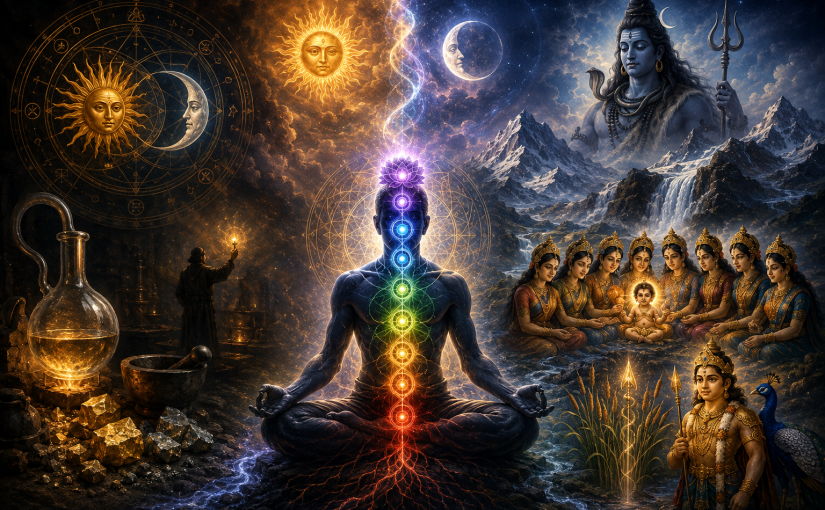
The Common Pattern of Alchemy, Tantra and Kundalini
A striking correspondence appears when the symbolism of the Emerald Tablet, tantric ideas of kundalini, and the traditional narratives of Kartikeya’s birth are examined together. This does not mean that the Emerald Tablet is literally a tantric text, that Kartikeya’s story was deliberately written as a chakra diagram, or that the two traditions necessarily influenced one another. Their histories are distinct. The important observation is structural: each can be read as describing a concentrated generative potential that is produced through complementary principles, carried by an intermediary force, progressively nourished or refined, and ultimately transformed into a higher or perfected state.
The Emerald Tablet is a short Hermetic text rather than a complete description of the whole alchemical process. Its central teaching begins with a unified principle, the “One Thing,” from which multiplicity arises. It describes the Sun as Father and the Moon as Mother, followed by the statement that the wind carries the generated principle in its womb and that the Earth nourishes it. The text then speaks of separating the subtle from the gross, ascending from earth toward heaven and bringing the powers of above and below together. Later alchemical traditions developed such imagery into the Magnum Opus, the great work of purification, separation, transformation and reunion, culminating symbolically in perfected matter, the Philosopher’s Stone and the transmutation of base metal into gold.
The phrase concerning the wind is especially important. The wind is not presented merely as something that transports an object; it carries the principle “in its womb.” The imagery therefore combines movement with containment and gestation. In a comparative yogic reading, this is reminiscent of prāṇa or vāyu: not simply physical air, but the vital movement associated with breath and subtle activity. The parallel should not be turned into the claim that the author of the Emerald Tablet was describing Indian prāṇāyāma. The historical evidence does not establish that. The meaningful comparison is functional: an already generated potential requires a medium through which it can be carried, developed and transformed. Similarly, earth symbolizes the Muladhara Chakra because it provides the constant foundation and nourishment necessary for its growth and ascent. Earth, or grounding, is also symbolically associated with the Muladhara in Tantra. This does not mean that the earth described in the Emerald Tablet refers specifically to the Muladhara Chakra; rather, the symbolic parallel between the two is clear.
The Tantric Parallel
Tantric and yogic traditions provide a different vocabulary for a similar transformational pattern. Kundalini is traditionally described as a latent power that can be awakened and directed through the subtle body, particularly through Suṣumṇā, the central channel. The chakra systems vary between traditions, and the familiar seven-chakra model is not universal across all historical yoga, but the later widely known model presents successive centers from the base of the subtle axis toward the crown. Within this framework, the process is not simply transportation from one point to another. Each stage can be understood as a transformation of the original potential.
This is why the correspondence becomes more precise when the chakras are regarded as stages of refinement rather than as seven physical containers. The generative potential associated symbolically with the lower center is progressively transformed as it passes through successive levels. Prāṇa provides the mediating movement, while Suṣumṇā represents the central route of ascent. The culmination is associated with the highest state of consciousness, traditionally symbolized by Sahasrāra. This should not be confused with a claim that chakras or Suṣumṇā are physical anatomical structures. They belong to a traditional subtle-body model and can be studied scientifically as a phenomenological and contemplative system without being presented as established anatomy.
The role of breathing must likewise be stated precisely. Yogic breathing practices regulate breath and prāṇic activity, but kundalini awakening is not traditionally reduced to mechanically pushing an energy upward by respiration alone. Different traditions combine breath regulation with concentration, meditation, purification, bodily locks and other practices. Thus the useful analogy with the Emerald Tablet is not “air physically carries semen through seven organs,” but rather that a concentrated potential is mediated and transformed through a regulated vital process.
The Birth of Kartikeya
The Kartikeya birth narratives provide a striking mythological parallel. There is no single uniform version: the Rāmāyaṇa, Mahābhārata and Purāṇic traditions arrange the roles of Śiva, Agni, Gaṅgā, the Kṛttikās, Svāhā and the reeds differently. Yet several versions share the central idea that an extraordinary generative power associated with Śiva cannot proceed through ordinary reproduction. It must be transferred, contained, carried and developed through several intermediary stages before Kartikeya is born.
The seven Kṛttikās are traditionally maternal figures who nourish Kartikeya and are associated with the Pleiades. The identification of these seven mothers with the seven chakras is not an explicit statement of the ancient myth and should therefore be treated as an esoteric interpretation, not a historical fact. Nevertheless, the symbolic correspondence is unusually coherent. If the seven Kṛttikās are interpreted as seven successive centers or stages, their nursing represents the nourishment and maturation of an already generated potential. The original essence is not merely transported unchanged; it is developed through successive levels until it can manifest in a new form.
This gives the Kṛttikās a particularly interesting symbolic relation to the chakras. The chakras, in this interpretation, are not merely passages. They are stages of gestation and refinement. What begins as a concentrated generative potential at the lower level is progressively transformed into increasingly subtle expression. The “nursing” of the seven mothers therefore becomes a mythic image of progressive development.
Himalaya, Gaṅgā and Suṣumṇā
The later stages of the Kartikeya narrative can also be read through a yogic symbolic framework. The Himalaya may be interpreted as an image of the great spinal axis, the mountain being the archetypal vertical structure of Indian sacred geography. Gaṅgā, which carries the developing essence in relevant versions of the story, can then be compared symbolically with Suṣumṇā, the central current of the subtle body. The comparison is not that the myth literally defines Gaṅgā as Suṣumṇā; it is that both function within their respective symbolic systems as a central route through which something transformative is carried.
The reeds at the final stage can similarly be read as an image of the place of culmination, corresponding symbolically to the highest region of the subtle ascent and, in a later tantric vocabulary, to Sahasrāra. Again, the reeds do not historically have to mean Sahasrāra for the comparison to be meaningful. The sequence itself is what matters: origin, transmission, sevenfold nourishment, central passage, culmination and birth.
Kartikeya’s birth can consequently be interpreted as the birth of an awakened principle. The significance is not ordinary biological reproduction but transformation: a powerful potential that begins in an unmanifest or unstable state passes through containment, nourishment and refinement until it emerges as a qualitatively different being. This is closely analogous to the alchemical movement from crude matter toward gold.
The Meaning of the Generative Essence
The sexual terminology in these traditions should therefore be understood primarily as symbolic language for concentrated generative potential. Where Kartikeya traditions speak of Śiva’s semen or reproductive essence, it is unnecessary—and scientifically unjustified—to claim that physical semen literally travels upward through the spine and becomes kundalini. The stronger interpretation is that reproductive substance represents concentrated creative potential: something capable of generating new life and therefore an effective symbol for energy that is retained, transformed and redirected toward another form of manifestation.
The same principle helps clarify the Father and Mother of the Emerald Tablet. They need not signify ordinary biological parents. They can represent complementary principles, such as active and receptive, conscious and transformative, or solar and lunar aspects. Their conjunction generates the potential; the wind carries it; the Earth nourishes it; and the process of separation (from worldly lust) and refinement (with help of meditation image constantly in mind) brings it toward perfection.
Thus the central subject is not sexual activity but generation, retention, mediation, refinement and rebirth.
The Alchemical and Yogic Meaning of Transmutation
This also explains why the alchemical transformation of base metal into gold is such a powerful parallel. Taken literally, historical alchemy sought material transformation and the Philosopher’s Stone. Taken symbolically, the same language describes the movement from the crude to the perfected, the impure to the purified, and the divided to the unified. Gold becomes an image of completion and incorruptibility.
In the tantric interpretation, the corresponding transformation is from an unawakened or conditioned human state into awakened consciousness. In the Kartikeya myth, an extraordinary generative power passes through a process of transmission and nourishment before becoming Kartikeya. In alchemy, the raw material becomes gold. The outward symbols differ, but the underlying narrative is similar: potential is not merely released; it is transformed.
This distinction is important. Kundalini should not simply be equated with semen, the Philosopher’s Stone should not simply be equated with Sahasrāra, and Kartikeya should not simply be equated with awakened consciousness, and Kritika not to be equated with an anatomically located chakra. The deeper correspondence is between processes rather than objects.
The Most Precise Comparative Model
The three systems can therefore be placed beside one another in a single sequence. In the Emerald Tablet, the One expresses itself through complementary Father and Mother principles; a generative essence arises; the wind carries it in its womb; the Earth nourishes it; the subtle is separated from the gross; ascent and descent bring higher and lower powers together; and perfection is achieved. In the tantric model, latent potential is awakened; prāṇa mediates its movement; successive chakras refine it; Suṣumṇā provides the central route; and the culmination is awakening. In the Kartikeya narratives, Śiva’s extraordinary generative power is transferred, contained, nourished through the Kṛttikās in relevant versions, associated with the mountain and Gaṅgā, and finally manifested as Kartikeya.
The common structure can therefore be expressed without forcing one tradition into another: unity or concentrated potential → complementary principles → generation → carrying medium → nourishment and progressive refinement → central ascent or transformation → culmination → emergence of a perfected state.
This is stronger than the simple assertion that “alchemy is Tantra” because it does not depend on proving an uncertain historical connection. It identifies a functional similarity in the way different traditions represent transformation.
A Scientific Boundary
A scientifically responsible interpretation must also distinguish experience from physical mechanism. Modern research can investigate breathing, meditation, attention, autonomic regulation, sensory changes, altered states of consciousness and the subjective experiences practitioners associate with kundalini. It cannot presently establish chakras as physical organs, Suṣumṇā as an anatomical channel, or the literal conversion of semen into an independently measurable substance called kundalini. The traditional subtle-body system is therefore best treated as a religious, contemplative and phenomenological model unless specific claims acquire independent empirical evidence.
That limitation does not make the model meaningless. A disciplined spiritual tradition can contain repeatable practices, defined procedures, recognizable stages and recurring experiences without being identical to modern physical science. What may legitimately be called experiential knowledge is knowledge obtained through structured practice and observation of experience. Whether such knowledge qualifies as “science” in the strict modern sense is a separate question requiring reproducibility, operational definitions and independent measurement.
The Full Meaning of the Parallel
The most compelling insight is therefore not that an ancient alchemist secretly knew the chakra system or that an Indian myth secretly describes modern physiology. It is that three very different symbolic traditions repeatedly use the same broad image of transformation. Something primordial or generative is concentrated; complementary principles participate in its formation; a medium carries it; successive stages nourish and refine it; the transformed potential moves toward a higher condition; and something new is born.
In the Emerald Tablet, the result is expressed through alchemical perfection and gold. In Tantra, it is expressed through the awakening and ascent of kundalini toward higher consciousness. In the Kartikeya narrative, it appears as the extraordinary birth of a divine being after a prolonged process of transmission, nourishment and maturation. The correspondence is therefore best understood neither as proof of identity nor as a coincidence to be dismissed, but as a meaningful comparative pattern: what is latent can be retained, carried, refined and transformed until it emerges as a higher state of being.
That is the deepest point at which the alchemical, tantric and Kartikeya narratives meet. Their languages differ, their histories differ, and their literal claims must remain distinct, but their central transformational imagination is remarkably close: the crude becoming refined, the latent becoming manifest, the divided becoming integrated, and the ordinary becoming awakened.
Discover more from Demystifying Kundalini
Subscribe to get the latest posts sent to your email.


