Why Osho’s Observation About Sex and Samadhi Feels Experientially True
Osho’s statement that sex can give a glimpse of samadhi begins to look much more meaningful when it is examined as an experience rather than as an idea. At the peak of sexual climax, there can be a brief interruption of ordinary thinking. The mind, which is usually filled with thoughts, images, expectations, memories and self-consciousness, can suddenly become completely quiet. For a moment, there may be no ordinary mental activity at all. In that limited sense, the experience can resemble a glimpse of samadhi. It does not necessarily mean that orgasm itself is samadhi, but it can reveal something important: when ordinary thought stops, consciousness can have a very different quality.
This distinction becomes especially important when comparing the experience with the different forms of samadhi described in yoga. There is a kind of high-energy awakening in which sexual or tantric energy becomes intense, consciousness expands, self-realisation appears, and there is a powerful sense of awakening or transcendence. Such an experience can resemble what I call savikalpa samadhi. At its peak, there may be a glimpse of energetic awakening, as I experienced. There is still something happening that can be experienced. There is still a subtle quality of consciousness, a sense of witnessing, bliss, expansion, energy or self-awareness. The mind may be extraordinarily quiet, but there is still some content to the experience.
What I am discussing here, however, is something different. I am referring to nirvikalpa samadhi, understood as the void in which even the ordinary structure of experience disappears. This is far more difficult to recognise. It is not simply a state in which there are few thoughts. Having few thoughts by itself can just as easily be a sign of dullness or mental inactivity. Nor is it merely extraordinary pleasure, bliss, energy, extreme wakefulness, extreme mental activity, trance, or even a sense of witnessing. It points toward a state in which the usual distinction between experiencer and experience is no longer available in the ordinary way. There is a complete absence of thought, yet it is not a state of mental blankness or inactivity. On the contrary, there is an unmistakable fullness of wakefulness—as though the mind is completely alive and fully active, yet without thought. There is no particular thing being experienced, no separate experiencer standing apart from it, and nothing to grasp or describe. It is simply this.
The difficulty is that we normally recognise consciousness through its contents. Here, the contents are absent, but consciousness is not. It is fully awake without being occupied by anything.
Why Nirvikalpa Samadhi Is So Difficult to Recognise
Nirvikalpa samadhi has a paradoxical quality that makes it especially difficult to describe. In one sense, it can resemble sleep because there is no ordinary memory of what happened during the interval. Yet it is not the same as unconscious sleep. In sleep, we ordinarily say that we were unconscious and later woke up. In deep samadhi, the question becomes much more subtle because the mental machinery that ordinarily produces experience, observation and memory may itself have become inactive.
This creates an extraordinary paradox. There may be no experience available afterward that can be described in the ordinary sense, and yet the person may know that something fundamentally different happened. There may be no ordinary content to remember, yet there may be a profound recognition of the transition and of the difference between that state and ordinary unconsciousness. It is therefore not quite accurate simply to say, “I experienced nothing.” A more careful description would be that there was no experiencable object there in the ordinary sense, yet the state did not feel equivalent to ordinary sleep.
This is also why nirvikalpa samadhi can be difficult to recognise the first time. Someone who has never gone deeply into meditation may experience a brief absence of thought and assume that they have fallen asleep, become exhausted, fainted, or simply lost a part of the experience. I had a similar thought when I first experienced keval kumbhak. I initially assumed that I had become tired and simply gone blank, but I soon realised that it was something entirely different.
Someone who has already experienced deep meditation has a useful inner reference point. They can compare the new experience with what they have already known in meditation and recognise the difference more easily.
That is why a person with genuine experience of deep samadhi may be better able to recognise a samadhi-like glimpse during another extreme state of consciousness. Someone like Osho, who spoke from a background of deep meditation, could potentially distinguish between ordinary pleasure, excitement, blankness, unconsciousness and a genuine cessation of mental activity. He could point toward something that most people otherwise struggle even to imagine.
The Difference Between the Orgasmic Glimpse and Nirvikalpa Samadhi
The most accurate way to understand the sexual experience is therefore not to say that orgasm is nirvikalpa samadhi. Rather, the sexual climax may sometimes provide a brief glimpse of the cessation of ordinary mental activity. It can show, in a form that is immediately accessible to human experience, what happens when thought suddenly stops.
There is an important difference between the event itself and what follows. The sexual climax can be very brief, whereas meditative samadhi may continue for a prolonged period. The climax may therefore act more like a doorway or a glimpse, while meditation allows the deeper state to be entered and observed more fully. In this view, the most interesting evidence is not merely the thoughtless moment at orgasm but what happens immediately afterward.
In my experience, the sequence matters enormously. If the body and mind are brought into a calm, wakeful state and the sexual peak is followed immediately by sitting quietly in meditation, the subsequent meditation can become remarkably effortless. One does not have to struggle to establish concentration in the usual way. Instead, the mind can settle almost immediately, and the person may enter a deep meditative state for a long period. Kevala kumbhaka, or a naturally breathless state, can arise without deliberate forcing. Meditation may remain deep for an hour or even two hours.
This is very different from simply becoming sleepy after sex. If one becomes exhausted, lies down and falls asleep, there is no opportunity to investigate the transition. The entire process has moved into ordinary unconsciousness. The possibility of observing whether the orgasmic glimpse can open into a deeper meditative absorption is simply lost.
Wakefulness, Calmness and the Quality of Sexual Experience
This makes the quality of the sexual experience extremely important. It is not simply a question of stronger stimulation or greater excitement. In fact, excessive excitement may interfere with the very phenomenon being investigated. When the sexual act becomes overly intense, agitated or forceful, attention can become scattered and the body can become exhausted. After discharge, the person may quickly become sleepy and fall into ordinary unconsciousness.
The experience seems more interesting when it takes place in full wakefulness and alertness, rather than late at night when the body is already tired and the mind is naturally approaching sleep. A calm and relaxed sexual experience may preserve a much clearer quality of awareness. There may be no need to force anything. The act can feel gentle, quiet and almost automatic, as though the body itself is carrying out its own natural process.
This is an important distinction between intensity and clarity. A more powerful experience is not necessarily a more useful one for investigating consciousness. What matters is whether awareness remains awake while effort, psychological interference and unnecessary excitement decrease. The ideal described here is not an act dominated by force or shock, but something calm enough that it almost seems as though “the body is doing itself.”
That quality is especially important if the intention is to observe what happens immediately after climax. If one remains awake, quiet and physically settled, the moment can become an object of careful inner observation. If one becomes drowsy and falls asleep, there is no such observation. The opportunity has passed.
The Importance of Sitting Immediately in Meditation
There is therefore a very practical point in this whole observation. If the aim is to investigate whether the brief thoughtless state at climax can lead naturally into deeper meditation, one needs to remain still afterward. Sitting calmly in a stable posture such as padmasana gives the body an appropriate environment in which to settle.
The sequence is then very different from simply returning to ordinary life. Sexual climax may be followed by a brief cessation of thought. If, at that precise time, one gets up, starts working, begins talking or becomes occupied with external activity, the mind soon becomes active again. The same thing happens if one simply goes to sleep. In either case, the meditative possibility is interrupted.
By contrast, sitting immediately in meditation allows the transient opening to be explored instead of being wasted. The sequence becomes sexual climax, brief thoughtless or void-like glimpse, immediate stillness, effortless settling, natural kevala kumbhaka or breathlessness, and prolonged meditation. The sexual experience may be only the beginning of the transition, while the subsequent meditation provides the real opportunity to investigate what has happened.
This also explains why the condition of wakefulness is so important. One needs enough alertness to recognise the transition and remain still without disturbing it. The body may have completed its physiological activity, but the mind has not yet returned fully to its ordinary pattern. That narrow interval may be especially interesting for someone who already knows deep meditation.
How Prior Meditation Changes Recognition
This brings me back to the most important distinction. Someone who has never experienced deep samadhi may not know what to look for. But someone who has already entered prolonged meditative absorption can compare the quality of one state with another.
This does not mean that every orgasmic climax is samadhi, nor that every moment of blankness is nirvikalpa. It means that prior meditation provides a phenomenological reference. The person has already experienced what deep absorption feels like, has already encountered kevala kumbhaka, has already seen how ordinary thought can disappear, and has already become familiar with the difference between deep meditation, sleep, excitement and unconsciousness.
Therefore, if a brief state during orgasm appears strangely familiar and is followed immediately by effortless deep meditation, the person is in a better position to notice the relationship. The strongest part of the observation is arguably not the claim that climax itself is nirvikalpa, but that the climax may create a brief opening followed by a state in which meditation suddenly becomes effortless.
Sharirvigyan Darshan Makes the Philosophy Practical
This is where Sharirvigyan Darshan becomes especially lively. The philosophy does not have to remain a system of abstract ideas. It can become a way of observing the body directly.
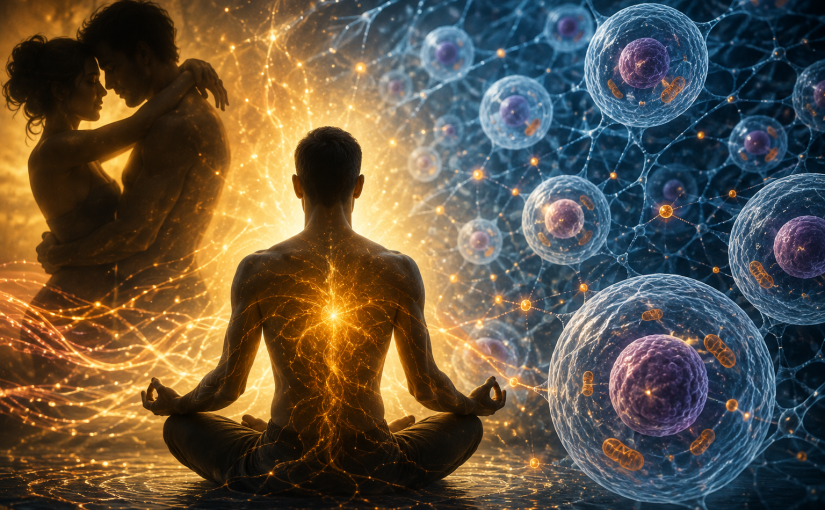
When two bodies meet sexually, instead of thinking only in terms of two personalities, two desires or two psychological identities, one can observe the meeting of two living bodily systems. There are sensations, breath, rhythm, muscular movements, nervous responses and countless cellular processes taking place continuously. The body is performing its own functions without needing the conceptual mind to supervise every detail.
During sex, the body is naturally fully activated, with all its systems and cells intensely engaged in the process. Yet the cells themselves are mindless. Their intense activity is not accompanied by excitement, anxiety, resistance, or psychological disturbance. Their mindlessness can therefore be understood not as unconsciousness or ignorance, but as a kind of inherent calmness—a “calm-mindedness” in which there is no separate mind to become disturbed. If they had a mind with attachment, as a living being does, they would also have an unconscious mind. But they never had such a mind; so from where could ignorance arise? Ignorance is only an after-effect of attachment. Since there was never attachment in the first place, there is no ignorance either. Their mindlessness is therefore not ignorance or unconsciousness; it is simply the absence of a mind that could become attached and disturbed. Observing this can help the human mind remain calm even while the body is intensely activated.
If the body’s cells can be intensely active without any mental disturbance, then why should the observing mind necessarily become disturbed merely because the body is highly activated? The activity of the body and its cells can continue fully while the observing mind remains calm. This is where Sharirvigyan Darshan becomes practical rather than theoretical: it allows one to see intense bodily activity without adding unnecessary mental excitement to it.
The idea of the karmayogi cell becomes especially relevant here. A cell does not think, “I am performing an action for myself.” It simply performs its function. It works without the egoic story that usually surrounds human action. Applying this way of seeing to the larger body can create a similar attitude: allow the body to function rather than constantly trying to impose an idea of what it should do.
The result is not indifference but observation. There can still be intense bodily experience, but the mental attitude becomes cooler and more spacious. The sexual event is no longer viewed merely as a pursuit of pleasure. It becomes an opportunity to observe the body, the mind, the cessation of thought and the transition from activity into stillness.
From Sexual Experience to Meditative Investigation
Seen in this way, the entire subject becomes less about sex itself and more about the nature of consciousness. Sexual climax happens to provide an unusually sharp and accessible moment in which ordinary thought can suddenly disappear. Meditation provides the environment in which that disappearance can be investigated more deeply.
The essential sequence is therefore not simply sex followed by pleasure. It is wakeful awareness, calmness, minimal force, natural bodily action, a brief cessation of ordinary thought, immediate stillness, and meditation. The more excited and exhausted the body becomes, the more difficult it may be to observe the transition clearly. The calmer and more alert the person remains, the more interesting the observation becomes.
This also gives a more careful interpretation of Osho’s teaching. He may have been pointing out that an ordinary human experience already contains a tiny hint of a profound truth. At climax, there can be a moment in which the mind stops its usual commentary. That moment can serve as an experiential clue. A person who has not meditated may simply enjoy it and forget it. A meditator may recognise that something significant has happened. A person deeply familiar with samadhi may be able to compare that moment with states already known through meditation.
The deepest insight, however, is not to confuse the glimpse with the destination. A sexual climax with calm, peaceful, and spontaneous sexual release may offer a temporary interruption of thought. Savikalpa samadhi may involve profound absorption in which some subtle awareness or content remains. Nirvikalpa samadhi, as understood here, points toward an even more radical void in which the ordinary structure of experiencer and experience disappears. The sexual moment may therefore provide a doorway, while prolonged meditation reveals what happens beyond that doorway.
A Living Experiment in Consciousness
What began as a statement about Osho and sex therefore becomes a much broader investigation of consciousness. Sex can sometimes reveal a sudden cessation of ordinary thought. Deep meditation can reveal that stillness more deliberately. Prior experience of samadhi can provide the reference necessary to distinguish it from sleep or simple exhaustion. Remaining awake and sitting in meditation immediately afterward can reveal whether the temporary opening naturally facilitates deeper absorption.
For me, this is where Sharirvigyan Darshan becomes remarkably alive. It takes philosophy out of books and places it inside direct observation of the living body. The body is not treated as an obstacle to spiritual experience but as a field in which consciousness, energy, sensation, breath and action can be observed without unnecessary interference.
The most intriguing possibility is therefore not that sex itself is samadhi, but that certain qualities of sexual experience may expose a doorway that meditation can explore more deeply. When excitement becomes calm, force becomes effortless action, thought becomes silent and the body seems to perform itself, an unusual threshold may appear. If one remains awake rather than becoming unconscious, sits quietly rather than returning immediately to activity, and allows meditation to continue without force, that threshold may become the beginning of a much deeper investigation.
Perhaps this is why the connection between sex and samadhi can be meaningful without reducing samadhi to sex. The sexual experience may provide a glimpse. Meditation provides continuity. Prior experience provides recognition. And Sharirvigyan Darshan provides a practical way of observing the entire process with coolness, wakefulness and minimal interference. What begins as an ordinary bodily event can then become a living experiment in the mystery of thoughtlessness, awareness, void and samadhi.
Discover more from Demystifying Kundalini
Subscribe to get the latest posts sent to your email.


