bhayankara rasa in quantum world

In Nātya-Śāstra, Bhayānaka Rasa is not merely “fear” as an emotion felt by the self, but the Rasa that evokes fear in the audience or observer — it is fear-producing, not fear itself.

So, in quantum terms, it’s more like the creation of instability or resonance that induces tension in another system, rather than the contraction of one’s own system (which we earlier associated with Bhaya / Fear).

Bhayānaka Rasa — Fear-Producing / Dread-Creating

Quantum Resonance as Disturbance

In physics, interactions propagate through fields, and a particle or system in an excited or unstable high-energy state can influence nearby particles by inducing oscillations or disturbances through well-defined mechanisms such as electromagnetic coupling, even across a distance. This influence is governed by measurable laws and does not imply emotion or intention. By analogy, in human experience, intense inner states also spread through interaction rather than contact. A person overwhelmed by stress or rage may appear highly charged—his tension visible in the eyes, face, and posture. Without speaking or acting, this state can unsettle those nearby. In Indian aesthetics, the contracted, agitated condition within such a person is termed Bhayānaka Rasa. In observers, the resulting response is bhaya, or fear. Spiritually understood, this comparison is metaphorical: just as physical disturbances propagate through fields by interaction, psychological tension propagates through perception and awareness, without implying that human emotions follow quantum laws.

Quantum Tunneling as Threat Potential

In physics, a particle may sometimes appear in a region where classical reasoning says it should not exist, creating a sense of unpredictability. A similar reaction occurs in the human mind. Fear and horror often arise not from direct harm, but from the sudden appearance of the unknown. When a stranger enters one’s familiar territory from an unseen path or unexpected direction, the mind immediately imagines possible dangers—attack, theft, or loss—before any action has taken place. This anticipatory tension is recognized in Indian aesthetics as bhaya—the felt experience of fear arising from suspense and uncertainty. The source that generates or radiates this tension is termed Bhayānaka, the fear-producing rasa. Spiritually, this distinction reveals a subtle truth: events themselves do not create fear; fear arises when the mind receives and mirrors a Bhayānaka expression and becomes dual like it, projecting potential tragedy into the unknown. A Bhayānaka person is always dual and attached, and he is generally driven by the urge to snatch or take something from the potentially fearful person. A nondual and inwardly free person, who wishes nothing and is detached, has no reason to become Bhayānaka, since he does not want to snatch anything violently; likewise, no one will feel fear toward him, because there is no anticipation of loss through him. Sometimes, however, a nondual person, due to prolonged exposure to the powerful energy of a Bhayānaka person, may begin to turn dual like him and then start feeling bhaya after living for some time in his company. This indicates that nondual contemplation—through quantum darśana or similar insight—needs to be strengthened and accelerated to prevent such influence. It also means that a Bhayānaka person is not necessarily an enemy, but may act as a friend or even a guru, indirectly helping the seeker mature nondual contemplation and grow spiritually through challenge and contrast.

I gained much spiritual growth through this Bhayānaka-produced bhaya challenge. In a way, this challenge has hovered around me since my first breath. It taught me a bhaya-free life of nonduality and detachment instinctively. Many times, seeing my nondual weapon winning, the bhayānaka weapon was upgraded against me, and I again upgraded my defending nondual weapon. Thus, this tug of war always went on—sometimes the defensive nonduality weapon was stronger, and sometimes the attacking duality weapon. Many duality weapons were eventually upgraded into nonduality weapons by coating them with the armor and shield of ‘non’ matter, influenced by the effectiveness of non-duality. Some took a long time, some took less. Ultimately, the nonduality weapon wins, as it is the nearest to truth. Actually, this is the situation for everyone—fear of the environment, fear of animals, fear of elders, fear of teachers, and fear at every step. All of this exists to teach us, inspire us, and help us grow.

Wavefunction Collapse and Observer Effect

In physics, observation collapses many possibilities into a single outcome. A similar process operates in human experience. When uncertainty is present, the mind holds multiple possible futures, but the moment authority, threat, or high stakes enter—like a strict boss assigning one task with warning—those possibilities shrink into a single demanded outcome. Fear arises not from the task itself, but from the sudden narrowing of freedom. However, one can gain unbelievable power from nondual śarīra-vijñāna darśana or quantum darśana to counteract fear and still function fully under the command and rule of law. This is my personal experience, not merely a philosophy. Art and drama use the same principle: by restricting attention and delaying resolution, they generate tension and suspense. Spiritually, fear is understood as the mind’s reaction to constraint, while actually awareness remains untouched by the collapse of possibilities, just as happen in the quantum world.

Quantum Instability / Chaos

In physics, systems that operate at the edge of stability are highly sensitive to small perturbations; even minor disturbances can trigger noticeable changes when balance is fragile, as interactions propagate through fields by well-defined physical mechanisms. A similar pattern appears in human experience. Bhayānaka arises when an event, action, or presence signals potential instability—loss of control, unpredictability, or imbalance—before any actual harm occurs. This signal makes observers alert, anxious, and tense, not because danger is certain, but because uncertainty has been introduced. Fear (bhaya) in others is generated when the mind mirrors this perceived instability, borrowing disturbance through perception rather than through any literal transfer of force. The fear-producing state (Bhayānaka) exists in the source, while fear itself (bhaya) arises only in the observer who allows inner imbalance to form. If this mirroring does not occur, fear is not produced, even in the presence of apparent threat. From a nondual perspective, both the fear-producing and the fearful are understood as transient expressions of the same underlying reality, comparable to temporary oscillations within a single field. When this quantum darśana is stable, distinctions between threatening and threatened dissolve, and fear loses its apparent reality—not through suppression, but through understanding. Simply put, when the targeted person finds himself equally disturbed as the targeting person, he begins to balance himself, as no one wishes to become like someone who intends to harm him.

Bhayānaka Rasa and the Quantum Reflection of Consciousness

Human experience suggests that inner emotional states are often reflected outward, as if the world responds in kind. These patterns are also seen in the quantum world in a similar manner. Bhayankara Rasa or aggression, Fear, calm, or harmony perceived outside—or observed in the quantum world—frequently mirror corresponding movements within consciousness. From this perspective, it appears as though worldly objects and even quantum particles behave analogously to living beings—not literally possessing organs or chakras, but expressing corresponding qualities or tendencies, such as love–hate linked to the heart chakra or interaction and expression linked to the throat chakra. Just as human emotions are connected to subtle centers of awareness, or chakras, one may then ask why it should not be said, analogously, that quantum particles also possess a body and chakras like human beings, or that a quantum particle is, in itself, a complete human being.

Fear, Polarity, and Kundalini Awakening

One may understand this symbolically: a single, unified soul appears to divide into two tendencies—attachment and aversion, attraction and repulsion, plus and minus. In a similar way, pure awareness manifests as particle–antiparticle pairs. The “plus” tendency slightly outweighs the “minus,” allowing the manifested world of humanity to continue and grow, just as matter dominates over antimatter in the observable universe. In this sense, the human being can be seen as a living expression of these polarities, sometimes acting as a particle, sometimes as its opposite. Even people can be categorized as plus, minus, or neutral, depending on which polarity predominates within them or whether both polarities have annihilated each other. After this apparent division, the soul experiences a loss of wholeness and naturally seeks to return to completeness. This movement often takes the form of growing sāttvikatā—an increasing refinement and purity of consciousness through worldliness with nondual awareness—whose extreme culmination is realized through Kundalini awakening and self-realization. actually awareness in spiritual context is always nondual awwareness. Actually, without a nondual attitude, awareness is simply differentiating worldly awareness, not spiritual or true or pure type one. Tantric traditions seek to accelerate this process within a single lifetime by consciously engaging with the so-called “minus” world through pañcamakāras, under discipline, awareness, and proper guidance. Used rightly, these act not as objects of attachment but as a recoil force, like rocket propellant, giving a powerful push toward transcendence. When attachment arises, however, the minus tendency overwhelms the plus, leading not to wholeness but to stagnation, as unresolved urges remain. It is simply a premature or raw wholeness that cannot provide liberation, as one has not yet reached the peak of worldliness through sattvikatā. In a similar way, the outer world does not collapse prematurely, but first reaches a peak stage of evolution, which is analogous to self-realization in the inner world. This stage may be understood symbolically as the enlightenment of Brahmā, after which its liberation occurs through the dissolution of the world, known as pralaya. This represents a mature annihilation of the plus and minus aspects of existence with each other. At the end of the world, one may symbolically imagine antiparticles appearing in balance, allowing particles and antiparticles to combine again and return to a state of initial void of complete pure awareness. Non-tantric spiritual paths also cultivate sāttvikatā, but often more slowly, lacking the intense friction generated by engagement with rājasic and tāmasic forces; thus awakening may unfold gradually, sometimes across many lifetimes. A comparable pattern is seen in physics, where particles and antiparticles are constantly produced together and annihilate each other. Antiparticles are not useless; their presence provides the conditions through which a small excess of particles persists, allowing the physical universe to expand and evolve. Symbolically, the continual creation and dissolution of lower tendencies like bhaya, bhayankara etc.—within oneself or observed in others—serve as a contrast and stimulus for higher growth, suggesting that those who embody negativity are not merely “bad,” but often become the very conditions that inspire others to be good, and the good to become even better. Those deeply attached to lower states may dissolve into repeated up–down cycles, while those inclined toward balance draw inspiration and momentum from this contrast, avoiding annihilation until reaching the peak of awakening and self-realization. In this way, fear (bhaya) and the fear-producing state (Bhayānaka) become meaningful forces within consciousness—not as final truths, but as dynamic tensions that propel awareness toward greater clarity and wholeness.

Bhayānaka Rasa: Surface Disturbance, Inner Stillness

Bhayānaka Rasa refers not to fear felt within oneself, but to the state or expression that produces fear in others. While bhaya is the personal contraction of the mind in response to perceived danger, Bhayānaka is the outward radiance of tension, suspense, or dread. It arises when an event, character, or atmosphere signals instability or threat, making the observer alert and uneasy even before anything harmful occurs. This rasa is widely employed in storytelling, drama, and art, where fear is deliberately evoked through uncertainty and anticipation. Yet from a nondual, quantum-aware perspective, both Bhayānaka and bhaya are understood as surface-level expressions only. Just as oscillations, fluctuations, and interactions continuously appear in the quantum world while the underlying field remains unaffected, outward expressions of fear may arise without disturbing inner stillness. One may therefore express or witness Bhayānaka or Bhaya outwardly—like an actor in a drama—while inwardly remaining calm, centered, and untouched, with disturbance confined only to the surface and not to the core of awareness just like wavy surface of inner calm ocean.

Like other negative worldly emotions, bhayānaka and bhaya tends to attach themselves to the remaining positivity within a person. When one becomes attached to fear or repeatedly identifies with it, this negativity (tāmasikatā) can overpower and even annihilate one’s accumulated sāttvikatā. Such attachment may lead to a kind of premature inner collapse, where growth toward wholeness is arrested. However, through detachment born of quantum darśana—the insight that all such states are transient surface expressions—fear can be neglected rather than resisted. In this detached stance, fear no longer binds; instead, it becomes a source of momentum. The presence of negativity then acts as a contrast that inspires the seeker to strengthen sāttvikatā further and further, until it reaches a level that can no longer be pulled back or annihilated by tāmasikatā. In this way, what once threatened dissolution functions like rocket propellant—providing thrust for irreversible inner ascent rather than drag or backward movement toward destruction.

Nonduality as the End of Fear: Freedom from Bhaya

Simply speaking, the best method to prevent bhaya is freedom from worldly attachments, or in other words, the cultivation of a nondual attitude. Fear exists because of the anticipation of losing something to which one is deeply attached. If there is nothing held tightly, and if everything is already accepted as lost, then there remains no anticipation of loss and, therefore, no bhaya. In this way, fear dissolves naturally. Human beings first become dual, and from this duality arise deep attachments to negativity or darkness, often rooted in unresolved and buried violent tendencies within. When such energy is projected outward, the person embodying it appears bhayānaka to others. This negativity may indeed cause loss or harm to a targeted person. Yet if the target is attached to possessions, identity, or outcomes, fear arises; if the target has already relinquished everything through nonduality-born detachment, fear cannot take hold, because there is nothing left to lose. When the bhayānaka individual sees that his fear-producing power fails against such inner freedom, he gradually loses faith in that weapon. Observing the victory of nondual detachment, he too may be drawn toward freedom, inspired by the one who remained untouched.

Fear, Contraction, and the True Path of Expansion

One who is afraid makes others afraid. It is because his consciousness is contracted. He has not yet experienced the full expansion of consciousness to the ultimate limit of awakening and self-realization. Therefore, he fears that he will have to put in great effort again to expand his consciousness.

But one who has once awakened through self-realization does not worry about this contraction. He has already tasted the fully ripened fruit. Now he moves toward Nirvikalpa Samadhi — beyond words like contraction or expansion of consciousness — into pure void. For him, the journey becomes easier, because worldly expansion of consciousness can no longer lure him back.

The fearful person, however, tries to regain expansion of consciousness through the world. He believes it is possible only through outer means. So he attempts to snatch from others, and as a result, others become afraid of his behavior. Yet this is the wrong way to expand consciousness. Because of the guilt it creates, his consciousness contracts even more.

The correct way of expansion is to avoid harming others, or to cause minimal harm. Then consciousness rises easily and quickly toward awakening. From such a peaceful walker, no one feels fear — even though he may be expanding his consciousness far more than the aggressive walker.

Quantum Analogy of Fear and Cooperation

In quantum physics, when a quantum system collapses from a wave of possibilities into a fixed particle state, it becomes localized and rigid. If such a collapsed entity strongly interacts with other quantum entities, it can disturb their superposition as well. Through forceful interaction, it induces collapse in them. In simple terms, a collapsed quantum state can trigger collapse in nearby systems.

This is similar to fear spreading through interaction. One contracted system creates disturbance, and disturbance reduces coherence. When both systems are collapsed and localized, their behavior becomes more particle-like — rigid, defensive, and limited. In such a condition, the probability of returning to a broad wave-like superposition decreases, because repeated disturbance reinforces localization. In physics, this resembles increasing decoherence.

However, interaction does not always have to be violent or forceful. Quantum systems can also become coherent. When interaction is gentle and aligned, phase relationships synchronize. Instead of forcing collapse, the systems enter cooperative coherence. In such coherence, even a localized state can gradually regain wave-like characteristics through constructive interference.

In this analogy, cooperation corresponds to quantum coherence. Rather than collapsing each other through fear-driven disturbance, systems align and stabilize one another. The result is collective amplification instead of mutual contraction. Expansion then is not achieved by snatching energy, but by resonance.

Thus, in quantum terms, fear behaves like forced measurement causing collapse, while cooperation behaves like phase alignment creating coherence. In coherence, growth becomes shared rather than competitive.

Those who fear themselves make others afraid—
just as disturbed quantum states tend to disturb other quantum states.

Vrindavan Within: How Cows, Prana, and Self-Awareness Open the Door to Nirvikalpa Dhyana

Vrindavan Not as a Place but as an Inner Field of Self-Awareness

The understanding began very simply and very directly, not as philosophy but as lived seeing. Vrindavan appeared to me not merely as a sacred town associated with stories and devotion, but as a field of self-awareness inside. This inner Vrindavan is not created by imagination; it is discovered when awareness becomes calm, spacious, and naturally present. In this field, nothing is forced and nothing is rejected. It is a place of inner softness, where awareness rests in itself without struggle. The idea that Vrindavan exists within is not symbolic poetry alone; it reflects an actual experiential landscape that becomes available when attention settles into its own source.

Cows as the Senses and Grass as Subtle Bliss

Within this inner Vrindavan, cows reveal themselves as the senses. Senses are often treated as enemies or distractions, but here they appear gentle, habitual, and innocent, just like cows. They move toward nourishment naturally. The nourishment they seek, in a meditative inner state, is not gross pleasure but subtle, blissful, calm, and peaceful thoughts. These thoughts feel like grass—soft, tender, refined, and non-violent. Grass is nourishment that does not agitate; it sustains without intoxicating. When blissful and sattvic thoughts arise in meditation, they are like this grass, feeding the senses without disturbing awareness.

From Inner Grass to Outer Grain and Worldly Activity

Grass, however, does not remain grass forever. When it grows outward, when it matures and hardens, it becomes grain. Grain is useful, productive, and necessary, but it is denser and harder. In the same way, subtle inner bliss, when expressed outwardly, becomes worldly activity. The outer world is not wrong or inferior; it is simply condensed sensory awareness. What is soft and fluid inside becomes structured and solid outside. The gross world is like hard grain, while the inner field remains like living grass. This distinction is crucial: it shows that worldly life is not separate from inner awareness, only a different density of the same reality.

Cow Grazing as Calm Sensing Without Disturbance

When cows graze peacefully, they do not fight the grass nor cling to it anxiously. They simply eat. Similarly, when the senses function calmly, without craving or resistance, sensing continues but does not bind. This is the meaning of cows grazing in the inner Vrindavan. Sensing happens, but awareness remains untroubled. There is no suppression of the senses and no indulgence. There is only relaxed participation. In this state, life flows smoothly, and awareness remains intact.

When grain is shown and fed to cows, they struggle to get it, fight with each other, and eat it with craving and attachment. They appear disturbed and restless. This disturbance also affects the cowherd, because he now has to actively control them.

Similarly, in the outer world, the senses behave like furious animals rather than grazing cows. They no longer move calmly but rush toward objects with craving and competition. This agitates self-awareness as well, because it must struggle to restrain and manage the senses instead of resting naturally in witnessing

The Cowherd as Witnessing Self-Awareness

The most important presence in this inner scene is the cowherd. The cowherd does not graze, does not become the cows, and does not consume the grass. He watches, guides lightly, and remains free. This cowherd is witnessing self-awareness itself. It is not effortful observation and not mental vigilance. It is simple presence. When witnessing becomes strained or intentional, the inner Vrindavan turns into a field of discipline. When witnessing is natural, it becomes play, or līlā. Awareness simply remains aware.

Krishna as Self-Awareness Itself

At this point, Krishna appears not as a mythological figure. He may have been incarnated in the Dvāpara Yuga, as scriptural stories always carry double meanings—both internal and external. Yet here, Krishna is revealed as the very essence of self-awareness. He is not the mind, not a personality, and not an individual doer. He is the effortless center of attraction that awareness naturally has when it rests in itself. That is why Krishna never forces anything. He does not command the cows; they come on their own. Self-awareness does not push the senses inward; alignment happens naturally when conditions are right.

The Flute as the Subtle Body and the Seven Chakras

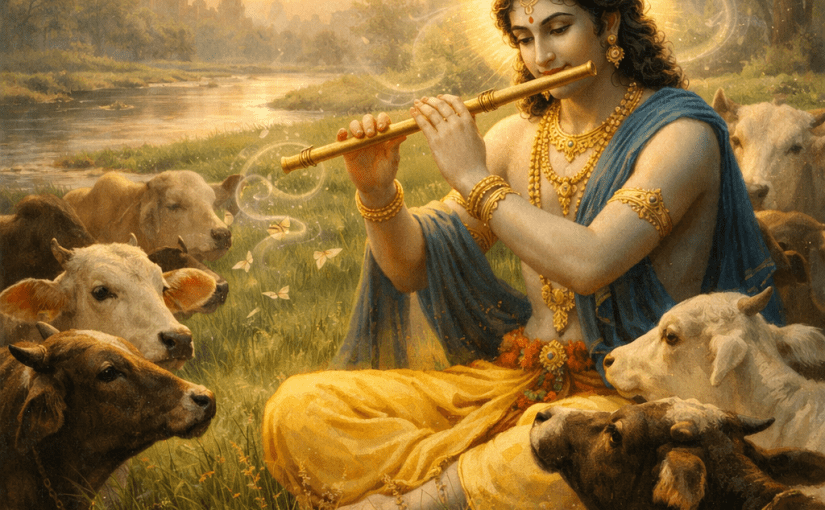
Krishna’s flute reveals another layer of lived understanding. The flute is empty inside, just like the subtle body must be empty of egoic tension to function as an instrument. It is helped by nonduality. Its seven holes correspond to the seven chakras of the body. Without holes, there is no sound; without chakras, there is no expression. The body itself does nothing. It becomes music only when prana flows through it under the presence of awareness. This emptiness is not absence but readiness. Prana flows through different chakras, invoking different expressions and emotions. It is as if different sounds are emerging from the flute.

Playing the Flute as Natural Prana Flow

Krishna playing the flute is awareness breathing prana through the subtle body. This is not forceful pranayama and not controlled breathing. It is natural breath, unstrained and effortless. Awareness does not blow hard; it simply allows prana to pass. Because of this alignment, the sound produced is irresistibly harmonious. In yogic terms, when awareness and prana align, the entire system becomes coherent. When awareness and prana align means prana becomes so subtle that it is equal to void-like awareness. Its subtle music is so refined and harmonious that the senses, which are feeding on grain in the gross outer world, leave it and move toward inner Krishna playing the flute in inner Vrindavan, to graze again on grass. As the breath passes through the flute and becomes almost zero-like, even the grazing senses calm down so deeply that they themselves dissolve into void.

Cows Leaving Grass as Entry into Nirvikalpa

When the flute sounds with feeling of breathlessness, the cows leave even the grass and move toward Krishna. This moment carries the deepest yogic meaning. Grass itself represents subtle bliss and sattvic pleasure. When cows leave the grass, it means the senses abandon even refined enjoyment. They are not suppressed; they forget themselves. This forgetting is nirvikalpa. There is no object, no experiencer, no claim of bliss. Even the thought “I am experiencing bliss” disappears. There is only absorption.

Why Nirvikalpa Cannot Be Held

This state cannot be maintained by will. The moment a thought arises—“I am in nirvikalpa”—the absorption breaks, and the senses return to grazing. Awareness does not mind. Krishna keeps playing. Self-awareness does not cling to states. It allows coming and going. That is why nirvikalpa often lasts only moments, yet leaves deep understanding behind.

Direct Experience in Riverbeds and Flood Plains

These insights are not theoretical. Repeatedly, I sit near a riverbed spread across vast flood plains. The ground is covered with stones of varied sizes and shapes, naturally polished and layered like a welcoming carpet. The openness of the land, the silence of the space, and the slow rhythm of nature create a natural inner stillness. In these places, stray cattle often roam and graze freely.

The Presence of Cows and Effortless Nirvikalpa Dhyana

In these environments, nirvikalpa dhyana arises easily, without effort. This repeated experience reveals something important: cows grazing are not only symbolic representations of yogic processes; cows themselves have a direct effect on the mind. Their presence calms the nervous system. Their grounded, non-aggressive energy supports inner silence. The mind mirrors what it perceives. When awareness rests among beings who live without inner conflict, awareness recognizes itself more easily.

Sages composed scriptural stories in such a way that they carry both physical and symbolic meanings, though the symbolic meaning is primary. The physical layer is not accidental; it supports and strengthens the inner teaching. For example, if grazing alone were the message, other grazing animals could have been chosen. The cow was chosen specifically because of her physical qualities as well—her calmness, non-violence, nourishing nature, and her ability to transform rough grass into sustaining milk. These physical characteristics make the symbolic teaching visible and experiential, ensuring that the metaphor is not abstract but lived and understood through everyday life.

Nature, Animals, and the Support of Awareness

The river, the stones, the open plains, and the grazing cattle together create an environment where prana flows smoothly and awareness remains uncontracted. This shows that yogic realization is not only an inward practice but also a resonance with living nature. The outer landscape reflects and supports the inner landscape.

Vrindavan as Awareness at Play

Ultimately, Vrindavan reveals itself as awareness at play. Senses graze on subtle bliss without agitation. Worldly action emerges naturally from inner calm, just as grain emerges from grass. Prana flows like flute music through an empty body. The senses abandon even bliss when alignment deepens. Awareness remains the silent cowherd, untouched and free. When awareness breathes through emptiness, the senses dissolve into silence, and nirvikalpa appears effortlessly. This is not mythology, not imagination, and not borrowed doctrine. It is direct yogic physiology lived, seen, and expressed through the timeless language of Vrindavan.

When Motion Reveals Nonduality: A Travel Darshan from Sky, Forest, and Ocean

A Journey That Was Not Just Travel

This was a family trip to coastal areas. We went by aeroplane, stayed near the sea, walked among coconut trees, and spent time watching waves. Outwardly, it looked like a normal vacation. Inwardly, something subtle unfolded. Nonduality became more visible — not through meditation, not through effort, but through motion.

I noticed that when the world moved fast, the sense of separation weakened. The faster and more total the movement, the more clearly nonduality revealed itself.

Aeroplane: Nonduality at High Speed

The aeroplane felt special. Not just because it was high, but because it was top in motion. When you sit inside a flying machine, your body is moving but you are not acting. Motion happens through you, not by you. The ground, clouds, distance, time — all flow together. Motionless non-living joins with the in motion living producing nonduality. Human considers motion as sign of life instinctively.

In this state, fixed reference points disappear. The mind cannot hold divisions. Living and non-living begin to mix. Metal, engine, sky, body, breath — everything moves as one system. This mixing itself produced nonduality.

I realized something important: motion is the primary quality of the living world. When non-living objects join a living motion-field, separation collapses. The aeroplane became a form of moving samadhi — a dynamic samadhi. It was not stillness, but total flow.

When I added quantum darshan to this perception — the understanding that at the deepest level there is no real separation between matter and life — nonduality reached near its peak.

Not the absolute peak, because motion still remains. But the highest possible nonduality within movement.

The second amazing movement of the plane is its upward rise, which feels like rising kundalini energy toward sahasrar. Sahasrar symbolically represents nonduality, bliss, and awakening, so this upward motion naturally evokes the same sense of expansion and release.

Coconut Trees: When Matter Looks Back at You

At the coast, coconut trees appeared intensely beautiful. But not because they had some special beauty different from other objects. Their beauty came from recognition.

Their shape is human-like:

  • the crown of leaves like a head
  • the long naked trunk like a body
  • the swaying like dancing
  • the rhythm like laughter and enjoyment

When wind moved them, they looked like they were communicating with each other. A group of coconut trees looked like a group of people talking, laughing, living.

This again was the same mixing of living and non-living worlds. Motion blurred the boundary.

When the thought arose that even at the quantum level they are not different from us, bliss amplified. Perception and understanding aligned. Separation dropped not only visually but ontologically.

It was not that trees became human. It was that human and tree revealed the same pattern of life.

Animal Perception: Entering the Forest Mind

At that moment I understood something else: animals perceive forests differently from humans.

Humans see objects.
Animals see patterns.

Animals read:

  • movement
  • rhythm
  • density
  • silence
  • vibration

To them, a forest is not a collection of things. It is a single living field. Wind, branches, birds, ground — all are messages. Animals are not in the forest. They are the forest sensing itself. Animals do not divide experience into “me” and “forest” just like human do. For them, there is no separate observer standing inside nature. Sensing simply happens as one continuous field of movement, smell, sound, and vibration. When something changes, the whole field responds together. That is why it feels as if the forest itself is sensing — because perception is not localized in a self, but distributed across the living field.

Animals have no benefit of objectify the world. They don’t work blindly nor they need to work so. Lack of hands and brain limits their working ability. So draining energy in objectifying world has no use for them instead it can divert energy from basic need of food and survival. So instinctively they follow sensational patterns to act and react quickly. Together, what’ll they loose natural bliss of nonduality when duality has no major worldly role to play for them. However, little duality is adopted even them as petty worldly roles also demand it but not extreme duality like human.

When I saw trees communicating, I briefly entered this animal mode of perception. But with a difference.

Animals live in nonduality, but they do not attain samadhi.

Why? Because samadhi requires awareness knowing itself. Animals are in the flow, but they do not reflect on the flow. Animals remain continuously in the flow of perception, because their attention is always responding outwardly to the environment. They cannot voluntarily slow the nervous system, pause the breath, or rest awareness in itself. They need to be always alert for survival. Humans, through calm sitting, slow pranayama, or natural stillness like keval kumbhak, can create a pause in the flow. In that pause, awareness reflects on itself. That reflection is samadhi — something animals live but cannot consciously realize. They live unity, but they do not know unity. That’s why it’s described everywhere in scriptures that animals act every way like a human act except only yoga and achieving brahman through it, so one must not waste his life in petty things without practicing yoga.

A constantly active karmayogi lives close to the natural flow of life, somewhat like animals do, where action happens without much inner division. This creates presence, grounding, and a weak sense of separation, but awareness remains outward-moving. However, unlike animals he does it with super intelligence that’s why he gets many benefits in worldly functioning. They realise they are doing karmayoga and instead of continuously being in nonduality flow helplessly like animals, they adopted it intentionally intermittently at will so they realise its real benefits and harness those for their worldly and spiritual development. I think what’s depicted each god and goddess with a companion animal is a metaphor for their nondual lifestyle. For awakening and samadhi to arise, such a person must intentionally rest, slow down, and allow attention to turn back on itself. Without this pause, even pure action cannot become realization. Yet this very life of flowing action becomes a great advantage later, because when the karmayogi finally sits in stillness, reflection happens easily and samadhi comes with less struggle.

Animals live in unity naturally, without thinking about it. Humans lose that unity, but can stop, look, and come back to it consciously. When a human returns to unity with awareness, that is samadhi.

I was perceiving like an animal and knowing it like a human — that knowing turned perception into darshan and amplified bliss.

Ocean: The Living Rhythm of Existence

The ocean felt alive. Not as a belief, but as an experience of resonance.

Waves came forward like a hug.
They went back like stepping away after a kiss — not to increase intimacy, but to prevent too much of it.

The continuous coming and going felt like human life itself:

  • approach and withdrawal
  • effort and rest
  • work and pause
  • earning and returning

The ocean was pure motion. No fixed form, no stable edge, no permanent boundary. My body, breath, and the waves moved together. Again, nonduality appeared through motion.

It was clear that the ocean was not literally hugging me, and trees were not literally dancing. This was not imagination or projection in a pathological sense. It was field perception — where meaning arises from rhythm and unity arises from shared movement.

Bliss did not come from the ocean. It came from dropping the burden of separation.

Motion as the Secret Teacher of Nonduality

Stillness is one door to nonduality. Motion is another — and often a more accessible one for worldly life.

When motion becomes total, separation cannot survive.

When matter moves like life, and life recognizes itself in matter, the world becomes a single body.

This is why:

  • travel opens awareness
  • forests heal
  • oceans calm
  • flight feels liberating

The nervous system relaxes because it stops dividing reality into inside and outside.

A Grounded Darshan for Daily Life

What happened on this journey was not escapism. I did not lose my body. I did not lose my family. I did not leave the world. The experience came, stayed, and left naturally.

This is important.

It shows that nonduality does not require renunciation. It can arise in movement, in travel, in family life, in nature, in ordinary moments.

This is a mature nonduality — one that lives with life, not against it.

Closing Note: A Simple Truth

When motion becomes shared, the boundary between human and world softens, and existence feels like one continuous activity.

This is not philosophy.
This is travel.
This is perception.
This is lived darshan.

And this is how nonduality quietly reveals itself — not in caves, but between waves, trees, clouds, and family laughter.

Gayatri Mantra, Kundalini Yoga, and Caste: Sushumna Awakening and Brahman Awareness Beyond Birth

Initial Thought About the Meaning of Gayatri

Today, a yogin visited me at my request to show some techniques of sutra neti. He is OBC by caste, as I asked him, and while responding, he said that there is no caste of yogins. While discussing it, an idea came to me that the word Gayatri contains “tri,” meaning three. I felt that this three could represent Ida, Pingala, and Sushumna. These three nadis are the fundamental energy channels in the yogic body. Ida and Pingala are both feminine in nature as they belong to Shakti, and Sushumna is the unified and highest form of Shakti. All nadis belong to Prakriti and not Purusha. Gayatri is therefore always addressed as Devi. This threefold Shakti is the basis of yogic practice and the inner origin of Vedic knowledge. That is why Gayatri is traditionally connected with yogis and Brahmins.

Gayatri as the Mother of the Vedas

It is said in tradition that Gayatri is the mother of the Vedas. This does not mean that she created books or texts. It means that Gayatri represents the state of consciousness from which Vedic knowledge arises. When Ida and Pingala are balanced, Sushumna opens. When Sushumna opens, the perception of cosmic order, called ṛta, becomes possible. This perception is Veda. Therefore Gayatri is not only a mantra but the condition through which Vedic seeing becomes available to human awareness.

Why Both Yogi and Brahmin Practice Gayatri

Originally, Brahmin did not mean caste. It meant one who abides in Brahman-awareness. Yogi means one who unites the energies through yoga. Both are describing the same inner process using different language. Gayatri japa regulates the breath, balances Ida and Pingala, and gradually activates Sushumna. For this reason, Gayatri is whispered, practiced at dawn and dusk, and given during upanayana to begin inner discipline. It is a yogic process expressed in mantra form.

Meaning of Gayatri as That Which Saves Through Singing

Gayatri is defined as “gāyantam trāyate iti gāyatrī,” meaning that which saves the one who sings or recites. Gāyana refers to rhythmic japa, especially inner recitation. Trāṇa refers to protection or release from bondage. Bondage in yogic terms is the imbalance of Ida and Pingala, which produces mental duality and repetitive samskaras. When japa is practiced, breath becomes subtle, nadis harmonize, and Sushumna opens. Awareness then shifts from mind to witness. This shift itself is liberation in a small but real form. That is how Gayatri saves.

Gayana as Inner Vibration and Its Effect on Awareness

True gāyana is not loud singing but manasika japa, inner repetition. Gayatri works best at sandhya times, when natural nadi junctions occur, and when attention is steady at Ajna or the heart. Through personal experience, it becomes clear that when attention stabilizes in this way, Brahman-awareness appears naturally without effort.

Mantra Governs Nadis, Not the Other Way Around

A necessary correction is that Gayatri is not created by Ida, Pingala, and Sushumna. Rather, she governs and regulates them. Mantra is primary, and energy follows. This maintains the correct hierarchy and keeps practice safe. The mantra acts as a regulator of the entire energetic system.

Meaning of Bhuh, Bhuvah, and Svah as Inner States

The words Bhuh, Bhuvah, and Svah represent levels of consciousness, not physical locations. Bhuh corresponds to the physical body and gross awareness. Bhuvah corresponds to prana, mind, and subtle activity. Svah corresponds to buddhi, light, and causal awareness. When Ida and Pingala dominate, awareness moves between Bhuh and Bhuvah. When Sushumna opens, awareness naturally rises to Svah.

Savitur as the Inner Illuminating Sun

Savitur refers not to the external sun but to the inner illuminator that lights all three states of consciousness. This is the central witness-light experienced when energy flows in Sushumna. It is the reflection of Brahman in buddhi and the source of inner clarity. Just as the sun is not affected by whatever abodes it illuminates, similarly pure Brahman awareness during Sushumna flow is not affected by any of the three worlds but only witnesses them.

Bhargo Devasya Varenyam as the Chosen Light

Bharga means the burning clarity that removes ignorance. It is not physical heat but luminous understanding. When Sushumna stabilizes, samskaras dissolve naturally in this light. Therefore the mantra declares this light as varenyam, worthy of choosing above all others, because other forms of light such as sensory, emotional, and mental illumination are unstable.

Dhiyo Yo Nah Prachodayat and Transformation of Intellect

Dhi refers to buddhi, the faculty of discrimination. Prachodayat means to impel, awaken, or reorganize. When Sushumna flows, buddhi is no longer personal but becomes universal. This transformation of intellect is the direct experience of Brahman-awareness. The Brahman referred to in the Gayatri mantra is the same Brahman realized through the opening of Sushumna.

Mantra, Nadi, and Awareness as One Process

Mantra, nadi, and awareness are three expressions of the same process. Mantra is the sound-form, nadi is the energy-form, and awareness is the realized state. Gayatri does not merely describe Brahman. It creates the pathway for perceiving Brahman. That is why mantra experience and Sushumna experience feel identical. They are two ways of expressing the same inner truth.

Why This Knowledge Is Encoded and Not Explained

This knowledge was traditionally encoded rather than openly explained because explanation can create desire for experience, while encoding allows only practitioners to discover it through practice. In this case, experience came first and meaning came later, which is the correct order of realization.

Personal Caution and Grounding

From personal experience, it is known that forcing Sushumna can destabilize life. Therefore mantra is the safest and most natural regulator of energy. Gayatri allows awakening to occur without loss of balance in worldly life.

Conclusion: Gayatri and Brahman Are the Same Realization

The Brahman described in the Gayatri mantra is the same Brahman realized when Sushumna opens. Gayatri is therefore the mother of the Vedas, the regulator of nadis, the awakener of buddhi, and the inner sun of awareness. She does not promise liberation as an idea but enacts it as a lived process through japa and awareness.

A Yogi is the real Brahmin

It seems that caste is not by birth in this sense. One who is a Brahmin by birth but does not do yoga does not look like a real Brahmin. But a man born in any caste who practices yoga seems to be a Brahmin. Many examples are there. Dasi-putra Vidur, Valmiki, Vishvamitra, Shabari, Kabir, Rahim, and many more were from different religions and castes, but all were awakened like yogis and are still revered like Brahmins.

Chapter 38: Karuṇa Rasa in the Quantum World

Compassion, Sorrow, and Empathy as Cosmic Sensitivity

Karuṇa Rasa, traditionally understood as the rasa of compassion, sorrow, and deep empathy, arises when consciousness becomes sensitive to suffering—both within oneself and in others. It is not mere emotional pain; rather, it is the refined vibration of empathy, born from the recognition that all beings share vulnerability, impermanence, and interconnectedness.

In human experience, Karuṇa manifests as a gentle yet powerful awareness: the capacity to feel another’s pain without resistance, avoidance, or judgment. It is sorrow infused with understanding, and compassion infused with clarity. When viewed through a quantum–cosmic lens, Karuṇa reveals itself not as weakness, but as a high degree of coherence and sensitivity within consciousness itself.

Quantum Entanglement and the Shared Field of Suffering

Compassion as Non-local Resonance

In the quantum world, entangled particles remain instantaneously connected, regardless of physical distance. A change in one is immediately reflected in the other. Karuṇa mirrors this phenomenon at the level of consciousness.

When compassion arises, one being feels the suffering of another without physical contact or personal involvement. The pain is not imagined; it is felt, as if consciousness itself were connected across different forms. Feeling is a deeper form of contact than imagination.

Spiritual parallel: Compassion is the recognition of inseparability. Just as entangled particles behave as a single system, Karuṇa reflects the emotional and existential entanglement of all beings within one field of awareness.

Compassion first requires entanglement. One must become entangled with another to truly develop compassion for them. And nondual wave nature is prerequisite to achieve entanglement. We feel only limited compassion for an unknown person because our waveform isn’t entangled with his waveform.

Pilgrimage Mathas as India’s Ancient Network for Spiritual Unity and Nondual Consciousness

Actually, pilgrimage centers like mathas were created to foster unity among otherwise isolated Indians, who belong to a vast range of cultures and languages. When people from different parts of the nation visited these temples, they experienced their non-dual, wave-like nature there. These waveforms, coming into contact with one another, became beautifully entangled, and from this arose compassion, followed by a sense of unity. However, when we realize the quantum truth that all particles are inherently entangled with one another, compassion naturally expands to include every being in the cosmos.

Compassion, Quantum Entanglement, and Vasudhaiva Kutumbakam: The Science of Feeling One with the World

Fast friends are deeply compassionate toward each other because they are tightly connected. People naturally feel more compassion for those who are closer to them; the greater the closeness, the greater the compassion. When a person becomes mentally disturbed by worldly stress and becomes localized into a particle-like, dual nature—losing their true non-dual, wave nature—they often lose this compassion, even toward those close to them. Similarly, when a quantum wave becomes decohered through interactions with the world and forgets its nondual wave nature, it loses its entanglement with other particles and no longer reflects their states. This shows that wave nature is essential for feeling connected with the cosmos, and this connection gives rise to all higher human qualities. The same truth is expressed in the Vedas as Vasudhaiva Kutumbakam—“the whole earth is one family.”

The Cosmic Screen: How Soul and Quantum Waves Arise from One Universal Background

The unbound nature of the human soul is connected with everything in the cosmos because it is rooted in the same background from which all things appear. Nothing is truly produced; everything is only expressed. One may imagine the cosmic background as a vast theatre screen on which the world is not created but merely shown as if created. In the same way, the wave nature of a quantum particle is connected to everything in nature because it arises from the same background of all physical existence.

Nondual Awareness, Quantum Entanglement, and Compassion: How Shared Wave Nature Creates Human Connection

Just as shared quantum waviness produces quantum entanglement, shared laughter and joy produces friendship and compassion. Wave nature of matter tends to become entangled with other matter. Similarly, the nondual nature of humans tends to feel and show compassion toward all others. For example when I used to be in an awakened nondual state, I could feel even distant happenings in advance, during sleep as realistic dreams or even while awake, reflected as a changed or disturbed mood.

Quantum Duality and Nondual Consciousness: The Forgotten Balance Behind Humanity’s Survival

It looks one of the deepest secrets of quantum science and its relationship with consciousness has been compressed into this short paragraph. The dual nature of the world is the signature of everything in the cosmos—both the unconscious, non-living realm and the conscious, living realm. Wave nature functions like the control unit or brain, while particle nature acts like the working unit or the rest of the body. Both operate together to move creation forward. If there were only wave nature, nothing would ever manifest. If there were only particle nature, the cosmos would become haphazard, uncontrolled, unregulated, and non-functional. Without entanglement, there would be no cosmic regulation; without superposition, there would be no choice; and without interference, there would be no refinement of character. Likewise, in the living human world, if there were only non-duality, no worldly evolution or growth would occur. If there were only duality, there would be overwhelming stress, inefficiency, poor quality of work, chaos, conflict, wars, and all other evils—enough to halt progress or even drive humanity toward extinction. There would be no mutual cooperation and thus no regulation of societies; no thinking beyond fixed parameters and therefore no discoveries or inventions; and no meaningful interaction, so no development of skills. Duality in the mind is like the particle nature of matter, while non-duality is like its wave nature—both must be present for the most balanced and humane outcomes. Just as all interactions in the quantum world arise from particle nature—and every interaction further reinforces particle expression—so too all emotions arise from the duality of the mind, and emotions in turn intensify that duality. The conscious entity that witnesses and feels interactions in the quantum world is called Brahman or the gods, yet it remains unaffected by those interactions. The conscious entity that experiences emotions in the human mind is called the soul, and it is deeply affected by them.
The force that keeps the gods unaffected by quantum interactions is the wave nature of the quantum world itself. It acts as a neutralizer of the disturbances created by interaction, because it is the opposite of particle fixation.
In the same way, the human mind can become god-like by adopting a wave-like, non-dual attitude while moving through particle-like worldly interactions. This is why non-dual traditions such as Sanātana Dharma, Buddhism, and Yoga arose at the very beginning of human civilization: to maintain this essential balance. Today, the non-dual dimension is being eroded, shifting the balance toward disorder, disaster, and a dying planet. The loss of non-duality is reflected in the loss of compassion, and the loss of compassion leads to selfishness, conflict, and war—endangering the entire human race.

The Sacred Lineage of Nondual Wisdom: From Parabrahman to the Sun and Humanity

Sanātana Dharma describes non-dual quantum darśan through an Upadeśa tradition that flows among the devatās and then to human beings. Nārāyaṇa, or Parabrahman, gave this teaching of non-duality to Brahmā; Brahmā passed it to the Sun-god; the Sun passed it to the Prajāpatis; the Prajāpatis passed it to Manu; and from Manu it reached humanity through various sages.

The Sun is the most visible expression of non-dual karma-yoga. It is the greatest worker and benefactor in the visible world. Everything we see on Earth—climate, rain, plants, animals, food, and all basic necessities—is sustained by the Sun, which gives without asking for anything in return. This is the mark of perfect non-duality. It means Sun is the most compassionate one in the entire cosmos. Then why not grow compassion with its worship. That’s why it’s also called as Surya Narayan.

Quantum Tunneling and the Courage of the Heart

Breaking Barriers Through Empathy

Quantum tunneling allows particles to cross energy barriers that classical physics would deem impossible. In the same way, compassion tunnels through psychological, social, and karmic barriers.

Karuṇa enables the heart to reach where logic, self-interest, or circumstance cannot. It allows love and assistance to flow even when obstacles appear overwhelming or insurmountable.

Spiritual insight: True empathy does not negotiate with fear or limitation. Like tunneling, it bypasses resistance and reaches directly into the core of suffering.

Quantum Tunneling of the Heart: How Two Distant Souls Became Entangled Without Physical Contact

Just reflecting on my own experience: sweetheart was a distant thing. There were so many obstructions in the path—obstructions at every step. Still, my wave crossed all obstacles and reached her wave to become entangled with it. Amazing. There was no physical contact in any form, yet the entanglement was so powerful that it defied every kind of physical contact. What is this, if not quantum tunneling? Through that feeling, profound compassion arose for each other.

Superposition and Emotional Wholeness

Holding Pain and Love Simultaneously

A quantum system exists in superposition, holding multiple states at once until observation collapses it into a single outcome. Karuṇa functions similarly within the human heart.

Compassion allows one to hold joy and sorrow, hope and despair, pain and love simultaneously, without collapsing into denial or depression. Rather than rejecting suffering, Karuṇa includes it within a larger field of understanding.

Spiritual parallel: Compassion is emotional superposition—an ability to remain whole while containing contradiction, uncertainty, and vulnerability.

Quantum Compassion: How Emotional Superposition Allows True Healing and Consolation

We often see people holding a double state of mind while consoling someone who is ill: they genuinely feel the person’s pain and suffering, and at the same time they also hold the sense of healing and recovery; if they felt only pain they would collapse into helplessness, and if they felt only optimism their words would sound cold and false, which shows that a kind of superposition is required for true compassion, something that psychology calls empathic attunement with emotional regulation and neuroscience explains through mirror neurons that let us feel another’s pain along with prefrontal circuits that hold a larger, healing perspective; because prolonged illness makes a person habituated to suffering, the patient feels only pain and not the possibility of cure, so a healthy consoler must carry that healing state for him, yet the patient will believe it only when he also feels that his pain is genuinely being shared, otherwise it seems like bluffing or empty formality.

Quantum Decoherence and the Transformation of Pain

From Suffering to Meaningful Action

When a quantum system interacts with its environment, it undergoes decoherence, transforming from pure wave-like potential into measurable outcomes. Likewise, sorrow and empathy, when allowed to interact with lived reality, transform raw pain into understanding, service, and action. Karuṇa does not remain abstract or sentimental. It channels suffering into awareness, and awareness into compassionate engagement with the world.

Think of a crying child. If the child is alone, the crying goes on and on. The pain stays raw and confused. Nothing changes. But when a mother comes, listens, and feels the child’s pain, something different happens. The crying slowly turns into calm, comfort, and maybe even a solution — food, rest, or a hug. Suffering by itself is like noise with no direction. But when someone meets that suffering with compassion, it gets a direction. It turns into understanding and then into action. So Karuṇā (compassion) is not just feeling sad for someone. It is feeling their pain and knowing how to help. That is how pain becomes wisdom, and sorrow becomes love in action. Wisdom in the sense of helping, just as the almighty pure consciousness helps all beings to live.

Compassion Beyond Nirvikalpa

The Voluntary Return to the World

Many realized yogis, having touched or stabilized nirvikalpa samādhi, have consciously abandoned continuous absorption—not out of ignorance, but out of Karuṇa. They willingly re-enter worldly expression to extend helping hands to the deprived and suffering.

This is akin to a quantum wave becoming decohered by the environment and manifesting as a particle. Pure transcendence collapses into form—not as bondage, but as compassionate choice.

Here, compassion becomes the bridge between absolute freedom and relative responsibility.

Karuṇa Rasa — Quantum–Spiritual Synthesis

Karuṇa (Compassion / Sorrow):
Quantum analogy — entanglement, superposition, and decoherence.
Spiritual essence — empathy, deep interconnectedness, egolessness, and the transformation of suffering into understanding and compassionate action.

Closing Reflection

Karuṇa is not sadness—it is sensitivity matured into wisdom. Compassion is not weakness; it is a state of awareness so clear and stable that it can feel the whole universe’s pain without collapsing — and from that clarity, helping naturally flows, just as pure consciousness supports life without effort. Help can arise only when the consoler does not collapse from his infinite natural awareness. If he collapses into the suffering, he becomes frustrated and withdraws, leaving the sufferer alone. Only a stable, spacious awareness can truly hold another’s pain and still offer support.

It means we need both high clarity and non-collapse together. Normally, in ordinary worldly situations, clarity and collapse appear as cause and effect — the more deeply we see pain, the more we tend to collapse into it. But in true compassion, clarity increases without collapse, allowing awareness to remain vast while still fully perceiving suffering. It means superposition must be continued with Karuna.

Karuṇā is a subtle inner discipline that keeps opposing poles together — deep sensitivity to suffering and unbroken inner stability.

Just as quantum systems show hidden unity behind separation, Karuṇā shows love behind suffering and quiet service behind silence.

When Buddhi Chooses Sleep: The Yogic Psychology of Gandhārī and Dhṛtarāṣṭra

A Moment in the Mahābhārata That Demands Deeper Seeing

In the Mahabharata, Gandhārī’s decision to cover her eyes for life so as to share the blindness of her husband Dhritarāṣṭra is often praised as the highest form of devotion. Yet when looked at quietly, without sentiment, this act does not remain simple. Something in it presses for a deeper reading. It feels less like sacrifice and more like a decisive inner posture—one that silently shapes destiny.

This is not a story about physical blindness alone. It is a story about consciousness, intelligence, and the subtle ways bondage continues even in the presence of love.

Jīva as Dhṛtarāṣṭra: Blindness Carried Forward

Dhṛtarāṣṭra represents the Jīva—the individual being shaped by past karma. His blindness is not accidental and not limited to the eyes. It symbolizes a long-standing incapacity to see clearly, to discriminate, to restrain desire and attachment. This blindness is carried forward from previous births as samskāra. In this birth, it simply expresses itself openly.

Nothing in the story suggests that this Jīva could not have been aided. Blindness here is not fate sealed forever; it is a condition awaiting either reinforcement or correction.

Gandhārī as New Buddhi in a Fresh Birth

Gandhārī represents Buddhi, the faculty of intelligence and discernment. She is not blind by nature. She enters this life with clear seeing, moral strength, and the capacity to guide. Before marriage, she stands close to what can be called samaṣṭi buddhi—intelligence that is still aligned with universal order rather than personal entanglement.

This is crucial: Buddhi arrives fresh in this birth. It is capable of seeing what the Jīva cannot.

The Warnings of Elders and Gurus

The elders and gurus advise Gandhārī clearly to keep her eyes open. This is not a social detail; it is symbolic. It represents śāstra, dharma, and higher wisdom reminding Buddhi of its responsibility. The message is simple: do not abandon discernment. Love does not require blindness. Partnership does not demand the sacrifice of intelligence.

At this moment, a real choice exists.

The Decisive Act: Buddhi Choosing Slumber

Gandhārī sees the blindness of the Jīva she is about to join. Instead of remaining awake and serving as a mirror, she chooses symmetry. She decides that if the Jīva cannot see, she too will not see. This is not ignorance and not compulsion. It is a conscious, emotionally motivated decision.

Here, Buddhi abandons its dharma of viveka. It chooses companionship over correction, harmony over awakening, loyalty over truth. Intelligence does not illuminate; it lies down beside blindness. It is like the Kundalinī snake coiled and Śakti sleeping in the Mūlādhāra chakra.

This is the silent turning point of the epic.

Why This Is Not Compassion in Yogic Psychology

In yoga, compassion never requires the dimming of intelligence. Buddhi exists to bring clarity to the Jīva, not to anesthetize it. When Buddhi voluntarily suspends its seeing, it does not become noble; it becomes dormant. By blindfolding herself, Gandhārī validates the Jīva’s blindness and removes the very friction that could have led to awakening.

This is love that prefers peace over truth—and therefore sustains bondage.

Why the Jīva Remains Unawakened

A Jīva does not awaken simply because Buddhi is present. Awakening happens only when Buddhi stays awake. In this pairing, Buddhi becomes a sedative rather than medicine. The Jīva remains blind not because help was absent, but because help chose not to function.

This is the deepest tragedy: intelligence was available, but it refused its role.

Later Power, Earlier Failure

Gandhārī later demonstrates immense tapas and spiritual power. Her curse after the war is devastating. Yet this power appears only after irreparable damage has occurred. If she had seen and acted early, things could have changed. Acting only at the end changed nothing. A blind Buddhi practicing yoga may acquire various powers and siddhis, but it does not attain awakening.

Blindness postpones responsibility. What is not corrected early returns later as destruction. Similarly, a blind Buddhi practicing yoga may acquire various powers and siddhis later in life, but it does not attain awakening.

A Pattern That Repeats Everywhere

This story is not confined to an ancient epic. It repeats wherever intelligence dims itself to preserve relationship, wherever clarity is sacrificed to avoid disturbance, wherever love fears awakening more than ignorance. In such moments, Buddhi chooses sleep, and Jīva continues as it is.

Awareness cannot be awakened by someone who refuses to see.

Final Understanding: How Bondage Continues Quietly

The Jīva was blind due to past karma.
The Buddhi was seeing in this birth.
But Buddhi chose sleep over sight, companionship over awakening.

Thus blindness continued—not by fate, not by ignorance, but by a conscious choice made in the name of love.

Liberation does not fail because light is absent.
It fails when intelligence willingly turns away from seeing.

Beyond Death and Liberation: Holding Consciousness Between Worlds

A Personal Reflection on Trishanku, Vishvamitra, Kundalini, and the Inner Guru

How Compassion, Ritual, and Inner Prayer Hold Consciousness Until Liberation Ripens

The Classical Story of Trishanku: The King Suspended Between Heaven and Earth

In the ancient tradition, King Trishanku of the Ikshvāku lineage desired to ascend to heaven in his physical body. When the royal priests refused to perform the rite, he approached the sage Viśvāmitra, whose tapas was unmatched. Through his austere power, Viśvāmitra attempted to send Trishanku to the celestial realms, provoking resistance from the gods. When the ascent was obstructed, Trishanku was left suspended between heaven and earth, neither accepted by the devas nor returned to the mortal world. Refusing to let him fall, Viśvāmitra established him in a unique state—neither fully liberated nor condemned—where he remained held by the force of the sage’s tapas.

Rethinking the Trishanku Story: Blessing, Not Punishment

I have often felt that the story of Vishvamitra and King Trishanku is misunderstood. Most readings stop at ego, rivalry, or defiance of the gods. But to me, it feels very different. It feels like a blessing, not a punishment. Vishvamitra did not abandon Trishanku halfway. He held him.

I feel Vishvamitra created an abode for Trishanku not out of anger, but out of compassion. However, it may be understood as a spiritual anger directed toward the devas for denying liberation to Trishanku. It was pure and positive—aimed at growth, and getting inspiration to do a great job, not rivalry. Trishanku was not ready for full liberation, yet he should not have fallen back. So Vishvamitra, through tapas, prayer, and sheer inner power, held him in between—high enough to be safe, steady enough to ripen. This suspension itself feels like grace. Liberation is not always immediate. Sometimes it is protection from regression.

Rituals for the Departed: Collective Tapas in Everyday Life

When I look at society today, I see the same intention expressed differently. People perform Bhagavatam kathas, shraddhas, yagyas, pindas, and tarpanas, prayers, rest in peace or RIP for their departed loved ones. These are not empty rituals. They are collective efforts to hold consciousness high enough so that it does not collapse back into unconscious karmic drift. Vishvamitra did this alone. Ordinary people do it together, repeatedly, across time.

Seen this way, Trishanku becomes an archetype. Not damned. Not liberated. But protected. Suspended with care.

When the Myth Became Personal: My Own Experience

This is not just philosophy for me. It touched my life directly.

Dream Visitations and the Call for Assistance

After the death of a close acquaintance, I experienced her presence repeatedly in dream visitations. These were not frightening. They were not dramatic. They felt like a seeking—an unspoken request for assistance in liberation. I did not try to command anything. I did not panic. I prayed.

Prayer, Kundalini, and the Meaning of Urging God

I prayed strongly. I urged kundalini for her peace, for her liberation, for forgiveness of acts that might be preventing liberation, for release from unresolved weight. For me, kundalini is representative of God—not as a personality, but as the deepest intelligence of integration. Urging kundalini is urging God. It is aligning intention with the highest coherence of consciousness. We may even call it a personified dhyāna-supporting chitra that often lingers during savikalpa dhyāna and, as it converges toward nirvikalpa dhyāna, enables a smooth and rapid transition.

I also urge liberation for all beings, twice daily, in my dhyana. I do this because liberation is not a limited resource. It is not like physical matter that gets exhausted by giving. It is like light. It can be wished for all, together, without loss. This understanding feels very clear to me.

Signs of Resolution: Clarity, Softening, and Residual Sadness

Over time, I noticed something important. The appearances in dreams became clearer. Calmer. More refined. Each interaction carried less confusion. There was a subtle sadness present—not fear, not agitation—but a gentle sorrow. It felt connected to not being perfectly cared for during illness and the dying phase. I did not try to fix this sadness. I simply allowed it. I know it will resolve one day on its own.

This clarity felt like confirmation—not in a grand mystical sense, but in a quiet, settling way. Something was integrating. Something was being completed.

Kundalini as Dhyana Chitra: The Inner Guru Clarified

I want to be clear about one thing. When I speak of kundalini here, I mean dhyana chitra. The inner meditative image. The inner guru. Not a voice. Not an external command. Not an authority that tells me what to do. It is orientation, not instruction. It does not demand action. It dissolves naturally in meditation.

Where Resolution Truly Happens

On careful observation, I see that nothing was resolved outside me. The resolution happened within. A tense relational field completed itself, which is why clarity increased and interactions became softer instead of more intense.

This reflects the true purpose of ancient rituals. They were meant as acts of love, not fear—support rather than rescue, holding rather than pulling. Their role was to stabilize awareness, reduce downward pull, and allow natural ripening to occur. It means these practices certainly work in this world, and they may also have effects beyond it, in the afterworld as well.

Yogic Understanding: Death as Pratyahara and Suspension

From a yogic perspective, death itself is forced pratyahara. The danger is regression into old samskaras. Holding practices—whether tapas, prayer, ritual, or remembrance—keep awareness above that collapse point or above throat chakra. Trishanku’s suspension mirrors this exactly.

Psychological Grounding: Grief, Holding, and Completion

From a psychological perspective, this is also healthy grief. Remembering without clinging. Caring without binding. Letting go without denial. Societies that abandon ritual often carry unresolved trauma because transitions are left unheld.

Responsibility Without Burden

One crucial truth remains central to me. I am not responsible for liberating anyone. I am responsible for not obstructing liberation with fear, guilt, or attachment. My prayers are permission, not intervention. Opening, not pushing.

Why Experiences Fade When Resolution Occurs

That is why these experiences naturally fade. Fewer visitations. Less emotional charge. More neutrality. Eventual quiet disappearance. Resolution softens. It does not escalate.

This is the role of the inner guru. Not to act. Not to control. But to allow completion to happen without force.

Returning to Trishanku: The Archetype of Compassionate Suspension

When I look back at Vishvamitra and Trishanku now, the story feels intimate, not mythic. One consciousness holding another until gravity loosens. One being refusing to let another fall, without pretending readiness that is not yet there.

Different methods. Same compassion.

Not a Conclusion, But a Resting Place

This blog is not a conclusion. It is a resting place. A suspension that does not need to hurry. Just as liberation itself does not hurry.

Chapter 36: shringar rasa in quantum world

From Binding Impulses to the Aesthetic Intelligence of the Cosmos

After traversing the Ariṣaḍvarga—the six binding movements of consciousness—and examining Bhaya Bhāva as a derivative emotional contraction, the inquiry now enters a subtler and more luminous territory: the realm of Rasas. Unlike the Arishadvargas, which bind awareness into survival-oriented patterns, Rasas represent the aesthetic flowering of consciousness, where emotion transforms from compulsion into expression. With spiritual or nondual understanding, the same energetic emotions that once appeared turbulent and binding are transformed into Rasas. What was earlier experienced as pressure, craving, or fear becomes blissful aesthetic movement. It is like a stormy sea that, without losing its depth or power, settles into calm, rhythmic waves. The energy remains the same; only its expression changes. Just as rasa or literally meant Juice is the abstract essence or distilled taste of a fruit, rasa is also the abstract essence of an emotion—the pure, refined experience felt when emotion is freed from personal story and fully savoured by consciousness.

Rasas arise only when emotion is accompanied by awareness. While all living beings experience bhāvas such as fear, anger, or affection, these remain immediate and instinctive. Rasa appears when the same emotional energy is consciously witnessed, understood, and inwardly tasted like juice of fruit rather than blindly acted out. This capacity for reflective awareness is most fully developed in the human being, which is why Rasas find their clearest expression in human art, devotion, and inner life. From a deeper nondual perspective, Rasas are not created by humans but are universal aesthetic movements of consciousness itself, with the human mind–body serving as the primary instrument through which they are consciously experienced. This is so because the cosmos is composed of quantum entities whose behavior resists classical separation and fixed identity. Their relational and nonlocal nature reflects a nondual pattern at the most fundamental level of reality. In this sense, contemporary quantum understanding resonates with nondual insight, allowing us to speak meaningfully of a quantum darśana.

Duality pushes emotion into immediate outward action, blurring its taste and leaving it crude—like an unripe fruit. Nonduality, by preventing reactive or vulgar expression, preserves the emotion within, allowing it to be slowly and fully tasted, like fruit juice savoured till the soul is satisfied. That is why it is said: “ras se tript ho gae”—fulfilled by rasa itself.

Among all Rasas, Śṛṅgāra stands first—not merely as love or attraction, but as the primordial impulse toward union, resonance, and beauty. Seen through a quantum lens, Śṛṅgāra reveals itself not as a human sentiment alone, but as a fundamental principle woven into the fabric of the universe itself.

Śṛṅgāra is often misunderstood as a refined form of desire, but its nature is fundamentally different from Kāma. Just as quantum attraction and quantum coherence are distinct, Kāma and Śṛṅgāra also operate at different levels. Kāma moves through attraction and seeks fulfillment, while Śṛṅgāra arises from resonance and harmony. It is the movement through which consciousness recognizes itself in another beautified or decorated form and is naturally drawn toward balance, beauty, and union. This is why Śṛṅgāra expresses itself not only in intimacy, but also in poetry, devotion, music, and art. Through this rasa, existence delights in its own expression. Seen through a quantum perspective, the same movement appears as the universe’s natural tendency toward relational coherence rather than isolated and separate existence.

With Śṛṅgāra Rasa, one naturally appears attractive to others, yet remains content within one’s own existence. This attraction does not arise from lack or desire, but from inner harmony. In being at ease with oneself, one also becomes a source of joy for others, as the same resonance that brings inner happiness gently spreads outward, creating happiness and ease in those who come into contact with it.

Classical literature and lived experience repeatedly show that Rasa is a spiritual art rather than mere emotion. In Kālidāsa’s Śākuntalam, Śakuntalā’s beauty does not arise from desire or seduction; her very presence creates harmony, calming nature and uplifting those around her. In the devotional songs of Mīrābāī, love for Kṛṣṇa is intense yet free of possession, where longing itself is joyful and complete. The Rādhā–Kṛṣṇa tradition portrays attraction without lack or anxiety, a union in which both remain fulfilled within themselves while overflowing with joy for one another. Bharata’s Nāṭyaśāstra further clarifies that when Rasa is properly evoked, even the spectator tastes emotion without personal craving or bondage. The same truth is visible in everyday life, where a person who is inwardly at peace often appears naturally attractive, content in their own existence, and quietly capable of making others feel lighter and happier. In all these cases, raw emotion is refined into conscious expression, revealing Rasa as the art through which awakened consciousness radiates harmony and joy.

In quantum physics, particles do not exist as independent entities in the classical sense. Through quantum entanglement, two particles that have once interacted cease to be separate systems altogether. Their states become inseparably correlated, responding as a single whole regardless of spatial separation. This phenomenon mirrors the very heart of Śṛṅgāra: union beyond distance, connection beyond causality. Just as entangled particles echo one another’s state instantaneously, lovers in Śṛṅgāra experience a shared vibration of consciousness, where individuality softens without being annihilated.

Śṛṅgāra Rasa as Quantum Coherence: A Lived Experience of Nondual Attraction

I once experienced a form of soul-level entanglement that endured for a long period and eventually culminated in a brief yet powerful glimpse of awakening during a dream state. The experience was overwhelming in its intensity, yet inwardly perfect. In retrospect, it felt like a pure expression of Śṛṅgāra Rasa. We knew nothing of each other’s address, family background, or detailed personality, even never mutually talked directly, yet there existed a profound and inexplicable attraction that clearly denied physical union. It resembled quantum coherence rather than classical attraction.

Even those emotionally close to me seemed repelled by her image, as if her presence occupied my entire mental space. For years, she appeared as a constant inner image, almost like a sustained mental samādhi. Yet this was not an attachment that pulled me away from life. I did not abandon others or chase her physically. On the contrary, there existed a strange inner force that counteracted physical attraction. Whereas physical attachment to one person often leads to neglect of others, this experience made me more attentive, more caring, and more present with those around me.

In this sense, her Śṛṅgāra Rasa felt deeply empowering. Rather than binding me to her, it turned my awareness inward, revealing my own nature and sense of self. Had the interaction been driven by pure Kāma, the result would likely have been the opposite—narrowing of attention, possessiveness, and emotional contraction. Instead, this rasa expanded awareness.

In much of classical and even contemporary literature oriented around Rasa, such a presence often becomes the central figure. My experience followed a similar pattern, with a depth and subtlety difficult to convey fully. To describe all its layers would require a separate book altogether. What is shared here is only a brief indication of the profound and transformative effects that Śṛṅgāra Rasa, when lived as coherence rather than desire, can have on human consciousness.

Rasa as Living Sādhanā: How Presence Alone Transformed Emotion into Spiritual Expression

Not only feminine Śṛṅgāra Rasa, but all other Rasas—including those traditionally associated with masculine expression—were lived and experienced by me at their highest intensity, fully and practically, without consciously studying any scripture or watching cinema for guidance with her indirect company. Later exposure to literature and art only enriched and clarified these lived experiences. I grew up, however, in an environment where classical and spiritual reading was natural within the family, and it is possible that this subtle atmosphere played a silent role in shaping the inner terrain.

What is most striking is that, through her presence alone, all raw emotions within me were gradually transformed into their corresponding Rasas. Fear, anger, longing, intensity—each was cleansed of its material distortions and compulsive tendencies, revealing its inherent nondual spiritual luminosity. It was as if emotional energy was being washed and refined, uncovering its true aesthetic and conscious form. The process felt similar to a quantum particle returning to its natural wave-form when no longer forcibly observed or interacted or outwardly acted—freed from distortion, it reveals its true nature. A similar process may occur in bliss-producing cinema, books, drama, and literature. The artists or characters involved are not objects of personal attachment, and we usually know little about their private lives. Even scenes in films or books are not viewed or read with personal attachment, as they are only semi-real. In this sense, we do not forcibly observe or localize them. This non-interfering distance allows emotions to remain in their wave-like form, preserving them as pure Rasa. When emotions are excessively localized through possession, expectation, or personal involvement, they collapse into raw emotional states. Rasa, in contrast, represents the natural and original form of emotion, while raw emotion arises from false localization and compulsive identification. At that time, cinema industry was booming, may be it had indirect effect on me.

She did not teach through words, doctrines, or instruction. She taught by presence alone. Without preaching, without guidance, without intention, she functioned as a living catalyst. In that sense, she became my guru—not through authority or philosophy, but through silent transmission. The detailed unfolding of this life journey, and how she came to occupy this central yet non-possessive role, is explored fully in the book She Who Became My Guru. What is shared here is only a brief glimpse into how Rasas, when awakened through presence rather than practice, can become a complete spiritual path in themselves.

Śṛṅgāra Rasa or Aesthetic impulse of harmony or beautification instinct as Quantum Coherence

Beyond entanglement lies quantum coherence, a condition in which multiple particles share a unified wave phase, allowing their effects to amplify rather than interfere destructively. The logic of my experience aligns not only with a quantum analogy but also with classical Indian aesthetic theory, particularly the Nāṭyaśāstra siddhānta. In Rasa theory, Bharata makes it clear that Rasa arises only when emotion is freed from personal possession and private gain. Mere entanglement—whether emotional or relational—tends to produce mirroring and closure, where one partner reflects the state of the other but the field remains narrow and self-contained. Such bonding often leads to isolation rather than collective harmony. Quantum coherence, by contrast, offers a more fitting analogy for Śṛṅgāra Rasa: it allows constructive interference, expansion, and amplification across a wider field. In my experience, the relationship was not confined to a closed dyad; alongside a loose entanglement, there existed a powerful coherence that naturally extended into the social sphere. This explains why the experience did not diminish social bonds but instead invited unexpected and generous social support. Had it been only a private, possessive connection between two individuals, such collective resonance would not have occurred. Both Rasa siddhānta and lived experience suggest the same principle: where emotion remains localized, it binds; where it becomes coherent and depersonalized, it expands and becomes shareable.

Coherence is not force; it is harmony. It is the physics of beauty itself. In Śṛṅgāra, this same coherence appears as emotional and energetic resonance, where two beings enhance one another’s vitality, creativity, and joy. Love, in this sense, is coherence within the field of awareness—a state where inner rhythms align and life begins to sing.

My relationship with sweetie was not merely a form of emotional or psychological entanglement, but closer to what may be understood as quantum coherence. It was not that only the two of us were connected; rather, through that coherence, a wider field seemed to open. Both of us felt naturally connected with society at large, and even when we were physically separated, that sense of connection appeared to extend further—to the community, the nation, and in a subtler way, to the wider world itself. In this sense, even a reader encountering these words from a distant corner of the globe becomes part of that extended field of resonance. Perhaps through the brief glimpse of awakening that arose from this coherence, the experience touched something vast, hinting at a connection that feels boundless, even cosmic, without losing its grounding in lived human experience.

Śṛṅgāra Rasa Explained Through Quantum Physics: Love, Beauty, Polarity, and Nondual Unity

The universe itself is born from an aesthetic act. Modern physics describes creation as emerging through spontaneous symmetry breaking—a perfect balance giving rise to polarity, form, and differentiation. Śṛṅgāra celebrates this very movement. Polarity is not opposition but invitation. Male and female, Shiva and Shakti, positive and negative charges exist not to negate one another, but to participate in a dynamic embrace that generates form, beauty, and experience. Beauty, therefore, is not sameness, but balanced difference held within unity.

Even attraction at the most fundamental level unfolds poetically. Electromagnetic interaction occurs through the exchange of photons, quanta of light that mediate attraction and repulsion between charged particles. Every bond in the universe is, quite literally, carried by light. In Śṛṅgāra, light appears as the glance, the touch, the silent recognition between beings. What physics names photon exchange, mysticism recognizes as the subtle transmission of consciousness from one heart to another. Repulsion follows a similar pattern. Hatred between individuals is often sustained through the exchange of toxic elements such as abusive words, hostile behavior, harmful actions, and negative thoughts. Likewise, the loving bond between father and mother is frequently reinforced through the shared exchange of their children; when such exchange diminishes, the bond may weaken. Conversely, hostility between parents seeking divorce is often maintained through repeated exchanges of legal notices, lawyer bills, accusations, hostile communication, and adversarial thoughts. In this sense, relationships—whether loving or hostile—do not persist in isolation; they are continuously reinforced through what is exchanged between the parties, mirroring the way interactions in the physical universe are sustained through mediating forces.

Seen in this light, Śṛṅgāra Rasa represents the most refined and conscious form of exchange. Unlike relationships sustained by material transactions or emotional bargaining, Śṛṅgāra operates through subtle, non-compulsive circulation—of presence, warmth, recognition, and shared meaning. Just as quantum coherence does not rely on repeated forceful exchanges to maintain interaction, Śṛṅgāra does not depend on constant gifts, demands, or emotional negotiations. Its bond remains alive through resonance rather than transaction. Where ordinary attraction must be continuously fed to survive, Śṛṅgāra sustains itself through harmony, allowing connection to persist without exhaustion. In this sense, Śṛṅgāra Rasa is the aesthetic and spiritual culmination of relational exchange, where interaction becomes effortless, non-binding, and quietly self-sustaining.

Śṛṅgāra Rasa and Kundalinī Meditation: The Power of Resonant Love in Awakening Consciousness

Śṛṅgāra Rasa plays the most important role in forming and sustaining a meditative Kundalinī image. Neither she nor I ever demanded anything from each other, yet a deep resonance arose naturally between us. This resonance did not remain confined to two individuals; it extended into the collective social field and unfolded on its own, without effort or intention. It is often said that the one who helps us the most is remembered the longest. Yet in this case, she offered no direct physical or mental help. The help came indirectly, through a constructive resonance generated by Śṛṅgāra Rasa itself. This subtle support far exceeded all other forms of physical or spiritual assistance I had known.

Because of this, her image became firmly and continuously imprinted in the mind, almost as an unbroken remembrance. That very image functioned as a living meditative form—one that nourished Kundalinī energy and supported its rise and awakening. All other forms of help tend to be limited, temporary, and dependent on external sources. The help received through resonant love, however, is limitless, enduring, and independent, because it arises from within oneself through resonance rather than being received from another person. Attractive love may provide partial support and produce a weak or short-lived meditative image, but resonant love born of Śṛṅgāra Rasa operates in the opposite way.

When beauty and adornment are expressed in a refined and dignified manner, they cleanse and illuminate the face, allowing it to be deeply and positively imprinted on the mind. If expressed vulgarly, the same process can lead to repulsion or destructive resonance. Physical love and Śṛṅgāra Rasa may appear to use similar routes of beautification at the surface level, but they differ completely in their mental and energetic implementation. This distinction reveals the supreme importance of Śṛṅgāra Rasa in meditation, where resonance—not possession—becomes the true source of awakening.

Thus, Śṛṅgāra Rasa is not an extra emotion, but the natural way life connects with itself. Where the Ariṣaḍvargas bind the mind through compulsion and Bhaya contracts awareness through fear, Śṛṅgāra gently opens and expands it. In meditation, this opening appears as a living image that nourishes Kundalinī energy without force or effort. At a wider level, the same principle operates throughout the universe, where beauty, resonance, and harmony hold things together—whether as human relationships, quantum interactions, waves of energy, or stars in motion. In Śṛṅgāra Rasa, consciousness no longer struggles to secure itself; it rests in fullness and quietly celebrates its own being.

Chapter 35: bhaya emotion in quantum world

The six fundamental emotional movements—Kāma, Krodha, Lobha, Moha, Mada, and Mātsarya—are not isolated states but root currents of consciousness. From these arise countless secondary and tertiary emotions, just as a single tree gives rise to many branches. Bhaya (fear), for example, does not exist independently; it emerges as a derivative expression when these primary forces remain unresolved or imbalanced. In the same way, the vast complexity of human emotional life can be traced back to varied combinations and distortions of these six foundational movements.

Fear arises when consciousness contracts from infinity into the illusion of separateness — and the quantum world offers perfect parallels for this contraction.

Bhaya (Fear) — Quantum Analogy

In human beings, fear is the vibration of insecurity that comes when we sense loss of control, separation from the whole, or threat to identity.
In the quantum world, this is mirrored by systems that resist uncertainty, collapse potential, or shield themselves from exposure to the infinite wave of possibilities.

Analogy 1 — Wavefunction Collapse (Fear of Uncertainty)

In the quantum domain, every particle exists as a probability wave — open, free, infinite in potential.
But the moment an observer measures it, the wave collapses into a single fixed state.
This collapse is the quantum reflection of fear — the system’s surrender of infinite possibility for the comfort of certainty.

Spiritual parallel: When fear arises, consciousness contracts from the infinite flow (“I can be anything”) to a limited self-image (“I must protect this”).
Just as observation kills superposition, fear kills freedom.

I was a fearful child—not violently bullied in the extreme sense, yet targeted enough for vulnerability to settle into my nervous system early. My physical weakness, later diagnosed as ankylosing spondylitis, had not yet surfaced as disease, but its genetic seed was present from birth, quietly keeping the body fragile; and fragility is noticed quickly, because the weak are always easier targets. It may also be that bullying is faced by everyone, but weaker individuals tend to panic more. At times fear would rise intensely, yet that very fear became the force that turned me inward toward spirituality, almost as a reflexive counter-movement—when identity weakens, fear weakens, and spirituality dissolves identity at its root—so what appeared as a curse became a blessing in disguise. Whenever I was established in a spiritual mode, fear simply could not touch me; it returned only in the worldly mode where identity reasserts itself, and this oscillation also hampered my worldly growth, because a fearful person cannot expand outwardly with confidence. In later school life, something unexpectedly protective occurred: I came into gentle, indirect company with girls, and bullish boys instinctively kept their distance; girls, cows, and the diseased are all traditionally considered weak, yet their company carried a peculiar fearlessness, the same unthreatened state I felt while grazing cows—an innocence untouched by social dominance. University life reversed this balance again; adolescent vulnerability was left unprotected, ragging in those days carried a ghostly brutality now largely controlled, and my weakness surfaced once more, though by then I had already entered a post-realisation phase—an awakening that had occurred momentarily in a dream state but left deep, lingering aftereffects. Empowered by that awakening and its fearlessness, I resisted and confronted what I would otherwise have endured silently, sometimes at the cost of my own life; once I was beaten severely, stripped to the last shred of dignity, and left broken, saved only by grace, yet throughout the episode I felt no fear at all. For nearly three years after that surge of awakening, my mind remained strangely conditioned—fear arose only when others narrated the seriousness of those events; otherwise I felt myself held by an invisible, divine handle, as though life itself had taken responsibility, and when I observed others trapped in their localized identities, I would momentarily return from the infinite to the finite and smile inwardly at the childlike seriousness with which they carried their fears. After about four years, something decisive crystallized: guided by an instinct that felt both divine and exact, I initiated a personal freedom-fighting movement based on a tit-for-tat principle—not out of aggression, but out of balance—and this erased even the last residual traces of fear, fitting wings simultaneously to my worldly and spiritual growth, a movement that has continued in quiet continuity till today. These oscillations between infinity and localization, between wave and particle, have accompanied me throughout life, and perhaps they must—for total transcendence may liberate inwardly, but some degree of localization remains necessary for functioning within the world.

Analogy 2 — Quantum Tunneling Barrier (Fear of Crossing the Unknown)

Electrons sometimes face an energy barrier they can cross only by tunneling — a process that defies classical logic.
A fearful system “hesitates” at the threshold, staying trapped in its potential well rather than tunneling through to freedom.
Likewise, fear in humans prevents transcendence beyond familiar boundaries.

Spiritual parallel: Enlightenment requires quantum tunneling of awareness — the courage to pass through the barrier of ego into the infinite. Fear keeps one oscillating inside the well of the known.

Many people are unable to begin their livelihood or entrepreneurial journey simply because of fear—fear of obstacles, fear of failure, fear of loss—and as a result remain unemployed or under-engaged throughout life. Obstacles are not accidental; they are necessary filters that test capacity, discipline, and intelligence, and they reward efficiency—without such filters, society cannot grow qualitatively. These barriers are meant to be crossed intact, not destroyed, just as a wall defines a meaningful passage rather than being removed altogether. To a fearful person, however, such obstacles appear impossible, because he is afraid of harm and of losing his fixed, conditioned identity while confronting them. When that rigid identity dissolves—along with the fears tied to it—and one becomes inwardly free, like a wave containing multiple possibilities rather than a single forced path, intelligence itself reveals a way forward that avoids collision altogether. Success, then, lies not in being uni-optional but in becoming multi-optional. In quantum physics, a particle restricted to a single path must strike a barrier to proceed, but by retaining its wave nature—by remaining open to multiple possibilities—it finds a way through without direct penetration, appearing almost miraculous. Great business leaders resemble such quantum entities: they do not entangle themselves in every detail of their enterprise, nor do they confront every obstacle head-on; instead, they operate with flexibility and strategic distance, allowing systems to function smoothly while preserving clarity, momentum, and inner freedom.

Analogy 3 — Quantum Entropy and Instability (Fear of Dissolution)

Particles and systems constantly try to maintain stability against entropy and decay.
This “clinging to form” mirrors the fear of death — a resistance to dissolution into the larger field.
But in truth, entropy is not destruction; it is reintegration into the quantum field — just as death is reintegration into consciousness.

Spiritual parallel: The enlightened one sees entropy as liberation; the fearful one sees it as loss.

In essence, fear (bhaya) is not merely an emotion but a fundamental contraction of consciousness. Just as a quantum wave collapses into a fixed particle when forced to choose prematurely, fear compresses infinite inner potential into a narrow, hesitant identity. This contraction creates resistance—resistance to uncertainty, to entropy, and to the natural flow of life—making even passable obstacles appear insurmountable. Spiritually, fear arises from the illusion of separateness, where the self is perceived as fragile, isolated, and threatened by the unknown. In this contracted state, one hesitates before action, clings to safety, and avoids passage, much like a particle that fears entering a barrier. When fear dissolves, the self expands again into its wave-like nature—fluid, multi-optional, and inwardly secure—allowing movement without collision and action without anxiety. Thus, fear is best understood not as danger itself, but as the inward withdrawal from one’s own infinite capacity.

Why Kundalini and Saṁskāras Do Not Operate in Animals the Way They Do in Humans

Saṁskāras can be understood as symbolic markings impressed upon a human being through consciously designed spiritual ceremonies. These are not casual social events; they are grand, emotionally charged occasions in which relatives, friends, elders, and the wider community gather with a single individual as the focal point. The person receiving the saṁskāra becomes the center of collective attention, intention, and emotion. This focused convergence is not accidental—it is deliberately structured to imprint deep emotional and psychological tendencies that shape the individual for life.

Such ceremonies generate powerful emotions within the recipient because humans are uniquely responsive to meaning, symbolism, and shared attention. When hundreds of minds momentarily align around one person with reverence, expectation, and intention, the effect is far stronger than ordinary cooperation or social interaction. Worldly cooperation is usually task-oriented and fragmented; saṁskāras, by contrast, are designed exclusively for emotional and inner imprinting. One individual becomes the sole beneficiary of the collective emotional field, making the imprint unusually strong and persistent.

Metaphorically, this process resembles quantum entanglement—not as a literal physical mechanism, but as a structural analogy. In quantum systems, particles that interact within a coherent environment exhibit correlated behavior even after separation. Similarly, during a saṁskāra, many minds temporarily converge within a highly focused symbolic space. The emotions, values, and intentions do not merely add up linearly; they become coherent. Once imprinted, these emotional correlations persist long after the ceremony ends, influencing the individual’s inner responses independent of physical proximity. This comparison does not claim scientific equivalence; it simply highlights a parallel principle: intense interaction under conditions of focus, coherence, and meaning creates unusually stable imprints.

Across a human lifetime, there are traditionally sixteen saṁskāras, each corresponding to key transitions—birth, learning, maturity, responsibility, and death. Together, they refine emotional depth, psychological structure, and spiritual receptivity. These imprints form a subtle emotional architecture within which higher processes, including Kundalini awakening, can later unfold. Saṁskāras are not merely cultural customs; they are intentional emotional technologies.

Not every individual absorbs these imprints equally. Certain emotionally receptive people resonate more deeply than others. Their sensitivity allows emotions to adhere more strongly, creating bonds that often appear as love or devotion. This love is not merely relational or outward-facing; when it matures and turns inward, it becomes transformative. In yogic and tantric understanding, this inward-turning love can later express itself as Kundalini movement. What begins as emotional bonding gradually converts into inner energy. In this way, bhāva (emotion) evolves into bhakti (love or devotion), and bhakti further condenses into śakti (inner power).

This progression is logical within its own framework. Focused collective attention produces strong emotional imprinting; individual sensitivity determines depth of absorption; deep emotional imprinting gives rise to love; and inward-directed love becomes spiritual energy. Psychology explains the imprinting, neuroplasticity explains the durability, and spiritual traditions describe the energetic flowering.

Animals, however, do not participate in this process in the same way. They do not receive saṁskāras—not because life or awareness is absent in them, but because the necessary emotional and neurological infrastructure is undeveloped. Animals do have emotions, but these are largely immediate, survival-oriented, and unlayered. They lack the capacity to absorb, integrate, and symbolize the collective emotions of many minds simultaneously. Their brains are not designed to hold complex symbolic meaning, long-term emotional imprinting, or ritualized identity formation.

Moreover, animals are not placed at the center of intentional emotional convergence. No ceremony is designed to imprint values, identity, or transcendental orientation upon them. Without repeated, structured emotional imprinting across life stages, there is no stable inner architecture for love to refine itself inwardly and no latent reservoir from which Kundalini can later rise.

Thus, Kundalini and saṁskāras are not absent in animals due to inferiority, but due to difference in design. Human life is uniquely structured for emotional accumulation, symbolic meaning, and inward transformation. Saṁskāras provide the emotional soil, love becomes the living current, and Kundalini is the flowering that appears when conditions mature. Animals live in harmony with nature, but humans alone are given the tools to consciously transcend it.